

Christian Horner’s latest interviews revisit two defining parts of his Red Bull tenure: the development philosophy that helped Max Verstappen thrive, and the relationships that fractured behind the scenes.
His explanation of Red Bull’s car characteristics adds detail to the difficult position occupied by Verstappen’s teammates, particularly Sergio Pérez. His comments about Helmut Marko, meanwhile, make clear how little remains of a partnership that helped build the team. Away from that history, Verstappen’s weekend at Portimão offered another perspective. There was GT3 racing, a catch-up with Anthony Hamilton, and a public intervention defending teammate Chris Lulham from personal abuse.
Together, those moments show how easily the competitive intensity of motorsport can obscure the people involved—and how much gets lost when every result, relationship, or technical decision becomes ammunition.
Horner Explains Why Red Bull Followed Verstappen’s Direction
On the High Performance podcast, Horner described the engineering logic behind Red Bull’s development direction: a team naturally leans toward its fastest driver as it seeks to maximize performance.
For Red Bull, that meant responding to Verstappen’s ability to use an exceptionally responsive front end while managing rear-end behavior that other drivers found much harder to accommodate. That distinction matters. A car with strong front-end grip can give Verstappen the response he needs to attack a corner, but the same characteristics can leave a teammate struggling for confidence. The performance may be available without being equally accessible to both drivers. Horner’s account also described a different starting point in 2022. The initial car had more conventional, predictable characteristics, influenced by Alex Albon’s development work. According to Horner, those characteristics were closer to what Pérez or Daniel Ricciardo could use comfortably, while Verstappen found the understeer frustrating.
He also recalled being confronted in Baku in 2023 by team executives and people close to Verstappen over why Red Bull had supposedly produced a car suited specifically to Pérez. That is an important complication in any claim that the car was simply built around Verstappen from the outset. Horner’s description is of a development process that increasingly followed the performance its fastest driver could extract. The tension lies in how that explanation fits with the familiar distinction between developing the fastest possible car and developing a car around Max. Those ideas can overlap substantially.
If the quickest development direction creates a more demanding car, and Verstappen can exploit that direction better than his teammate, following outright performance also moves the car toward his strengths. That does not diminish Verstappen’s contribution. His ability to operate at that limit is central to why the approach works.
It does, however, give necessary context to the difficulties on the other side of the garage.
Pérez’s Struggles Deserve More Than a Simple Verdict
Horner credited Pérez with doing an excellent job while acknowledging the performance gap created by the extreme characteristics Verstappen could manage.
A teammate’s difficulty with those characteristics should not automatically be treated as proof that the car lacked performance. Equally, Verstappen’s results should not automatically establish that the same performance was realistically available to everyone else. Both drivers can be operating the same machinery while facing very different levels of confidence in its behavior. Albon’s previously described computer-mouse analogy captures the problem: imagine sharing a game with someone who performs better as the sensitivity increases, while your own ability to control it becomes progressively worse.
The setting that unlocks one person’s speed can make the other person less effective. That creates a rational short-term incentive for the team. When one driver can deliver victories and championships with a particular development direction, there is an obvious reason to pursue it. There is also a longer-term vulnerability. A team that depends heavily on one driver’s unusual tolerance for difficult characteristics may struggle to find a second driver who can consistently access the same potential. Replacing that lead driver would present an even larger challenge.
The useful question is how a team balances the highest possible performance ceiling with a car that more than one driver can use effectively. Horner’s explanation makes that tradeoff clearer, even if it does not make it easier to solve.
Horner and Marko’s Partnership Has Become a Personal Rupture
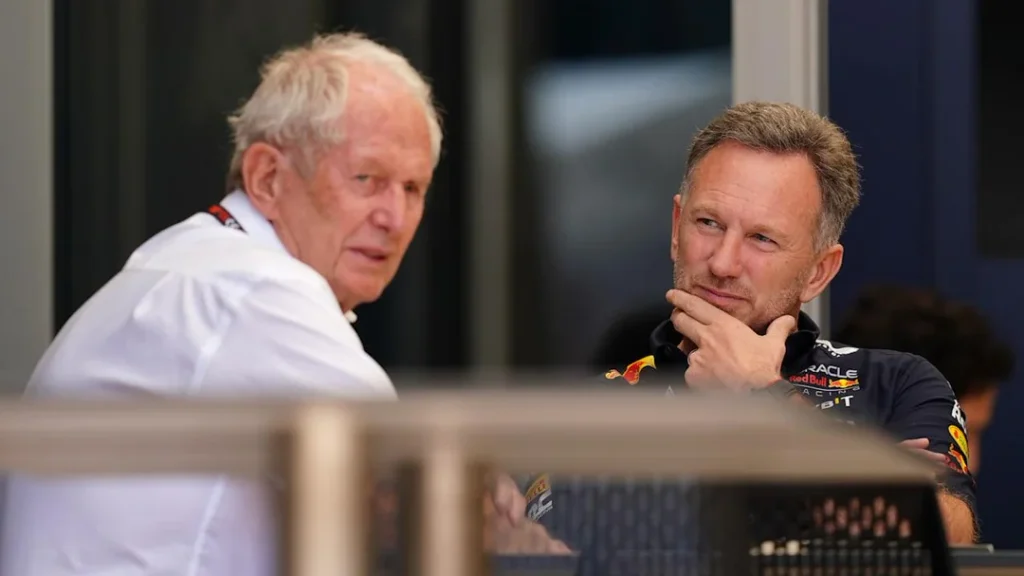
Horner was considerably more direct about the state of his relationship with Marko.
“I no longer have any relationship with Helmut Marko,” he said in comments attributed to BILD.
He described their final contact as a handshake in his office on his last day at Red Bull. He also said it hurt that Marko had worked to get him fired. The most personal part of Horner’s account concerned the death of his former partner, the mother of his daughter. Horner said Marko had not offered condolences, something he characterized as a lack of class. Those are Horner’s claims and his interpretation of the breakdown. They provide a view of how he experienced the end of their relationship, rather than a complete account of Marko’s position.
What they do establish is that Horner now discusses the separation in terms that extend well beyond a disagreement over team management. A working partnership can survive competing priorities for years, particularly when it continues to produce results. Once trust breaks down, the same disagreements can become personal grievances. Red Bull’s achievements also belonged to a wider organization. Horner and Marko were significant figures, but neither built that success alone. Any retrospective that reduces the team’s history to a contest between two individuals leaves too much out.
The stronger assessment is that a successful leadership arrangement eventually became unsustainable. Assigning every good decision to one side and every destructive motive to the other would require evidence that these accounts do not provide.
A Return Would Require More Than Revisiting the Past
Horner’s broader Up To Speed interview addresses his Red Bull exit, the Porsche discussions, internal power struggles, and the allegations that surrounded part of his tenure.
His management record remains relevant to any discussion of a potential return. So do the circumstances and controversies associated with his departure. Those subjects require care. Sporting achievements cannot settle questions about workplace conduct, and disputed material cannot responsibly be turned into a definitive finding through repetition. The conflicting claims surrounding those matters do not become established facts simply because they appear alongside an interview. The same restraint applies to potential destinations. Speculation about openings at Alpine, Ferrari, or Williams does not establish that a role is available or that a team wants him. A prospective employer would have to consider what Horner could contribute, the authority he would seek, and how he would fit within an existing organization.
His account of Red Bull explains how he views his past. A return would depend on whether another team sees a workable future.
Verstappen Draws a Clear Line After Portimão
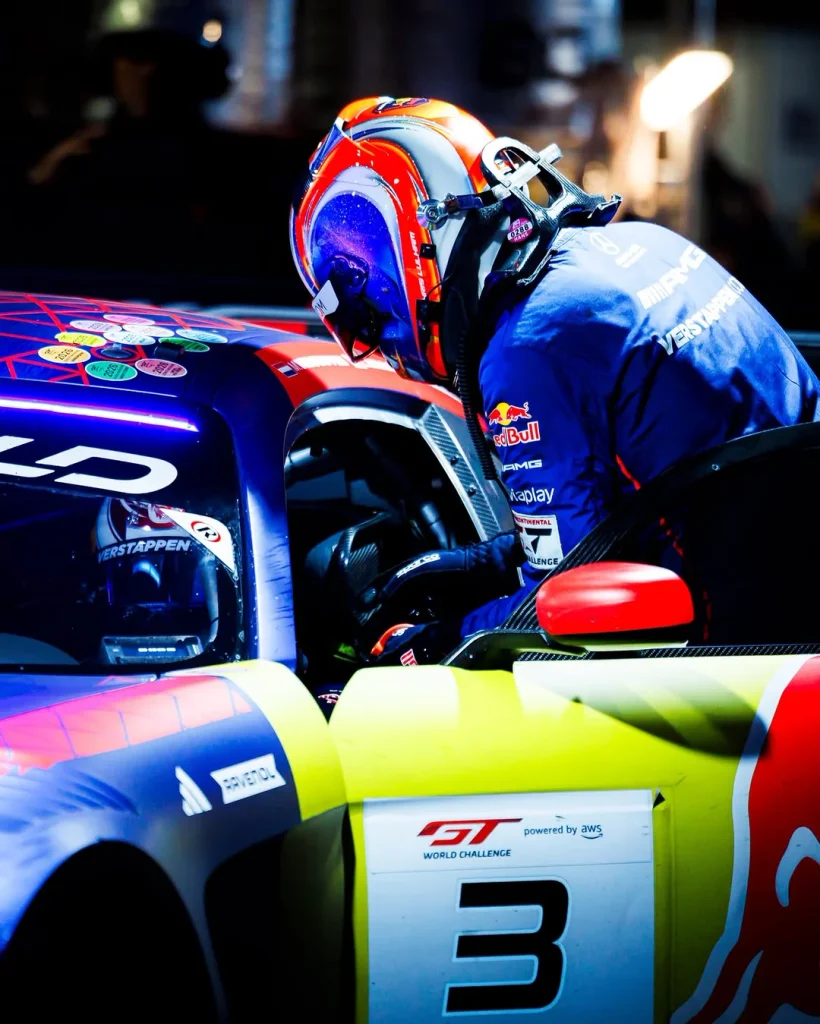
While Horner revisited Red Bull’s history, Verstappen’s GT3 weekend produced a more immediate statement about how people in racing should be treated.
After Lulham received personal abuse following the race, Verstappen publicly defended him.
“Everyone can have their opinions about what happened on track, but these personal attacks are not okay,” he wrote.
He added that Lulham had driven a strong stint, that mistakes happen, and that abuse has no place in the sport. The on-track sequence explains the sporting frustration. Running sixth, Lulham made contact that spun another car and received a drive-through penalty. Verstappen subsequently began his final stint in 24th. The mistake had consequences. It was legitimate to assess the contact, the penalty, and the positions lost.
Personal harassment adds nothing to that assessment. Endurance racing involves sharing responsibility with teammates. A driver can produce strong overtakes and competitive pace, then make an expensive mistake. One incident does not erase everything that preceded it. Nor does abusing a teammate help the driver supposedly being supported. It introduces more pressure into a working relationship and turns a shared racing effort into a search for someone to blame.
Verstappen’s response was especially useful because he acknowledged both parts of the situation: Lulham had performed well, and he had made a mistake. Neither point needed to be denied to reject the abuse.
Racing Relationships Extend Beyond Rivalries
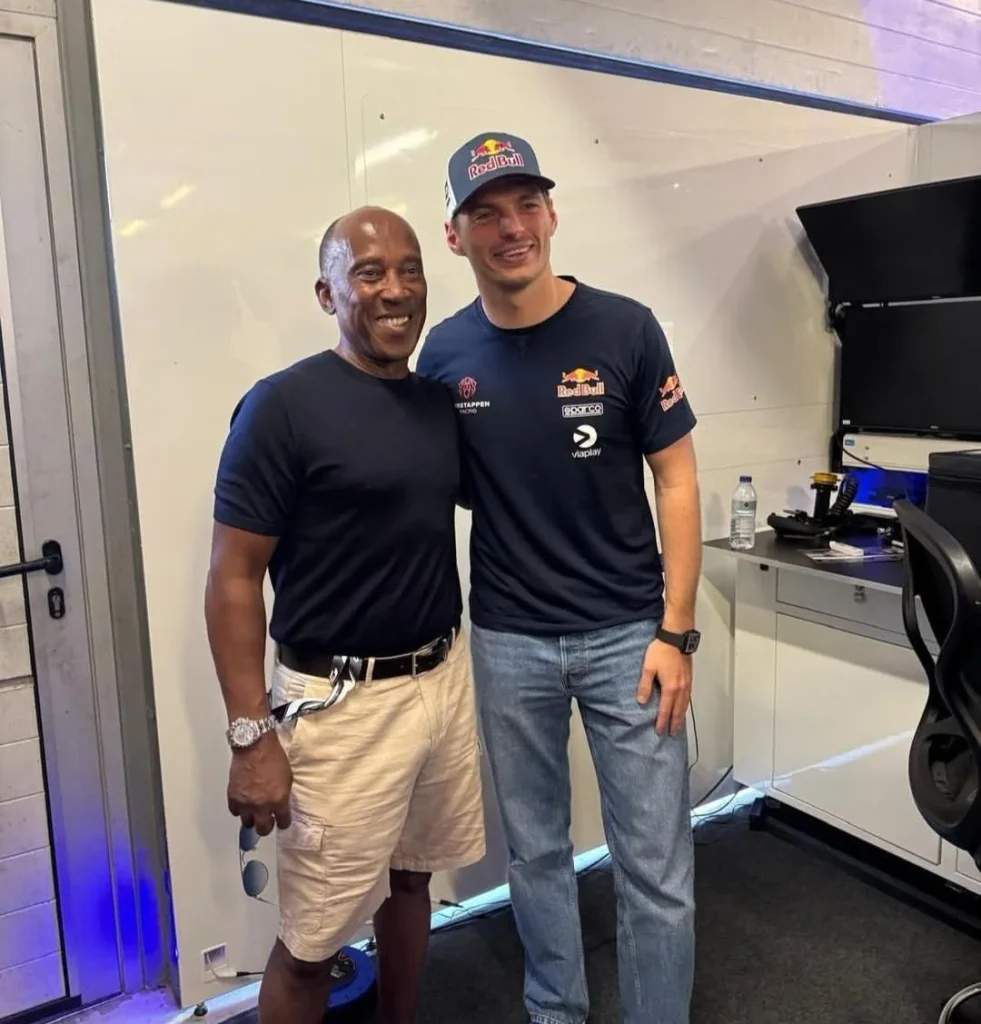
Verstappen catching up with Anthony Hamilton at Portimão offered a quieter reminder of the relationships that exist beyond championship competition.
The moment does not require a sweeping interpretation. A conversation cannot explain every aspect of a person’s character or erase the intensity of past sporting battles. It can still show how narrow the permanent-rivalry framing becomes. Anthony’s connection to motorsport extends through Lewis and Nicolas, while his support for Isack Hadjar after his first-race disappointment provided another example of engagement beyond his own family. Verstappen’s interest in GT racing, sim racing, and other drivers similarly places his racing life in a wider setting than his F1 results alone.
There is room to appreciate that without treating it as surprising that a fierce competitor can also enjoy an ordinary conversation. Aggression in a racing contest does not have to define every interaction outside it.
Formula E’s Monza Appearance Needs Context
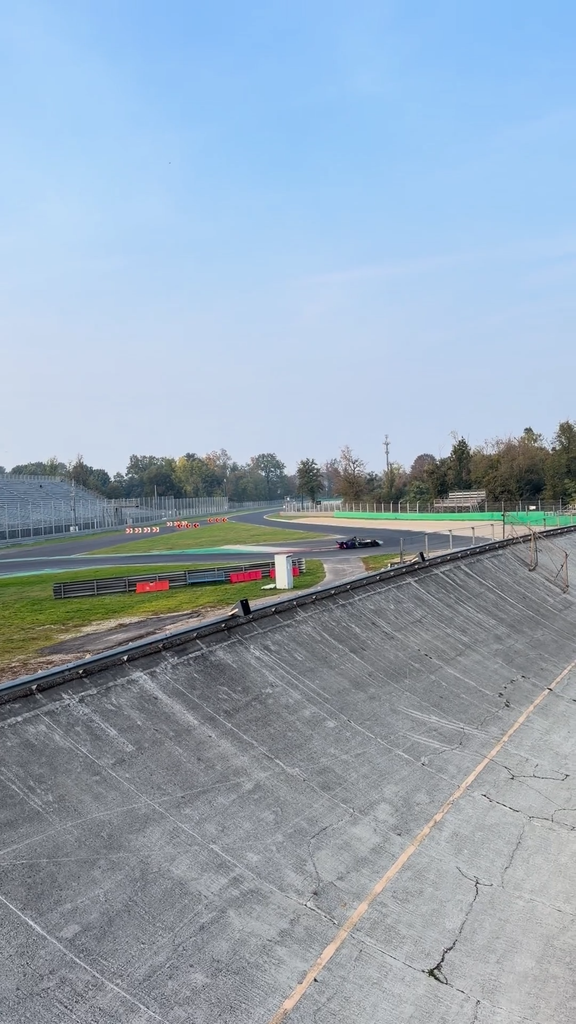
Another strand of the day’s material looked toward a different kind of racing future: a car identified as Formula E’s Gen4 running at Monza.
An observer reported a lap of approximately 1 minute 48 seconds, while explicitly questioning whether it was a representative full lap. That uncertainty should remain attached to the number. Without knowing the run plan, power setting, or how hard the driver was pushing, it cannot support a firm judgment about the car’s ultimate pace. The suggestion that it may have been running at 450kW was an interpretation, rather than a confirmed description of that lap.
There is still reason to be interested in what the next generation could deliver. The decisive test will be the racing: whether the performance, tires, and energy demands combine into a compelling contest. Predictions that Formula E will make F1 obsolete go considerably further than this sighting supports. Equally, dismissing electric racing outright leaves no room to judge the car on what it eventually produces. The Monza setting also offered a reminder of how much circuit character television can hide. The proximity of the first chicane to the old banking is a striking part of the venue’s identity.
Occasional wider shots could communicate that relationship while giving viewers a stronger sense of speed and place. Close framing serves a purpose, but a circuit should remain recognizable as more than the background behind a sponsor logo.
Even a Celebration Has Practical Limits
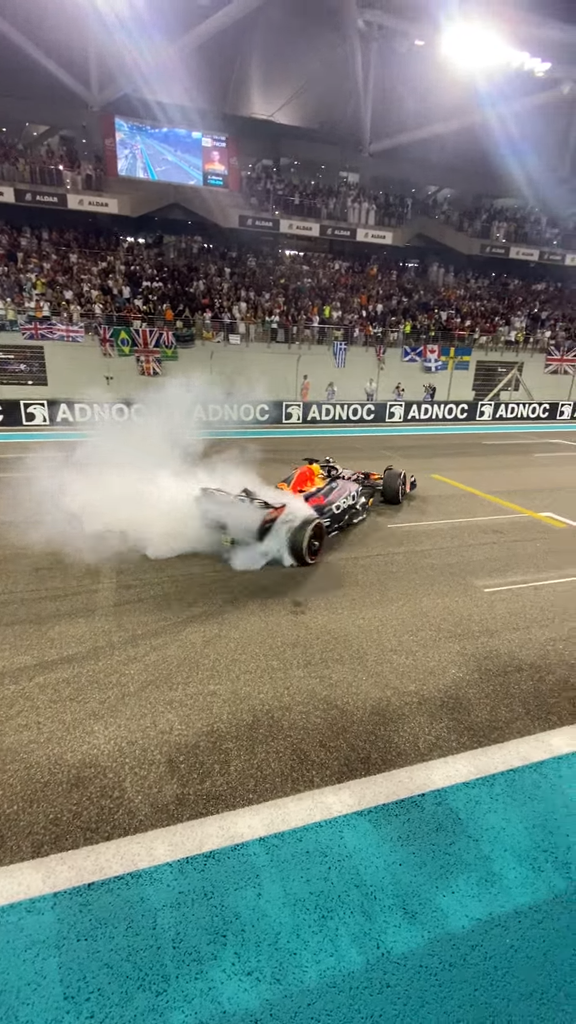
Footage of Verstappen’s celebratory donuts after the 2022 season brought the discussion back to something more immediate: car control, engine sound, and the spectacle of a driver enjoying the moment.
The sound debate remains a matter of preference. Older V8, V10, and V12 engines have an appeal rooted partly in their volume and character. The quieter V6 experience can be more comfortable for spectators, and recordings do not necessarily convey what those engines sound like trackside. A preference for one does not establish a universal verdict on the other. Nor does enthusiasm for a V8 hybrid proposal mean a return has been confirmed. Donuts themselves also involve more than a driver deciding to put on a show. Fuel, weight, and mechanical considerations can influence whether a team approves them. A celebration still has to fit around the condition and compliance of the car.
There is skill in producing a controlled rotation rather than a broad, untidy slide. The enjoyment comes from seeing that control expressed in a way a timed lap rarely allows. That same space for enjoyment runs through Verstappen’s Portimão weekend. Racing another category, talking with familiar faces, defending a teammate, and celebrating a season are all part of a sport that extends beyond its arguments.
Horner’s interviews offer plenty to examine about how Red Bull succeeded and how its leadership relationships broke down. Verstappen’s message after Portimão provides a simpler standard for what should follow any sporting disagreement: assess the driving, recognize the consequences, and leave personal abuse out of it.