

The 2026 Firestone Grand Prix of St. Petersburg weekend didn’t just start a season, it detonated one.
From chaotic timing graphics to rookie statements and tire discourse that somehow spiraled into a referendum on global motorsport engineering, St. Pete delivered a qualifying and practice narrative that already feels bigger than Round 1.
Scotty Mac Opens 2026 With Authority
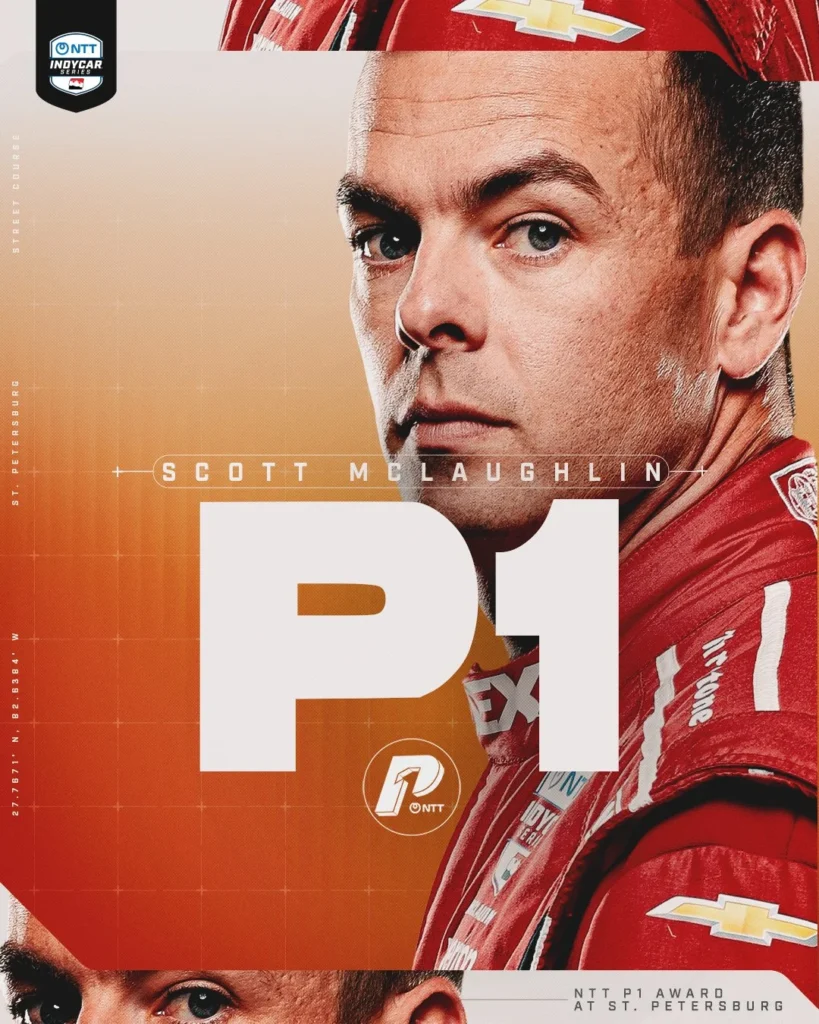
Scott McLaughlin claimed the NTT P1 Award with a 1:00.5426, adding another St. Pete pole to his résumé. It marks his third pole at this circuit in five years — not coincidental at a venue often described as the most “Supercars-esque” track on the calendar and one that historically suits Penske’s street setup philosophy.
The Fast Six itself was a snapshot of modern IndyCar’s eclectic appeal: a Supercars champion, two former F1 drivers, an IndyNXT graduate, a four-time champion, and one of the paddock’s emerging American storylines. That mix, established pedigree and upward momentum, is precisely why this series feels so volatile in 2026.
But the headline wasn’t just McLaughlin.
It was Dennis Hauger.
Hauger’s Arrival Changes the Math
Hauger missed pole by just 0.03 seconds. In his IndyCar debut. Driving for Dale Coyne Racing.
Let that settle.
He outqualified Alex Palou on debut. In a Coyne car.
The magnitude of that result is layered. Dale Coyne’s last two wins both came at St. Pete (2017 and 2018), and the team has quietly appeared more structured in recent seasons, with signs of improved engineering depth. There’s a growing sense that this isn’t just opportunistic overperformance, it may be foundational progress.
Hauger’s performance forces uncomfortable contract questions at Andretti immediately. He’s on loan. If this trajectory continues, the 28 car conversation becomes unavoidable. Marcus Ericsson’s seat security is no longer theoretical debate, it’s performance-based evaluation.
And while it is only one qualifying session, the ceiling Hauger just displayed shifts expectation from “promising rookie” to legitimate Rookie of the Year favorite.
There is also a broader talent pipeline implication. Hauger already looks like a driver who won’t stay static in IndyCar if this is the baseline. When someone qualifies like that in machinery not typically expected to challenge for pole, it recalibrates long-term projection models instantly.
Grosjean Reasserts Himself
Romain Grosjean making the Fast Six carries its own weight. After a turbulent few seasons, this weekend felt like a driver intent on re-establishing value.
The grid is crowded with redemption arcs in 2026, but Grosjean’s pace signals that experience still matters deeply in street circuit rhythm management.
Broadcast Friction and Timing Chaos
The on-track product was compelling.
The coverage? Less so.
The live delta graphics fluctuated wildly, swinging from minus one second to plus one second within corners, undermining confidence in real-time tracking. The scoring tower felt inconsistent, making session flow harder to interpret.
St. Pete last season also suffered from strategic narrative gaps, particularly in tracking undercuts and fast-lap sequences that flipped the race. If Palou wins again, the audience needs to see how it happens, not discover it after the fact.
By contrast, the international IndyCar Live feed’s more relaxed commentary tone during breaks demonstrated how effective conversational analysis can be when not boxed in by rigid broadcast pacing.
Practice 2: Small Moments, Reset Energy
Practice 2 delivered something subtler: normalcy.
After the offseason, simply watching cars circulate again carried emotional weight. Even chaotic meme moments, a ladybug interruption turned instant paddock humor, added to the lived-in feel of the series.
It’s the small texture of a race weekend returning that reminds fans why the rhythm matters.
Mick Schumacher and the Tire Discourse Spiral
Mick Schumacher added another layer to the weekend conversation, describing his IndyCar as feeling like “an F2 car, just with better tyres.”
That comment alone triggered a broader comparison cascade between Firestone and Pirelli, not just in Formula 1, but across ladder categories and rallying. The debate resurfaced longstanding frustrations over working windows, degradation philosophy, compound design intent, and whether tire drama enhances or undermines racing quality.
Some argue manufacturers simply build what regulations demand. Others contend that performance windows and durability issues expose design philosophy flaws.
What’s clear is this: Firestone’s stability in IndyCar stands in sharp contrast to the perception volatility surrounding F1’s tire narratives.
For Schumacher personally, the opportunity feels meaningful. His F1 tenure remains polarizing in retrospective analysis, shaped by team instability, financial constraints, leadership style debates, and developmental environment questions. But there is a quiet optimism around what maturity plus a more stable IndyCar platform could yield.
Expectations remain measured, consistent top tens would already represent progress b,ut road course potential appears more realistic than immediate street dominance.
The 2026 Forecast
We are one qualifying session into the season.
Yet already:
- Penske asserts early street authority.
- Dale Coyne Racing looks structurally stronger.
- Hauger forces contract math.
- Grosjean re-enters relevance.
- Broadcast execution becomes part of the competitive conversation.
- Tire philosophy becomes global discourse again.
And hovering over it all is the familiar Palou question, whether strategic precision will quietly dismantle the field once more.
St. Petersburg didn’t just open 2026.
It reminded everyone how quickly IndyCar narratives accelerate.