

Haas has confirmed Rafael Câmara will join the team on a multi-year deal in 2027, giving Oliver Bearman a new teammate whose greatest strength also explains why his development will be so interesting to follow.
Câmara brings exceptional qualifying speed. The question is how consistently he can turn that speed into results when he is fighting through traffic rather than controlling a race from the front. His arrival also comes with a number choice rooted in his birthday, a remarkably small age gap to Bearman, and a name that deserves a little more attention than simply removing the accent.
Elsewhere, an inauthentic video has muddied the account of Lewis Hamilton’s Singapore strategy mistake, Oscar Piastri’s old social media posts offer a reminder of the personality behind his reserved public image, and Abu Dhabi’s organizers are continuing preparations while projecting confidence about the season finale.
Haas Chooses Câmara’s Speed—and Takes On the Development Work
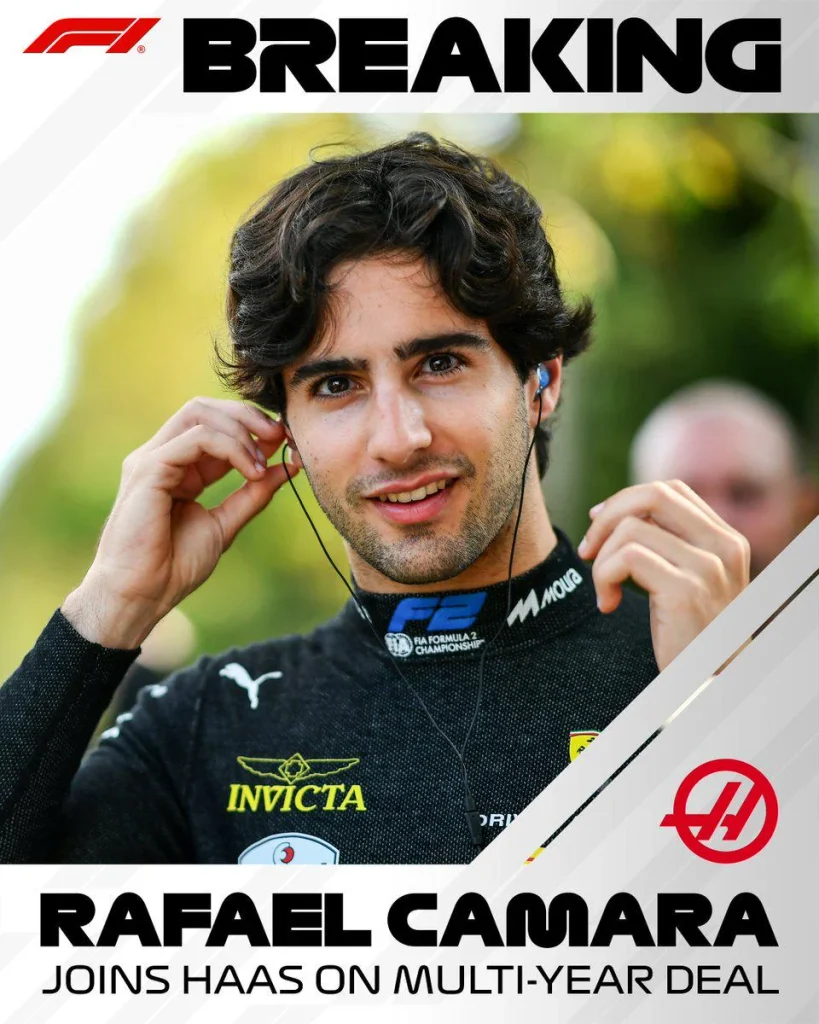
Câmara will replace Esteban Ocon at Haas next season, creating a partnership with Bearman that offers considerable potential.
The strongest part of Câmara’s case is his raw speed, particularly over one lap. His qualifying performances make it easy to understand why Haas wants him. A driver capable of extracting an exceptional lap can create opportunities before the race has even started. The more difficult part is making those opportunities count. Câmara’s wheel-to-wheel judgment remains an area for improvement. Incidents in F2 and F3, particularly when racing in the pack during sprint races, give Haas something specific to work on. Being quick enough to earn a strong grid position and being precise enough to protect it through a crowded opening stint are related skills, but they are not interchangeable.
That matters for a driver entering a midfield team. There will be weekends when he has to make progress among cars of similar performance, with little margin for an ambitious move that does not quite work. A standout qualifying lap loses much of its value if contact compromises the race. The logic behind the signing is still clear. It is easier to build a development program around a driver who already possesses outstanding speed than to assume that speed will eventually appear. However, improving consistency is a task, not a guarantee. There is also no need to exaggerate Câmara’s junior record to justify the decision. His career has not been an uninterrupted sequence of championships. He did not win Italian F4 or his first FRECA season, and removing Antonelli from those results would not automatically have made Câmara champion. He also did not win either of his Formula Regional Middle East campaigns, with Tuukka Taponen beating him in the latter.
Those qualifications matter because the more compelling story is his progression. His performances since moving into F3 have strengthened his case considerably. Haas is investing in the driver he has become and the potential he still has, rather than an imaginary record of winning everything.
Bearman Provides a Useful Benchmark
The Câmara–Bearman comparison should be interesting because their ages are almost identical while their Formula 1 experience will be different.
Bearman was born on May 8, 2005. Câmara was born on May 5, 2005. Just three days separate them. By the time they become teammates, Bearman will already have experience within Haas and in Formula 1. That gives him a practical advantage that their near-identical birthdays do not capture. Câmara’s qualifying pace could make that part of the contest particularly competitive. Over a race distance, the challenge will be broader: managing tires, judging battles, and converting the car’s performance into points without giving away opportunities.
It is reasonable to see Bearman as the more established reference entering the partnership. It would be premature to decide how quickly Câmara can close that experience gap. The temptation to describe Câmara as another Charles Leclerc also needs some restraint. Exceptional qualifying speed can invite the comparison, but an error while pushing a car to its limit is different from an error in wheel-to-wheel judgment. “Racecraft” should describe how a driver handles racing situations, rather than become a catch-all label for every mistake.
Câmara’s development will be easier to assess if those distinctions remain clear.
Three Days Apart, but There Is a Closer Historical Example
The birthday coincidence is almost too convenient for Haas: one week in May, two drivers to celebrate, and perhaps an opportunity to negotiate a shared cake.
It does not, however, establish the closest age gap between teammates in Formula 1 history. At the 1965 Monaco Grand Prix, Richard Attwood and Mike Hailwood drove for Reg Parnell Racing. Attwood was born on April 4, 1940, and Hailwood on April 2, 1940. Their birthdays were just two days apart, beating the three-day gap between Câmara and Bearman. That is a specific historical example rather than proof of an exhaustive all-time ranking. It is enough to answer whether a closer pairing has existed.
Nor should the Haas duo’s similar ages be confused with a youngest-pairing record. Max Verstappen and Carlos Sainz were 17 and 20 when they began their 2015 Toro Rosso partnership. Two drivers born in the same week can be unusually close in age without being unusually young by every historical measure.
Why Câmara Will Race With Number 50
According to Julianne Cerasoli, Câmara will use number 50 in Formula 1.
The connection begins with his birth date: May 5, 2005. Number 5 would have been the obvious choice, but Gabriel Bortoleto already has it. Number 55 belongs to Carlos Sainz, leaving Câmara to choose another variation on the theme. Number 50 also has a recent Haas connection. Bearman used it when replacing Kevin Magnussen at the 2024 Azerbaijan and São Paulo Grands Prix. That does not mean it was Bearman’s permanent number. Temporary numbers used for replacement appearances and testing are assigned through the team, which also explains why Bearman used number 38 when replacing Sainz at Ferrari in Jeddah.
Câmara will therefore give number 50 a different role: his own Formula 1 identity. There is a fitting generational detail in all of this. Câmara and Bearman were born in 2005, Antonelli in 2006, and Arvid Lindblad in 2007. Birth years that still feel recent are now attached to drivers establishing themselves on the grid.
Meanwhile, Fernando Alonso remains the reference point for anyone who would prefer to look toward the other end of the age range.
A Quick Guide to Saying Rafa Câmara
The accent in Câmara matters.
An approximate English guide to the shortened name is “HAH-fa KUH-muh-ruh,” with the emphasis on the first syllable of the surname.
The initial “R” in Brazilian Portuguese has an H-like sound. The circumflex over the first “a” in Câmara also helps distinguish it from the “kah-MAH-rah” pronunciation an English speaker might instinctively reach for.
The “r” within the surname is a light tap rather than an extended rolled sound. For many American English speakers, the tapped consonant in a word such as “ladder” offers a useful comparison.
English spelling can only approximate the original sounds, but getting the emphasis right is a good starting point. With Câmara about to become a regular name on Formula 1 broadcasts, there is an opportunity to establish it correctly from the beginning.
The Hamilton Video Was Not the Missing Singapore Radio
Away from the driver market, a video purporting to reveal Hamilton’s radio exchange during the Singapore Grand Prix’s Virtual Safety Car period has been identified as inauthentic.
The audio was assembled from other races. One identifiable section—Carlo Santi saying, “So Lewis, we are boxing for soft”—came from this year’s Dutch Grand Prix.
The account that originally posted the footage subsequently withdrew it and acknowledged that it could not verify its authenticity. At the time of the supplied account, no authentic recording of the relevant Singapore exchange was publicly available. That distinction matters because the edited video appeared to supply evidence for a moment it did not actually document. Hamilton’s own explanation also needs to be represented accurately. He said:
“Under the VSC, the team called me in but I missed the entry.”
He then described a subsequent decision:
“After that, I decided to stay out and try to hold track position to the end.”
Those are separate parts of the sequence. Missing the pit entry during the VSC and later choosing to continue without another stop should not be compressed into a claim that he admitted deliberately ignoring the original instruction. Hamilton said tire degradation became severe in the closing laps, costing him three positions and leaving him sixth. He accepted responsibility for his decisions and apologized to the team for the lost points.
There is ample room to analyze that gamble. It failed, and Hamilton acknowledged as much. Fabricated audio adds nothing useful to the assessment.
An Incomplete Broadcast Record Is Not Proof of a Cover-Up
The unavailable exchange leaves limits on what can be reconstructed about the timing of the call and the discussion around it.
It does not establish that Ferrari hid the radio, that Formula 1 deliberately suppressed it, or that Hamilton was instructed to accept blame for public relations reasons. Likewise, without the complete exchange, it is difficult to reach a firm conclusion about precisely what information Hamilton received before missing the entry. The later discussion about whether to stop again presents its own strategic question. Once the VSC opportunity had passed, the calculation had changed. A subsequent decision to gamble on track position cannot automatically be treated as the same decision Ferrari faced while the VSC was active. The editorial lesson is straightforward: use the evidence that exists, preserve the sequence of events, and leave gaps visible when the available material cannot resolve them.
Hamilton can be criticized for a strategy decision without rewriting his account. Ferrari’s communication can be examined without inventing a conversation. An edited clip should never become a substitute for the missing record.
Piastri’s Old Posts Show the Limits of the “Iceman” Label
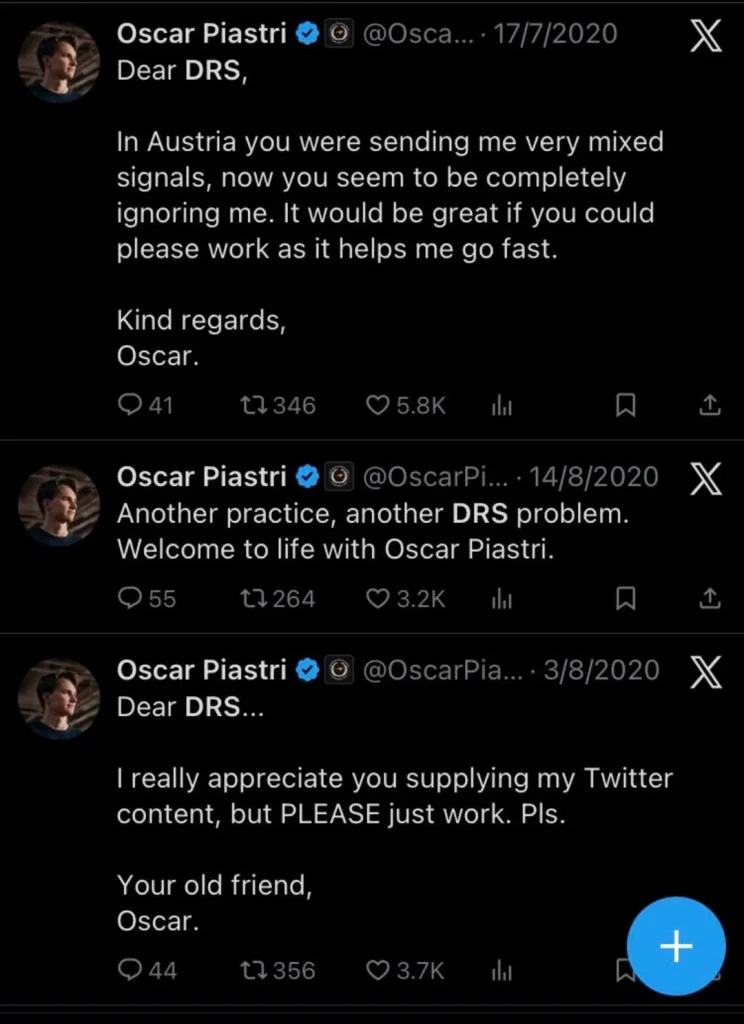
There is a related problem in how a driver’s public image can become more rigid than the person behind it.
Piastri’s pre-Formula 1 social media posts offer a reminder of his dry humor, including the context of persistent DRS problems during his F3 campaign. A reserved interview style does not mean a driver lacks personality. Nor does an outwardly calm reaction mean he is unaffected by what happens around him.
The “Iceman” framing risks turning one characteristic into an expectation that Piastri should always appear detached. His humor and composure can coexist with frustration, excitement, and every other emotion involved in racing.
There are several possible explanations for why a driver posts differently after reaching Formula 1. A larger audience changes the stakes of a casual remark. Professional scrutiny increases. People also change as they get older. None of that establishes that a team has deliberately removed someone’s personality.
It is also worth separating Piastri’s actual remarks from edits built around them. The “move of a world champion” radio line was from 2024, rather than a response to Norris during the recent Singapore sprint.
Placed over different footage, a real remark can acquire a meaning it never originally had. That is less elaborate than constructing an entire radio exchange, but the underlying problem is similar: the edit supplies a connection the original material does not support.
Abu Dhabi Projects Confidence With 50 Days Remaining

Abu Dhabi’s organizers are continuing to present a confident outlook for the Grand Prix.
Saif Al Noaimi, chief executive of organizer Ethara, described demand as “unprecedented” and said preparations remained on track with 50 days to go.
That is the organizer’s stated position. It should be reported as such. Demand and operational preparations, however, answer different questions from those surrounding regional security. Strong sales do not settle whether conditions will remain suitable for an event, just as concern about those conditions does not itself establish that cancellation is inevitable. The supplied material contains competing assertions about the regional situation, predictions of future military action, and theories about who would bear the financial consequences of cancellation. None provides a sufficient basis to declare the race certain to proceed or certain to be called off.
The position supported here is narrower: Ethara says preparations are on schedule and demand is exceptionally strong. That confidence is newsworthy, while the eventual outcome remains open.