


George Russell won the 2026 Dutch Grand Prix Sprint ahead of Charles Leclerc and Lando Norris, but the result will probably be remembered less for the podium and more for just how little happened before the rain finally arrived at exactly the wrong moment.
Russell led home Leclerc and Norris, with Andrea Kimi Antonelli fourth, Oscar Piastri fifth, Max Verstappen sixth, Lewis Hamilton seventh and Pierre Gasly taking the final Sprint point in eighth. On paper, it was a useful Saturday result for Mercedes and an encouraging one for Ferrari. In reality, though, the 24-lap Sprint at Zandvoort quickly turned into the kind of race that made the decision to hold a Sprint at one of Formula 1’s more difficult overtaking venues look questionable. The opening lap set the tone almost immediately.
Antonelli managed to get ahead of Piastri at the start, but beyond that there was almost nothing happening at the front. The field settled into position extremely quickly, and what followed looked more like a procession than a short-form race supposedly designed to provide extra action. The frustration was made worse by the format itself. At a circuit where track position is especially valuable and passing is difficult, there was very little incentive for drivers sitting outside the points to take major risks with qualifying still to come later in the day. The reward for pulling off an ambitious pass could be nothing at all, while the punishment for damaging the car could compromise the much more important qualifying session and Sunday Grand Prix.
That problem became especially obvious further down the order. Liam Lawson finished 11th for Red Bull, while Arvid Lindblad and Yuki Tsunoda were also caught in the same general train. Their fastest Sprint laps were 1:16.090 for Lawson, 1:16.886 for Lindblad and 1:16.925 for Tsunoda, but those numbers offer very little useful comparison. All three were stuck in traffic, and there was little reason for Lawson, for example, to attempt a high-risk move on Lindblad when doing so would not immediately put him into the points. With qualifying only hours away, simply bringing the car back intact was arguably the more rational choice.
That makes attempts to use the Sprint as a definitive comparison between Lawson, Lindblad and Tsunoda difficult. Tsunoda’s performance may still have offered some encouragement given his experience, while Lindblad continuing to run around the same level as more established drivers can also be viewed positively for a junior. But the Sprint itself simply did not create the conditions necessary to draw meaningful conclusions about any of them. Lawson had already shown some speed earlier in the day by beating Verstappen in SQ1 before his SQ2 did not go as smoothly, and the Sprint was effectively a non-event for most of the field. Verstappen himself finished sixth, while Lawson was 11th.
The larger Red Bull debate remains difficult to settle from a race like this. Lawson, Tsunoda, Lindblad and Isack Hadjar have all generated comparisons about their relative level, but Zandvoort’s Sprint did little to separate anyone. If anything, it reinforced how difficult it can be to judge drivers when track position overwhelms outright pace.
Leclerc Produces the Move of the Sprint

The clearest exception to the general lack of action was Charles Leclerc.
Leclerc passed Norris for second place and managed to make his soft tires last through the entire 24-lap Sprint, an especially impressive outcome considering he was reportedly running used softs. It was one of the few moments where the Sprint genuinely came alive. McLaren’s pace dropped sharply enough that Norris reported his rear tires were gone, and both McLarens appeared to suffer far more degradation than expected. Piastri had already lost ground at the start to Antonelli, while Norris later fell into Leclerc’s reach.
The sudden deterioration was striking because McLaren had previously been associated with strong tire degradation performance. Under the 2026 regulations, however, there are plenty of reasons why that previous strength may not automatically transfer. The power delivery and braking characteristics are different, the tire size and compounds have changed, and the aerodynamic and cooling requirements are also substantially different. Even if McLaren had previously found an advantage around areas such as brake and wheel-hub management, the new regulations can change where those gains are available. Verstappen appeared curious himself afterward, taking a closer look at Piastri’s McLaren.
For McLaren, the Sprint therefore produced a strange statistical milestone alongside a potentially much more important warning. Norris’ third place gave McLaren its 25th Sprint podium, moving it ahead of Red Bull’s 24 for the most Sprint podiums by any team. But Norris saying he had no rear tires only around 10 laps into the Sprint was hardly encouraging with the full Grand Prix still to come. The positive is that Norris at least held onto third despite Antonelli getting close enough to make the final portion uncomfortable. Every point still matters, and third was far better than allowing another position to disappear.
The bigger issue is whether McLaren can understand why the degradation appeared so severe before Sunday.
Leclerc’s Form Continues to Improve
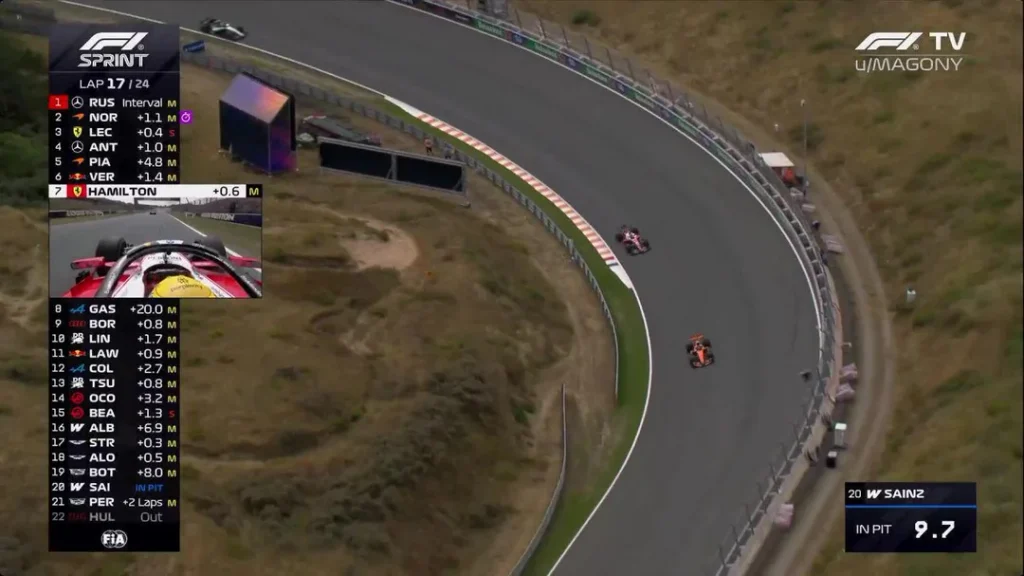
Ferrari, meanwhile, had much more reason to be encouraged.
Leclerc’s second place continued a stretch in which his confidence and performance appear to have recovered after a difficult run before Silverstone. His adaptation to a different brake setup has been part of the conversation around his recent form. Leclerc had used the same brake brand throughout his Formula 1 career before making a change, so expecting an immediate transition was probably unrealistic. Instead, the adjustment period appears to have lasted only a handful of races.
That makes some of the earlier concern about his form look premature. Three difficult races can quickly become a major narrative around Leclerc, but the broader picture remains that he has rarely had a car capable of sustaining a championship challenge. At Zandvoort, his pace was strong enough not only to preserve the soft tires but also to accomplish something almost nobody else managed during the Sprint: complete a meaningful pass at the front. If Ferrari can qualify near the front, that matters enormously at a circuit where overtaking proved so difficult.
Leclerc may even have had an opportunity to pressure Russell more seriously if he had cleared Norris sooner, although Russell ultimately controlled the race from the front.
The Action F1 Didn’t Show

Part of the Sprint’s reputation as a complete snoozefest was also created by the television direction.
There actually was some racing further down the order. Fernando Alonso completed overtakes on Carlos Sainz and Valtteri Bottas, including moves around Turn 13, but much of that action was not shown live. Alonso was also involved in a late fight around Lance Stroll. Instead, coverage repeatedly concentrated on the front-running cars even when very little was happening there.
That made an already quiet Sprint look even worse. When a race produces very few overtakes, a battle for 18th suddenly matters a lot more. It is still racing, and when the leaders are circulating with stable gaps, there is little justification for ignoring action simply because it is happening outside the points. The final lap offered another example.
Stroll and Alex Albon finished just 0.018 seconds apart, with the rain beginning to affect the final moments. Yet viewers following the main broadcast were left largely unaware of how close that fight had become. The criticism of the broadcast is therefore slightly different from the criticism of the race itself. Zandvoort did not provide much action, but the production also failed to show some of the limited action that did exist.
That became especially obvious once the highlights package appeared. Trying to produce six minutes of highlights from the Sprint almost became a joke in itself. The basic sequence could nearly be reduced to the start, Antonelli passing Piastri, Colapinto passing Tsunoda, Alonso and Sainz fighting, Leclerc passing Norris and Russell winning.
For a format built around providing additional competitive entertainment, that is not exactly a glowing advertisement.
Then, Naturally, It Started Raining
The most frustrating moment came after the race had effectively ended.
Rain began falling almost immediately as the leading cars crossed the finish line. After 24 laps in which the race desperately needed something to change the competitive order, the weather waited until the exact moment it could no longer matter. Verstappen asked afterward why the rain could not have arrived during the final laps.
His race engineer Gianpiero Lambiase replied that they could have had “a bit more fun maybe.”
Verstappen’s response was simple: “Or not haha.”
It summed up the Sprint perfectly. Even the prospect of rain apparently could not guarantee that this particular race would become entertaining. The timing also continued a frustrating pattern in 2026 in which Formula 1 has repeatedly come close to getting meaningful wet running without actually receiving it. Miami came particularly close before lightning and local regulations led to the start time being changed. At Zandvoort, the rain waited until the top runners were crossing the line.
For anyone hoping the weather could rescue Sunday’s Grand Prix, that timing felt particularly cruel.
Was Zandvoort Ever a Good Sprint Venue?
The larger question after Saturday was whether Zandvoort should have been selected for a Sprint in the first place.
The circuit can be spectacular for qualifying. It is narrow, fast, difficult and punishing, and a single lap around the banking can be one of the more visually impressive challenges on the calendar. That does not automatically make it a good race track for modern Formula 1 cars. Zandvoort’s difficulty for overtaking meant qualifying was always likely to matter enormously, and adding a Sprint did not change that fundamental characteristic.
If anything, the Sprint emphasized it. Drivers had little reason to take large risks before qualifying, passing opportunities were scarce, and once the field settled into position, the race had almost no mechanism for changing the order. The comparison to Monaco was inevitable.
Zandvoort may be a better driving circuit than Monaco in terms of pure speed and rhythm, but for a Sprint race, the result looked uncomfortably similar: qualifying mattered more than racing, and track position became the dominant factor. That raises another uncomfortable question with Singapore still scheduled to host a Sprint. If Formula 1 wants the Sprint format to convince skeptics that it adds value to a race weekend, placing Sprints at circuits known for being difficult to overtake appears counterproductive.
There are circuits where shorter races can create urgency and aggression. At Zandvoort, the opposite happened. The short distance reduced strategic variation, the points structure discouraged unnecessary risks for drivers outside the top eight, and the upcoming qualifying session gave everyone another reason to protect the car. The Sprint therefore exposed one of the format’s fundamental weaknesses.
More racing does not automatically mean more action.
Russell Gets the Result, Ferrari Gets Encouragement, McLaren Gets Homework

For Russell, none of that diminishes the result.
He won the Sprint, collected the maximum available points and controlled the race from the front. Leclerc emerged as perhaps the most impressive driver behind him, combining tire management with one of the only significant overtakes of the entire race. Norris completed the podium but McLaren left with questions.
The team’s 25th Sprint podium is a significant statistical achievement, particularly because it now places McLaren ahead of Red Bull in that category. Yet the way Norris and Piastri lost performance was far more important for the rest of the weekend than the record itself. Antonelli’s fourth place was another strong result for Mercedes, while Piastri salvaged fifth after losing ground at the start. Verstappen took sixth, Hamilton seventh and Gasly eighth.
Further back, there was too little meaningful racing to draw major conclusions about Lawson, Lindblad or Tsunoda. And somewhere behind all of that, Alonso was actually overtaking people. Viewers simply weren’t allowed to see much of it. By the time the rain finally arrived, Russell had already won and the Sprint was finished. For a race that was supposed to add another competitive highlight to the Dutch Grand Prix weekend, perhaps the most damning summary is also the simplest:
It really could have been an email.