

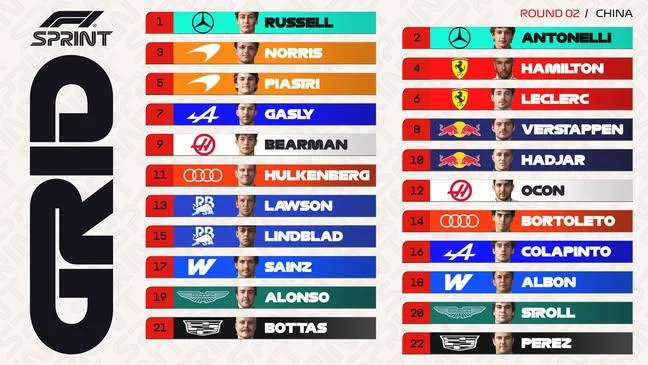
Sprint Qualifying for the 2026 Chinese Grand Prix did not just set the grid for Saturday’s Sprint. It also sharpened the early-season picture in a way that Free Practice 1 and Melbourne only hinted at. At Shanghai International Circuit, a 5.451 km track whose long straights and heavy braking zones put every weakness under a spotlight, Mercedes turned a strong Friday into a front-row lockout, Ferrari showed signs of a genuinely competitive car but not yet a complete package, and Red Bull sank into a crisis severe enough for Max Verstappen to call the car “undriveable.”
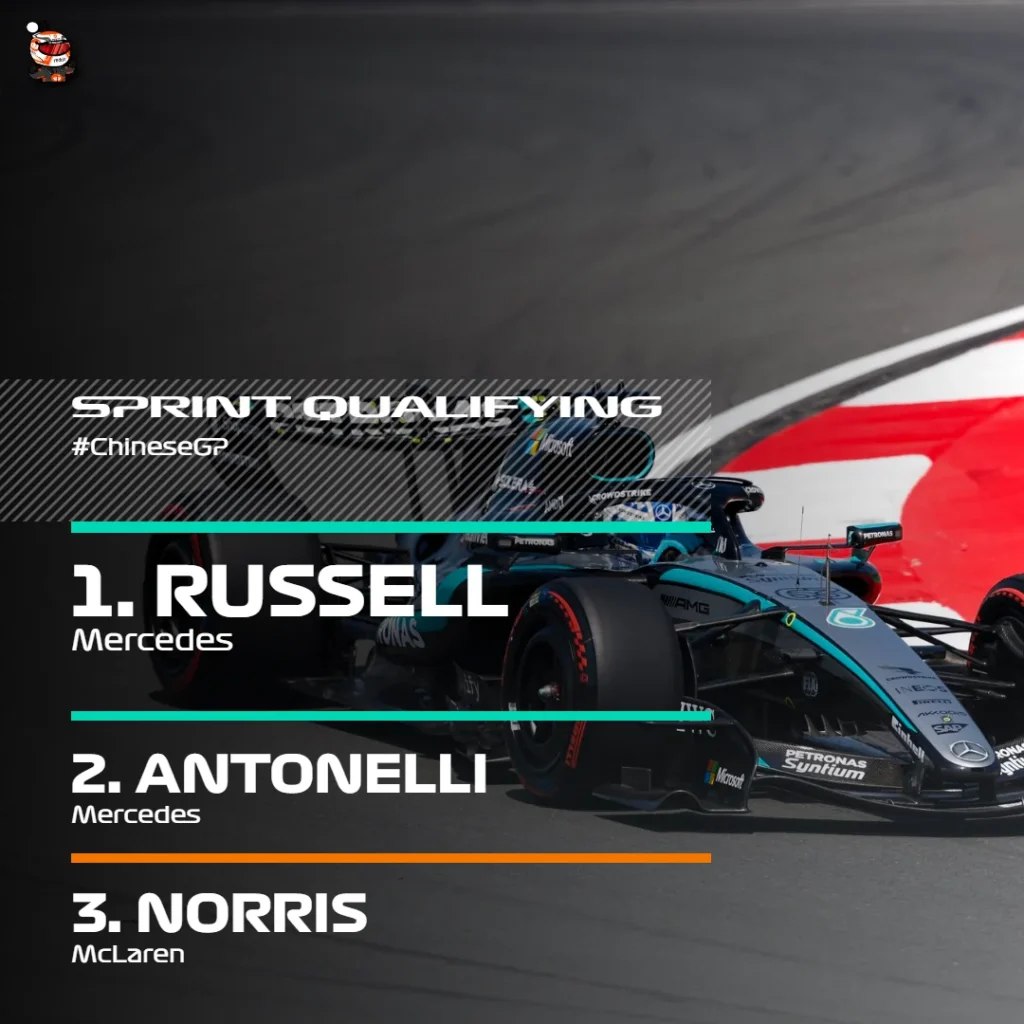
George Russell took Sprint pole, with Kimi Antonelli alongside him to complete a Mercedes 1-2, while Lando Norris qualified third. Lewis Hamilton put Ferrari fourth ahead of Oscar Piastri and Charles Leclerc, Pierre Gasly produced one of the standout laps of the session to take seventh for Alpine, Verstappen could manage only eighth, and Oliver Bearman and Isack Hadjar completed the top ten.
That grid alone tells much of the story. Mercedes was comfortably the reference point. Ferrari was close enough to remain interesting but not close enough to feel threatening everywhere. Alpine put a car ahead of Red Bull on outright pace. And Red Bull, which left Australia with at least some ambiguity around where it truly stood, came out of Shanghai looking disjointed from the first meaningful laps of the weekend.
The setting only amplified the contrast. This was a return to a circuit where, last time in China, Oscar Piastri had taken pole with a 1:30.641, won the race, and Lando Norris set fastest lap with a 1:35.454. Shanghai remains a place where straight-line efficiency, traction, energy deployment, and braking stability all feed into one another. That matters even more under the 2026 regulations, where battery usage, clipping, and deployment strategy can radically alter how a lap looks and where time is lost.
For Red Bull, the day began badly and only deteriorated. In FP1, Verstappen’s car stalled as he was pulling out of the garage, an early sign that the weekend was unlikely to run smoothly. That problem fed into a growing sense that Red Bull’s issues in China were not confined to one lap or one setup call, but spread across reliability, drivability, and baseline competitiveness. There was also another stalling-related issue referenced elsewhere in the Red Bull system, adding to the impression of a new package still fighting teething troubles.
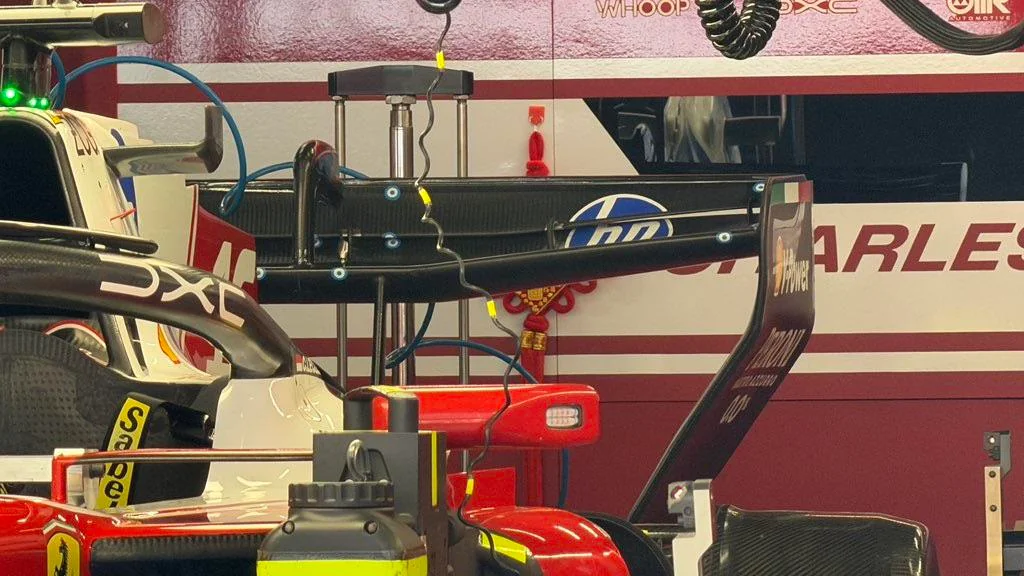
Ferrari’s day, meanwhile, became a technical story almost from the outset. Albert Fabrega reported that Ferrari discarded its experimental “Macarena” rear wing for the Sprint after trying it in FP1. That in itself was revealing. The concept had been one of the more eye-catching development items of the early season, and China’s long straights made it an obvious place to evaluate. But the signs from Friday running were that it was not ready for proper competitive use. The car appeared too loose at the rear, and the underlying explanation circulating around the session was that the closing behavior of the wing could create an awkward transition in load application rather than a clean, confidence-inspiring return to downforce. On a Sprint weekend, with minimal time to correct a wrong call, Ferrari quickly reverted. That was probably the sensible move, but it still underscored how aggressively teams are experimenting under the new rules and how quickly they have to abandon ideas when the stopwatch and the drivers reject them.
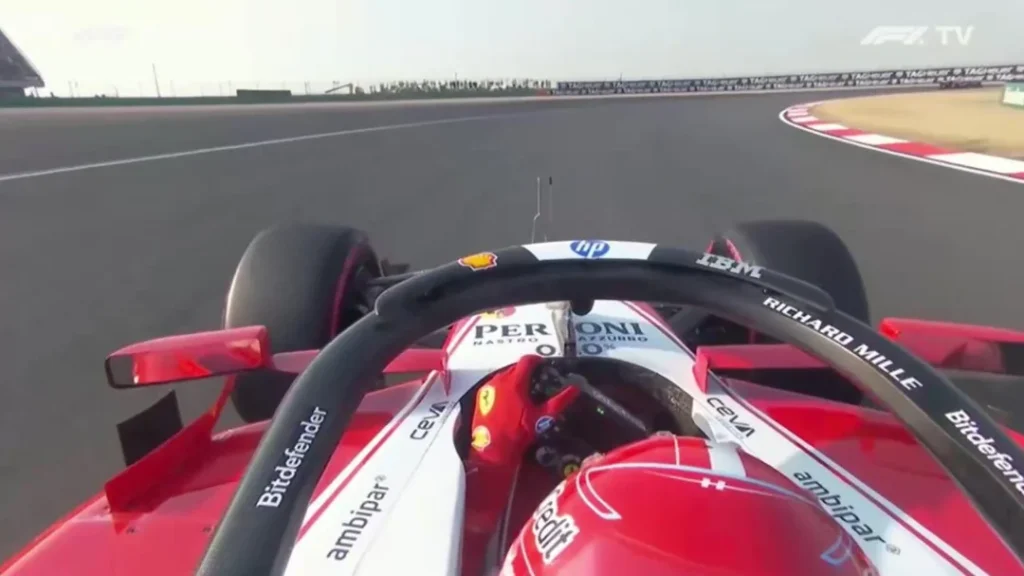
If Ferrari’s wing experiment was a visible problem, its more serious issue in Sprint Qualifying was less obvious but arguably more costly. After the session, Leclerc captured the confusion perfectly over the radio: “What the hell is happening? What. The. Hell. Is. Happening? I lost like four tenths on the back straight.” Hamilton’s own post-session assessment complemented that picture from the other side of the garage. “My team did a really great job, my engineers did a fantastic job to turn the car around,” he said. “I think car-wise, the car feels great and I think we can compete with them through corners, but when you’re down on power, it’s just the way it is.”
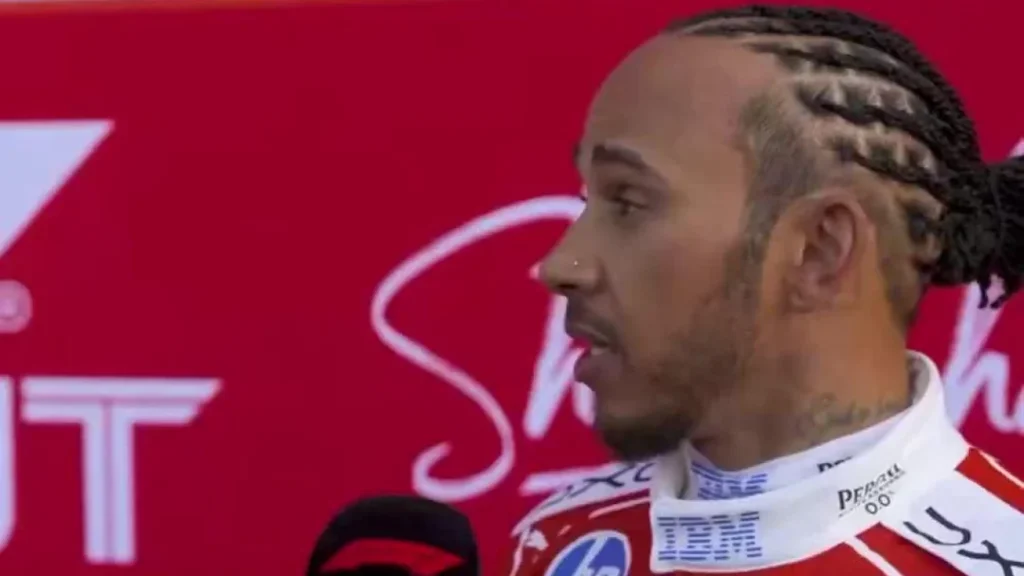
Together, those remarks outlined Ferrari’s Friday with unusual clarity. Hamilton felt the car underneath him was good. Leclerc felt the straight-line behavior was inexplicably costing him major time. Across SQ1, SQ2, and SQ3, the lap-time swings between the two Ferraris looked too large to chalk up simply to driver variation. The far more plausible reading was that Ferrari was fighting an inconsistent deployment or software-related issue, particularly on the back straight. That matters enormously in Shanghai. The long run into the hairpin is not just a test of power, but a test of how well a team understands the interaction between battery release, clipping, braking regeneration, and what comes after.
That wider 2026 backdrop hung over the whole session. Friday’s discussion around the field made clear that fans and observers are still trying to map the new vocabulary of these cars onto what they are seeing on track. The distinction between clipping and super-clipping has suddenly become central to understanding performance. When the battery is depleted and the car continues only on combustion power, straight-line speed plateaus. When the system goes a step further and diverts engine output to recharge the battery before the braking zone, the car can visibly slow before the corner in order to have electrical energy where it matters more later in the lap. Shanghai, with its enormous back straight and heavy braking points, is one of the clearest places to expose who has mastered that balancing act and who has not. On Friday, Mercedes looked like the team with the cleanest answers.
That became unmistakable in Sprint Qualifying itself. Russell took pole, Antonelli joined him on the front row, and Norris slotted into third. Whether Russell had every last tenth on the table or not, Mercedes looked stable, composed, and entirely in control of the session. Antonelli’s speed continued the impression that this is not merely a one-driver team riding one exceptional lap, but a car with real performance margin. That said, there was also nuance in how the two Mercedes drivers achieved their times. Russell appeared smooth and settled, while Antonelli’s approach looked more aggressive and perhaps more eager. But the headline did not change: Mercedes locked out the front row.
Behind them, Norris took third, Hamilton fourth, Piastri fifth, and Leclerc sixth. Gasly then delivered a huge result for Alpine in seventh, ahead of Verstappen in eighth, Bearman in ninth, and Hadjar in tenth.
The lower-order eliminations further reinforced the session’s surprises. Knocked out in SQ1 were Sergio Pérez, Valtteri Bottas, Lance Stroll, Fernando Alonso, Alexander Albon, and Carlos Sainz. Eliminated in SQ2 were Franco Colapinto, Arvid Lindblad, Gabriel Bortoleto, Liam Lawson, Esteban Ocon, and Nico Hülkenberg.
Williams, in particular, emerged from Shanghai under heavy scrutiny. Sainz had warned ahead of time that “This weekend was always going to be difficult for us with this track exposing our weaknesses. Missing half of FP1 didn’t help. I’ll use this event to test different setups. The target is to maximise our performance and help the team.” That was a measured assessment, but the underlying point was damning enough: Williams knew this track would reveal what the car could not do. Across the conversation around the session, the judgment was harsh and fairly consistent. With Mercedes power in the back, Williams is expected to be far more competitive than this, and yet it was lumped in with the season’s early disappointments. Repeated references to the car being overweight only sharpened that criticism. If the engine is one of the strengths available on the grid, then too much of Williams’ deficit is being read as self-inflicted.
Still, Williams was not the defining disappointment of Friday. That distinction belonged to Red Bull.
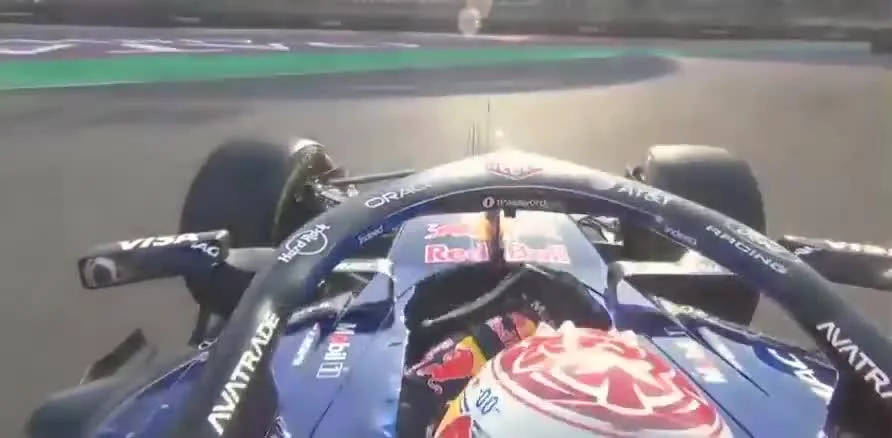
The clearest evidence came from Verstappen himself. After qualifying eighth, he did not hide behind traffic, procedure, or fine margins. “I can’t. This is undriveable. We never had anything this bad,” he said. Later, he expanded on it: “The whole day has been a disaster pace wise, no grip. I honestly think that’s the biggest problem. No grip, no balance, just losing massive amounts of time in the corners to be honest, and then because of that you start triggering other little problems.” He added: “The big problem for us is just that the cornering is completely out.”
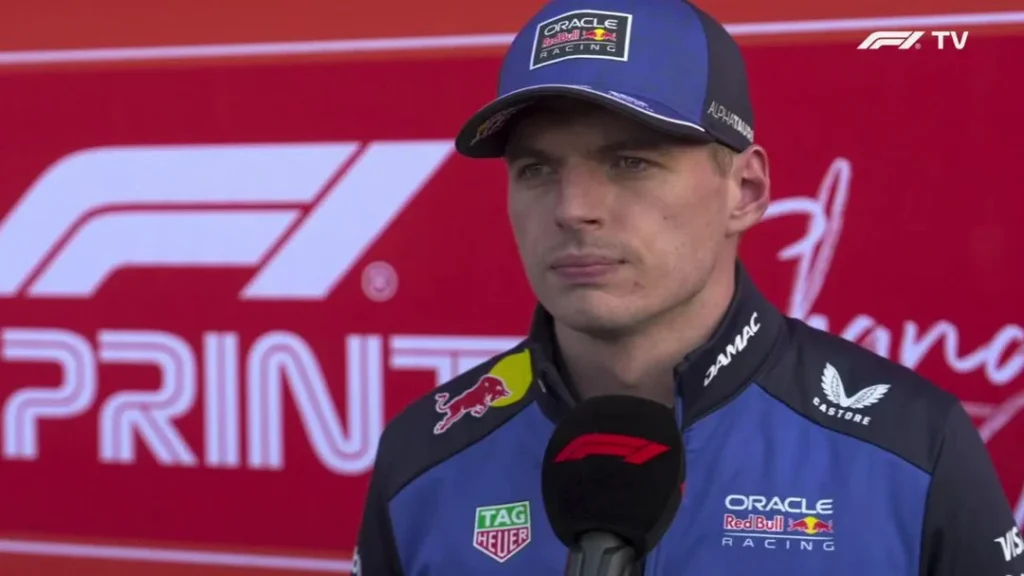
Those comments were the most important diagnosis of the session. Red Bull’s problem in China was not simply that the engine was not good enough, or that the setup was missed by a small margin. Verstappen was describing a car with no cornering confidence, no platform consistency, and no grip. And once those issues emerge, everything else starts to unravel as well. Brake phases get compromised. Energy recovery windows become harder to optimize. The exits become less tidy. The straights begin from a worse place. In that sense, the raw time gap was only the symptom. The bigger concern was how many different systems were being dragged down by the same weak foundation.
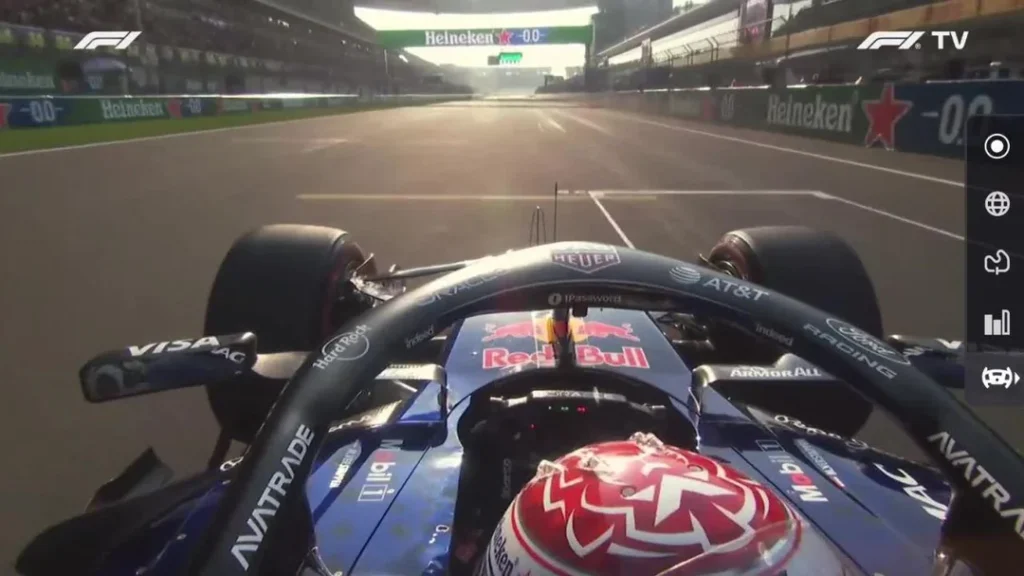
That explains why his eighth place felt far worse than a normal off-day for a front-running driver. It was not just that Verstappen was behind Russell, Antonelli, Norris, the two Ferraris, and Piastri. It was that he was also behind Gasly’s Alpine, and that the overall gap was so large it changed the conversation entirely. One of the more telling reactions from the session was the observation that Verstappen’s time was closer to Alonso’s in nineteenth than to Piastri’s fifth-place time. Whether or not that becomes the enduring metric of this weekend, it captured the shock of seeing Red Bull so disconnected from the front.
Nor was the session smooth in execution. Verstappen had a moment at the hairpin while reacting to an Alpine nearby, gesturing and then asking the team to check the floor. That was a small incident inside a much bigger problem, but it fit the pattern of a driver who never looked fully comfortable with the car or the environment around him. Later, Laurent Mekies came over the radio with an apology that only reinforced the scale of the setback: “Sorry, Max. Tough one. A lot to learn from that one. The weekend’s still long – we need to from and try again.” Teams do not talk like that after a normal P8.
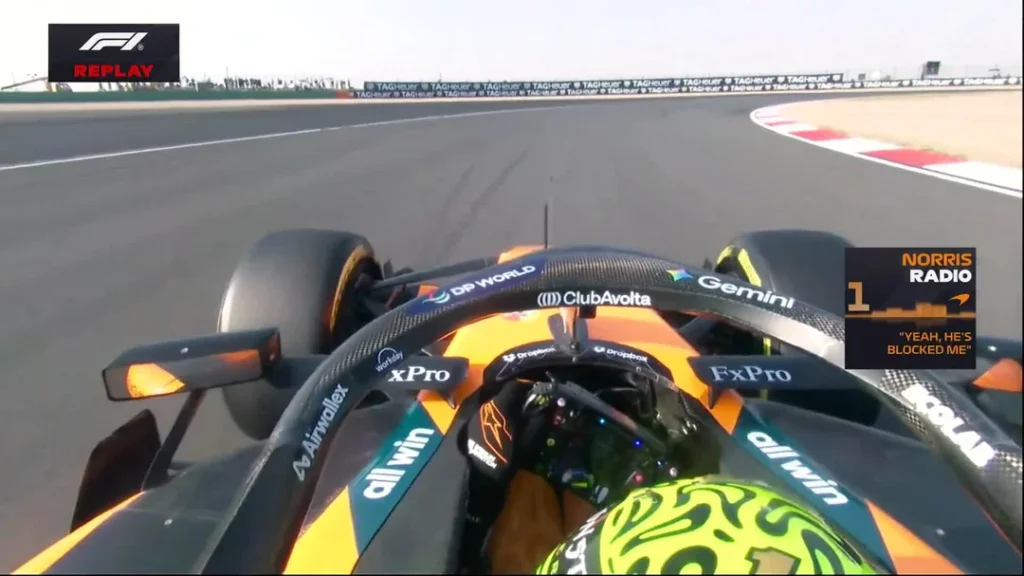
The traffic management during SQ2 also became one of the storylines of the session, but in both major investigations the decisive factor was ultimately the testimony of the drivers involved. The first centered on Antonelli and Norris at Turn 1. Norris initially reacted as though he had been held up, and the incident was referred to the stewards after the session. But the FIA took no further action. The reason was specific and important. Norris told the stewards he had been on a “pushing warm up lap” rather than a genuine push lap, meaning he was not trying to set a meaningful lap time when Antonelli exited the pits. The FIA’s wording made the point clearly: had Norris been on a push lap, Antonelli would have unnecessarily impeded him. Because he was not, the case ended there.
The second investigation involved Gasly and Verstappen at Turn 14. Here, Verstappen actually was on a push lap and encountered Gasly on what he described as his preferred line at the exit of the corner. But again, no penalty followed. Gasly explained he believed staying to the left was the safest option, Verstappen said the Alpine affected his preferred line but did not actually impede him, and the stewards accepted that explanation. Once more, no further action.
Those decisions mattered for the grid, but they also reflected something more subtle about Sprint Qualifying in Shanghai. The track was congested enough, and the margins tight enough, that multiple incidents looked worse in the moment than they ultimately were once the drivers and the data were examined. Both Norris and Verstappen backed away from the strongest possible interpretation when asked directly. In a session where radio frustration came quickly, that was significant.
Gasly’s own performance deserved more than a stewarding footnote. Seventh place for Alpine was one of the laps of the session. It was not just a solid midfield result. It was a lap that put Alpine ahead of Verstappen on pure qualifying pace and contributed to the impression that the midfield order is far less settled than it first appeared. Bearman’s P9 was strong as well, and Hadjar’s P10 kept him in the points conversation for the Sprint. Hülkenberg, meanwhile, was thought to have lost out partly due to a lock-up at the hairpin, a small error that may well have cost him a place in SQ3.
Hamilton’s fourth place left Ferrari in an intriguing spot for the Sprint itself. The straight-line power gap appears real, but so does Ferrari’s strength in the corners and at launch. There was obvious anticipation around what Hamilton might do from the second row on the long run into Turn 1. The Australian Grand Prix had already shown flashes of Ferrari’s launch strength, and Shanghai offers a similar opportunity to gain ground immediately if the start is right. Even those skeptical about Ferrari’s race pace could still see how a short Sprint might compress the variables enough to bring Hamilton into direct play.
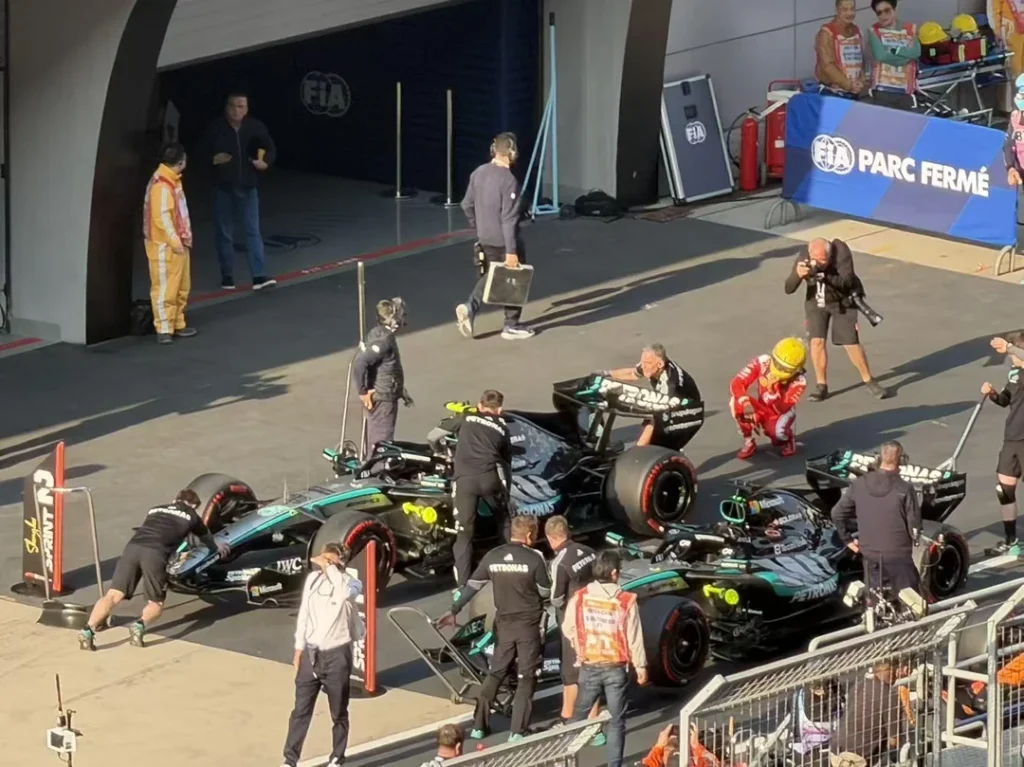
That possibility gave added significance to one of the most discussed visual moments after the session. Hamilton was seen closely inspecting the Mercedes in parc fermé, an image that almost immediately took on a life of its own. At a basic level, drivers studying rival cars is completely normal. At a symbolic level, this one carried more weight. Hamilton had just qualified fourth in a Ferrari that he said felt good in the corners, only to be beaten by the team he left, now armed with the fastest-looking package on the grid. The image worked because it captured the balance of the day so neatly: Hamilton did not look like a driver regretting Ferrari so much as one acutely aware that the reference car currently sits elsewhere.
That distinction matters. The broader mood around Hamilton in the material from Friday was not of a driver consumed by second thoughts. If anything, it was of someone who finally seems re-engaged. Australia had already been framed as positive and focused from his side, and China did not erase that. Hamilton sounded more encouraged by the Ferrari underneath him than deflated by the Mercedes ahead of him. The car, in his words, “feels great.” The limitation, at least here, is power.
That may end up being the defining split of the 2026 field in its early phase. Mercedes currently appears to have the complete package. Ferrari may have a car capable of fighting through the corners at the right tracks, but not the top-end performance to do it everywhere. McLaren remains in the mix, particularly with Norris and Piastri both close enough to capitalize if Mercedes falters. Alpine and Haas have shown enough to suggest the midfield is alive. Williams is underperforming relative to what its power unit should allow. And Red Bull, at least in Shanghai Sprint Qualifying, looked like a team in search of answers that go far beyond fine-tuning.
That is what makes Russell’s pole so important. It was not just another front-row start. It was the clearest competitive statement yet of the season. Mercedes locked out the front row, did so with apparent control, and did it while one of its closest historic rivals spent the session inspecting its rear end in parc fermé and another, Red Bull, spent it apologizing to Verstappen for a car with no grip, no balance, and no cornering performance.
Shanghai has a way of making weaknesses obvious. On Friday, it did exactly that. Mercedes left Sprint Qualifying looking like the class of the field. Ferrari left with enough promise to believe in some tracks, but not this one. Red Bull left with Verstappen in eighth, behind an Alpine, describing the car as worse than anything he has felt in years.
For a Sprint grid that only runs ten places deep, that is a remarkable amount of information packed into one Friday.