

Formula 1’s Singapore Grand Prix weekend has become as much about controversy off the track as competition on it, with Mercedes facing questions over George Russell’s reliability problems, Toto Wolff dismissing accusations of favoritism, and Max Verstappen finding himself at the center of another debate over stewarding consistency.
For Russell, the situation has become particularly frustrating. The Mercedes driver has received a staggering 40-place grid penalty following multiple power unit changes, adding another setback to a season in which mechanical problems have repeatedly complicated his campaign. The timing could hardly be worse for Mercedes. Wolff has already been forced to address accusations that the team is deliberately compromising Russell’s performance to benefit teammate Kimi Antonelli, responding with a sarcastic question about whether fans genuinely believe Mercedes has a button designed to destroy Russell’s engine.
Meanwhile, Verstappen has escaped punishment after overtaking Lewis Hamilton under yellow flags, prompting accusations that the Red Bull driver receives preferential treatment from the stewards. However, a closer examination of previous FIA decisions suggests Verstappen’s treatment may be considerably more consistent with established precedent than some critics believe. Away from the circuit, Verstappen has also attracted attention after attending dinner with the Yoovidhya family, Red Bull’s Thai majority shareholders, offering another reminder of the relationships behind one of Formula 1’s most influential organizations.
Together, these developments highlight an increasingly familiar characteristic of modern Formula 1: the gap between what actually happens, how fans interpret those events, and the narratives that develop around them.
George Russell Receives a 40-Place Grid Penalty in Singapore
Russell’s Singapore Grand Prix has been dealt a significant blow after the FIA confirmed that Mercedes exceeded the permitted allocation of multiple power unit components on car No. 63.
According to FIA Document 20, Mercedes introduced four additional components beyond their respective permitted allocations. The changes include:
| Power unit component | Allocation used | Grid penalty |
|---|---|---|
| Internal combustion engine (ICE) | Fifth | 10 places |
| Turbocharger (TC) | Fifth | 10 places |
| Exhaust set (EXH) | Fifth | 10 places |
| MGU-K | Fourth | 10 places |
| Total | 40 places |
The FIA determined that the changes breached Articles B8.2.2 and B8.2.3 of the Formula 1 regulations, with the resulting penalty imposed under Article B8.2.8. Each additional component carries a 10-place grid penalty, producing an accumulated 40-place drop. Importantly, the penalty applies to the main Grand Prix rather than the Sprint.
Under Article B2.5.4b.iv, provided Russell is classified in qualifying, his race starting position will be determined according to the applicable grid allocation procedures. Of course, a 40-place penalty sounds particularly dramatic when there are only 22 cars on the grid. In practical terms, Russell cannot physically drop 40 positions from wherever he qualifies. Instead, the penalty effectively consigns him to the back of the grid under the applicable regulations.
The enormous numerical penalty has nevertheless reignited discussion about whether Formula 1’s power unit penalty system has become unnecessarily complicated.
When Grid Penalties Become Bigger Than the Grid
Formula 1 has a long history of handing out penalties that exceed the number of available starting positions.
The McLaren-Honda era provided some particularly memorable examples. At the 2015 Belgian Grand Prix, Fernando Alonso reportedly received a 55-place grid penalty, while teammate Jenson Button received another 50 places. Together, McLaren accumulated 105 grid positions of penalties for a single race weekend.
The absurdity of such numbers has long been a source of amusement among fans. Russell’s 40-place penalty has similarly inspired jokes about the Mercedes driver having to start from another country entirely. Given the recent Malaysian Grand Prix at Sepang, the suggestion that Russell might have to start from Baku or cycle to Singapore along Valtteri Bottas’ recent route provides a particularly fitting illustration of how ridiculous the numbers can sound.
But behind the humor is a legitimate regulatory question. If a driver is already starting at the back of the grid, what practical difference does an additional 10-, 20-, or 30-place penalty make? The current approach allows teams to absorb large penalties during a single weekend rather than carrying them across multiple events.
That can create an incentive to replace several components simultaneously, maximizing the benefit of fresh equipment while minimizing the number of races affected. Some have suggested that unserved grid penalties should carry over into subsequent events or trigger additional sanctions, such as a drive-through penalty. Formula E’s approach has been raised as one possible alternative.
However, that proposal introduces another problem: teams sometimes have no realistic option other than replacing failed equipment. If Russell genuinely lacks sufficient functioning components to assemble a usable power unit, additional penalties would not solve the underlying reliability problem. They would simply punish the driver further for a mechanical situation beyond his control.
There is also a commercial consideration. Formula 1 has little incentive to create a regulatory environment in which cars are forced to miss races because their teams cannot replace unreliable components without accumulating effectively endless penalties. Such an approach could disproportionately hurt smaller teams and customer operations, particularly during the first season of a new engine regulation cycle.
The 2026 power units represent a substantial technical change, and reliability problems are hardly surprising when manufacturers are still developing and refining their new designs. The previous generation of engines benefited from years of development and accumulated operational knowledge. Expecting the same level of reliability immediately from a new generation of complex machinery may be unrealistic. Nevertheless, Russell’s penalty underscores just how costly those early technical challenges can become.
And it has arrived at an especially sensitive moment for Mercedes.
Toto Wolff Fires Back at George Russell Sabotage Theories
Russell’s ongoing reliability problems have fueled increasingly vocal accusations that Mercedes is deliberately favoring Antonelli.
Some fans have gone further, suggesting that the team is intentionally compromising Russell’s machinery. Wolff has little patience for those claims. Speaking to journalist Julianna Cerasoli about the accusations surrounding Russell’s treatment, the Mercedes team principal responded:
“I don’t know what they think. Do they think we have a ‘break George’s engine now’ button?”
Wolff added that such accusations demonstrate “zero understanding of what F1 is.”
His frustration is understandable. The suggestion that Mercedes would intentionally sabotage one of its own cars raises several obvious questions. Why would a team invest enormous resources in developing a competitive Formula 1 car, only to deliberately make it unreliable?
Why would an organization employing hundreds of highly skilled engineers intentionally compromise its own Constructors’ Championship results? And how would such a coordinated effort remain secret within an organization involving so many employees? A deliberate mechanical sabotage operation would require an extraordinary level of coordination while offering little obvious competitive benefit to the team itself.
Mercedes has every reason to want both Russell and Antonelli scoring as many points as possible. Even if the organization has a preferred long-term driver, intentionally destroying the performance of the other car would be an extraordinarily inefficient way to pursue that objective. The 40-place grid penalty only makes the conspiracy theory more difficult to reconcile with the team’s interests.
Mercedes is already paying a substantial competitive price for its power unit difficulties. Deliberately creating additional problems would be self-defeating.
Yet dismissing the sabotage accusations does not necessarily mean every criticism of Mercedes’ treatment of Russell is without merit.
Favoritism and Sabotage Are Two Different Accusations
An important distinction is being lost in the debate.
A team can favor one driver through strategy, race management, or organizational priorities without deliberately sabotaging the other driver’s equipment. Some concerns surrounding Mercedes have focused on decisions made during races rather than mechanical failures. Zandvoort has been cited as one example.
Critics have questioned a Mercedes instruction that reportedly required Russell to drop behind Antonelli rather than simply avoid holding up his teammate once Antonelli caught him. At the time, Russell was reportedly still nearly a second ahead, and surrendering the position exposed him to greater pressure from Hamilton. That type of decision is a legitimate subject for scrutiny.
Team orders can affect finishing positions, driver confidence, and championship outcomes. They can also reveal how an organization balances the interests of its two competitors. There have also been complaints about Wolff’s public comments, with some interpreting his assessments of Russell’s performances as harsher than his treatment of Antonelli.
Whether those interpretations are fair is debatable. However, questioning the consistency of team orders or public support is fundamentally different from claiming that Mercedes engineers are deliberately destroying engines. The former can be evaluated through observable decisions. The latter requires evidence of intentional misconduct.
And the information currently available does not establish such evidence.
Why Russell’s Reliability Problems Fuel Suspicion
The frustration surrounding Russell is not entirely difficult to understand.
When mechanical problems repeatedly affect the same driver, supporters naturally begin questioning why the difficulties appear unevenly distributed. Russell has reportedly experienced deployment issues throughout the season, in addition to the power unit problems that have now resulted in his Singapore penalty. The situation becomes even more frustrating when considering that Mercedes also supplies power units to McLaren, Williams, and Alpine.
If those teams appear to be experiencing fewer problems, the repeated failures affecting Russell’s car can seem particularly unusual. However, unusual patterns do not automatically establish deliberate interference. Mechanical reliability is influenced by numerous factors, and a relatively small number of failures can create the impression of a systematic imbalance.
Antonelli has also experienced significant setbacks. His retirement in Catalunya and a wheel shield failure at Silverstone have been raised as examples demonstrating that Russell is not the only Mercedes driver to suffer mechanical problems. That does not make Russell’s situation any less frustrating.
But it complicates the narrative that Mercedes has somehow engineered a season in which only one of its drivers encounters difficulties. There is also historical precedent for drivers becoming suspicious when repeated failures appear to affect them disproportionately. During the 2016 Malaysian Grand Prix, Lewis Hamilton publicly questioned why his engines seemed to be failing while other Mercedes-powered cars were avoiding similar problems.
His frustration reflected the emotional reality of competing for a championship while repeatedly encountering mechanical setbacks. But frustration and suspicion are not substitutes for evidence. In Russell’s case, the repeated problems provide legitimate grounds for questioning Mercedes’ reliability and operational execution.
They do not, on their own, establish sabotage.
Mercedes’ Singapore Social Media Post Becomes Part of the Joke
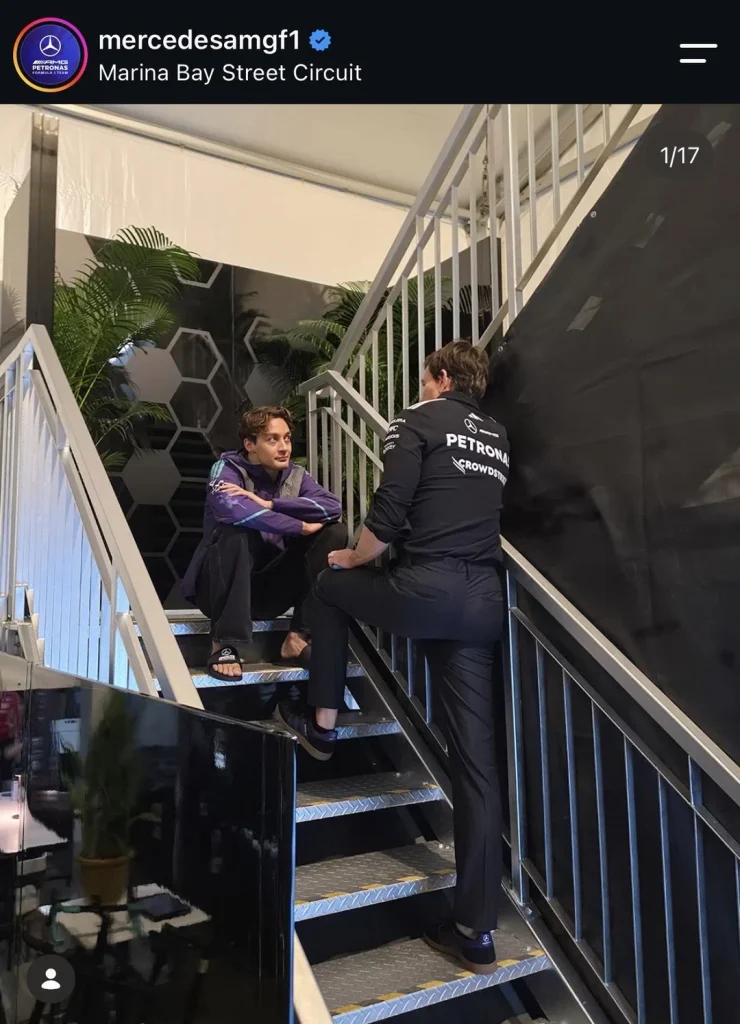
Mercedes added another dimension to the discussion with a Friday social media post from Singapore featuring Wolff and Russell.
Ordinarily, photographs of a team principal interacting with one of his drivers would attract little attention. But against the backdrop of the sabotage accusations, even a routine social media update became an opportunity for fans to revisit the controversy. The photographs prompted jokes that Mercedes was working overtime to convince everyone that Wolff and Russell actually get along.
Others imagined Wolff reassuring Russell that the supposed engine shutdown button did not exist, while joking that the team principal might secretly have the controls hidden under his desk or installed on his phone. The fictional sabotage switch has quickly become one of the more entertaining running jokes surrounding Mercedes. Wolff’s distinctive Austrian accent has only added to the humor, with fans imagining increasingly elaborate conversations between the team principal and Russell.
Even the driver’s footwear became a topic of discussion, with Russell’s open-toe shoes attracting attention. The lighter reactions are relatively harmless. But the broader response demonstrates how quickly an unsupported theory can become part of a team’s public identity.
Once a narrative becomes established online, even ordinary interactions can be interpreted as attempts to address it. A photograph of Wolff and Russell talking can become supposed evidence of a public relations campaign. A mechanical failure becomes further confirmation of an imagined conspiracy.
And an ordinary team decision can be reframed as part of a coordinated effort to undermine one driver. That is the challenge Mercedes now faces. The organization can explain its decisions, publish photographs, and dismiss the accusations, but it cannot necessarily control how supporters interpret those actions.
In fact, Wolff’s sarcastic response has only given the conspiracy another memorable phrase. The imaginary engine-destruction button may not exist, but it has certainly become a fixture of the fan conversation. Has Formula 1’s Growing Popularity Changed Its Fan Culture?
The reaction to Mercedes has also sparked a broader discussion about how Formula 1 fandom has evolved. The championship’s growing visibility, particularly through social media and Drive to Survive, has introduced the sport to audiences who might never previously have followed motorsports. That expansion has been enormously valuable.
More people discussing Formula 1 means greater engagement, wider cultural relevance, and opportunities for the championship to reach new markets. For longtime fans who once struggled to find others interested in the sport, the change can be particularly welcome. However, the increased attention has also amplified some of the less productive characteristics of sports fandom.
Driver loyalty can become so intense that supporters interpret almost every incident through the lens of their favorite competitor. A setback affecting one driver becomes evidence of unfair treatment. A successful result for another becomes suspicious.
And a technical or strategic decision can quickly develop into a debate about personal relationships and hidden agendas. There are similarities with the tribalism seen in soccer and other major sports, where loyalty to an individual or team can sometimes overwhelm an objective assessment of events. Formula 1’s personality-driven presentation may reinforce that tendency.
Drive to Survive has helped introduce audiences to the individuals behind the sport, but its emphasis on interpersonal drama can also encourage viewers to approach Formula 1 as an ongoing narrative of heroes, villains, rivalries, and betrayals. Of course, it would be unfair to blame newer fans for every unreasonable argument. Formula 1 has been an internationally popular sport for decades, long before the arrival of Netflix or modern social media.
The championship enjoyed enormous audiences during previous eras, and its established history includes plenty of passionate and occasionally irrational rivalries. The difference is that social media now makes those arguments impossible to ignore. An opinion that might once have remained confined to a conversation between friends can now reach thousands of people within minutes.
The result is not necessarily a less knowledgeable fanbase overall. It is a more visible one, where the most provocative interpretations can receive disproportionate attention.
And that brings us to another controversy unfolding in Singapore.
Max Verstappen Escapes Penalty for Passing Lewis Hamilton Under Yellow Flags
Verstappen has avoided a grid penalty following an incident in which he overtook Hamilton under yellow flags.
The decision prompted immediate accusations that the Red Bull driver had received preferential treatment from the stewards. On the surface, the argument appears straightforward. Overtaking under yellow flags is prohibited, so a driver who passes another car while yellow flags are displayed should presumably receive a penalty.
However, the circumstances surrounding Verstappen’s incident complicate that interpretation. Hamilton was traveling slowly to allow Verstappen, who was on a push lap, to pass without being impeded. As Verstappen approached, the yellow flag appeared around the corner.
That created a dangerous closing-speed situation. Verstappen was traveling considerably faster than Hamilton, who had already moved aside to facilitate the pass. Attempting to remain behind Hamilton after encountering the yellow flag could have created a collision risk.
According to the discussion of the stewards’ findings, telemetry showed that Verstappen responded by braking. He subsequently communicated his intention to return the position and did so. The key consideration was therefore not simply whether Verstappen had passed Hamilton.
It was whether he had reacted appropriately to the yellow flag and whether avoiding the overtake was realistically possible without creating an additional safety risk. The purpose of yellow flags is to protect drivers, marshals, and other personnel from danger. Applying the regulations in a manner that would make a situation more dangerous would undermine that objective.
In this instance, the circumstances support the argument that Verstappen’s actions were consistent with a reasonable effort to respond safely.
Historical FIA Decisions Suggest Verstappen Was Not Given Special Treatment
One of the strongest arguments against the claim of preferential treatment comes from a review of previous FIA decisions.
An examination of incidents involving overtaking under yellow or red flags during 2025 and 2026 identified 14 relevant cases. Of those, nine resulted in no penalty. The initial review overlooked two incidents from Zandvoort, but the figures were subsequently corrected.
The analysis also identified an important distinction between incidents occurring during races and those taking place in practice or qualifying. When race incidents were excluded, nine of the remaining 11 cases resulted in no penalty. Yellow- and red-flag overtaking decisions reviewed, 2025–2026
All incidents reviewed
9 of 14
Received no penalty
Excluding race incidents
9 of 11
Received no penalty
Share without penalty, all incidents
64%
Share without penalty, excluding races
82%
Figures from a fan review of FIA decision documents, with corrections incorporated. This was not presented as an exhaustive audit of every incident. These figures challenge the suggestion that overtaking under yellow or red flags almost always produces a grid penalty. In fact, the reviewed decisions indicate that stewards have frequently declined to penalize drivers when the circumstances made avoiding the overtake impractical or unsafe.
The distinction between race and non-race situations is particularly important. During a Grand Prix, passing another competitor under yellow flags can provide a direct sporting advantage. Drivers are also generally operating in a competitive environment where the consequences of gaining or losing positions are immediate.
During practice or qualifying, the circumstances can be quite different. One driver may be completing a flying lap while another is traveling slowly to create space. The difference in speed can be enormous.
If a yellow flag appears at the wrong moment, the faster driver may have very little time to react before reaching the slower car. That does not mean the regulations cease to apply. It means the stewards must evaluate whether the driver responded appropriately and whether the overtake could reasonably have been avoided.
Verstappen’s incident appears to fit that category. The corrected historical figures do not prove that every decision has been consistent, and the review was not an exhaustive study.
Nevertheless, they provide useful context that is largely absent from the accusations of preferential treatment.
Why Verstappen’s Incident Was Different From Bearman’s Monaco Penalty
Some critics have compared Verstappen’s treatment with Oliver Bearman’s penalty for a red-flag infringement at Monaco in 2025.
However, the circumstances described in the respective decisions are materially different. In Bearman’s case, the driver reportedly acknowledged seeing the red flag but did not immediately reduce his speed as required. That is a substantially different situation from encountering a yellow flag while rapidly closing on a slower car and taking action to avoid a collision.
The Monaco incident also included examples of other drivers responding differently. Carlos Sainz and Franco Colapinto reportedly slowed appropriately under the same red-flag conditions and avoided penalties. The relevant distinction was not simply which driver passed another car.
It was whether the drivers complied with the safety requirements after becoming aware of the flag. That is precisely the type of context that can be lost when incidents are compared through short video clips or isolated descriptions. Two situations may appear similar because both involve overtaking under flags.
But the circumstances surrounding the overtakes can justify different outcomes. The same principle applies to comparisons with penalties issued at Zandvoort. Incidents involving drivers failing to slow sufficiently during a race cannot automatically be treated as equivalent to a qualifying situation involving a sudden yellow flag and a large closing-speed difference.
The stewards must evaluate the specific actions and available evidence. That includes telemetry, timing, track position, and the driver’s response. In Verstappen’s case, the reported braking evidence and subsequent return of the position were important considerations. The absence of a penalty therefore does not necessarily indicate leniency.
It may simply reflect the application of the same contextual approach used in numerous previous decisions.
The Real Problem With F1 Stewarding Debates
The reaction to Verstappen’s incident reveals a broader weakness in how stewarding decisions are discussed.
Too often, the debate begins with the identity of the driver rather than the circumstances of the incident. If Verstappen avoids a penalty, critics may immediately interpret the outcome as evidence of favoritism. If Hamilton or another driver receives a penalty in a superficially similar situation, that decision becomes further evidence of inconsistency.
But comparisons are only meaningful when the relevant circumstances are comparable. A driver who ignores a red flag after clearly recognizing it is not necessarily in the same position as someone who brakes under yellow flags but cannot safely avoid passing a slower car. Similarly, an overtake that creates a competitive advantage during a race is different from one occurring during a disrupted qualifying lap.
This does not mean the FIA is immune from criticism. Formula 1 has every reason to demand clear, consistent, and transparent stewarding. But legitimate scrutiny requires examining the reasoning behind decisions rather than simply comparing their outcomes.
The historical review of yellow- and red-flag incidents is a useful example of how that discussion can become more productive. Instead of assuming that Verstappen received special treatment, the analysis examined previous decisions to establish whether his outcome was unusual. The resulting figures suggest that it was not. That does not eliminate every question about the stewards’ interpretation of the regulations.
It does, however, make the accusation of preferential treatment considerably harder to sustain on this incident alone.
Verstappen Meets Red Bull’s Thai Majority Shareholders

Away from the Singapore circuit, Verstappen has also attracted attention after attending dinner with members of the Yoovidhya family, Red Bull’s Thai majority shareholders.
The gathering offered a rare public glimpse of the relationship between Red Bull’s most prominent Formula 1 driver and the family behind the company’s majority ownership. The Yoovidhya family’s position is particularly significant following the death of Red Bull co-founder Dietrich Mateschitz. Mateschitz had been closely associated with Red Bull’s Formula 1 ambitions, and his influence helped shape the organization’s identity within motorsports.
Although the Austrian side of the business historically exercised considerable influence, the Thai shareholders’ majority position has become an increasingly important consideration in discussions about the company’s leadership and direction. That naturally raises questions about how involved the Yoovidhya family is in Red Bull Racing’s operations. However, a dinner with Verstappen does not, by itself, indicate any particular strategic development.
There is no information in the material provided suggesting that the gathering involved contract negotiations, team management decisions, or changes to Red Bull’s Formula 1 program. It could simply reflect the relationship between a company’s ownership and one of its most valuable sporting representatives. Given Verstappen’s status as a four-time world champion, maintaining that relationship would hardly be surprising.
The public reaction to the photographs was considerably less serious. Much of the attention centered on Verstappen’s decision to attend in jeans and a relatively casual outfit. For a driver accustomed to spending much of his public life in Red Bull-branded clothing, appearing in ordinary clothes was apparently enough to become a talking point.
There is also something fitting about a four-time world champion attending a dinner with major shareholders without feeling compelled to adopt particularly formal attire. At a certain level of sporting achievement, status can speak louder than a dress code. The photographs also prompted discussion about the Yoovidhya family’s history and the origins of Red Bull itself.
Some fans revisited the relationship between the original Thai energy drink, Krating Daeng, and the international Red Bull brand associated with Mateschitz. Others noted that Red Bull branding had already been used in Asian markets before the international brand became established. The historical discussion serves as a reminder that Red Bull’s identity extends well beyond its Austrian Formula 1 operation. For all the attention devoted to the racing team, the company behind it has a much broader ownership history.
And while Verstappen’s dinner may have been a relatively ordinary social occasion, it illustrates the unusually close relationship between Formula 1’s leading drivers, their teams, and the corporate interests supporting them.
Singapore Highlights the Difference Between Controversy and Evidence
The stories surrounding Mercedes and Verstappen may appear unrelated, but they share a common theme.
In both cases, strong fan reactions have developed around situations where the available evidence does not necessarily support the most dramatic interpretation. Russell’s repeated reliability problems are real. His 40-place grid penalty is real.
Questions about Mercedes’ team orders and the treatment of its drivers are legitimate subjects for discussion. But none of those facts establishes that Mercedes is deliberately sabotaging Russell. Similarly, Verstappen did overtake Hamilton under yellow flags.
That fact is not disputed. However, the circumstances surrounding the incident, the reported telemetry evidence, and the history of comparable stewarding decisions provide a reasonable explanation for why no penalty was imposed. The difference lies in how the information is interpreted.
Formula 1 is a sport built on extremely complex technical systems, split-second decisions, and regulations that frequently require judgment rather than mechanical application. Not every failure is evidence of misconduct. Not every unusual decision is evidence of favoritism.
And not every controversial outcome is necessarily inconsistent with precedent. That does not mean teams or officials should escape scrutiny. Quite the opposite.
Mercedes should be expected to explain its reliability problems and the decisions affecting its drivers. The FIA should be expected to provide transparent reasoning for its penalties and non-penalties. And Formula 1 should encourage informed debate about the decisions that shape its championship.
But the quality of that debate matters. A 40-place grid penalty can be criticized for its regulatory absurdity without inventing a deliberate sabotage operation. A controversial yellow-flag incident can be examined through previous decisions without assuming the stewards are protecting a particular driver.
And a photograph of a team principal talking to his driver can simply be a photograph, rather than evidence of an elaborate public relations campaign. As Formula 1 continues to attract new audiences and greater attention, separating evidence from speculation will become increasingly important. The championship has never lacked controversy, and passionate disagreement is part of its appeal.
But the most useful questions are not always the most dramatic ones. For Mercedes, the immediate issue is whether it can overcome its reliability problems and give Russell a competitive car. For Verstappen, the yellow-flag controversy appears to be another example of a stewarding decision that makes considerably more sense once the circumstances are examined.
And for Formula 1’s increasingly vocal fanbase, Singapore provides another reminder that sometimes the explanation is less complicated than the conspiracy. After all, as Wolff has effectively pointed out, Mercedes does not need an imaginary engine-destruction button to have a difficult weekend.
Its real reliability problems are already causing enough trouble.