

IndyCar fans don’t always agree on much, but there has been a noticeable trend in recent conversations across the paddock and fan community. Whether discussing Scott McLaughlin’s latest throwback livery, defending Graham Rahal’s place on the grid, or reacting to encouraging television ratings from the Chevrolet Detroit Grand Prix, many supporters have found themselves pushing back against criticism and focusing instead on what they believe the series is getting right.
The topics themselves may be unrelated, but the reaction has been remarkably similar: appreciation for the sport’s history, recognition of underappreciated contributors, and optimism about IndyCar’s future.
McLaughlin’s Throwback Brings Back a Penske Classic
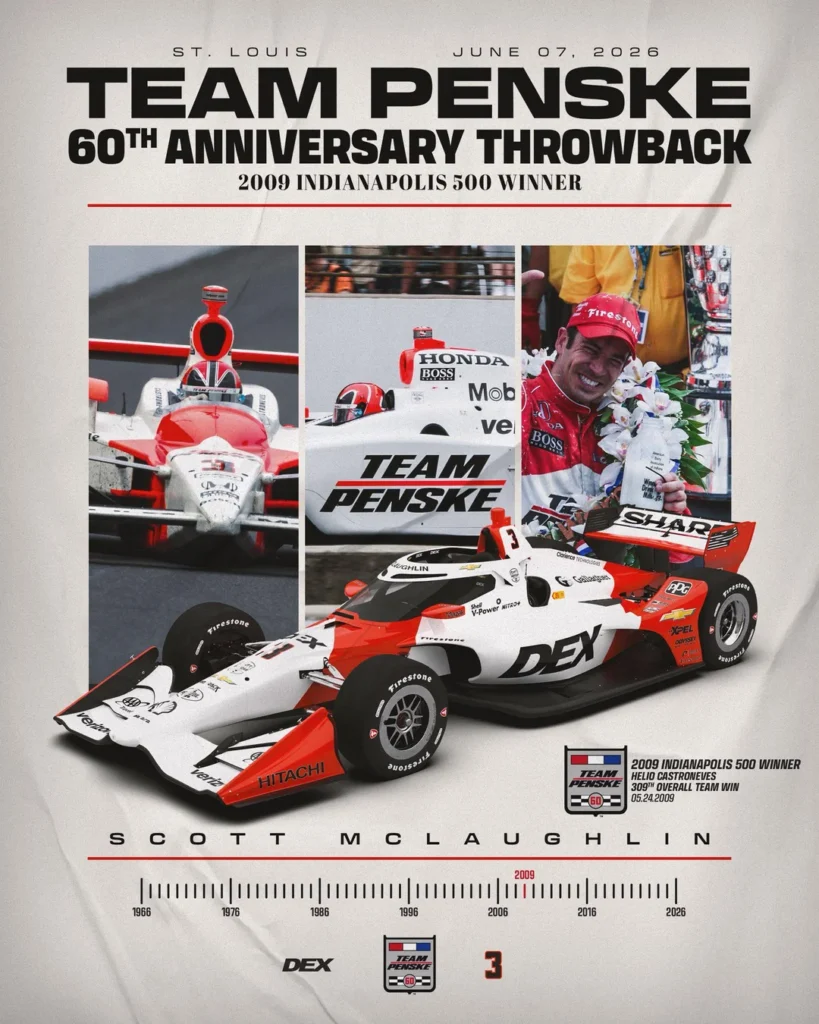
Team Penske revealed that Scott McLaughlin will run a throwback to Hélio Castroneves’ 2009 livery at Gateway this weekend, and the reaction was overwhelmingly positive.
Many fans immediately pointed out that McLaughlin seems to have a habit of landing some of the most popular special liveries in the series. After previously running the fan-favorite Yellow Submarine design, supporters joked that the New Zealander continues to win the throwback lottery.
More than anything, however, the livery reignited nostalgia for one of the most recognizable eras in Team Penske history.
While officially a tribute to Castroneves’ 2009 machine, much of the discussion revolved around the unmistakable resemblance to the iconic Marlboro-era Penske designs. Fans celebrated the return of the famous red chevrons and bright accents that defined some of the team’s most successful years.
Questions did emerge about how closely modern teams can replicate historic liveries under today’s sponsorship regulations. Some noted that previous throwback efforts in both IndyCar and Formula 1 have often required subtle design changes. Others pointed out that Penske specifically chose a 2009 version of the car, a period when tobacco branding restrictions had already altered the appearance of the original scheme.
Still, the technical details quickly became secondary.
The overwhelming sentiment was simple: the car looks incredible.
Many fans described it as one of the best-looking liveries in modern IndyCar, while others argued that nothing feels more natural than a Penske wearing classic red-and-white colors. The conversation soon expanded into wish lists of other historic Penske liveries that deserve modern tributes, including PPG, Miller High Life, Sunoco, and other iconic designs from the team’s past.
For a fanbase that loves the sport’s history, McLaughlin’s latest throwback felt less like a marketing exercise and more like a reminder of what has made Team Penske such a defining part of IndyCar for decades.
Fans Defend Graham Rahal’s Place in IndyCar
Another major discussion centered around a question that resurfaces regularly in IndyCar circles: why does Graham Rahal still have a ride?
The responses were swift.
Rather than agreeing with the criticism, many fans questioned why the debate was happening at all.
The most common point raised was Rahal’s current season. With three podium finishes already this year and a position inside the top ten in the standings, many felt it was an odd time to argue that he no longer deserves his seat.
Fans acknowledged that Rahal’s connection to Rahal Letterman Lanigan Racing will always be part of the conversation. After all, the team carries his family’s name. However, many argued that reducing his entire career to nepotism ignores both his current performance and his broader value to the organization.
Several pointed to Rahal’s reputation for securing sponsors and maintaining commercial relationships. In modern motorsport, where funding remains critical, many fans argued that those skills carry significant value beyond what appears on a timing screen.
Others highlighted his growing role within the business itself. With Bobby Rahal now in his 70s, many believe Graham plays an increasingly important role in helping manage the organization and guide its future direction.
The discussion also sparked a broader conversation about expectations in modern IndyCar.
Outside of a handful of powerhouse organizations, race wins are far from guaranteed. Many fans argued that consistently producing podium finishes and remaining competitive for a team outside the championship’s elite tier is a meaningful accomplishment in its own right.
For many participants, the debate ultimately became less about Rahal specifically and more about how success should be measured in a series where only a select group of drivers realistically enter each weekend expecting to win.
Detroit Ratings Give Fans Another Reason for Optimism
The third major conversation came after television numbers were released for Sunday’s Chevrolet Detroit Grand Prix.
According to the figures shared, the race averaged 1.167 million viewers on Fox, up from 1.061 million for the event last year.
The response was immediate.
Fans quickly embraced the increase, often with a healthy dose of humor. Many joked that the statistics proved a groundbreaking concept: when viewership goes up, more people are watching.
Behind the jokes, however, was a clear sense of optimism.
Crossing the one-million-viewer threshold remains an important benchmark for the series, and many fans viewed the increase as another indication that IndyCar’s momentum is moving in the right direction.
Several pointed to Detroit’s strong on-track action as a reason the event connected with viewers. Others highlighted reports of strong attendance at the race itself, seeing both trends as encouraging signs for the health of the championship.
The conversation also generated praise for Fox’s coverage and, in particular, lead commentator Will Buxton.
Many fans argued that Buxton has become one of the most valuable additions to IndyCar broadcasts. While some acknowledged that his public image was heavily shaped by his appearances on Formula 1’s Drive to Survive, many now see him as someone genuinely invested in helping the series grow.
Supporters praised his ability to explain concepts for new viewers while still respecting longtime fans, a balancing act that many believe is essential if IndyCar hopes to continue expanding its audience.
The ratings discussion also highlighted growing confidence in the series’ future. Rather than focusing on worst-case scenarios, many fans chose to view the numbers as evidence that recent efforts to promote and grow IndyCar are beginning to show results.
A Rare Point of Agreement
IndyCar fans are rarely short on opinions.
Yet one common thread continues to emerge. Fans celebrated a throwback livery instead of looking for reasons to criticize it. They defended a veteran driver many felt was being unfairly dismissed. They embraced positive television numbers rather than searching for reasons they were not good enough.
None of these conversations were really about a paint scheme, a driver, or a ratings report. They reflected something larger: a fanbase increasingly willing to recognize positive developments when they happen.
At a time when discussion around motorsport can often gravitate toward controversy and criticism, many IndyCar supporters seem eager to focus on the reasons they continue to love the series in the first place.