

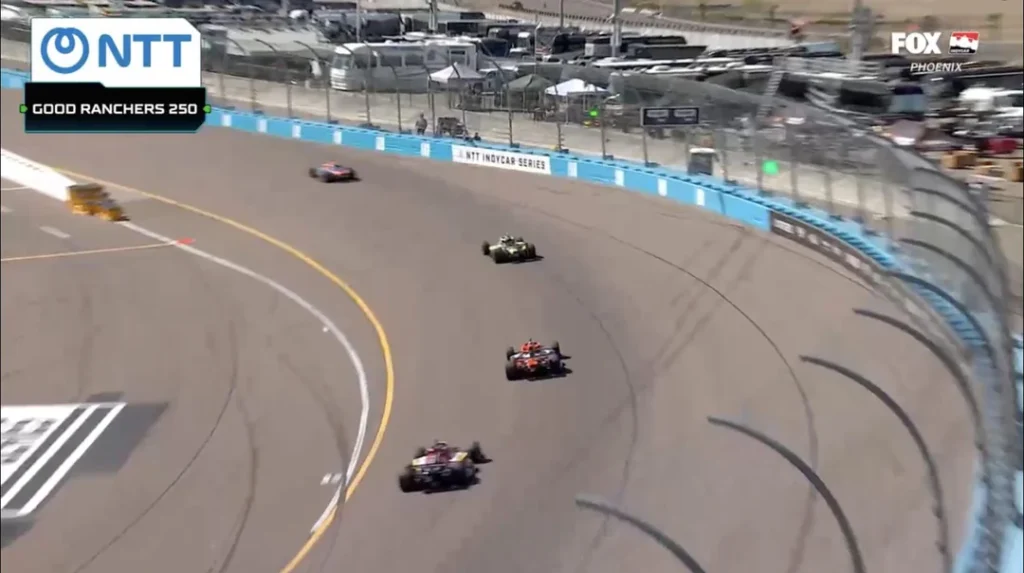
IndyCar’s Saturday broadcast on Fox drew sharp criticism from viewers after a series of technical and production issues disrupted coverage, with many fans pointing to inaccurate timing graphics, confusing direction, and missed on-track action as the biggest problems.
While some elements of the broadcast were praised, the overall viewing experience left many frustrated, particularly when it came to the reliability of timing and scoring. Throughout the race, viewers noticed the running order graphic lagging behind the actual action on track, with position changes sometimes not reflected for multiple laps. In a sport where battles unfold rapidly and strategies hinge on seconds, those delays made it difficult for audiences to follow what was really happening.
The timing glitches appeared to extend beyond a single driver or moment. At times, lap counts and intervals fluctuated wildly, with some drivers shown cycling between different lap deficits from one moment to the next. In several cases, the leaderboard even displayed inconsistent ordering among lapped cars, creating sequences that made little sense in the context of the race. For viewers relying on the broadcast graphics to track the field, it created the impression that something fundamental in the timing feed had broken down.
Some observers speculated that the issue might not have been limited to the television broadcast itself. Spectators at the track reported seeing irregularities with the lap counter and remaining-laps displays at the circuit as well, suggesting the possibility that the underlying track timing system was behaving erratically. Yet other viewers pointed out that IndyCar’s official website ticker appeared to function normally throughout the race, raising further questions about where exactly the breakdown occurred between the track data, the broadcast production systems, and the graphics shown on screen.
The confusion extended to other platforms as well. Fans who had the IndyCar app open during the race noticed that the running order there sometimes differed from what appeared on television. Because live timing platforms often update faster than a broadcast feed that is slightly delayed, discrepancies can occur—but the scale of the mismatch this time made the situation particularly frustrating for viewers trying to piece together the real order.
Even when the timing graphics worked, the direction of the broadcast became another point of criticism. Several viewers argued that the production frequently failed to follow the action being described by the commentators. On multiple occasions, commentators discussed overtaking attempts or close battles while the camera feed focused elsewhere entirely.
At times, the broadcast appeared to miss key moments outright. Fans pointed to instances where overtakes were either cut away from mid-sequence or shown only after the decisive moment had already happened. In one particularly frustrating example late in the race, the broadcast reportedly switched away from the fight for the lead just as the decisive move was developing, returning only after the overtake had already taken place.
For viewers accustomed to the rhythm of race storytelling, where an overtake builds through pressure, culminates in the pass itself, and then unfolds with the immediate counterattack or consolidation, the fragmented coverage made the race harder to follow. Instead of seeing the full narrative arc of a battle, fans often felt they were getting disconnected pieces of it.
The criticism wasn’t directed solely at camera operators, either. Many pointed out that the decision about which angles appear on the broadcast lies primarily with the production director. The issue, in that view, was less about individual camera shots and more about the overall editorial choices determining which battles were shown and when.
Those editorial decisions also contributed to the sense that much of the broadcast remained focused on the front of the field. Some viewers argued that the coverage often concentrated on the top two cars while other fights deeper in the pack went largely unnoticed. For fans who enjoy tracking battles throughout the grid, that narrow focus made the race feel less dynamic than it actually was.
Beyond the camera direction and timing glitches, viewers also highlighted missing context in the graphics package. Information about tire strategies, gaps between drivers, and pit cycle implications often felt sparse, forcing dedicated fans to rely on second screens, such as live timing data on laptops or phones, to keep up with the broader strategic picture.
Despite the criticism, not every aspect of the broadcast was poorly received. Several viewers felt the commentary booth itself performed well, with the core team providing clear and engaging analysis during the race. Guest appearances in the booth also drew mixed but sometimes positive reactions, with some viewers appreciating the additional perspective offered.
Still, the broadcast’s production issues overshadowed those strengths for many fans. When timing data becomes unreliable and camera direction fails to capture critical moments, even strong commentary struggles to compensate.
The debate also unfolded within the broader context of IndyCar’s television partnership with Fox. Some fans remain optimistic that the network will refine its coverage as the season progresses, noting that there have already been changes and improvements compared to earlier races. Others are less convinced, pointing to similar complaints from motorsport audiences in other Fox broadcasts.
At the same time, the move to broadcast races on free-to-air network television remains a significant advantage for the series. Wider accessibility can help grow the audience and expose new viewers to IndyCar racing, a factor many fans consider important for the championship’s long-term health.
For now, however, the reaction to Saturday’s broadcast underscores a simple reality: motorsport coverage lives or dies by its ability to capture the action as it unfolds. When viewers struggle to trust the timing graphics or feel that the cameras are missing the most important moments, even a compelling race can become a frustrating viewing experience.
As the season continues, Fox will likely face increasing pressure to address the timing inconsistencies, refine the broadcast direction, and ensure that the drama on track is fully translated to the screen. For a series built on close racing and constant battles throughout the field, getting that storytelling right is essential.