


Kimi Antonelli’s championship breakthrough should have provided the defining image of Formula 1’s Mexican Grand Prix weekend. Yet the aftermath also exposed the frustrations surrounding him: Ferrari’s drivers fighting over a lost opportunity, George Russell questioning another deployment failure, and performances farther down the field struggling to receive the attention they deserved.
Beyond Mexico, Yamaha’s withdrawal from MotoGP’s Qatar Grand Prix has opened a separate debate with implications for F1’s upcoming Middle Eastern races. The central question is how a championship responds when its participants do not share its confidence that an event should proceed.
These stories involve different stakes. Together, they put the decisions made by teams and organizers under scrutiny—and show why the explanation can matter almost as much as the outcome.
Ferrari’s lost opportunity goes beyond assigning blame
The argument over Lewis Hamilton and Charles Leclerc’s opening-lap confrontation risks becoming narrower than the problem Ferrari needs to solve.
Leclerc’s aggression deserves scrutiny. So does Hamilton’s response. Both drivers went off the circuit during their fight, and Max Verstappen benefited. For Ferrari, the relevant question is not simply which driver bears more responsibility, but how a promising position became an opportunity for a rival. There is a reasonable case that Hamilton could have protected his own race by keeping his car on the circuit rather than extending the defense. In that scenario, Leclerc’s excursion and any requirement to surrender an advantage could have been addressed without Hamilton also losing ground to Verstappen. That is a plausible alternative, not proof that Hamilton would have won.
The race still contained strategic decisions, interruptions and a red flag. Changing the opening sequence would have changed the circumstances under which those decisions were made. A stronger position is not the same thing as a guaranteed result. Equally, acknowledging Hamilton’s role does not excuse Leclerc’s approach. Two teammates can contribute to the same costly outcome without their actions carrying identical responsibility. Ferrari needs to examine both decisions instead of allowing the discussion to become a choice between absolving one driver and condemning the other. Nico Rosberg added to that debate with his observation:
“But interestingly it’s always Charles’ fault, isn’t it? It’s never Lewis’s fault. In the last couple of times, in Monza was Charles, here was Charles….”
The excerpt alone does not establish Rosberg’s tone or the full direction of his argument. The broader issue, however, is clear: repeated disputes cannot be resolved solely through another public debate over fault. That puts responsibility on Fred Vasseur and Ferrari’s management. Whatever instructions already exist, the team needs rules of engagement that both drivers understand and follow when racing each other. Protecting the team’s position through the opening corners does not require appointing a permanent supporting driver. Nor does allowing a quicker teammate through under particular circumstances require abandoning equal opportunity. Those are decisions about how to maximize a race result.
Ferrari can accommodate two ambitious drivers. It cannot afford for each driver’s attempt to beat the other to repeatedly improve someone else’s chances.
Red Bull recognized the value of staying ahead
While Ferrari’s confrontation dominated the discussion, Red Bull’s response to Leclerc’s pit stop deserves attention.
By covering Ferrari’s stop despite Verstappen already running the more durable tire, Red Bull prioritized immediate track position over building a larger tire advantage for later. That choice reflected the difficulty of converting extra pace into an overtake. A tire offset is only useful if a driver can exploit it. When following and passing are difficult, surrendering position in pursuit of a theoretical late-race advantage can leave a faster car trapped behind a slower one. Red Bull’s decision therefore had a coherent logic: protect the position first, rather than assume fresher tires would recover it later. The subsequent interruptions limit how confidently that strategy can be judged. The red flag and free tire change altered the contest, so the final result cannot establish exactly how the original choices would have played out.
Nevertheless, Red Bull responded decisively to the race in front of it. Ferrari’s opening-lap fight was especially expensive in a contest where keeping a rival behind appeared considerably easier than passing one.
Russell’s radio explains the frustration, but not the failure
At Mercedes, Antonelli’s title success coincided with another difficult afternoon for Russell.
The radio exchange supplied from the race captures Russell’s reaction to the battery deployment failure:
“Mate, how is this possible?… I am gonna shut the f**k up.”
Toto Wolff replied: “Sorry, George, for that.”
That exchange gives the discussion more substance than speculation based solely on Russell’s demeanor. His frustration was attached to a specific problem with the car, and Wolff acknowledged it with an apology. It does not, however, identify the technical cause. Suggestions involving deployment mapping, differences between the two sides of the garage, driving inputs or individual engineers remain explanations to investigate, not conclusions established by the radio. Neither does an uneven distribution of problems demonstrate deliberate favoritism.
A recurring issue can be deeply damaging without being intentional. If a driver cannot trust the car to deliver its expected acceleration at a critical moment, the consequences extend beyond the immediate positions lost. It becomes harder to build confidence in starts, attacking moves and the repeatability of the machinery. Mercedes needs to understand and resolve that problem. The information supplied does not support assigning it to one engineer or claiming that Antonelli’s side of the garage withheld a solution. Antonelli’s achievement and Russell’s frustration can also be acknowledged together. Recognizing the impact of Russell’s technical difficulties does not erase his teammate’s performance. Celebrating the champion does not require treating every setback on the other side of the garage as irrelevant.
Russell could be pleased for Antonelli while remaining bitterly disappointed with his own afternoon. Those emotions are compatible. His subsequent media absence became a separate disciplinary matter. Thomas Maher reported that Mercedes said Russell would not attend the media pen, with no reason offered, while the FIA said he had not received dispensation. The stewards later confirmed that Russell had left the circuit without completing his post-race media commitments. Mercedes—not Russell personally—was fined €5,000 for breaching Article B10.1.4e of the FIA F1 Regulations. The decision establishes the infringement and penalty. It does not establish why he left.
There is room for sympathy toward a driver after a difficult race while recognizing that media appearances are part of the job. The size of this fine should not be mistaken for a standing offer to purchase an exemption, either. This ruling concerns one incident; it does not establish what repeated absences would cost.
Lawson and Hirakawa deserved more of the spotlight
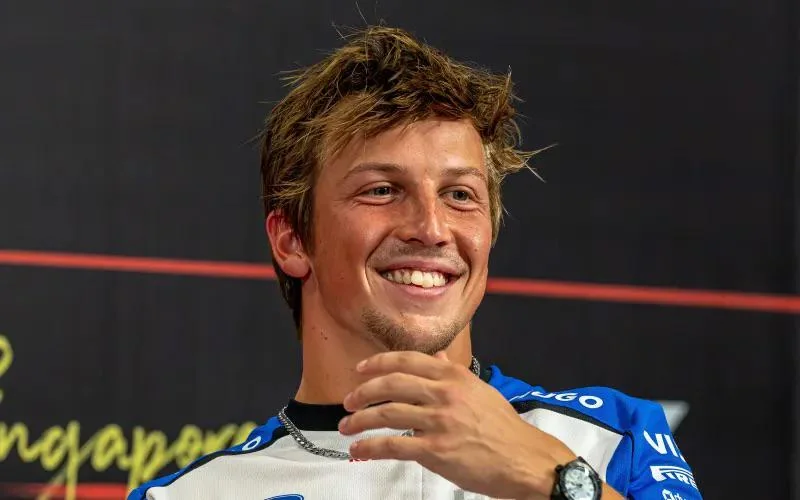
Mexico also delivered two significant results away from the championship celebration and leading-team disputes.
Liam Lawson recovered from the pit lane to seventh, while the supplied career comparison places him ahead of Yuki Tsunoda’s points total after 54 Grands Prix against Tsunoda’s 117—a difference of 63 appearances. That is a notable milestone. It is not a complete driver ranking. Career points reflect the opportunities available in different cars and seasons as well as how well a driver uses them. The comparison strengthens the case for taking Lawson’s record seriously, but it cannot isolate his contribution from the competitiveness of the machinery.
His Mexico recovery offers a more immediate reason to pay attention. A pit-lane start followed by seventh place is a result that should carry weight in any discussion of his future. The debate over Lawson’s prospects often moves quickly toward sponsorship, nationality, marketability and Red Bull’s search for another exceptional talent. Those are possible considerations in the wider driver market, but the material supplied does not establish which factors are determining his position. Nor does speculation about another promotion, a replacement or a move elsewhere amount to an announced decision.
The sporting argument is more straightforward: a driver producing results should be assessed on those results, his development and his performance relative to the opportunities available. Searching for the next Verstappen can become counterproductive if it means overlooking the value of a driver who is already contributing. Ryo Hirakawa provided another reminder that worthwhile performances can come from outside the most familiar narratives. Haas confirmed that further post-race penalties promoted him to tenth on his first Formula 1 race appearance, earning a point on debut.
The circumstances matter. This was a result improved by penalties after the race, not a claim that Hirakawa finished ahead of every affected rival on the road. But being in position to inherit the point still gave Haas something tangible from his debut. His appearance also supports a broader argument for keeping F1’s recruitment open to accomplished drivers from other disciplines. Success elsewhere does not guarantee success in Formula 1, just as an F1 background does not guarantee superiority in every other category. Different championships reward different combinations of speed, adaptability and teamwork. One race cannot settle those comparisons. It can justify a closer look.
Hirakawa’s result does not resolve Haas’s next lineup decision. Suggestions involving Rafael Câmara, Colton Herta or Esteban Ocon’s future remain speculation in the supplied discussion. These midfield stories also highlight a weakness in the viewing experience described around Mexico. A race can contain important recoveries and sustained battles without the main broadcast making them easy to follow. Lawson’s progress and Hirakawa’s debut deserved a clear narrative alongside the championship story.
A busy list of incidents is not automatically the same thing as compelling racing. When overtaking is difficult, showing the battles and recoveries that do exist becomes even more important.
Yamaha’s Qatar withdrawal raises a larger question for F1
The most consequential dispute in the supplied material took place outside Formula 1.
Yamaha announced that it would not participate in MotoGP’s 2026 Qatar Grand Prix because its latest assessment had not provided sufficient grounds to change company-wide restrictions on travel to the Middle East. The manufacturer said its decision was independent of the measures implemented by MotoGP Group and the event organizer. It also reaffirmed its commitment to the championship and its intention to return at the Portuguese Grand Prix. MotoGP responded that it was disappointed. Its statement cited consultation with the State of Qatar, Lusail International Circuit and independent safety advisers, alongside its ongoing risk assessment, and said it had received no information warranting a change of plans.
It also said the remainder of the grid had confirmed participation. The disagreement is therefore explicit: MotoGP considers its assessments and assurances sufficient to proceed, while Yamaha does not consider them sufficient to change its corporate travel restrictions. MotoGP further referenced contractual implications and possible sporting consequences, with the latter to be handled by the FIM under championship regulations. The statement does not specify a ban from the remaining races. That particular claim appears in the accompanying discussion and should not be presented as the wording of the official announcement. Jack Miller’s comments, reported by Autosport, nevertheless make the riders’ opposition clear.
“I don’t want to go. Nobody does. There are 19 or 20 of us who are pretty adamant about it. We don’t want to go,” Miller said.
His demand centered on accountability:
“If you want us—if you want the paddock to go there, put your name on it. Do you believe that it’s safe for us to be there, put your name on it.”
Miller also described the pressure participants face: “They can attack us both financially and on the sporting side with our licenses. Same goes for the teams.”
Those comments expose the gap between an organization confirming attendance and the people traveling feeling comfortable with that decision. MotoGP’s statement that other teams will compete does not answer Miller’s concern about whether individuals feel able to refuse. The responsibility also extends beyond riders. Mechanics, engineers and other personnel are part of the same traveling event. A manufacturer-level decision can keep that burden from falling entirely on individuals who must weigh their concerns against their careers and obligations. For F1, the dispute raises questions about its own upcoming events, but it does not establish that Qatar or Abu Dhabi will be canceled. Nor does it prove theories that a decision was being delayed until Antonelli secured the championship.
Claims about cancellation fees, insurance exclusions and contractual minimums also remain unestablished by the supplied statements. The principle is more important than those theories. A safety decision should follow the assessment of risk and the responsibility owed to everyone attending. Whether a championship remains mathematically open should not determine the standard.
Yamaha has made its decision. MotoGP has explained why it disagrees. Miller has asked who will accept responsibility for the assurances being given. That question deserves a direct answer.