

Formula 1 is heading into Monza with several major storylines converging at once.
Ferrari is preparing another significant power unit development as it tries to stay in the championship fight. Max Verstappen is now on his longest winless streak in nearly a decade. Lewis Hamilton could be preparing to extend his Ferrari stay through 2028. Lando Norris is reportedly trying to convert his world championship status into a massive pay raise. Meanwhile, questions are growing around F1’s decision to move behind the Apple paywall in the United States, the FIA is considering legal action following the backlash to Franco Colapinto’s Dutch Grand Prix penalty, and Madrid’s new circuit is already generating plenty of attention before Formula 1 has even raced there. And somehow, Max Verstappen is also going to try to pass 100 people in go-karts.
There is a lot going on.
Ferrari Is Finally Changing the Power Unit Direction
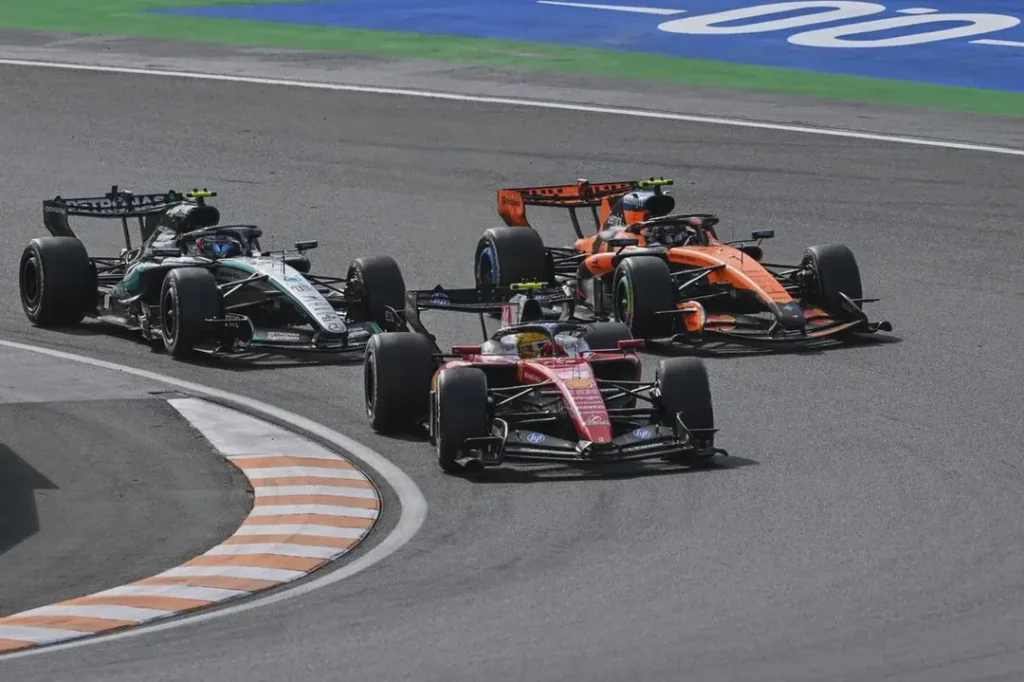
Ferrari is preparing what could be one of its most important technical developments of the season.
The team is reportedly finalizing ADUO 2 for Monza, featuring a larger turbine and a new compressor. The upgrade is expected to deliver at least 10 horsepower, while also improving power unit efficiency and turbocharger utilization. The larger turbo should also help Ferrari at high speeds and on circuits where the current architecture has struggled. That matters because Ferrari’s original concept went in the opposite direction.
The team began the season with a smaller turbo, which appeared to give Ferrari a major advantage off the line. Early in the year, the Ferraris were producing exceptional launches. Then the start procedure changed. The additional pre-start time gave engines with larger turbos more opportunity to spool before the lights went out, reducing one of Ferrari’s most obvious competitive advantages.
That remains one of the most frustrating parts of Ferrari’s season. Ferrari made a deliberate architectural choice, warned about the issue surrounding other concepts, built around the regulations as they existed and then watched the procedure change in a way that directly reduced the benefit of its decision. It is easy to understand why Ferrari supporters feel the team was punished for getting something right.
The timing made it worse. Ferrari’s biggest launch advantage existed earlier in the season, when Mercedes had enough outright performance that gaining one or two places at the start often didn’t matter much. Mercedes could simply recover those positions through superior pace. Now the front of the grid appears considerably tighter.
Norris has become a serious threat, Ferrari is more competitive, and Verstappen can still occasionally insert himself into the podium battle. At circuits like Hungary and Zandvoort, where track position carries enormous value, gaining two positions off the start could have dramatically changed Ferrari’s races. Mercedes has also improved its starts, so it would be simplistic to argue that Ferrari would still have the same overwhelming advantage it had in the opening rounds.
But the procedural change undeniably reduced the value of Ferrari’s original design.
Was Ferrari’s Smaller Turbo Actually the Right Choice?
That is where the debate becomes more complicated.
The smaller turbo may have been the better solution specifically for starts, but that does not necessarily mean it was the best overall power unit architecture. Ferrari has still been down on power compared with Mercedes and Red Bull at points this season, and gaining positions for the first 10 seconds of a race doesn’t automatically compensate for losing performance over every lap that follows. That is presumably why Ferrari is now moving toward the larger turbine.
The more important part of ADUO 2 may not even be the headline horsepower figure. If the upgrade improves efficiency and allows Ferrari to manage energy more effectively, that could be more significant across an entire race distance than whether the gain is exactly 10 horsepower, 14 or something slightly higher. The horsepower speculation has already become its own running joke.
The reported gains seem to fluctuate every time the story is discussed, to the point that Ferrari fans are joking the upgrade will somehow lose power by the time Monza arrives. For now, the safest number is the one actually being reported here: at least 10 horsepower. Ferrari may also have another aerodynamic package coming for Austin.
But that only increases the urgency. The season is already halfway gone. Ferrari cannot keep talking about improvements arriving several races from now if it still believes this championship can be won.
If this package works, Ferrari needs it to work immediately.
Ferrari’s Strategy Problem Doesn’t Disappear With 10 Horsepower
The obvious counterargument is that Ferrari’s problems have not purely been technical.
The Dutch Grand Prix brought another round of criticism over strategy decisions, and 10 additional horsepower will not automatically cure indecision on the pit wall. There is some truth to the argument that strategy becomes much easier when you have the fastest car. During dominant periods, leading teams can make imperfect calls and simply recover through pace. Everyone else has to react to them.
Ferrari hasn’t consistently had that luxury. At the same time, it would be unfair to pretend Ferrari’s strategy operation has not improved at all. The team has made mistakes, but so have McLaren and others. The difference is that Ferrari’s mistakes tend to become magnified because every lost opportunity feels more costly.
If ADUO 2 finally gives Ferrari a package capable of controlling races, we may find out very quickly how much of the strategy problem was really a strategy problem and how much was simply the difficulty of operating without a sufficient pace margin.
Verstappen’s Winless Streak Is Suddenly Historic
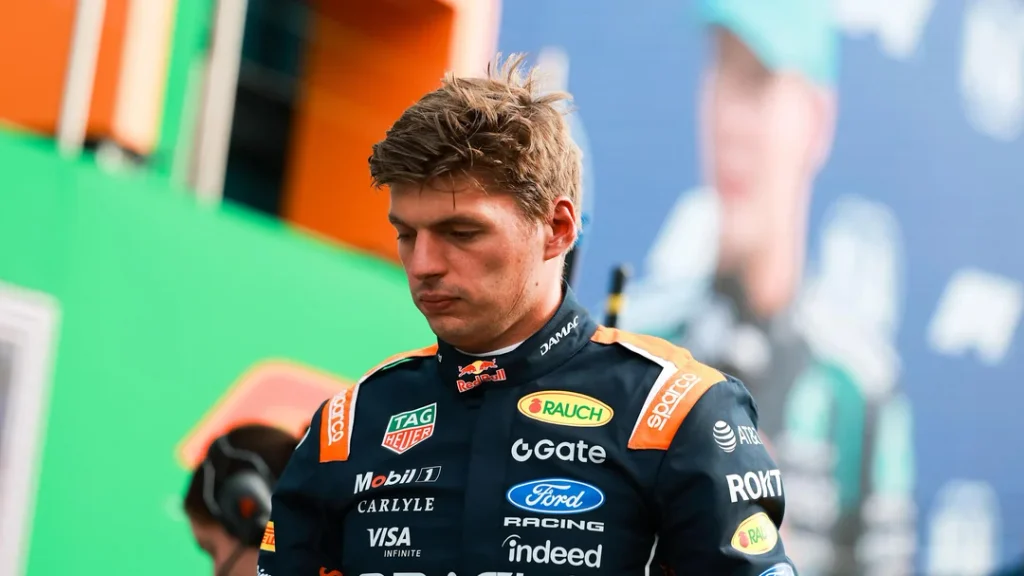
While Ferrari is still pushing forward, Red Bull’s season is moving in the opposite direction.
Max Verstappen has now gone 12 races without a victory since Abu Dhabi 2025. That is his longest winless streak since 2017, when he had only recently secured the second victory of his Formula 1 career. That statistic is remarkable when you consider what Verstappen has done since.
He has won at least one race in every season since 2016. That streak is now genuinely threatened. And unlike some previous stretches where a Verstappen win always felt inevitable, there is a legitimate question over whether Red Bull has enough performance left in this car to make it happen.
Mercedes, Ferrari and McLaren are all ahead. Red Bull has reportedly shifted its focus toward 2027, while those three teams are still introducing developments. That means the gap could grow rather than shrink.
None of this is an indictment of Verstappen. Even the best driver in the world cannot simply manufacture enough lap time to overcome a car that is fundamentally too slow. We have seen exceptional drivers go winless before because their equipment wasn’t good enough.
Verstappen will not be the last.
A Win Is Still Possible — But It May Need Chaos
There are still opportunities.
Mexico has been mentioned as one of Red Bull’s better remaining possibilities after the car showed relative strength at altitude in Austria. Brazil is another, particularly given Verstappen’s history at Interlagos. A chaotic wet-weather race could also create an opening, with Sepang frequently mentioned as the kind of race where conditions could scramble the established order.
And Formula 1 always retains the possibility of something absurd happening. Alpine scored a double podium in 2024. Pierre Gasly won in an AlphaTauri in 2020. Strange races happen.
But if Verstappen wins this season from here, it may require exactly that kind of race. He has two podiums in the last three events, so it would also be overly reactionary to suggest he suddenly cannot finish near the front. The problem is what happens next.
If Red Bull stops developing while its rivals continue improving, today’s gap may not resemble the gap several races from now. A podium may gradually become more dependent on mistakes or failures ahead.
A win even more so.
Zandvoort Showed the Emotional Cost of Verstappen’s Season
Nothing illustrated Verstappen’s current campaign better than the reaction in the grandstands after his home race ended almost immediately.
When Verstappen crashed at Zandvoort, the mood among the Dutch fans shifted instantly. For many spectators, particularly those who may have saved for months specifically to attend their home hero’s race, seeing Verstappen eliminated before completing his second lap was brutal. Technically, the confusion over whether it was Lap 1 or Lap 2 came from the race counter showing the leaders already beginning their second lap.
For Verstappen himself, it was Lap 1. The reaction from the stands was almost as memorable as the crash. Some fans looked devastated. One person in the background of a viral clip appeared to be going through an entire emotional collapse.
And then, because modern sporting events never allow silence to linger very long, the music started. The absurdity of a DJ immediately trying to revive the atmosphere after the home favorite had just crashed out only made the scene stranger. At one point later in the race, Verstappen’s own song was reportedly played despite him no longer participating. For Dutch fans, it was miserable.
Australian fans found it oddly familiar.
Australia Understands the Pain Better Than Anyone
The immediate joke was that Australians experience this kind of disappointment every year.
Despite years of Mark Webber, Daniel Ricciardo and now Oscar Piastri, Australia still hasn’t enjoyed an Australian podium at the home Grand Prix. That has produced some especially painful moments. Piastri’s reconnaissance-lap crash became one of those surreal experiences where spectators initially thought the screens were showing an old highlight before realizing the crash had just happened.
For fans sitting near the Piastri grandstand, that realization was brutal. The broader lesson may be that supporting only one driver is a dangerous way to watch Formula 1. The sport can deliver its highest highs and lowest lows within seconds.
Verstappen fans wearing orange at Zandvoort were still cheering other drivers after Max disappeared. That is ultimately healthier.
There were still 21 other drivers racing.
Verstappen Will Get a Very Different Kind of Race in September
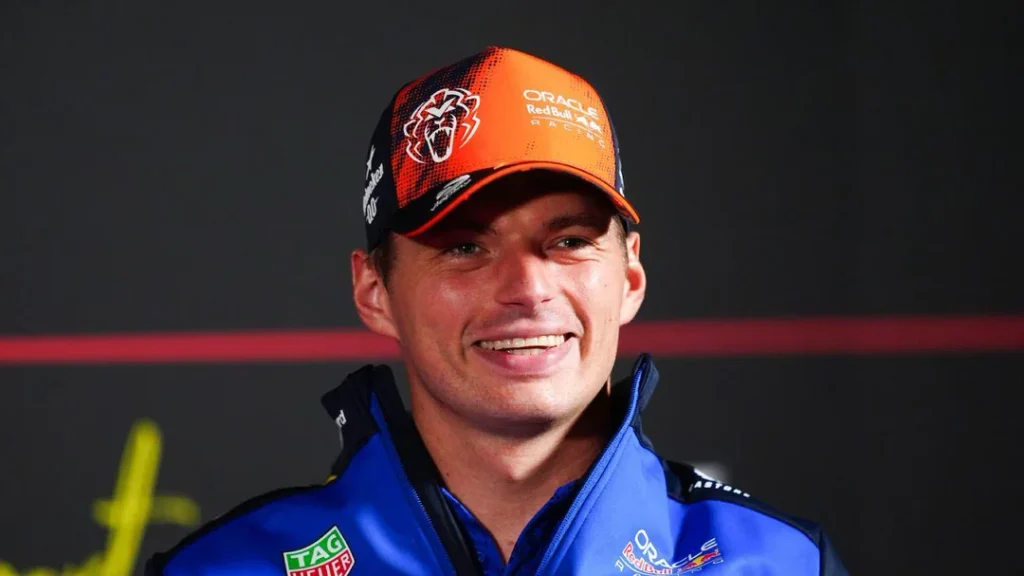
If Verstappen needs something fun after Zandvoort, he is about to get it.
On September 16, Verstappen will compete in a special karting event at Silverstone called Max vs 100, streamed live on Disney+. The format is exactly what the name suggests. Verstappen will start at the back of a 101-driver field and attempt to overtake all 100 competitors.
The field will include participants from sport and culture, including Red Bull athletes, streamers, content creators, personalities and fans from around the world. The broadcast will also include live race data, game-inspired graphics and drone footage. Most importantly, Verstappen will apparently be able to communicate directly with other drivers during the race.
That alone might be worth watching. Formula 1 fans have already imagined how quickly unrestricted driver-to-driver communication would descend into chaos. Probably before the third corner.
The karting challenge itself will not necessarily be as easy as people assume. Bearman recently did something similar against 50 karts and still finished only around fourth or fifth after roughly 10 minutes. Verstappen is obviously an extraordinary driver, but he is also starting behind 100 people in equal machinery.
Passing that many cars takes time no matter how much better you are. And Verstappen has reportedly said he hasn’t driven karts regularly since he was around 16. He should still be the best driver there.
But simply assuming he will teleport from 101st to first immediately misses the actual challenge.
The Influencer Question Is Already Dividing Fans
The moment people heard that content creators would be involved, enthusiasm dropped in some corners.
There was immediate disappointment from fans who had imagined 100 serious karters or drivers from other professional series. But “influencer” is doing a lot of work here. The announced field is broader than that label suggests.
Athletes from different disciplines, streamers, fans and other personalities are all involved. And even among content creators, there is a major difference between someone with genuine motorsport knowledge and someone who happens to have a large following. The event’s entire point is also to put a professional driver against ordinary people and show the size of the skill gap.
From a marketing perspective, using participants who already have audiences is obvious. They bring viewers.
And if some of those participants end up discovering exactly how difficult racing Verstappen actually is, fans may enjoy that even more.
Hamilton Could Be Staying at Ferrari Through 2028
Back in Formula 1’s increasingly quiet driver market, Lewis Hamilton may be preparing to stay at Ferrari considerably longer than some expected.
Marc Limacher reports that Ferrari is finalizing a new contract with Hamilton that would extend the seven-time champion’s stay through 2028. Discussions reportedly began after Ferrari and Charles Leclerc officially agreed their own deal. An announcement is expected at Monza.
As always with F1 contract reporting, caution is sensible until the team confirms it. But Limacher is regarded by some fans as relatively reliable on contract details, and Sky Sport Italy reportedly made a similar claim during the Dutch Grand Prix. If correct, the move makes sense. Hamilton has been performing well enough to justify Ferrari continuing the relationship, and his experience remains enormously valuable while the team develops under these regulations.
The more interesting question may be what it means for Ferrari’s future driver pipeline.
Where Does That Leave Bearman?
Ollie Bearman has long appeared to be the obvious Ferrari junior waiting for an eventual opening.
If Hamilton stays through 2028, that opening gets pushed farther away. And even then, Ferrari may have other options. Antonelli is the name that produces the most interesting hypothetical.
The idea of an Italian race winner eventually driving for Ferrari would be enormous culturally. It is difficult to imagine Mercedes voluntarily giving him up anytime soon, but that doesn’t mean Ferrari wouldn’t try if the opportunity ever emerged. Oscar Piastri and George Russell have also been discussed as drivers Ferrari could theoretically pursue before simply promoting Bearman.
There is even a possibility that Bearman’s long-term Ferrari prospects become tied to how he performs against other Ferrari-associated talent. None of that means Ferrari has abandoned Bearman.
It simply illustrates how difficult the modern driver market has become.
F1’s Driver Market Is Becoming Incredibly Illiquid
The current generation of elite Formula 1 drivers increasingly spend most of their careers within the same organizational families.
Verstappen has effectively been a Red Bull driver his entire F1 career. Leclerc rose through Ferrari’s structure. Russell came through Mercedes.
Norris has spent his whole F1 career with McLaren. Piastri has only raced for McLaren. Top teams develop their own talent, lock them down young and hold onto established stars for as long as possible.
That leaves remarkably few opportunities for drivers in the midfield to move upward. Antonelli joining Mercedes was a major change, but even that came from Mercedes’ own pipeline after Hamilton made the radical decision to leave. The traditional path where an impressive midfield driver earns a move into a top team is becoming rarer.
Sainz may be one of the last recent examples of someone making that jump without being developed by the destination team. The driver market may technically remain open every year.
In reality, the top seats increasingly appear closed unless someone already inside the club decides to leave.
Norris Is Trying to Cash In
That brings us to Lando Norris.
Limacher also reports that Norris is negotiating with McLaren for a salary of €60 million per season beginning in 2027. The 2025 world champion will reportedly earn €40 million in 2026. If the new figure is agreed, Norris would become the third-highest-paid driver on the grid.
The timing makes perfect sense. Verstappen’s enormous new contract has reset the market. Norris now has a world championship.
And if Carlos Sainz is reportedly earning only €10 million less than Norris currently does, Norris has every reason to ask McLaren for considerably more. The question is leverage. McLaren knows Norris is deeply embedded within the team and does not appear eager to leave.
But that doesn’t mean he has no options. If Norris became available, almost every team would at least have the conversation. Red Bull has shown interest before.
Aston Martin would obviously be interested. And depending on circumstances, even Mercedes or Ferrari could become possibilities. McLaren’s leverage is that Norris probably doesn’t want to leave. Norris’ leverage is that McLaren probably doesn’t want to find out whether he actually would.
That is enough for a negotiation.
The Dutch GP Power Rankings Are Back to Cause Arguments
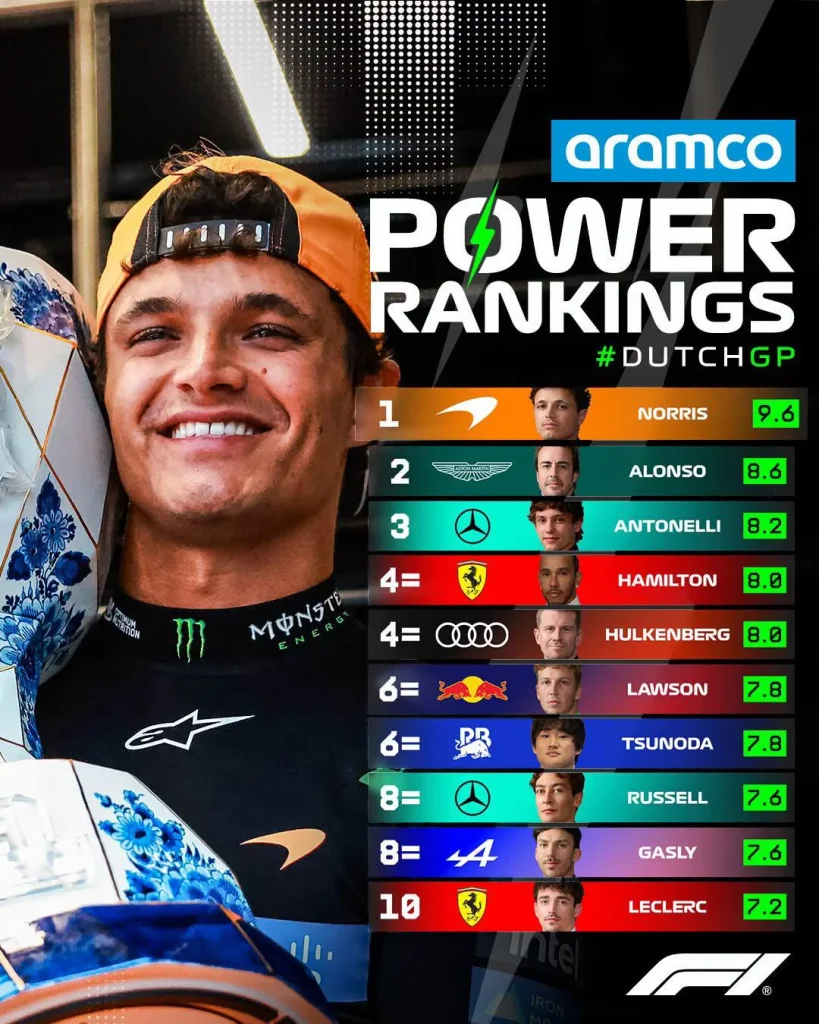
And because no Formula 1 week is complete without an unnecessary argument, the official post-Dutch Grand Prix power rankings returned.
The top 10 were:
- Lando Norris — 9.6
- Fernando Alonso — 8.6
- Kimi Antonelli — 8.2
- Lewis Hamilton — 8.0
- Nico Hülkenberg — 8.0
- Liam Lawson — 7.8
- Yuki Tsunoda — 7.8
- George Russell — 7.6
- Pierre Gasly — 7.6
- Charles Leclerc — 7.2
Norris being first is difficult to argue with after his weekend. Alonso in second also drew plenty of praise, particularly for holding Gasly behind late in the race. But Hülkenberg’s 8.0 might be the most entertaining number on the list because his avoidance of the Gabriel Bortoleto incident was spectacular.
There is a legitimate argument that simply saving that situation without creating a massive accident deserved a score closer to 10. The reaction to these rankings is always predictable. Some fans treat them as intentional rage bait designed to generate engagement.
Others point out that people simply disagree over subjective evaluations and should stop treating every ranking as a personal attack on their favorite driver. Both are probably true to some extent.
Either way, F1 fans will continue analyzing every number as though it were a championship classification.
FIA Considers Legal Action After Colapinto Backlash
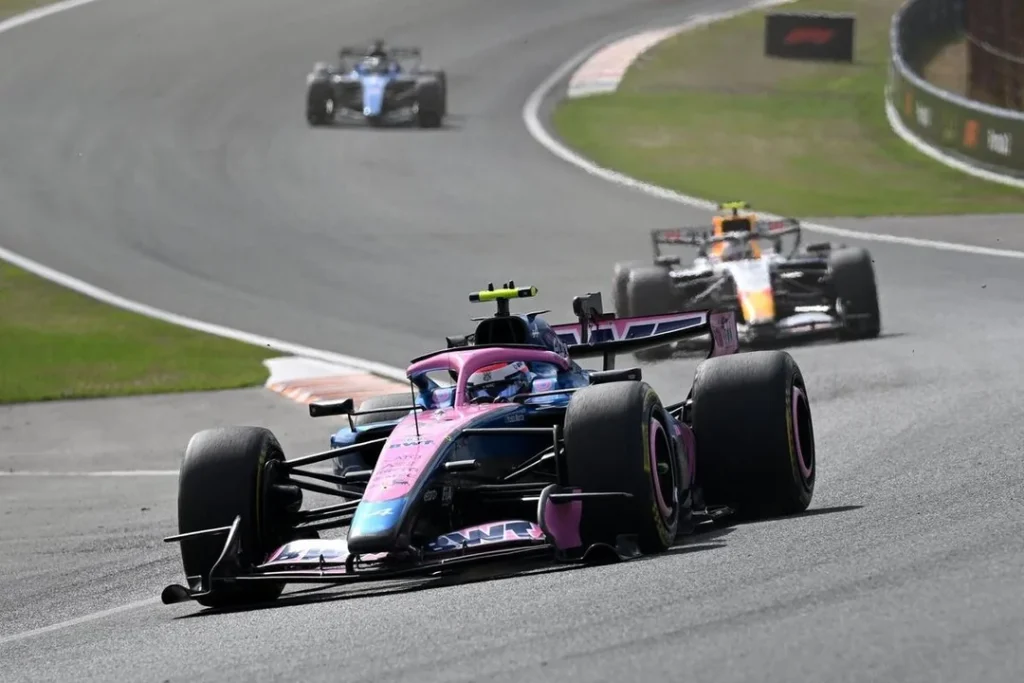
The most serious story of the week involves the FIA and the reaction to Franco Colapinto’s Dutch Grand Prix penalty.
The FIA is reportedly exploring legal options following abuse directed toward F1 stewards after Colapinto was penalized. There are two separate issues that have frequently been mixed together. The first is fan abuse and threats toward officials.
The second involves comments from Sean Summers, the CMO of Mercado Libre, which sponsors Colapinto. Summers reportedly suggested the stewards were dishonest. That distinction matters because a sponsor executive publicly attacking officials is very different from anonymous fans complaining online.
There may be contractual non-disparagement obligations involved, which could create a pathway for legal action. Some discussion has focused on whether Mercado Libre itself should face consequences or even be removed as a sponsor.
That would be an extreme step, but the basic point is reasonable: sponsors cannot expect to operate within Formula 1’s commercial ecosystem while simultaneously accusing officials of dishonesty without consequences.
Criticizing the Penalty Is Not the Same as Abusing Officials
At the same time, the backlash should not be reduced to “Argentine fans behaving badly.”
Plenty of people across the broader F1 audience questioned the yellow-flag penalties handed out after the oval crash. Fans have every right to argue that a penalty was wrong. The line is crossed when disagreement becomes harassment, threats or allegations of corruption without evidence.
There is also precedent in Formula 1 for stewards applying common sense rather than following rules mechanically when obvious mitigating circumstances exist. That is where the sporting debate should remain. Was the decision consistent?
Were mitigating circumstances considered? Could the regulations have been applied differently? Those are legitimate questions.
Threatening stewards is not. And a sponsor executive publicly suggesting officials are dishonest introduces a completely different legal and commercial issue. Ironically, overly aggressive support for Colapinto could ultimately hurt him. No team wants every penalty involving one driver to become an international controversy involving sponsors, threats and allegations against officials.
The people claiming to defend him need to understand that.
F1’s Apple Experiment Is Already Under Scrutiny in America
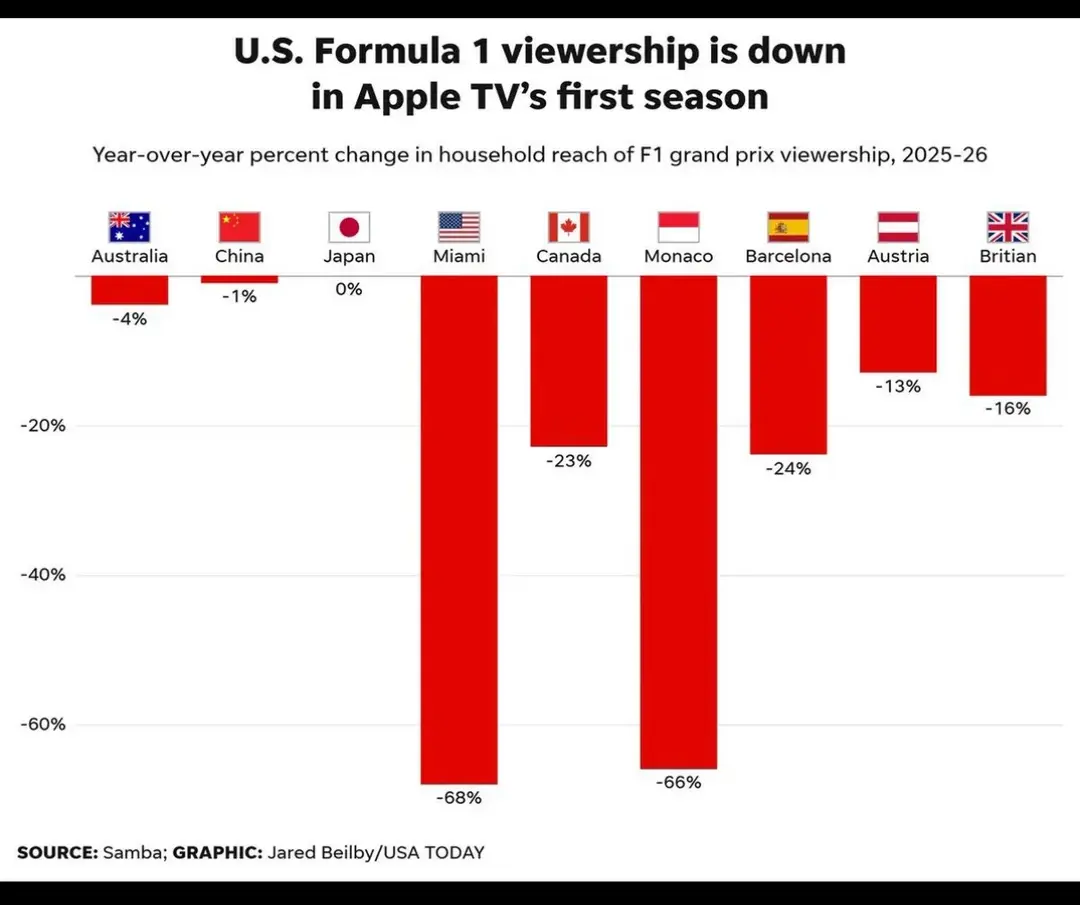
Perhaps the biggest business conversation, though, concerns Formula 1’s United States television audience after moving to Apple.
The immediate narrative is simple: U.S. viewership has fallen after F1 moved behind another subscription wall. For casual American viewers, the logic is obvious. Many already had ESPN because they watched college football, the NFL, baseball, SportsCenter or other programming.
Watching Formula 1 therefore cost them nothing extra. Apple requires another decision. Do you care enough about F1 to add another subscription?
For plenty of people, apparently the answer is no. That doesn’t necessarily mean Apple is expensive relative to F1TV. Some fans actually pay less now.
T-Mobile discounts, Apple Music student plans and the broader Apple TV library can make the package attractive. For someone who was already paying specifically for F1TV, switching to Apple can even offer more content for roughly comparable money. The problem isn’t necessarily price.
It is friction.
Casual Fans Don’t Chase Sports Across Platforms
This is the fundamental danger.
A dedicated F1 fan will figure out where the race is. A casual fan probably won’t. If someone already has ESPN and sees Formula 1 available, they may watch.
If the same person has to download another app, create another account and pay for another service, a large percentage will simply do something else. That matters because Formula 1 spent years deliberately trying to expand in America. Miami.
Las Vegas. Austin. Drive to Survive.
More U.S.-focused marketing. All of that was aimed at making F1 easier to discover. Putting the races behind a dedicated streaming subscription moves in the opposite direction.
It keeps the core audience while creating a much higher barrier for casual and potential new fans. That is why comparisons with NASCAR’s past mistakes resonate.
American motorsports fans have seen what happens when a series chases short-term media revenue while making itself harder to access.
But the Viewership Data Needs a Huge Asterisk
There is one very important problem with the dramatic viewership-drop narrative.
The methodology being discussed apparently only measures viewers using 24 specific smart TV brands or models. That excludes enormous portions of the actual audience. People watching on laptops aren’t counted.
People watching on phones or tablets aren’t counted. Some streaming devices aren’t counted. People using an Apple TV box connected to a television may not be counted depending on the measurement method.
F1TV viewing also appears to complicate the comparison. So while it is entirely plausible that U.S. viewership is lower under Apple, the graph circulating online may dramatically overstate the decline. Miami and Monaco also distort year-over-year comparisons because those races had previously received particularly broad broadcast exposure.
Remove major outliers and the change may look much less catastrophic. That doesn’t mean everything is fine.
It means the data being circulated is not strong enough to support the most extreme conclusions.
Apple May Still Have Gotten Exactly What It Wanted
There is another uncomfortable possibility.
Maybe Apple and Formula 1 expected this. Apple reportedly paid substantially more than ESPN. If F1 receives dramatically more guaranteed rights revenue while retaining most of its dedicated American audience, the business case may look perfectly acceptable internally.
From that perspective, losing casual viewers could be considered a tradeoff. The problem comes later. Television audiences create sponsorship value.
Casual viewers become dedicated viewers. Kids who happen to see races become future ticket buyers. A media deal can be financially successful in the short term while still damaging the long-term audience funnel.
That is the real question surrounding Apple. Not whether this year’s rights check is bigger.
Whether Formula 1 is sacrificing future American growth to collect it.
Madrid’s New Circuit Is Already Causing Chaos — Sort Of
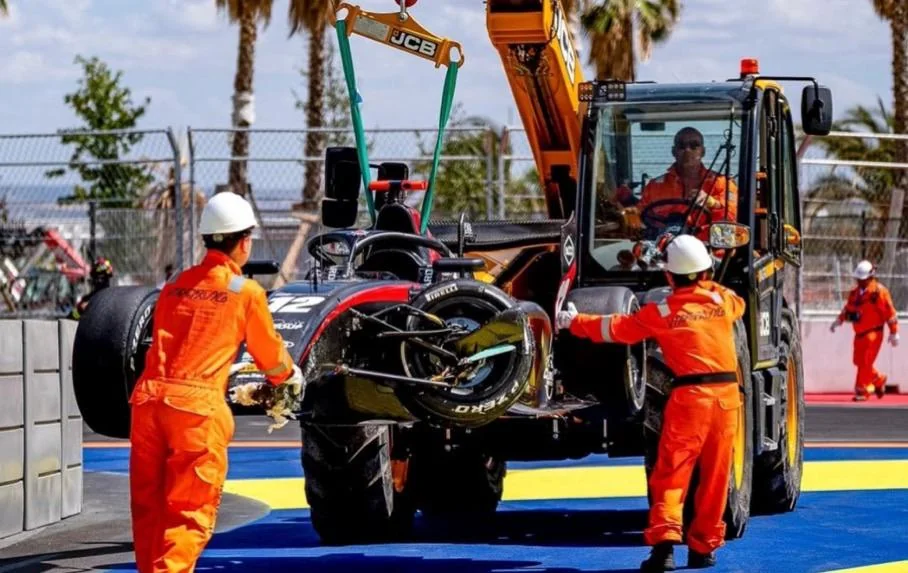
Then there is Madrid.
A report initially claimed there had been 19 red flags in six hours of Formula 3 testing at the new MadRing. That sounded absurd. It also wasn’t quite right.
The 19 red flags occurred across two days and 12 hours of testing. Of those:
- 11 resulted from contact with barriers
- Three involved spins
- Three involved mechanical failures
- Two had no stated cause
That is roughly one red flag every 40 minutes rather than every 20. Still high. Not necessarily catastrophic.
F3 drivers were learning a brand-new street circuit, likely on a green and dusty surface. Testing sessions are also more willing to use red flags because organizers aren’t working within the same compressed schedule as a race weekend. Eleven barrier contacts are enough to show that Madrid punishes mistakes.
But it is far too early to declare the circuit fundamentally broken.
Madrid Could Become Another Baku
The comparison many immediately made was Baku’s first weekend.
The junior races there were chaotic, with a huge number of incidents, while F1 drivers largely approached the race with much more caution. Madrid could follow the same pattern. If F3 and F2 spend the weekend repeatedly demonstrating where the walls are waiting, Formula 1 drivers may arrive with enough information to avoid doing the same.
That could ironically produce exactly the opposite of what the testing suggests. Junior-series carnage. Conservative F1 racing.
Formula 2 could be particularly unpredictable because it apparently will not receive equivalent in-season testing beforehand and will arrive relying more heavily on simulation. Qualifying may be the session to watch. A driver can leave margin in the race.
They cannot leave much margin when fighting for pole. If the circuit really does feature several awkward sections where a missed braking point leads directly to the wall, Madrid could become one of the more chaotic qualifying sessions on the calendar.
Potentially with a lot of time spent staring at red flags.
Formula 1 Is Entering a Strange Second Half of the Season
The championship has reached an unusual point.
Ferrari is still developing aggressively enough to bring a new turbine and compressor to Monza. McLaren has a reigning world champion reportedly asking for €60 million per year. Hamilton may be preparing to stay at Ferrari through 2028.
Red Bull has already begun looking toward 2027 while Verstappen stares at the possibility of his first winless season since before he became an established star. The FIA is dealing with abuse against stewards. F1’s American broadcast strategy is being questioned.
Madrid’s walls are already collecting F3 cars. And Verstappen is preparing to start 101st in a kart race and talk directly to the other 100 drivers while he tries to pass them. The competitive hierarchy may actually be the least strange part of Formula 1 right now.
Monza should tell us something important about one of the biggest questions. Ferrari is finally changing the part of its power unit concept that helped define the beginning of its season. If ADUO 2 delivers, the championship could tighten again. If it doesn’t, Ferrari may find itself talking about Austin and 2027 before long.
And for Verstappen, every Ferrari improvement potentially makes that 12-race winless streak just a little harder to end.