

Formula 1 has reached the point in the season where almost every conversation begins with the same question: what happens next?
The first 11 races of 2026 have already produced a very different competitive picture from the opening stretch of 2025. Kimi Antonelli has six wins, George Russell has two, and Lewis Hamilton, Charles Leclerc and Lando Norris have one apiece. At the same stage last year, Oscar Piastri had five victories, Norris had three, Max Verstappen had two and Russell had one. The simplest way to describe the change is that Mercedes and McLaren have effectively swapped places, while Ferrari has inherited the role Verstappen occupied last season: close enough to make people wonder whether the second half could become much more interesting than the first. That possibility has opened the door to everything from serious title speculation to the kind of predictions that sound less like analysis and more like fan fiction. Ferrari winning the constructors’ championship after 20 years, Russell taking the drivers’ title, Norris producing a comeback, Hamilton stealing the championship from Antonelli, Leclerc scoring the most points in the second half and Arvid Lindblad reaching the podium have all been offered as bold calls.
Then there is Fernando Alonso making Q3, which has somehow become one of the most believable and most heavily mocked predictions of them all. The bigger point is that fans do not necessarily need one particular driver to win. Many simply want a championship that remains alive into the final few races, ideally with multiple contenders and enough uncertainty that reliability, strategy or one mistake can alter everything. The irony is that Formula 1 fans often claim to want exactly that, then spend the season complaining whenever a leading team fails to close out a championship cleanly. Last year’s title fight remained open late, yet McLaren’s repeated errors became a source of frustration rather than appreciation. A close championship is romantic in hindsight, but in the moment it often looks like teams throwing away opportunities.
That contradiction may define the rest of 2026.
The first half is not always the season
The comparison with 2025 is also a reminder that the first half of a championship can become almost irrelevant once development, form and pressure begin to change.
Verstappen finished last season with the most race wins despite the opening 11 races suggesting that McLaren had established the stronger position. The second half felt completely different from the first. There remains disagreement over why. One interpretation is that Red Bull finally fixed its car and gave Verstappen a package capable of winning regularly. Another is that McLaren had the most complete car for much of the year but repeatedly failed to maximize it. Others argue that Verstappen’s performance made the Red Bull look better than it was because, once the team found a setup he could use, he extracted results that were not always obvious from the car’s raw pace.
That debate matters in 2026 because it shapes how people view Ferrari’s chances now. Leclerc appears to have returned to stronger form, Mercedes has endured reliability problems, and Ferrari is close enough for supporters to imagine a late charge. The more pessimistic expectation is that Ferrari will get close enough to make the ending painful before losing by a tiny margin in the most Ferrari way possible. That might mean a technical disqualification, a late engine failure, a strategy error or simply finishing two points short. Ferrari hope is rarely clean. It usually arrives with an implied warning label.
Russell’s title prospects are also difficult to read. He has only two wins and, according to the discussion around the comparison, five podiums, while Antonelli has already won six races. Norris won last year’s championship despite having only three victories at the same point, but he had more second places and podiums than Russell currently does. Mercedes’ reliability problems help explain some of that gap, but they do not change the points table. Russell can still challenge, but his path is narrower than the raw win comparison initially suggests.
Antonelli’s rise may be the most remarkable element of the season so far. Six victories in the first 11 races would have sounded extraordinary before he joined the grid. Yet there is also a sense that both Antonelli and Toto Wolff may have believed this was possible sooner than everyone else, particularly if the young driver had already spent considerable time helping to prepare for the 2026 car.
McLaren’s “OP1” accident becomes a championship prophecy

McLaren added its own small contribution to the post-break speculation when a team post showed Oscar Piastri’s garage marked “OP1.”
It may have been nothing more than a labeling mistake. Piastri races with the number 81, and in McLaren’s font the “P” can resemble an eight at a glance. Someone may simply have applied the wrong decal or failed to complete the number properly.
There is also evidence that the board was genuinely present in Canada rather than being created with artificial intelligence or edited into the image. The signage appeared on the wall during a session, and “OP1” had previously been used on official merchandise after Piastri’s first victory.
None of that stopped the obvious conclusion: McLaren had accidentally leaked the second-half script. Oscar P1astri. The chosen one. McLaren’s only hope.
It is a perfect example of how F1 fans can take one tiny visual detail and build an entire internal team conspiracy around it. A misplaced number becomes proof of favoritism. A garage label becomes evidence of a future world champion. By the end of the discussion, “OP1” was no longer a typo. It was a prophecy.
The more realistic interpretation is much less dramatic, but that has never stopped Formula 1 fandom before.
Max Verstappen does not just race the car
If one driver has repeatedly shown why small details matter, it is Verstappen.
Former F1 driver and current steward Vitantonio Liuzzi described Verstappen as particularly difficult to judge because of how precisely he positions himself on the edge of the regulations. According to Liuzzi, Verstappen is constantly thinking about where to place the car so that an incident becomes difficult to analyze, whether he is attacking, defending or being overtaken. That does not mean he is always right. Verstappen has taken penalties. The point is that even when he crosses the line, he tends to do so while forcing officials to examine exactly where that line sits.
Liuzzi called him a “war machine” in this regard and suggested Norris and Piastri should study his races, his positioning and his understanding of overtaking regulations.
This is not simply about aggression. It is about spare mental capacity. Verstappen has shown an ability to process information that many drivers would struggle to notice while stationary, let alone while driving at racing speed. One famous example involved hearing the sounds of another Ferrari pit stop in the background of a radio message, combining that with information he had already been given about Charles Leclerc, and correctly deducing that both Ferraris were on a two-stop strategy. He has also used trackside television screens to follow battles behind him, much like Alonso has done. These deductions are logical once explained. What makes them unusual is that they are happening while the driver is braking, cornering, managing tires, listening to the radio and racing other cars.
This ability extends to the rulebook. Verstappen has repeatedly pushed tactics to the point where regulations were later clarified or rewritten. Once the rule changes, he does not simply lose the advantage. He adapts and searches for the new limit. That is one of the clearest differences between a very good driver and a historically significant one. The best do not only adapt to the car. They adapt to officiating, regulations, rivals, tires, conditions and every other moving part around them.
There is also an important distinction between exploiting gray areas and openly breaking rules. Comparisons with Michael Schumacher are inevitable because both were willing to test boundaries, but Schumacher sometimes went well beyond ambiguity. Verstappen’s skill has more often been about making officials uncomfortable without making the decision easy. That is not always attractive. It can look cynical, overly aggressive or needlessly provocative. But Formula 1 is not a sport built around making life simple for competitors or stewards.
The rules are part of the race.
F1 keeps trying to decide what kind of racing it wants
The discussion around Verstappen’s rulebook mastery connects to a much older debate: what should Formula 1 reward?
Should races be decided by drivers fighting directly on track? Should strategy create major performance swings? Should overtaking be made easier through circuit design? Or does every attempt to manufacture action simply move the decisive moment somewhere less satisfying? The anniversary of Jos Verstappen’s 1994 pit-lane fire reopened the debate over refueling. The strategic appeal is obvious. A car could start heavy and run long, or carry less fuel and attack in a shorter stint. Different fuel loads could create major lap-time offsets and allow teams to attempt genuinely different race structures.
The problem is that the theory was often better than the racing. During the refueling era, major position changes frequently happened in the pits rather than on track. Drivers could run at different speeds, but the order often became clear only after the final fuel stops were complete. Instead of wheel-to-wheel racing, the audience was left trying to calculate who had enough fuel to reach which lap. Modern viewers already complain about invisible battery deployment and software-driven overtakes. Reintroducing another hidden strategic variable might add complexity without improving the spectacle.
The 1994 fire also demonstrated what happened when teams chased faster stops by interfering with safety equipment. The system used at the time was pressurized and delivered fuel at a much higher rate than the gravity-fed systems used in some other categories. That does not mean refueling could never be made safe. IndyCar and other series still use it, often with different fuels, lower-pressure systems, minimum stop times or safety procedures designed to reduce the incentive to rush. But Formula 1’s question is not merely whether refueling can be done safely. It is whether bringing it back would produce better racing.
History suggests the answer is far from obvious.
Barcelona’s old chicane was another solution that created a problem

The same pattern appeared at Barcelona.
The previous final-sector chicane was introduced partly for safety reasons, with concerns about the wall and grandstand near the old final corners. It was also hoped that slowing the cars before the main straight might help them remain closer and improve overtaking. Instead, the chicane killed momentum. Cars exited the final sector too slowly to build a meaningful run into Turn 1, and the section disrupted the natural flow of the track. Following another car through it was difficult, and unless a driver was already close enough before the straight, the race could become a parade.
The chicane did occasionally help create unlikely results. Pastor Maldonado’s win benefited from Fernando Alonso being unable to generate enough momentum to pass him. Verstappen’s first victory also involved defending from Kimi Räikkönen and Sebastian Vettel around a circuit where the final sector made overtaking difficult. For supporters of an underdog, that could be thrilling. For anyone watching a faster car become trapped without a realistic passing opportunity, it was maddening. Since the chicane’s removal, the quality of racing has generally improved. Barcelona may still not guarantee a classic, but it is no longer automatically ruined by a final sector that seemed designed to neutralize everything interesting that happened before it.
The circuit may also have suffered from familiarity. When Barcelona hosted winter testing and then appeared later in the season, teams arrived with enormous amounts of data. They knew the track, the car and the setup window too well. Moving winter testing elsewhere has at least reduced some of that predictability. There is also a broader tendency to place historic tracks above criticism. Spa and Monza are revered, but neither automatically produces a great modern F1 race. Barcelona, by contrast, is often dismissed even though the recent layout has delivered better racing than its reputation suggests.
A famous name does not guarantee good racing. A less beloved circuit is not automatically bad.
Hockenheim’s possible return raises the same question

That is why Hockenheim’s approach to Formula 1 about reviving the German Grand Prix has generated so much enthusiasm.
The circuit last hosted F1 in 2019, and that final race remains one of the most chaotic of the modern era. Extreme heat earlier in the weekend gave way to rain on Sunday. Cars repeatedly went off at the same section, Mercedes unraveled, Daniil Kvyat reached the podium, Lance Stroll finished fourth and Sebastian Vettel recovered from 20th to second. Whether it deserves to be called the race of the decade is debatable. Canada 2011, Brazil 2012 and several races from the 2012 season can make stronger claims. Hockenheim 2019 may not have been the decade’s best pure race. It was, however, unforgettable.
It also arrived at a point when the season needed something dramatic. The races immediately before it had begun to improve, but Hockenheim delivered nearly every form of chaos at once. That memory now carries much of the emotional case for its return. There is also excitement at the possibility of both Hockenheim and Sepang appearing on the calendar, although their situations seem different. Hockenheim’s new investors and possible facility expansion suggest a longer-term project. Sepang appears more likely to be a short-term solution, particularly if another promoter is covering the financial side.
The wider question is whether Formula 1 is rediscovering the value of European fan engagement. Portugal’s return has been welcomed, and an alternating arrangement among European venues would not be surprising. Germany’s absence still feels unusual given its history with the sport. During the Schumacher era, the country could support two races. Now it has none.
A Hockenheim return would not automatically produce another 2019. Rain cannot be scheduled, and nostalgia is not a guarantee of quality. But unlike some calendar additions, it would arrive with an existing fan base, a recognizable identity and a track that already means something to Formula 1.
Haas shows the limits of the budget cap

While Formula 1 debates circuits, racing formats and championship possibilities, Haas is confronting a more fundamental issue: money.
Ayao Komatsu has said the team is not operating at the 2026 budget cap and described reaching that level as one of his top priorities. In his view, spending at the cap should be the baseline. If Haas is the only team not reaching the maximum permitted spend, then it enters every development race at an automatic disadvantage. The budget cap was introduced partly to stop smaller teams from bankrupting themselves while trying to compete with the biggest organizations. In that sense, it has worked. Teams are more valuable, the grid is stable and survival no longer requires endless spending.
But Haas exposes the other side of that system. A team owner can keep spending below the cap, remain financially secure, benefit from the rising value of an F1 entry and still occupy one of the limited grid positions without seriously pursuing the maximum sporting result. That is why criticism of Gene Haas has become so intense.
The team has now spent a decade in Formula 1. It has often performed above expectations given its resources, but it still lacks the sponsorship or owner investment required to reach the cap. The sporting staff can occasionally produce an impressive result, only to be outdeveloped as better-funded teams improve. That does not necessarily mean the operation is incompetent. In fact, the sporting side may deserve more credit precisely because it is achieving anything while underfunded. The problem is the business objective.
Gene Haas has repeatedly described Formula 1 as a way to promote Haas Automation and create business opportunities. Winning would obviously be welcome, but the team can still fulfill its marketing purpose without becoming a regular front-runner. That creates the impression that Haas is not failing to achieve its ambition. It may simply have a less ambitious goal than fans want from an F1 team. There are comparisons with Racing Bulls, which also faces criticism for existing without an obvious path to becoming a championship contender. The difference is that Racing Bulls is viewed as subordinate to Red Bull, while Haas at least presents itself as an independent team.
Williams represents the opposite problem. It wants to spend and improve, but years of underinvestment left its infrastructure so far behind that the cost cap now limits how quickly it can modernize. Haas is fighting with both hands tied because it cannot reach the ceiling. Williams is fighting with one hand tied because it cannot spend enough beyond the ceiling to rebuild everything at once. The cost cap creates stability, but stability is not the same as ambition.
That is why Toyota remains part of the conversation. A full buyout is far from certain, and Toyota may only be testing the waters, but the question will persist as long as Haas continues to operate below the maximum while the value of an F1 entry keeps rising.
Lewis Hamilton gets a new beginning

Not every major story has to be about titles, budgets or regulations.
Lewis Hamilton has a new golden retriever puppy named Halo, who is being flown to Los Angeles. The name immediately produced every possible F1 joke. Halo was linked to Mercedes, Toto Wolff, the FIA’s safety device and even a future driving career based on the technicality that no regulation explicitly says a dog cannot race a Formula 1 car. Beneath the jokes, the reaction was emotional because of Roscoe.
Many fans were relieved that Hamilton had chosen a golden retriever rather than another English bulldog. Roscoe lived to an advanced age for his breed and was clearly deeply loved, but English bulldogs are associated with serious health problems created by generations of breeding for extreme physical traits. Golden retrievers have their own risks, including cancer and hip issues, and no breed guarantees a long life. But the normal shape of the snout removes many of the breathing problems that can affect bulldogs. There was also debate over whether an extremely wealthy owner automatically gives a dog the best possible life.
Halo will have access to exceptional veterinary care, high-quality food and every physical comfort imaginable. She may also accumulate more air miles than almost any human being. But dogs do not understand luxury the way people do. They want stimulation, companionship, routine, exercise and a sense of belonging. A dog running through a field every day may be happier than one traveling between glamorous locations with a full support staff.
Hamilton’s relationship with Roscoe suggests he understands that distinction. The important part is not whether Halo lives like a celebrity. It is whether she gets to live like a dog.
Max’s view of immortality is much simpler
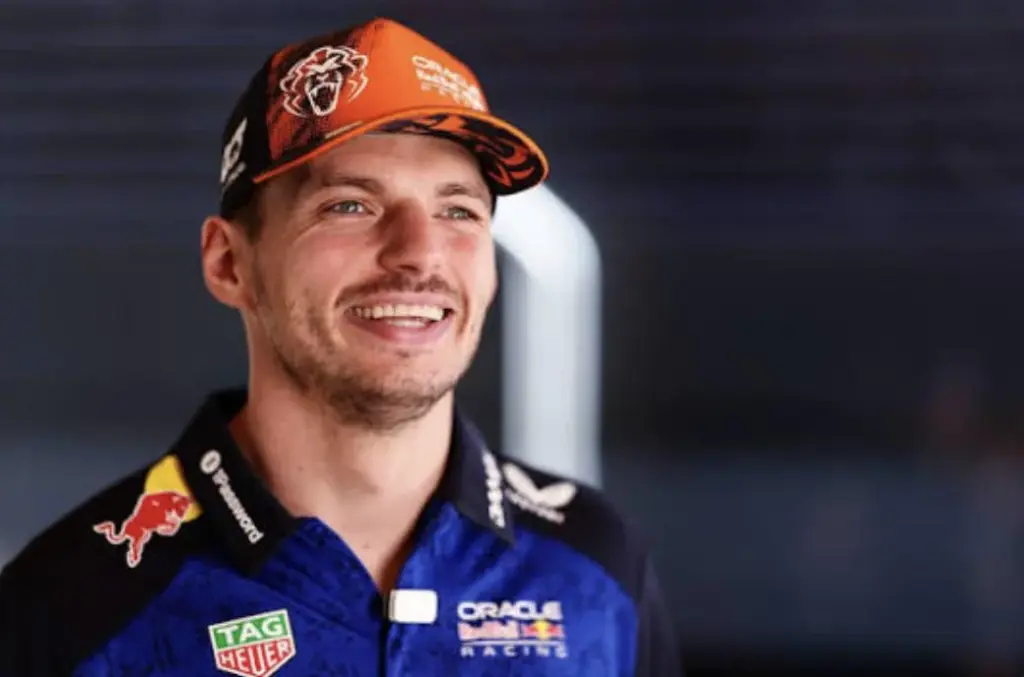
Verstappen offered a more characteristically blunt view of legacy when asked whether Scheivlak at Zandvoort might one day be named after him.
He said that was not up to him and observed that corners are usually named after people who are dead. When the interviewer replied that they hoped the discussion would not happen for another hundred years, Verstappen pointed out the obvious problem: they would not be discussing it with him. The timing was especially funny because parts of circuits have already been named after Hamilton while he is still very much alive.
That immediately produced the conclusion that Hamilton had apparently died multiple times through track naming and then somehow been revived by receiving more than one honor. The conversation expanded into a debate over whether corners, statues and other memorials should be named after active athletes. Some believe drivers should at least retire before receiving permanent circuit honors. Others see no reason to wait when a career has already become historically important. The discussion also wandered into British and Dutch honors, with fans debating the distinction between a British knighthood and Verstappen’s rank in the Order of Orange-Nassau. None of that seemed likely to interest Verstappen himself.
The most believable interpretation is that he would consider death’s main advantage to be freedom from interview questions.
Formula 1 cannot stop arguing with itself
Taken together, these stories reveal a sport constantly debating its own identity.
Fans want closer championships but become angry when teams fail to dominate efficiently. They want more strategy but dislike races decided in the pits. They want safer circuits but hate changes that destroy racing.
They celebrate historic venues while overlooking how often some of them produce processional events. They support a cost cap that keeps teams alive, then question whether survival without ambition should be enough. They complain when regulations are vague, then admire drivers who understand those vague regulations better than anyone else.
And they treat a mistaken garage decal as a championship prediction because sometimes the smallest story is the most fun. That is Formula 1 at the 2026 summer break. Mercedes appears to have the season under control, but last year proved how quickly a championship can change. Ferrari is close enough to inspire hope and historically reliable enough to inspire dread. McLaren has an “OP1” sign and perhaps a second-half comeback waiting behind it. Haas is trying to reach the financial baseline that every rival already occupies. Hockenheim wants back in. Barcelona is finally recovering from one of the most disliked layout changes in recent memory.
And Verstappen remains exactly where he is most comfortable: somewhere on the limit, forcing everyone else to decide where the line actually is.