

Formula 1’s paddock rarely focuses on just one storyline at a time. Between technical experimentation, rule debates, driver ambitions beyond the sport, and shifting team politics, the latest round of discussions across the grid paints a picture of a championship grappling with both innovation and uncertainty.
Ferrari, in particular, has found itself at the center of the conversation, both for the technical experimentation appearing on the SF-26 and the broader rule discussions affecting race starts. Meanwhile, Max Verstappen’s candid reflections about his future and George Russell’s comments about dream teammates and grid procedures highlight how drivers themselves are navigating a rapidly evolving era of the sport.
Ferrari Continues to Experiment With Aerodynamics
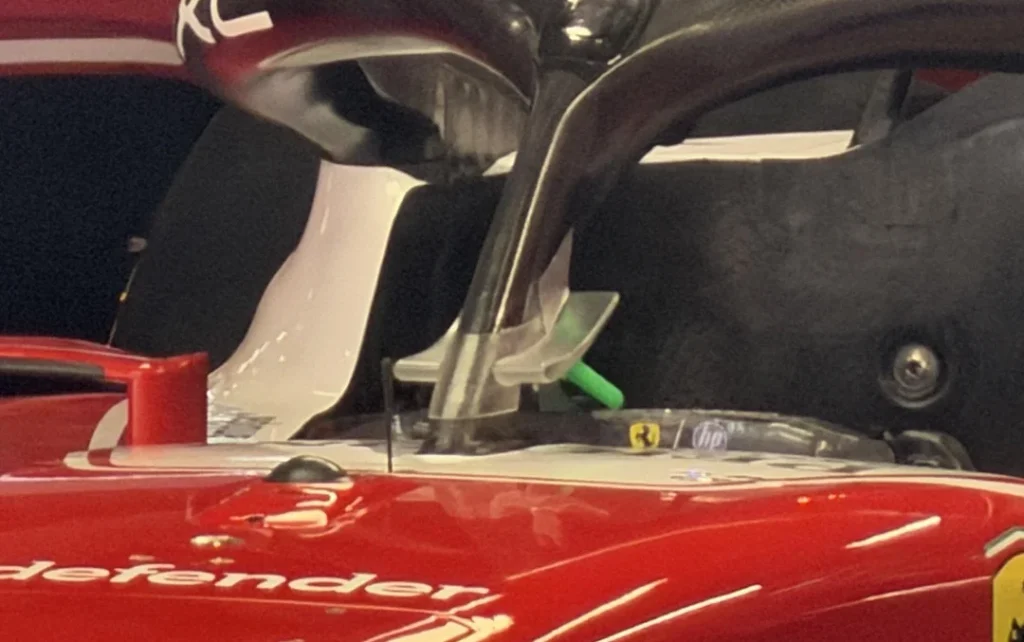
Ferrari arrived in China testing several small but intriguing aerodynamic tweaks to the SF-26, including additions around the halo area that immediately sparked discussion throughout the paddock.
One of the visible updates was a small fin mounted on the central halo pylon. The intent is straightforward from an aerodynamic standpoint: the halo’s central column naturally disturbs airflow, creating turbulence around the driver’s helmet area. By adding a deflector, Ferrari aims to redirect that airflow upward toward the airbox while also smoothing the path over the cockpit. Cleaner airflow in that region can reduce drag and improve the efficiency of the flow traveling down the body of the car.
Another halo-mounted deflector spotted on the car reinforces the same philosophy. In an era where aerodynamic gains often come in tenths or hundredths of a second, teams are willing to explore every small surface capable of manipulating airflow.
The visualizations accompanying the update sparked the usual wave of humor among fans, who quickly latched onto the bright airflow graphics used in technical illustrations. The exaggerated colors and swirling diagrams led to jokes that Ferrari had “unlocked green air,” while others suggested the images resembled little more than stylized renderings rather than true technical explanations.
Still, the presence of these parts shows Ferrari continuing to search for aerodynamic gains, especially important if the team believes it is losing time elsewhere.
Some observers suggest that Ferrari’s heavy focus on aero details reflects a broader challenge. In a field where energy deployment and power unit performance can create significant gaps between teams, aerodynamic gains of a few tenths can easily be erased if a rival has a stronger engine package or better energy harvesting and deployment.
In that context, Ferrari’s development approach may represent a deliberate attempt to claw back performance wherever possible.
A Rear Wing With a Name, Sort Of
Ferrari’s experimentation hasn’t stopped with the halo. The team has also been testing a new rear wing concept, which Lewis Hamilton discussed with characteristic humor.
“I don’t know if it has an official name,” Hamilton said. “Someone said ‘Macarena’. I have no idea why. It’s the ‘flip-flop’ wing.”
Even without a formal designation, the wing quickly became a talking point. Fans immediately turned the nickname into a running joke, with some likening the bistable behavior implied by “flip-flop” to electronic circuits and computing components.
Others took the nickname more literally, joking that the device could either flip Ferrari’s season, or flop entirely.
The wing’s exact aerodynamic function remains unclear from the outside, but the discussion around it reflects a broader truth in modern Formula 1: even the smallest aerodynamic element can quickly become a talking point across the paddock.
Ferrari’s Steering Wheel and a Mario Kart Joke

Ferrari’s social media team added to the playful tone by joking that a particular feature on the SF-26 was “like a mushroom in Mario Kart.”
The reference, implying a temporary speed boost, triggered a wave of playful speculation about just how much computing power might be hiding in an F1 steering wheel.
Some fans jokingly wondered whether the wheel could run classic video games, asking the now-legendary question associated with unusual computing devices: could it run Doom?
Others suggested that if the steering wheel could handle that challenge, the real test would be whether it could run Crysis, a long-standing benchmark joke in gaming culture.
While the jokes highlight the surreal complexity of modern Formula 1 electronics, they also underscore a real point: the computing power and software systems embedded in modern race cars rival those used in many advanced industrial systems.
Russell Criticizes “Selfish” Approach to Rule Fix
Away from Ferrari’s technical experiments, the team has also been drawn into a debate about race procedures.
George Russell recently criticized what he described as “selfish views” among teams regarding a potential rule adjustment related to energy harvesting during the formation lap and race start.
Russell explained that a quirk in the rules means drivers starting toward the front of the grid may be penalized in terms of energy harvesting. Because the cars at the front can already be considered within the lap when certain procedures begin, the energy used during practice launches and the formation lap counts toward the harvest limit.
Meanwhile, drivers starting further back may cross the timing line after their launch sequence, effectively resetting the system and allowing them to recover more energy before the race start.
Russell argued that this discrepancy can create a disadvantage for drivers at the front of the grid, who may find themselves with little battery charge during the critical opening phase of the race.
Ferrari, however, has been accused by Russell of opposing changes to the rule, something he described as teams prioritizing competitive advantage over fairness.
The debate illustrates how modern Formula 1 rules, particularly those involving hybrid energy systems, can create complex and sometimes unintended consequences.
Russell Names Verstappen as Dream Teammate

Russell also made headlines by naming Max Verstappen as his ideal teammate, continuing his long-standing stance that he wants to measure himself against the strongest possible competition.
Russell has previously shared a garage with Lewis Hamilton at Mercedes, and his comments suggest he remains eager to compete directly with the very best drivers on the grid.
The idea of a Russell-Verstappen pairing naturally sparked speculation about whether Mercedes could one day attempt to sign the Dutch champion.
While the scenario remains hypothetical, the suggestion alone highlights the ongoing intrigue surrounding Verstappen’s long-term future.
Verstappen Reflects on His F1 Future

Verstappen himself has recently spoken openly about his relationship with Formula 1, offering unusually candid remarks about his current feelings toward the sport.
“I wish I had a bit more fun, for sure,” Verstappen admitted. “But I’m also doing other stuff that is a lot of fun.”
The Red Bull driver pointed to his growing interest in racing beyond Formula 1, including the Nürburgring Nordschleife, the Spa 24 Hours, and potentially the 24 Hours of Le Mans.
“I don’t really enjoy driving the car,” Verstappen said of the current F1 machinery. “But I do enjoy working with all the people in the team and from the engine department as well.”
Despite his frustrations, Verstappen emphasized that he remains engaged in efforts to improve the sport.
“I’ve had discussions with F1 and the FIA and we are working towards something,” he explained. “Hopefully that will improve everything.”
The comments suggest that while Verstappen’s passion for racing remains strong, the current generation of cars may not provide the same driving enjoyment he once felt.
Why Verstappen Hasn’t Run an F1 Car at the Nürburgring
Verstappen’s love of other forms of racing is well known, particularly his interest in the Nürburgring Nordschleife.
Yet despite that enthusiasm, he has never completed a demonstration lap there in a Formula 1 car.
“I was not allowed,” Verstappen revealed when asked about the possibility. “Otherwise I would’ve done it already.”
The reason appears straightforward: a demonstration run would likely remain a demonstration only in theory. Verstappen’s reputation for pushing to the absolute limit makes teams wary of placing him in a scenario where a “show run” could quickly turn into an all-out lap attempt.
In other words, the concern is not that Verstappen would fail to entertain, but rather that he might try to set a lap record.
Mercedes Exploring a Stake in Alpine

Meanwhile, off the track, Formula 1’s political landscape continues to shift.
Mercedes is reportedly exploring the possibility of acquiring a minority stake in Alpine’s Formula 1 team. The proposal would involve the Mercedes F1 organization itself purchasing the shares, rather than team principal Toto Wolff personally.
Such a move would effectively give Mercedes a second team on the grid, something rivals already enjoy in various forms.
Red Bull’s relationship with its sister team and Ferrari’s long-standing technical ties with customer teams have demonstrated the strategic advantages of having an additional partner organization.
If Mercedes were able to secure a stake in Alpine, it could provide opportunities for driver development, technical collaboration, and greater influence within the sport’s competitive ecosystem.
However, the idea has also sparked debate among fans and observers, with some questioning whether such arrangements blur the lines between independent competitors.
A Sport in Flux
Taken together, the week’s developments illustrate how Formula 1 is navigating multiple fronts at once.
Teams like Ferrari continue to chase marginal gains through creative aerodynamic solutions. Drivers such as Verstappen are openly discussing how the sport might evolve to make racing more enjoyable. Rule debates, like the one raised by Russell, show how technical regulations can create unexpected competitive effects.
At the same time, broader structural questions about team ownership, partnerships, and competitive balance continue to shape the future of the grid.
In Formula 1, progress rarely happens in isolation. Aerodynamics, regulations, driver ambitions, and team politics are all intertwined, and the latest conversations across the paddock show just how complex the modern championship has become.