

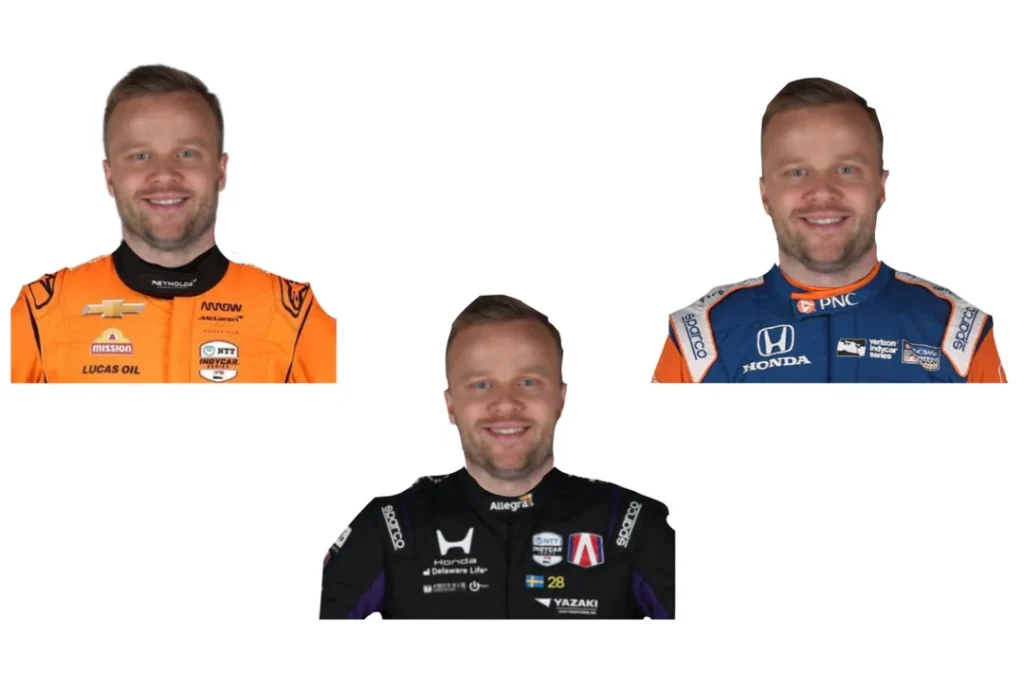
Felix Rosenqvist winning the Indianapolis 500 should have been the moment Meyer Shank Racing locked in its future. Instead, it may have been the moment the rest of the paddock realized there was a prize worth stealing.
MSR has confirmed Rosenqvist will leave the team at the end of the season, and Mike Shank’s own explanation says plenty. Speaking about how contract negotiations changed after the 500, Shank said, “I think that woke some people up, and I guess he had a decision to make after that.”
That is the entire story in one sentence. Rosenqvist won the biggest race in the world, the market changed overnight, and suddenly a driver who may have been waiting for MSR to fully commit had leverage from somewhere else.
The timing is brutal for Shank. Before May, MSR could reasonably have wanted more proof. Rosenqvist had been fast, but the early season had not been seamless. Then came Long Beach, then came Indianapolis, and suddenly the conversation was no longer about whether MSR wanted Rosenqvist. It was about whether MSR could still afford the version of Rosenqvist the rest of IndyCar had just rediscovered.
That is why this feels less like a breakup and more like a missed window. If MSR wanted Rosenqvist at a number it could control, the deal probably had to be done before May 25. Once he became an Indy 500 winner, there was no putting the genie back in the bottle.
And now the paddock has questions. Big ones.
Where is Rosenqvist going? Who replaces him? Is this Andretti? Is this McLaren? Could Chip Ganassi be involved? Is Marcus Ericsson in danger? Is Dixon’s seat actually part of this? Is Marcus Armstrong waiting in the wings? Is Linus Lundqvist suddenly back in the frame? Is Honda eyeing a bigger international play? Could Rinus VeeKay, Kakunoshin Ohta, Jack Harvey, Conor Daly, or someone completely outside the current IndyCar grid factor into MSR’s next move?
Silly season has officially begun, and Rosenqvist lit the match.
The obvious speculation centers on Andretti and McLaren. Andretti makes sense because the team has been linked to bigger driver-market swings, and the No. 28 seat has been under the microscope despite Marcus Ericsson’s improved form. A Rosenqvist-for-Ericsson type of shuffle would be fascinating, but also ruthless. Ericsson has not always matched the pure pace expected at Andretti, but he has been consistent, he has delivered at Indianapolis, and this season has felt more like the version Andretti wanted when it signed him.
That is what makes the potential move complicated. Rosenqvist may be faster on raw pace, especially on street circuits, but Ericsson is hardly an obvious discard. If Andretti is the destination, it would say the team sees Rosenqvist not just as an upgrade, but as a veteran capable of raising the entire program.
McLaren is the funnier possibility, mostly because Rosenqvist going back there would feel like someone willingly reopening a group chat they muted years ago. His first McLaren tenure was awkward, tangled in the wider Palou drama, Formula E possibilities, unclear commitment, and the sense that Felix was never quite treated like a secure long-term centerpiece. Yes, there may not have been scorched-earth bad blood. But there was enough weirdness that a return would only make sense if the money, contract length, and role were significantly better this time.
And honestly, that may be the whole point.
Rosenqvist is 34. He has a newborn. He has had a long and successful career across multiple disciplines, but not a particularly stable one in IndyCar. This may be his best and final chance to cash in on a major long-term deal. If Andretti or McLaren is offering substantially more money than MSR, it is difficult to fault him for taking it. Sentiment does not pay for the rest of your life. An Indy 500 win, at the right time, absolutely can.
That does not mean it is risk-free. There is a strong argument that Rosenqvist is leaving the better racing situation. MSR is no longer just a plucky stepping-stone team. With the Ganassi technical alliance, improved pace, and Honda factory-related future possibilities, Shank’s program suddenly looks like one of the most attractive seats in the series. It may not carry the brand flash of McLaren or Andretti, but it has something more important: speed.
Rosenqvist was becoming the lead figure in a team that had found a real performance window. Marcus Armstrong has also grown into a consistent threat. MSR has looked quick at Indianapolis, Road America, and beyond. The team appears to be evolving from “nice landing spot” into “future contender.”
That is why the move feels so strange. Leaving MSR two years ago would have been easy to understand. Leaving MSR now, after winning the 500 and watching the team take a major competitive leap, feels like a gamble.
But maybe the gamble was staying.
MSR may have wanted Rosenqvist, but the timing suggests it did not make the kind of offer that ends a conversation. The team may have liked him. It may have valued him. It may have wanted to retain him. But there is a difference between wanting a driver and making sure that driver never takes another call.
Rosenqvist took the call.
Now MSR is suddenly one of the most important seats on the board. Shank has already said the team has drawn interest from free agents in IndyCar and from drivers outside the series. That opens the door to all kinds of speculation: Ohta, Lundqvist, VeeKay, Ericsson, maybe even international names from the F1 orbit. The Japanese angle is especially interesting with Honda’s influence. A Honda-aligned MSR seat with international appeal could become a very different kind of asset by 2028.
That is where some of the wilder suggestions begin. Yuki Tsunoda? Ayumu Iwasa? Kevin Magnussen? Luke Browning? The serious answer is probably not most of those names, but the fact they are even being tossed into the conversation says something about how attractive this seat has become.
MSR is not begging for options. MSR has options.
The irony is that Rosenqvist may have made the seat more valuable by leaving it. His Indy 500 win validated the program. His departure created the vacancy. And now the same team that may have hesitated over his value gets to test just how desirable its own seat has become.
Meanwhile, the broader driver market is suddenly full of dominoes. If Rosenqvist goes to Andretti, what happens to Ericsson? If Ericsson leaves, could he go to MSR, RLL, or somewhere else? If Rosenqvist goes to McLaren, what does that mean for Nolan Siegel? If Ganassi somehow becomes involved, what does that mean for Dixon, Armstrong, or Simpson? And if Dixon controls his own timeline, as he probably should, then how realistic is any No. 9 speculation in the first place?
The Ganassi theory is tempting because Rosenqvist has history there, but it is also the least clean. Chip already benefits from Rosenqvist being in the MSR/Ganassi orbit. Dixon being forced out would be almost unthinkable. Armstrong’s future remains a fascinating piece of the puzzle. And charters complicate any fantasy of simply adding another full-time car.
The cleaner answer remains Andretti or McLaren. The more emotional answer is that Rosenqvist should have stayed where he was becoming the centerpiece. The more practical answer is that when someone offers life-changing money after you win the Indy 500, you listen.
That is why this move is both shocking and understandable. Rosenqvist may be leaving a better competitive situation, but he may also be taking the one offer he could not afford to decline.
And if he does end up regretting it competitively, at least he will have done so with a Borg-Warner face and a much larger bank account.
While Rosenqvist’s exit dominated the serious side of IndyCar conversation, the series also got a very different kind of win this week: 1.803 million viewers for Road America.
That number is massive. It is not just good by recent IndyCar standards; it is the kind of number that forces a rethink of what the series can do when it is placed in front of a larger audience. The World Cup lead-in clearly helped, and that is the point. Strong lead-ins work. They always have. They do not magically create interest from nothing, but they create sampling. And IndyCar’s racing product is good enough to keep a meaningful portion of that audience.
That should be the lesson FOX takes from Road America. IndyCar does not need to be hidden, apologized for, or treated like schedule filler. Put it after a major event, keep it on network television, and it can deliver.
FOX still gets criticism for parts of its coverage, and some of that criticism is fair. But from a scheduling and exposure standpoint, the network has done more for IndyCar’s visibility than the series has seen in years. Pairing races with stronger sports properties is not a small thing. Keeping World Cup-period races on FOX rather than burying them elsewhere is not a small thing. Treating IndyCar like something worth promoting is not a small thing.
The next obvious question is whether this opens the door for fall expansion.
That is where things get complicated.
The optimistic case is simple: IndyCar has spent years avoiding football, but maybe it should try surfing football instead. If FOX can hand IndyCar a World Cup audience, could it eventually hand IndyCar an NFL audience? Could a fall street race or a Michigan 500-style finale work with the right lead-in? Could the series add one or two marquee events rather than treating September and October as forbidden territory?
It is a fun idea. It also has real problems.
The NFL is not the World Cup in the summer. The NFL is the gravity well of American television. Even on Sundays when FOX does not have the late national game, regional windows still create complications. Some markets have late local games. Some viewers immediately flip to CBS. Others go to RedZone. FOX also has enormous production resources tied up in football. A clean national handoff is not as simple as “put IndyCar after the 1 p.m. game.”
A fall IndyCar race on FOX could work in theory, but it would require precision: the right weekend, the right market, the right event, the right lead-in, and probably a willingness to accept some regional weirdness. Same-day tape delay in select markets would make the fanbase lose its mind. FS1 would defeat much of the lead-in argument. And a season finale in front of empty grandstands, no matter how cool Michigan sounds on paper, would be a rough way to crown a champion.
The better takeaway is not “IndyCar should immediately go race football.” It is that IndyCar should stop assuming its ceiling is fixed. Road America proved that platform matters. The racing converts. The audience is not necessarily absent; it often has not been properly delivered.
FOX may not have solved fall expansion. But it has given IndyCar evidence that bigger swings are worth considering.
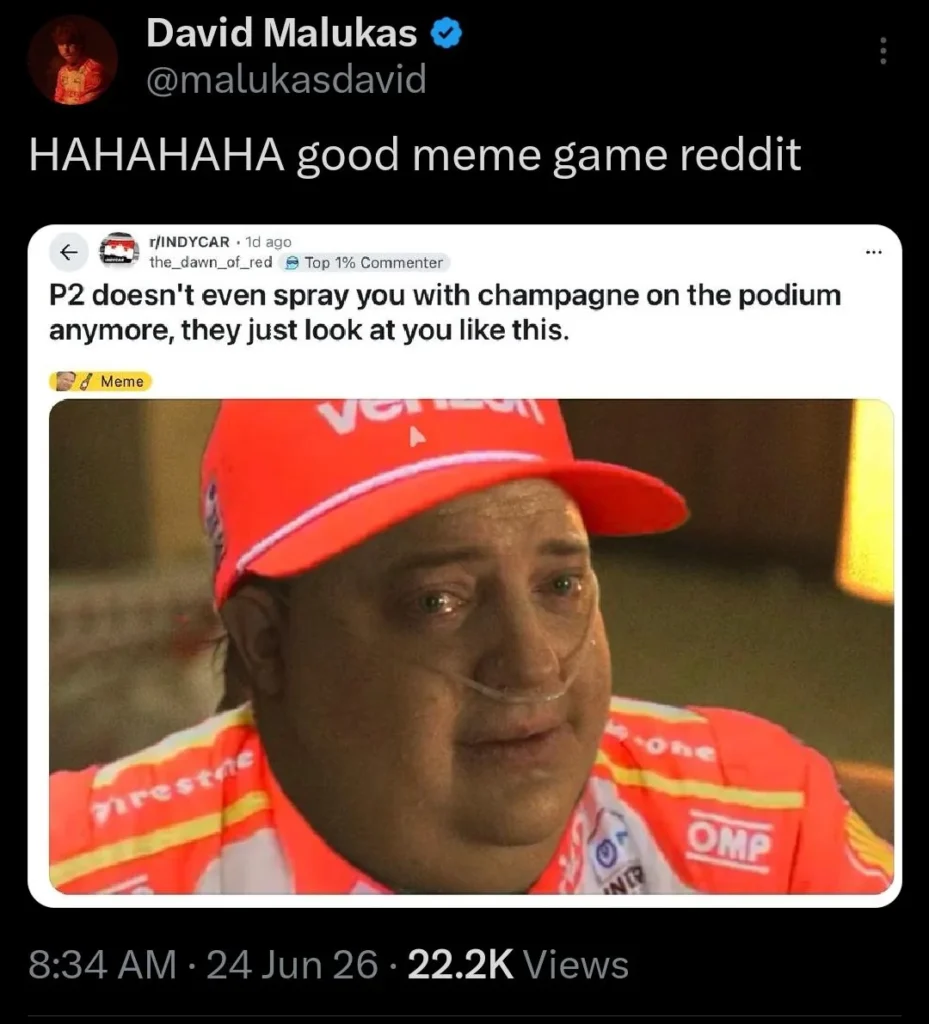
Then, because IndyCar never lets the week be too normal, David Malukas reminded everyone that the drivers may be reading the same memes as the rest of us.
Malukas shared a Reddit meme and praised the subreddit’s “meme game,” which immediately turned the community into an Among Us lobby. What if Malukas is among us? What if he has a burner? What if he has been arguing about his own restart technique with strangers online? What if the most Reddit-coded driver on the grid has been farming karma this whole time?
This is the kind of harmless chaos IndyCar should embrace. Malukas has always had an online-native, self-aware energy, and the idea of him lurking in fan spaces fits almost too perfectly. In a week dominated by contract leverage, ratings strategy, and schedule debates, the “which one of you is secretly David Malukas?” subplot was exactly the right amount of ridiculous.
It also points to something broader about IndyCar’s culture. The wall between drivers and fans is thinner here than in many major sports. Sometimes that creates nonsense. Sometimes it creates weird arguments. Sometimes it creates a driver laughing at a meme that may or may not have been made by his own burner account. Either way, it gives the series personality.
The same thread also produced a more grounded side conversation around Nolan Siegel. Results criticism is fair, but there remains sympathy for a young driver who may have been thrown into a difficult seat before he was ready. IndyCar can be brutal that way. A driver can be 21, well-liked, clearly talented, and still become a symbol of everything a team is struggling to figure out.
And finally, we arrive at Christian Lundgaard and the yellow-flag conspiracy that probably is not a conspiracy.
During qualifying, Lundgaard said, “We know how the yellows are gonna fall,” then appeared to pause and stumble through what he meant. After the race result, that line sent a few minds racing. Did he know something? Was he predicting chaos? Did he have secret Danish telepathy with Christian Rasmussen? Was there a long-shot betting market somewhere waiting to be investigated?
Or, far more likely, a driver whose first language is not English phrased something awkwardly while explaining that yellows are part of IndyCar strategy and can reshape a race.
That is the boring answer. It is also almost certainly the correct one.
In IndyCar, teams always know yellows can fall in ways that make or break a strategy. That is not suspicious. That is the sport. Road and street races often become exercises in timing, track position, fuel windows, and whether the caution comes one lap too early or one lap too late. Lundgaard was likely speaking in that general strategic sense: you know cautions are possible, you plan around them, and sometimes they decide everything.
The better joke is that Lundgaard has apparently joined the great motorsport conspiracy archive alongside Roswell, the grassy knoll, DB Cooper, Brian Redman’s cat, and whatever psychic network connects Danish drivers named Christian.
Which, honestly, is a fitting end to this IndyCar news cycle.
One story was about money. One was about leverage. One was about television. One was about the future of the schedule. One was about drivers lurking in the subreddit. One was about whether a yellow-flag comment had secret meaning.
Together, they show a series in a fascinating place. IndyCar has a growing TV platform, a silly season with real stakes, a team like MSR becoming a destination instead of a fallback, and enough online weirdness to keep the whole thing from taking itself too seriously.
Rosenqvist’s decision may be the first major domino. FOX’s Road America number may be the bigger long-term signal. Malukas may or may not be reading this. And Lundgaard probably does not control the cautions.
Probably.