

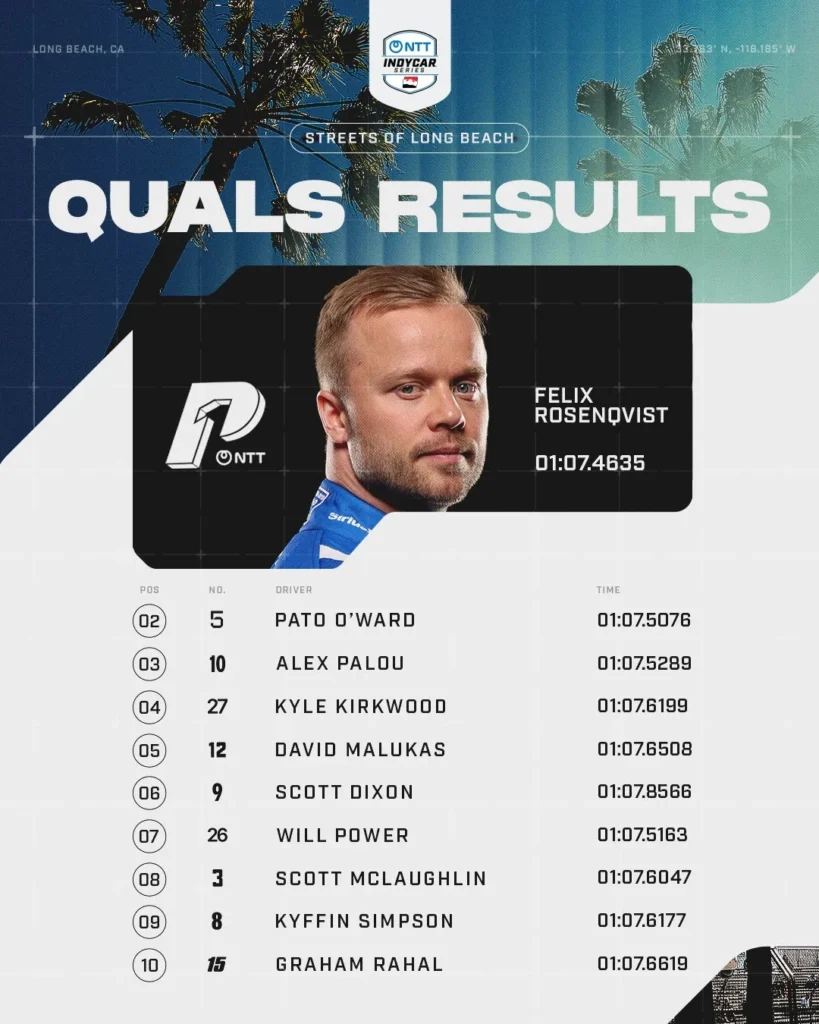
Qualifying for the 2026 Acura Grand Prix of Long Beach delivered exactly what the series aims for on a street circuit: tight margins, unpredictable storylines, and just enough chaos to keep everyone guessing. But while Felix Rosenqvist ultimately emerged with the NTT P1 Award, the conversation throughout the session—and afterward—extended well beyond the stopwatch.
Rosenqvist Delivers in a New-Look Fast 6
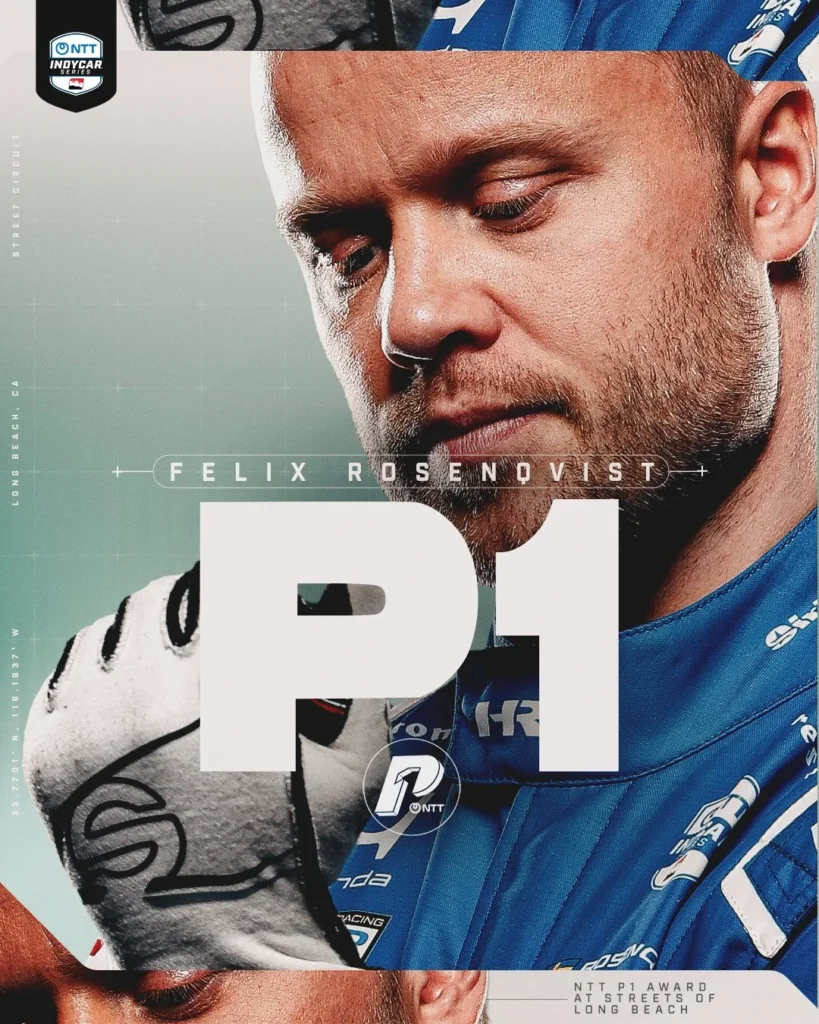
Rosenqvist’s pole lap stood out not just for its execution, but for how it capped off a session defined by experimentation. The single-car Fast 6 format drew immediate attention, with many viewing it as a compelling evolution of the qualifying structure. The format added tension and clarity—each run isolated, each lap decisive.
That tension was evident in how the top contenders shuffled. At one stage, it looked like a dominant performance was on the table, only for Rosenqvist to edge ahead by the narrowest of margins, with Pato O’Ward slotting in between challengers late in the session. The margins were razor-thin across the board—just 1.2 seconds covering the entire field—reinforcing the sense that parity in the series remains one of its defining strengths.
Even so, the outcome raised eyebrows in places. O’Ward, who had downplayed expectations heading into the weekend, still secured a front-row start—prompting the familiar sense that his ceiling often exceeds even his own projections. Behind them, Alex Palou’s presence near the front was treated almost as routine, a reflection of just how high expectations have become.
Broadcast Frustrations Undercut the Spectacle
If the on-track product delivered, the same couldn’t be said universally for how it was presented. The most consistent critique centered on the broadcast graphics—specifically, the lack of clear, real-time delta comparisons.
Viewers were left relying on flickering green and red indicators rather than precise time gaps, leading to widespread frustration. The absence of sector times during the Fast 6 only amplified the issue, especially given they had been available earlier in the session. The result was a viewing experience that often felt less informative than it should have been for a format built on fine margins.
There was a sense that the tools were there, just inconsistently applied. Some saw the broadcast as improving overall—particularly with added visual cues like highlighting drivers on improving laps—but the execution remained uneven. At times, even key moments slipped by unnoticed, such as late improvements that weren’t clearly communicated in real time.
Still, there was acknowledgment that progress is being made. The integration of more data-driven graphics and increased visibility for strategy elements—like draft usage—suggests a direction of travel that could elevate the product if refined.
A Qualifying Session That Felt Longer Than It Should
Beyond the visuals, the structure itself drew scrutiny. The session stretched to roughly 75 minutes without a red flag interruption, raising questions about efficiency—particularly in the single-car shootout.
Suggestions ranged from adjusting pit release timing to compressing gaps between runs, though not without trade-offs. Tire management, temperature control, and the risk of external interruptions all complicate any attempt to streamline the format. As always in IndyCar, competitive fairness and operational practicality remain in tension.
Performance Talking Points: Parity, Surprises, and Frustrations
On the competitive side, the depth of the field once again defined the session. The narrow spread between first and last reinforced the idea that no one is comfortably out of reach—and that even small execution gaps can have outsized consequences.
That reality hit some drivers harder than others. Nolan Siegel’s struggles stood out sharply, particularly in contrast to his teammates and direct comparisons on track. Being outqualified across both groups—and even behind drivers typically viewed as benchmarks for the back half of the grid—intensified scrutiny around his seat. The broader frustration around pay drivers resurfaced as a result, especially when juxtaposed against the absence of proven names still seeking opportunities.
Elsewhere, intra-team and intra-driver debates continued to simmer. O’Ward versus Christian Lundgaard remains a flashpoint, particularly when qualifying performance diverges from race pace. Lundgaard’s Saturday struggles have become a pattern, even as his Sunday form remains competitive—raising questions about whether he can consistently contend from deeper starting positions.
Andretti’s performance also came under the microscope. While there were flashes of competitiveness, the overall outcome felt underwhelming relative to expectations. Missing key opportunities in a session where margins were so tight only added to that perception.
A Competitive Grid—and a Polarizing Experience
In the end, Rosenqvist’s pole was the headline, but the qualifying session as a whole painted a broader picture of IndyCar in 2026.
On one hand, the competitive product is undeniably strong. The field is tight, the outcomes uncertain, and the stakes high even in qualifying. On the other, the presentation and format still feel like works in progress—capable of enhancing the spectacle, but not yet fully delivering on that potential.
Long Beach qualifying showed both sides clearly. The racing is there. The drama is there. The challenge now is making sure viewers can fully see it unfold.