

Formula 1’s final Dutch Grand Prix weekend should be a celebration.
Zandvoort has been one of the sport’s success stories since returning to the calendar in 2021. Fans have packed the seaside circuit, arriving by train and bicycle, creating one of the most recognizable atmospheres on the schedule. Formula 1 CEO Stefano Domenicali has even credited the event with pioneering sustainable solutions that influenced other races. Instead, Saturday accidentally became a fascinating snapshot of the identity crisis facing modern Formula 1.
A Sprint that left some spectators literally reaching for a book. A brilliant Liam Lawson-Arvid Lindblad battle that television viewers didn’t get to see. Thousands of spectators struggling to reach the circuit in time. Fans proposing increasingly elaborate ways to fix the Sprint format. And Domenicali dismissing criticism of the 2026 regulations by drawing a distinction between diehard fans who understand “clipping” and people who might associate a clip with something they put in their hair.
Put everything together and there is a question much bigger than whether Zandvoort produces enough overtaking.
Who exactly is modern Formula 1 being designed for?
The Zandvoort Sprint Was a Pretty Good Advertisement Against Sprints

If the purpose of the Sprint format is to create additional competitive action, Zandvoort wasn’t exactly the ideal demonstration.
The biggest problem wasn’t complicated. Not much happened. Charles Leclerc reportedly needed around 18 laps to produce an overtake involving the top half of the grid. Fans joked that Singapore and Monaco should be next in line for Sprints if this was the desired product. One spectator attending their first Grand Prix was photographed reading a book, which quickly became an appropriate visual metaphor for the session.
Honestly, fair enough. A book arguably provided more uncertainty about what was going to happen next. Zandvoort is spectacular to drive and spectacular to look at. Its banking, dunes and compact layout give it a character almost nothing else on the calendar can replicate.
But character and good Formula 1 racing aren’t necessarily the same thing. The circuit is narrow and difficult to pass on with modern F1 cars. Some fans argued that the track works substantially better for smaller machinery, pointing toward the F1 Academy action as evidence. The reverse-grid F1 Academy race even featured three-wide running into Turn 1. That contrast is important. Perhaps Zandvoort isn’t fundamentally a bad racetrack. Perhaps modern Formula 1 cars simply aren’t particularly well suited to it.
And Zandvoort isn’t alone in creating that discussion.
Maybe The Cars Are The Problem, Not Europe
One particularly provocative reaction to Saturday argued that, with Silverstone as the exception, the European portion of the calendar has become boring because modern F1 cars are too big and too fast for traditional circuits.
The proposed solution was effectively to make the cars smaller and slower or build new European circuits. The reaction was appropriately brutal. The Red Bull Ring was immediately offered as an obvious counterexample. Spa remains beloved even if its recent Formula 1 races haven’t always matched the reputation of the circuit. And blaming European heritage tracks collectively ignores how wildly different those venues actually are.
But buried inside an exaggerated argument is a legitimate concern. F1 shouldn’t respond to cars becoming poorly suited to traditional racetracks by concluding that the traditional racetracks are obsolete. Zandvoort provides a particularly interesting case because it can simultaneously be a fantastic circuit and a mediocre circuit for current Formula 1 cars.
The same track that can produce entertaining racing with smaller cars can struggle when 20 modern F1 machines arrive. That distinction matters as Formula 1 decides what its future calendar should look like.
Removing circuits because the cars have outgrown them treats the symptom rather than the disease.
But Zandvoort Is Leaving Anyway
Ironically, none of that is why the Dutch Grand Prix is disappearing.
The race will leave Formula 1 after 2026, with the promoter describing the decision as a business calculation rather than the consequence of a failed event. Zandvoort has been successful. That’s precisely why its organizers appear comfortable stopping.
The risk is continuing until it isn’t successful anymore. That might sound bizarre when the event has attracted sold-out crowds, but its popularity is unusually intertwined with Max Verstappen. As long as the Netherlands has a superstar fighting at the front of Formula 1, enormous demand seems easy to understand. But what happens if that changes?
History offers enough warnings about what can happen to national interest when the driver responsible for an enormous surge in popularity disappears. And even before Verstappen leaves Formula 1, his competitiveness can influence enthusiasm. Meanwhile, the financial obligations of hosting don’t disappear simply because fewer tickets sell. The uncomfortable reality is that a sold-out Formula 1 race can still represent enough financial risk that its promoter decides the smartest move is to quit while ahead. That should probably concern F1 more than whether Zandvoort is an ideal overtaking circuit.
A promoter has a successful event, passionate fans and international recognition — and still decides that continuing isn’t worth the risk.
The Sprint Format Makes Zandvoort’s Weaknesses Worse
Zandvoort also demonstrated a fundamental problem with Sprint races.
A normal Grand Prix has strategic variables that can transform an otherwise processional race. Tire degradation, pit stops and changing conditions can disrupt the natural performance order. A Sprint removes much of that. Then there is the risk-reward calculation.
Why attempt a marginal move for a small points gain if contact could damage the car immediately before qualifying for the Grand Prix? The Sprint asks drivers to race aggressively while giving them an excellent reason not to. That’s why the complaints aren’t really solved by simply changing Sprint Qualifying.
One proposal following Saturday’s race suggested returning to single-lap qualifying for Sprints, with drivers running in championship order. The greener track encountered by the championship leaders could potentially mix the grid without artificially reversing it. It’s an interesting idea. But Formula 1 has experimented with qualifying formats before, and the current elimination system remains one of the most consistently entertaining elements of an F1 weekend.
Maybe qualifying isn’t what needs fixing. Another idea makes considerably more sense to us: isolate the Sprint from the Grand Prix weekend as much as possible. Make Friday the Sprint portion of the event and allow Saturday and Sunday to operate more like a conventional Grand Prix weekend.
That could at least reduce the feeling that Saturday’s short race is merely spoiling Sunday’s story in advance. There were plenty of other suggestions: reverse grids, using one qualifying session for both races, adapting a MotoGP-style format, eliminating cars during the Sprint based on average lap times and even using the Sprint result as Sunday’s starting grid. Some of those ideas have obvious problems. Some revisit concepts F1 has effectively tried before. But the sheer number of proposals tells us something.
Fans are still searching for the problem Sprints were supposed to solve.
Maybe The Real Problem Is Too Much Formula 1
There is another possibility: perhaps no format change fixes overexposure.
One longtime fan described increasingly choosing not to watch sessions live despite having followed Formula 1 for decades. That should matter. More competitive sessions theoretically produce more engagement. A Sprint weekend offers something meaningful on Friday, Saturday and Sunday instead of asking audiences to watch hours of practice.
From a television and commercial perspective, the logic is obvious. More people will watch competitive sessions than FP2 or FP3. But maximizing the importance of every hour doesn’t necessarily maximize how much fans care. Practice has a strange value precisely because it isn’t essential viewing.
You can watch it if you’re fascinated by Formula 1. You can listen to commentators wander into stories and tangents. You can study long runs and upgrades. Or you can miss it entirely without feeling as though you’ve missed part of the competition. A Sprint creates another thing you’re supposed to care about.
Multiply that by an increasingly crowded calendar and eventually “more Formula 1” stops automatically meaning “more excitement.”
Scarcity matters.
The Best Racing of the Sprint Might Have Been the Racing F1 Didn’t Show
There was, however, some genuinely entertaining racing Saturday.
You just might not have seen it. Liam Lawson and Arvid Lindblad produced an extended midfield battle during the Sprint that wasn’t properly replayed on the television broadcast. That became particularly frustrating because the two have apparently been producing exactly this kind of racing repeatedly.
Fans following their onboards described Lawson and Lindblad fighting hard while continuing to leave one another space. Their battles have stretched across multiple weekends, including side-by-side action through Eau Rouge and Raidillon at Spa and a particularly contentious Austrian Grand Prix that required viewers to piece together onboard footage and team radio to understand what had happened. That’s a storyline. Two drivers repeatedly meeting on track, racing aggressively and developing a season-long rivalry is precisely the sort of thing Formula 1 should want audiences invested in.
Instead, viewers increasingly feel as though anyone outside the leading teams barely exists. There is a fair counterargument. If the leaders are separated by a second or two and fighting for meaningful positions while midfield cars are battling for 12th, television direction has to prioritize something. Twenty cars create multiple simultaneous stories, and live direction is considerably harder than identifying the missed action afterward. But Saturday wasn’t overflowing with action.
When the Sprint itself is being criticized for being a procession, failing to show one of the best actual battles becomes much harder to defend.
F1 Can’t Complain About Boring Racing While Hiding The Racing
This criticism extends beyond Lawson and Lindblad.
Fans pointed toward qualifying as another example. George Russell could be producing a highly competitive lap while attention remained elsewhere. There were complaints about missing timing information and frustration when the broadcast stayed with a driver after crossing the finish line while other cars were still racing in changing conditions. The broader perception is that F1 coverage has increasingly concentrated around the biggest teams. That’s particularly strange because midfield stories are one of the best protections Formula 1 has against dominant seasons.
A championship fight isn’t guaranteed. A midfield fight almost always exists somewhere. During seasons when one driver dominates at the front, the difference between a boring championship and an interesting season can be whether audiences become invested in everything happening behind them. If viewers aren’t shown those battles, they can’t become invested in them.
And that leads directly back to Domenicali.
Domenicali’s “Hair Clip” Comment Was A Remarkable Choice
Domenicali isn’t particularly concerned about criticism surrounding Formula 1’s new regulations.
His explanation certainly didn’t calm anyone down.
“There are diehard motorsport fans who talk about clipping during a Formula 1 weekend, but there will also be many who think of a clip as something to put in your hair.”
There is a reasonable argument underneath that comment. Most Formula 1 viewers don’t need to understand every technical process occurring inside a car to enjoy a race. That’s always been true.
A casual fan doesn’t need to understand energy deployment maps to recognize an overtake. Someone watching their first race shouldn’t need an engineering degree before they’re allowed to enjoy it. And judging the success of regulations exclusively through the complaints of the most technically obsessed portion of the audience would be foolish. But there is an enormous difference between making Formula 1 accessible to casual viewers and sounding dismissive of the people who understand it deeply.
The latter is how Domenicali’s comment landed.
The Hair Clip Comparison Made It Worse
There was another layer to the reaction.
Some female fans interpreted the choice of a hair clip specifically as revealing an assumption about who F1’s newer, less technically engaged audience is supposed to be.
There were countless gender-neutral meanings of “clip” available. Domenicali happened to choose one strongly associated with hair.
Maybe there was absolutely nothing intentional behind it. But when Formula 1 has experienced tremendous growth among female fans, casually contrasting knowledgeable diehards with people who think of hair clips is an unnecessarily clumsy way to make the point. It risks reinforcing the tired idea that newer female fans are interested in Formula 1 without really understanding Formula 1.
And that’s particularly unfair because “new fan” and “casual fan” aren’t synonyms for “uninformed fan.”
Someone who discovered F1 during the sport’s recent growth can become obsessed with technical details just as easily as someone who started watching decades ago. People learn.
That’s how diehard fans are created.
F1 Should Be Trying To Turn Casual Fans Into Diehard Fans
This is where Domenicali’s argument becomes strategically questionable.
Casual audiences are incredibly valuable. But casual audiences are also, by definition, easier to lose. The people analyzing clipping, following practice sessions, studying upgrades and searching for Lawson-Lindblad onboard footage are the ones most likely to remain when the championship is boring, their favorite driver retires or Formula 1 stops being culturally fashionable.
The objective shouldn’t be choosing between casual fans and diehard fans. It should be converting the former into the latter. That means explaining technical concepts rather than assuming audiences don’t care about them.
It means showing midfield battles so viewers can develop attachments beyond the biggest stars. It means preserving the quirks and history that make circuits distinctive while ensuring the cars remain capable of racing on them.
And it means being careful not to treat the people most invested in Formula 1 as an inconvenient minority whose complaints can simply be averaged away by a much larger global audience.
Yuki Tsunoda’s Briefing Sheet Shows The Other Side Of Modern F1
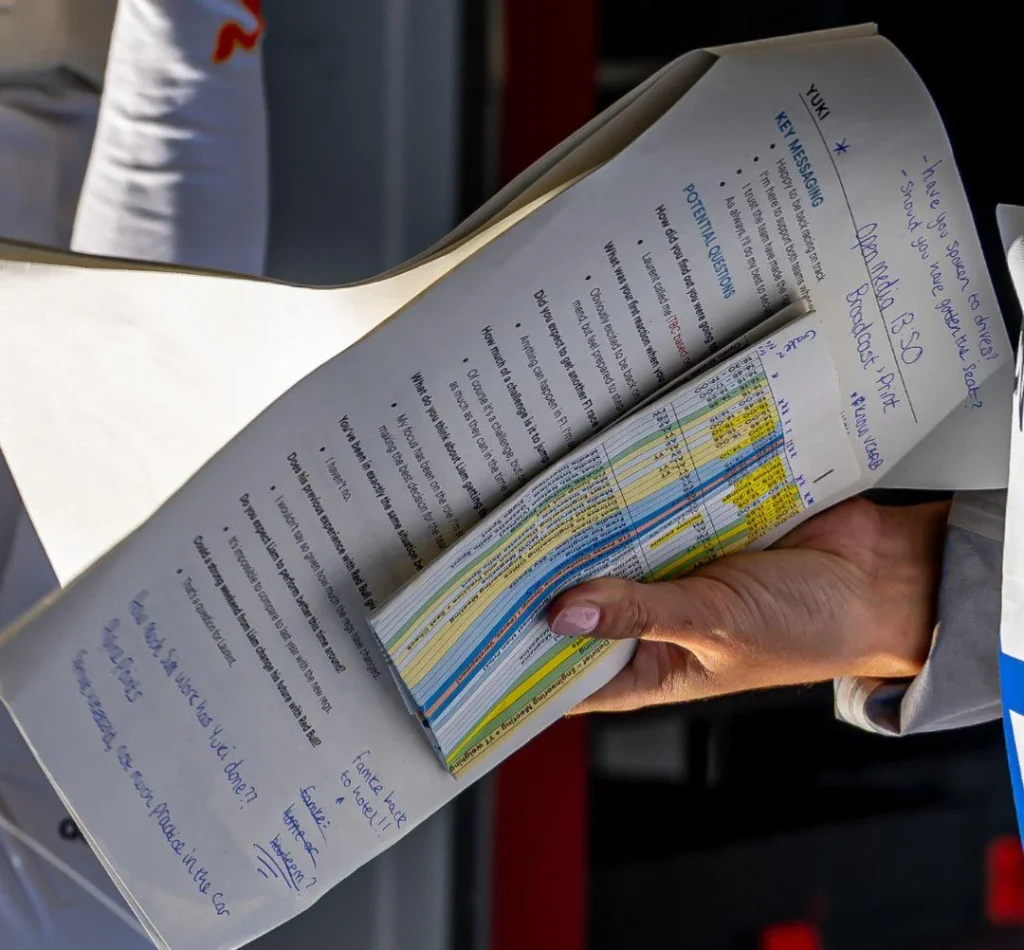
Saturday also provided an amusing glimpse into another part of the modern Formula 1 machine when Yuki Tsunoda’s media briefing material became visible.
The document appeared to contain anticipated questions and concise messaging for media appearances. Naturally, the immediate joke was that the Formula 1 script had finally leaked. But there isn’t actually anything scandalous about drivers receiving media preparation.
They have packed schedules and repeated interview obligations. Giving them concise answers and anticipated topics reduces the amount of mental energy spent navigating essentially the same questions repeatedly. In that sense, a briefing sheet is a focus tool as much as a PR tool. The interesting part is how completely unsurprising it felt.
Everyone already knows F1 drivers are media trained. We hear the same carefully constructed phrases constantly: focus on ourselves, anything can happen, unfortunate result, take the positives, keep pushing. The sheet merely exposed the machinery behind something viewers already understood.
And Tsunoda is particularly funny as the subject because his appeal has often included moments when he very clearly doesn’t sound perfectly scripted. The broader concern isn’t that PR teams prepare drivers. They should.
It’s that an increasingly optimized Formula 1 can sometimes optimize the personality out of Formula 1.
Even Getting To The Sprint Became Part Of The Story
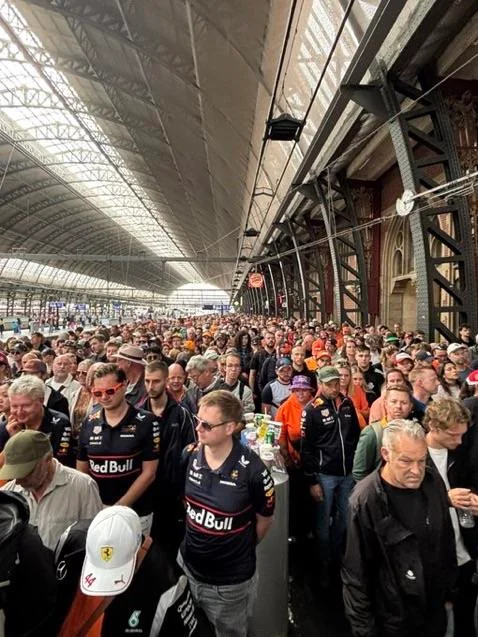
Thousands of spectators were also expected to miss the Sprint amid congestion around Amsterdam’s main train station.
Initial framing made it sound like a rail failure. The reality appears considerably more complicated. Fans on the ground reported trains continuing to run at extremely frequent intervals, with the primary issue being that they were reaching capacity. There was also a report of a broken-down train causing an approximately 20-minute interruption and contributing to the buildup.
Organizers had encouraged spectators to arrive early, with events taking place during the morning. Some travelers who left early reported straightforward journeys. That led to a fairly unsympathetic conclusion from many fans: arriving shortly before a Formula 1 Sprint and trusting that thousands of other people won’t have the same idea is a gamble. A Grand Prix weekend is an all-day event.
Support racing is part of what you’re paying for. Showing up several hours early isn’t paranoia. At an event of this scale, it’s insurance. The Sprint format may also have concentrated demand differently than a conventional Saturday. Instead of spectators gradually arriving around less consequential practice sessions, considerably more people had a reason to target the same midday start.
So even here, the Sprint changed the rhythm of the weekend.
Max Verstappen Isn’t Getting The Farewell He Would Have Wanted

Amid everything surrounding Zandvoort’s final weekend, Max Verstappen has also been struggling with an illness.
It is unfortunate timing. This isn’t merely another Dutch Grand Prix for Verstappen. It is his final home race under the current plans for the event. Fans immediately joked about Red Bull’s increasingly absurd driver situation, particularly after the recent uncertainty surrounding Isack Hadjar’s injury. Liam Lawson apparently needs to prepare himself to drive multiple cars simultaneously if the jokes are to be believed.
But Verstappen’s illness adds a slightly melancholy note to a weekend already built around farewell. Zandvoort returned because Dutch enthusiasm for Formula 1 had become impossible to ignore.
Now the race is leaving while that enthusiasm still exists.
Zandvoort Deserves A Better Farewell Than This Sprint
There is a temptation after a race like Saturday’s to reduce everything to a simple conclusion: Zandvoort is bad for Formula 1, therefore losing it doesn’t matter.
We don’t agree. A racetrack can be valuable for reasons beyond its overtaking statistics. Zandvoort has atmosphere. It has identity. It looks unlike almost anything else Formula 1 visits. Fans reach it by train and bicycle. Its grandstands feel organically full rather than constructed as scenery around a global entertainment product.
And yes, qualifying around it is fantastic. That doesn’t mean we should pretend the racing is consistently brilliant. It isn’t.
But if smaller racing cars can put on a show there while Formula 1 cannot, perhaps the lesson shouldn’t automatically be that Zandvoort is obsolete. Likewise, if a Sprint produces little action while an entertaining midfield battle happens outside the television feed, perhaps the answer isn’t simply adding more competitive sessions. And if technically engaged fans are criticizing the behavior of the cars, perhaps explaining why they’re wrong would be more productive than joking that millions of other people think clipping means something you put in your hair.
Formula 1 is currently extraordinarily successful. Zandvoort is currently extraordinarily successful. Yet the Dutch Grand Prix promoter has decided the financial risk of continuing isn’t worthwhile, longtime fans are questioning whether more races and Sprints have diluted their enthusiasm, viewers are complaining that genuine racing isn’t being shown, and the CEO is publicly distinguishing the sport’s most knowledgeable fans from the enormous casual audience surrounding them.
None of those things individually represents a crisis. Together, however, they’re worth paying attention to. Because the lesson of Zandvoort’s departure is strangely appropriate for Formula 1 itself: Being popular today doesn’t guarantee you’ll be popular forever.
And sometimes the people worrying about tomorrow are worth listening to before the grandstands stop being full.