

Formula 1 heads toward São Paulo with a new champion being held up as the sport’s model competitor, a Brazilian rookie preparing for a home debut, and another prospective newcomer approaching the final hurdle to a Super Licence. Yet the opportunities opening for that next generation come with uncomfortable questions about how drivers are judged, how teams handle their departures, and whether the cars give them enough freedom to race.
Haas has confirmed that Esteban Ocon will not compete for the team again this season, with Rafael Câmara set to make his Formula 1 debut at Interlagos. Colton Herta will also get another FP1 outing there for Cadillac, potentially securing the final Super Licence point needed to put him in contention for a 2027 race seat.
Meanwhile, Toto Wolff believes Kimi Antonelli’s championship marks the end of the ruthless champion. Lando Norris’s assessment of Mexico offers a different concern: whatever personalities occupy the cockpit, the racing itself needs work.
Haas Closes the Door on Ocon
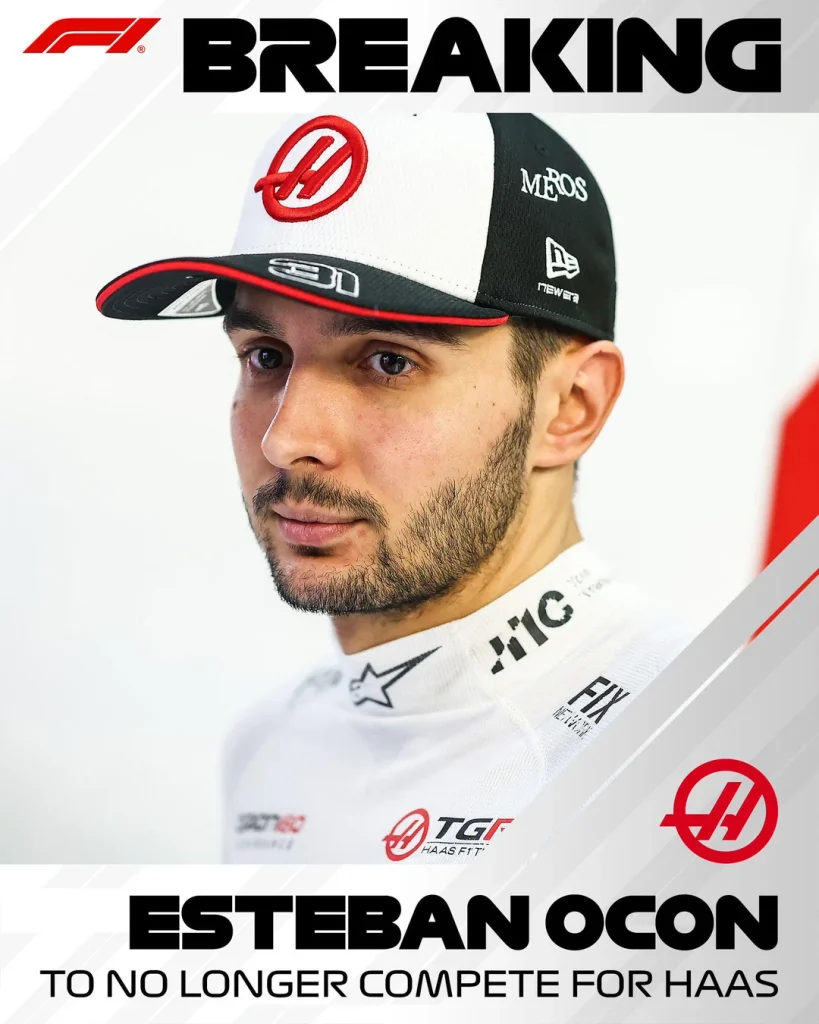
Haas’s decision to end Ocon’s racing duties for the remainder of 2026 turns the situation that unfolded in Mexico City into a definitive break.
Team principal Ayao Komatsu made clear that Haas considers the decision necessary, while declining to reveal the discussions behind it.
“Such decisions are never made lightly, as was the case in Mexico City — but then, as now, we feel this is firmly in the best interest of the team moving forward,” Komatsu said.
“The conversations that ultimately unfolded between the team and Esteban remain an internal matter, and we will continue to respect the private nature of closed-door situations.”
That establishes the team’s position. It does not establish precisely what happened. The distinction matters because the information gap has become fertile ground for competing explanations. Ocon’s history of strained relationships is being used to argue that Haas finally reached its limit. The timing of Câmara’s promotion, immediately before his home Grand Prix, invites the opposite interpretation: that the team had an incentive to accelerate a change it already wanted. Neither argument proves what happened behind closed doors. A convenient opportunity for a replacement does not demonstrate that the dispute was engineered, just as a driver’s reputation does not establish his responsibility for an incident whose details remain private.
There is also no basis here to declare that a legal fight is inevitable, that a particular contractual clause has been invoked, or that either side will receive a specific financial settlement. Those conclusions require information neither party has supplied. What can be assessed is the consequence. Haas has decided that continuing with Ocon is less desirable than changing drivers during the closing stretch of the season. That is a substantial step, and Komatsu’s reference to both Mexico City and the current decision suggests the team views them as connected parts of the same situation. Ocon’s departure also carries a more personal dimension. His modest family background has long been a reason to identify with him in a sport with formidable financial barriers. That story deserves recognition without becoming either a defense of every disagreement or something to dismiss whenever his conduct is questioned.
His career and his public manner cannot resolve the missing facts. For now, Haas has announced its decision and chosen privacy over a detailed explanation.
Câmara Gets a Home Debut, While Haas Looks Ahead
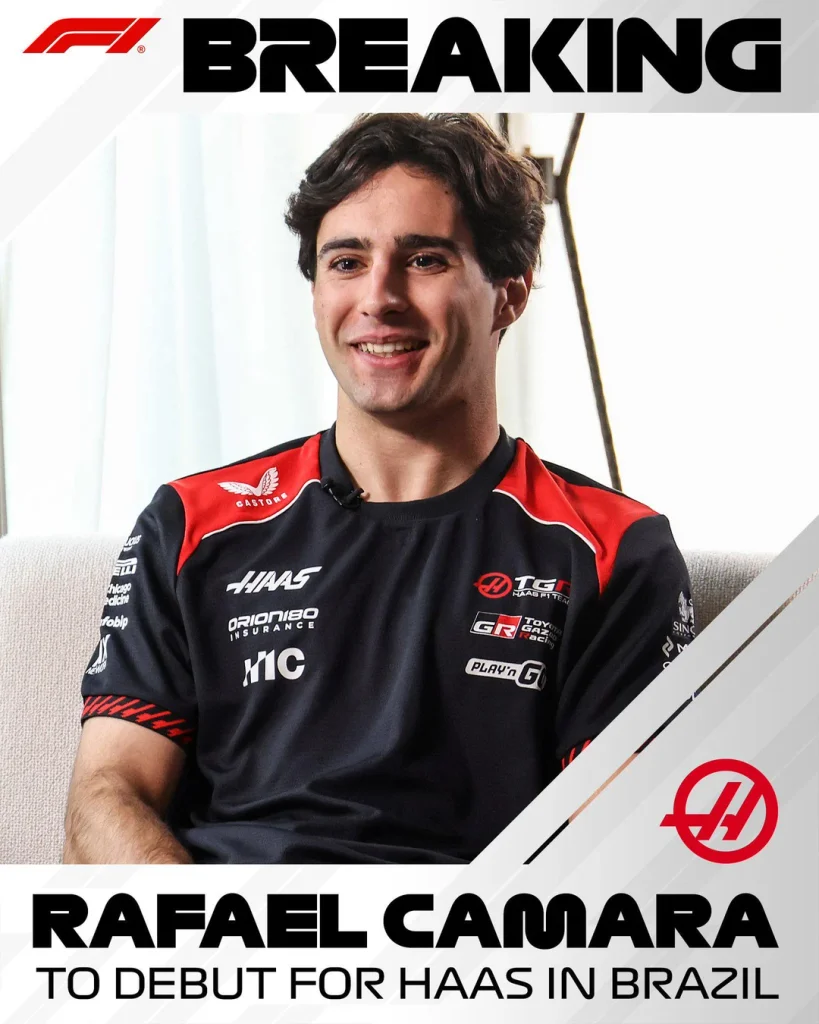
The other side of Haas’s announcement is a major opportunity for Rafael Câmara.
The team has confirmed that the 21-year-old will make his Formula 1 debut at the São Paulo Grand Prix, becoming the 34th Brazilian driver to race in F1. An earlier report also identified Las Vegas as an intended outing, although the confirmation supplied here specifically establishes his São Paulo debut. For a driver already set to join the team full time next year, the sporting logic is straightforward. An early start gives Câmara experience of the car, the working relationships, and the demands of a Grand Prix weekend before his first complete season begins. Making that debut at home adds significance, but the preparation has value well beyond the occasion.
It also explains why Ryo Hirakawa’s points-scoring appearance in Mexico does not automatically translate into a longer run in the seat. Hirakawa made a strong immediate contribution. Haas can appreciate that performance while still deciding that available mileage should help prepare its future race driver. Those are compatible judgments. Replacing a substitute does not necessarily amount to a rejection of what he achieved. The remaining uncertainty concerns how Haas manages the rest of the season alongside Câmara’s F2 commitments. There is a reasonable argument for prioritizing every available F1 start: experience in the category he will race in next year has obvious practical value.
But finishing an F2 campaign also matters. A championship effort represents the work of a whole team, and a driver with an F1 seat already secured is not necessarily choosing between an F2 title and his only chance to reach Formula 1. The question becomes how to balance preparation for the next step with completing the current one. Potential rookie-session implications add another consideration, but they should not be presented as Haas’s confirmed motivation. Nor does the absence of Qatar or Abu Dhabi from the earlier report establish anything about whether those events will take place.
For now, the clear development is significant enough: Câmara will begin his F1 racing career in front of a home crowd, and Haas’s transition toward its next lineup has already started.
Herta Approaches Eligibility, but the Performance Debate Remains
Interlagos could also become an important weekend for Colton Herta.
According to Chris Medland, Cadillac has confirmed another FP1 appearance for Herta as he pursues his final Super License point. A clean session with sufficient running would allow him to apply for the license and could open the way to replacing Valtteri Bottas next season. The distinction between those steps is essential. Securing eligibility would remove a barrier. It would not itself confirm a race seat or answer whether Herta is Cadillac’s strongest sporting option. His difficult F2 season is a legitimate concern. A driver being considered for Formula 1 should face scrutiny over how convincingly he has performed in the machinery available to him, particularly when the proposed move would displace an experienced Grand Prix driver.
At the same time, writing off everything Herta demonstrated in IndyCar would be too simplistic. His speed there remains part of his record. The challenge is assessing why that promise has not translated more convincingly into his current campaign and how relevant each part of his experience is to an F1 opportunity. Comparisons with Nyck de Vries, Logan Sargeant, or Mick Schumacher cannot settle that question. Different drivers arrive with different preparation and encounter different circumstances. Predicting that Herta will repeat somebody else’s career is easier than establishing what Cadillac should expect from him. The commercial argument needs similar care. An American driver in an American team offers an obvious promotional story, but nationality alone does not guarantee support. American fans can value competitiveness, personality, and credibility just as strongly as a shared flag.
If Cadillac chooses Herta, the decision will need to stand on more than the assumption that American supporters automatically want an American driver regardless of results. There is a defensible model in pairing an experienced driver with a newcomer who offers long-term potential. The difficult part is evaluating that potential honestly. Bottas’s performances can be questioned without making Herta’s case automatically convincing, and Herta’s struggles can be acknowledged without declaring his future a failure before it starts.
First, he needs the running. Then Cadillac must decide what the opportunity is worth.
Wolff’s Praise for Antonelli Becomes a Verdict on Everyone Else
While Haas and Cadillac weigh their future drivers, Wolff has offered a sweeping assessment of what Formula 1’s newest champion represents.
“This notion of win at all costs, selfish, opportunistic, ruthless for your own benefit, that model of racing driver has died,” Wolff said.
“We have a new champion that represents values: humility, integrity, loyalty, respect. Being himself. He should be a role model for many other young drivers.”
His praise then became a pointed challenge to the rest of the grid.
“He should be a role model for the few entitled ones in Formula One. The endless moaners on the radio. The ones that complain, the ones that crash. Look at this kid of 20 years and then think what you can do in order to improve.”
Wolff also placed Antonelli’s example within a broader vision for the championship.
“That is modern Formula One. Kimi represents the modern Formula One driver, because of those values, not only because of his talent. The talent is there with everyone. But you got to be a good person too and he has demonstrated that you can beat everyone out there by being a good person.”
Antonelli deserves recognition for winning while maintaining the demeanor Wolff describes. A young champion can provide a powerful example without cultivating hostility or treating every rival as an enemy. But one championship cannot establish that another competitive model has become obsolete. The circumstances of a title fight matter. A driver with a consistent performance advantage faces a different set of pressures from one trying to overturn a deficit or defend a championship in a closely matched car. How a champion behaves in one campaign does not answer every question about how he will respond in another.
Max Verstappen’s competitiveness has not ceased to matter because Antonelli has won. Nor is humility something Formula 1 has only just discovered. Praising this champion does not require treating those who came before him as representatives of a failed moral code. Wolff’s reference to radio complaints also creates an awkward standard. Frustration over the radio is hardly confined to drivers outside Mercedes, and George Russell’s own exchanges make it difficult to draw a clean line between the behavior being celebrated and the behavior being condemned. Wolff did not name his targets, but broad criticism naturally invites scrutiny of his own team. More fundamentally, respect and competitive fire can coexist. Formula 1 does not need every driver to be agreeable in every interview or calm in every moment of disappointment. It needs room for personality, disagreement, and rivalry without making abuse or dangerous conduct part of the attraction. The lasting fascination with Prost versus Senna and Hamilton versus Verstappen reflects how much emotional intensity can add to a sporting contest. That does not mean every championship must become a feud. It means the sport loses something if good character is confused with emotional uniformity.
Antonelli can be a role model without becoming a template everyone else must copy.
Four Leading Teams, Four Champions — and Ferrari’s Familiar Question
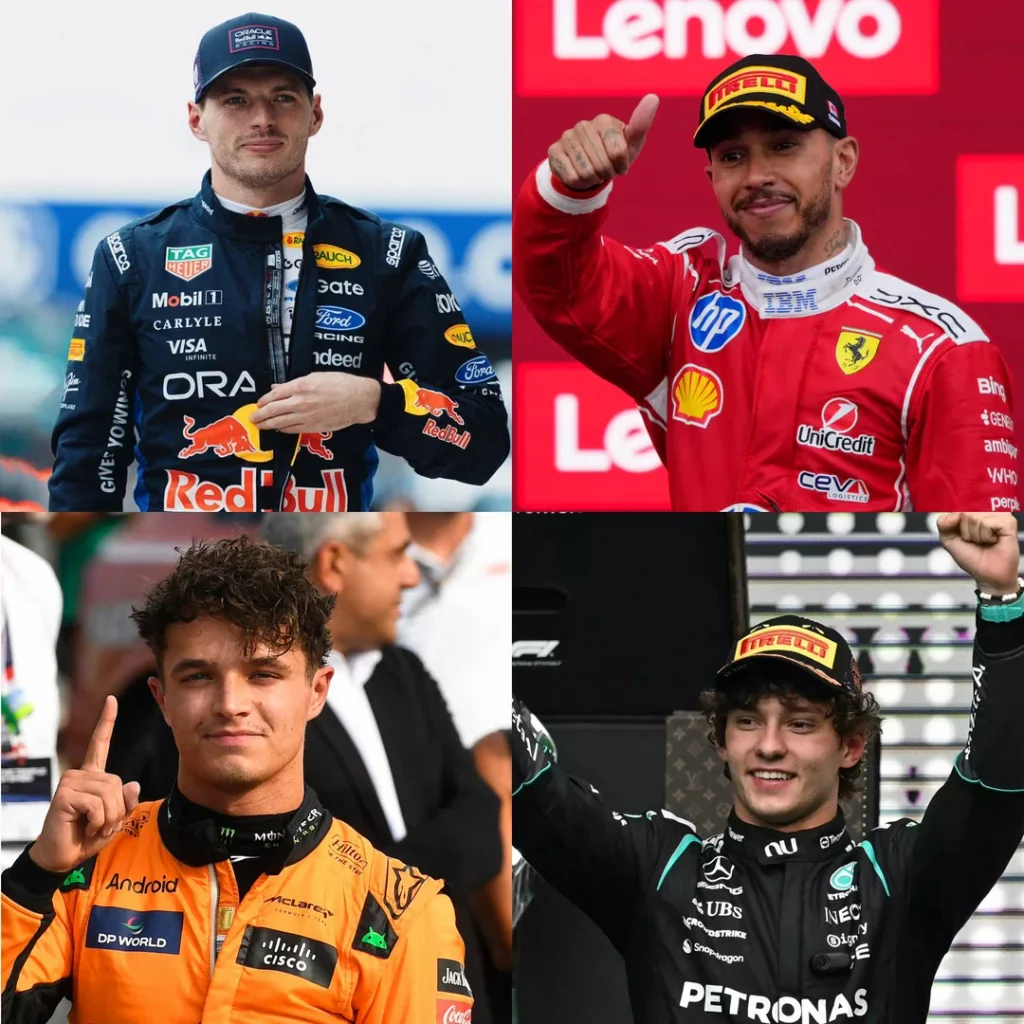
Antonelli’s title also produces a notable distribution of champions: for the first time in 12 years, each of Formula 1’s big four teams has a world champion driving for it.
Mercedes has Antonelli, McLaren has Norris, Red Bull has Verstappen, and Ferrari has Lewis Hamilton. Fernando Alonso brings the current grid’s total to five champions. The supplied historical comparison identifies 2012 as the benchmark with six: Michael Schumacher, Alonso, Hamilton, Sebastian Vettel, Jenson Button, and Kimi Räikkönen. The current arrangement is striking because of how those champions reached their positions. Antonelli, Norris, and Verstappen won their first titles with the teams they currently represent. Ferrari recruited an established champion in Hamilton.
That contrast says more about Ferrari’s continuing challenge than it does about the value of any individual driver. Ferrari has repeatedly had access to drivers capable of fighting at the highest level. Its championship drought cannot reasonably be reduced to a succession of inadequate people behind the wheel. Recruiting a champion gives a team proven ability; it does not automatically supply the technical performance, operational consistency, or leadership required to win another title. The same applies to Charles Leclerc. It is impossible to prove how many championships he would have won in somebody else’s car, particularly without accounting for who would have been alongside him. But hypothetical arguments about his ceiling should not distract from the team’s responsibility to provide a sustained opportunity. There is also a useful distinction between a driver establishing himself as the stronger performer and a team formally designating a number one. Antonelli and Norris beating their teammates does not, by itself, demonstrate that those teammates began the season in subordinate roles.
Ferrari’s challenge is to turn the quality of its lineup into results. Having a champion in the garage makes that ambition credible. It does not make the organizational work disappear.
Norris’s Mexico Verdict Challenges the Product on Track
The debate over the ideal driver matters less if the cars prevent those drivers from competing effectively.
Norris was direct about Mexico.
“Overtaking is pretty much impossible with the limiter that we have. It ruins the racing, honestly,” he said. “I think today could have been a very exciting day if we didn’t have this and hopefully for next year we can make this better.”
His complaint highlights the difference between having an overtaking aid and having one that remains useful at the decisive point of a straight. The technical discussion supplied around Mexico centers on electrical deployment reducing as speed rises. If the pursuing car loses its additional electrical assistance before it can complete an attack, closing the gap earlier in the straight may not translate into a passing opportunity. The supplied explanations disagree on exact speed thresholds, so those figures should not be treated as settled here. They also distinguish between the underlying deployment curves and separate restrictions intended to control excessive closing speeds in particular situations.
That distinction complicates the claim that a single intervention simply ended good racing. Energy management, speed profiles, safety concerns, aerodynamic behavior, and circuit characteristics all interact. Mexico’s thin air adds another element to that balance. But explaining the compromise does not erase Norris’s criticism. A system can have understandable engineering reasons and still produce unsatisfactory competition. There is a wider tension between the early-season complaint that position changes felt artificial and the current frustration that attacks stall altogether. Neither extreme is an especially satisfying outcome. A high overtaking count does not automatically mean convincing racing, but prolonged inability to challenge is no improvement.
Calls to restore DRS reflect that frustration, although changing one overtaking mechanism cannot be separated from the active aerodynamics and energy demands of the current cars. The immediate question is what will change for 2027. The supplied discussion raises the possibility of revised limits, but also notes that relevant speed-dependent curves may be contained in a supporting FIA document. Removing a curve from one published regulation is not sufficient evidence that the restriction itself has disappeared.
Norris has expressed hope for improvement. There is not enough here to declare that improvement guaranteed.
McLaren’s Possible Halo Fairing Adds Another Development Question
McLaren’s suspected flexing halo fairing offers a smaller but revealing example of the technical contest continuing late in the season.
The key word is “possible.” The material supplied does not establish that McLaren has introduced a deliberately flexible device, what benefit it might provide, or whether the apparent movement has another explanation.
Camera behavior, reflections, and movement of the car have all been proposed as alternatives. Even if the fairing is moving, its purpose cannot be confidently inferred from the observation alone. There is nevertheless an important distinction between the halo’s structural core and the aerodynamic bodywork surrounding it. The discussion concerns the external fairing, not evidence that McLaren has altered the protective structure itself. That should prevent an unconfirmed aerodynamic observation from becoming an unsupported claim about compromised crash protection.
The timing also has more than one interpretation. Introducing an idea late in the year could give rivals time to study it before next season. Equally, running it now could provide useful information while there are still competitive sessions available in which to evaluate it. Without knowing what McLaren is testing, when it became ready, or what the team hopes to learn, calling the timing a strategic blunder goes beyond the evidence. The broader argument is familiar: Formula 1 celebrates innovation, then debates whether an advantage should survive once somebody finds it. The discussion of Ferrari’s turbo characteristics and the starting procedure reflects the same tension between preserving the rewards of a design choice and managing the wider consequences for the field.
Those decisions shape both the engineering contest and the racing Norris wants improved. São Paulo now brings several of these questions together. Câmara will get his first Grand Prix start, Herta will pursue the point that could unlock his next step, and Haas will begin racing beyond its split with Ocon. Antonelli arrives as the champion Wolff wants others to emulate.
The opportunities are real. So are the demands that follow: teams must justify their choices, newcomers must demonstrate their readiness, and Formula 1 must give its drivers a competitive environment in which their differences can actually decide the racing.