

Formula 1’s newest regulatory pivot has sharpened a debate the sport has been circling for years: how much should F1 still care about “road relevance”?
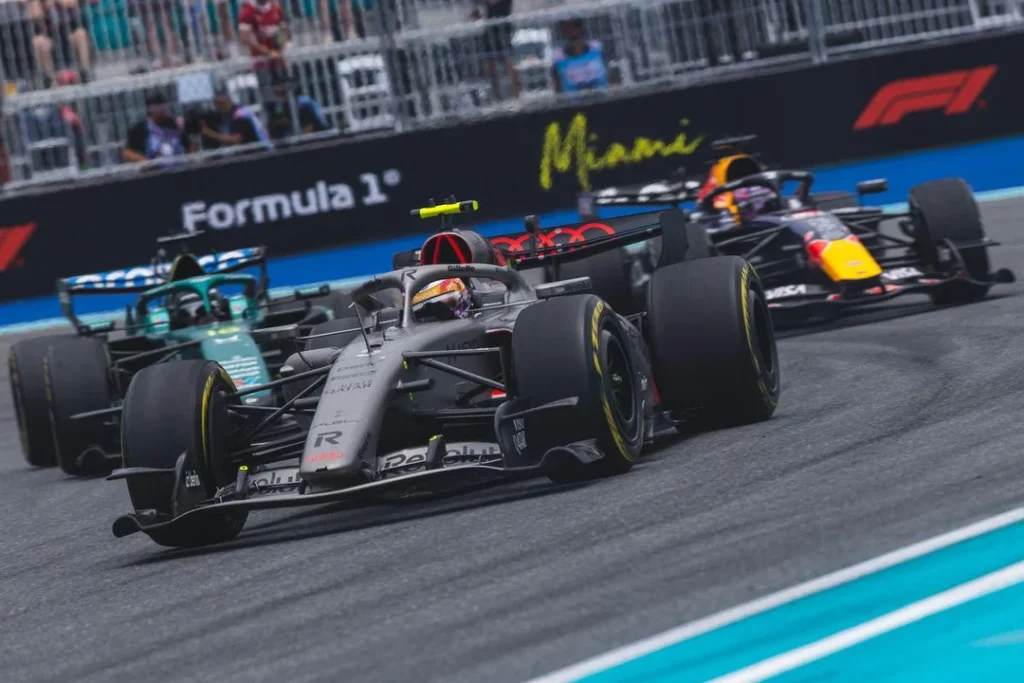
The FIA has now approved a shift for 2027 that moves the upcoming power unit formula away from its much-discussed near-50/50 split between combustion and electric power. The agreed direction is a nominal increase of around 50kW in internal combustion engine power, supported by a fuel-flow increase, alongside a nominal 50kW reduction in ERS deployment power.
In simpler terms: more brumbrum, less bzzzbzzz.
That adjustment moves the balance closer to a 60/40 split, and the reaction has been telling. For many, this felt less like a minor calibration and more like a tacit admission that the original concept had gone too far. The immediate concern around the 2026-style philosophy was always energy starvation: cars running out of usable electrical deployment on straights, clipping heavily, or even needing compromised driving patterns to manage charge. Moving more of the workload back to the ICE should reduce the dependence on battery deployment, make the cars more consistent over a lap, and help limit the most awkward symptoms of superclipping.
The fact that this has already been agreed for 2027 is significant. It suggests the FIA and stakeholders saw enough warning signs early to act quickly. That is rare in a sport where regulatory pride often outlives regulatory logic. The 50/50 concept was sold as forward-looking, but the quick move toward 60/40 makes it look increasingly like F1 overshot the mark and is now trying to patch its way back toward something raceable.
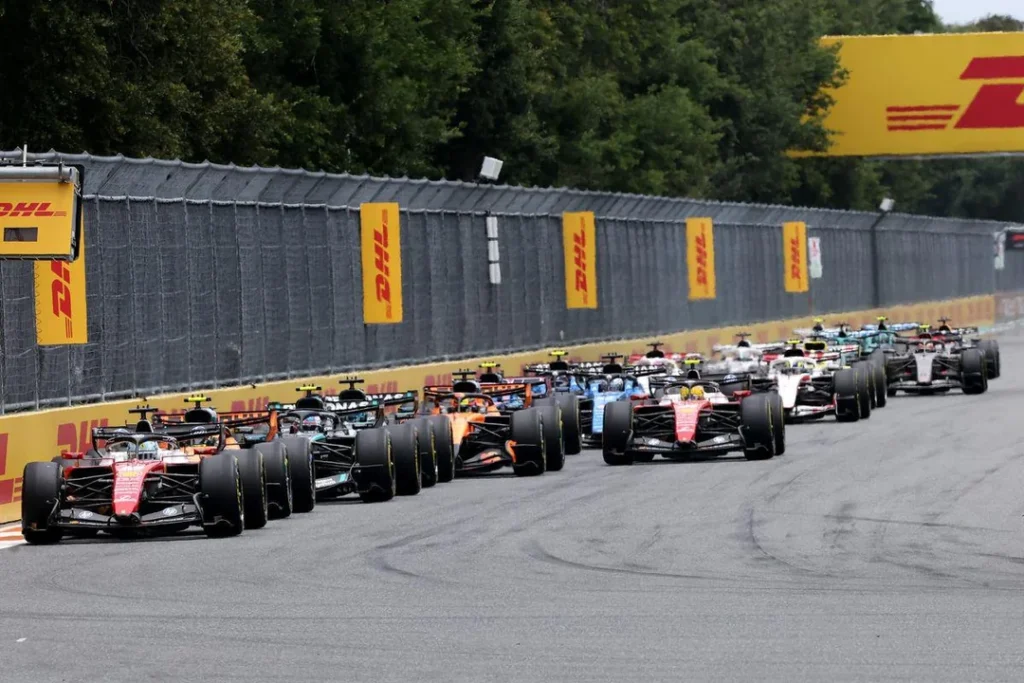
That brings the bigger issue into focus: F1’s long-running chase for road relevance increasingly feels misaligned with what the championship actually is.
An open-wheel, single-seater prototype series has always had a strained relationship with road-car applicability. If the point is direct technology transfer, other series arguably have cleaner claims. Formula E can credibly attach itself to EV development. WEC and rally have clearer links to endurance, hybrid systems, homologation culture, and road-car engineering. F1, by contrast, has often used road relevance less as a technical truth than as a boardroom justification.
That does not mean F1 has never produced useful technology. The hybrid era brought valuable work around efficiency, fuel injection, energy recovery, and combustion optimization. But the idea that every major regulation change needs to be framed around what may one day benefit the daily driver has started to feel backwards. F1’s best road relevance has historically come as a byproduct of racing innovation, not as the central objective.
The current debate exposes that inversion. Instead of asking what makes the best Formula 1 car, the sport has often asked what makes the most palatable corporate pitch. Manufacturers want a story they can sell internally. Sponsors and boards want a connection to the day-to-day business. But the racing product cannot become subordinate to that narrative.
That is why the 2027 shift matters. It is not just a technical tweak. It is a philosophical correction.
There is also a political layer. Christian Horner and Red Bull had warned years ago that the new rules risked creating “technical Frankensteins,” including fears that drivers might have to manage bizarre energy behavior on straights. Toto Wolff dismissed that concern at the time, arguing that F1’s engineers would be innovative enough to avoid such outcomes. Now, with the FIA moving the balance away from the original concept, the old argument has resurfaced.
The irony is that this is not simply about who was right or wrong. Mercedes may be doing just fine competitively. Red Bull may have its own issues. The wider point is that the warnings about the formula itself were not imaginary. Whether the current problems come from power unit design, deployment rules, regen limitations, chassis interaction, or all of the above, the sport has already decided that the balance needed changing.
The remaining concern is whether 50kW is enough.
Some believe the move should materially reduce clipping by lowering ERS demand and increasing ICE contribution. Others argue that without deeper fixes — especially around deployment control, regen strategy, or front-axle energy recovery — F1 is still only trimming the symptoms of a flawed architecture. There is a strong case that if the sport is going to rely heavily on electrical power, it needs a more complete way to recover and manage that energy. Otherwise, the cars risk remaining too algorithm-driven and too energy-compromised.
Still, the decision is a step in the right direction. It acknowledges that power delivery should be reasonably consistent and that a Formula 1 car should not feel like it has 1,000 horsepower in one part of the lap and dramatically less in another. Fans may enjoy complexity in the engineering war, but the spectacle still depends on cars being fast, aggressive, raceable, and predictable enough for drivers to attack.
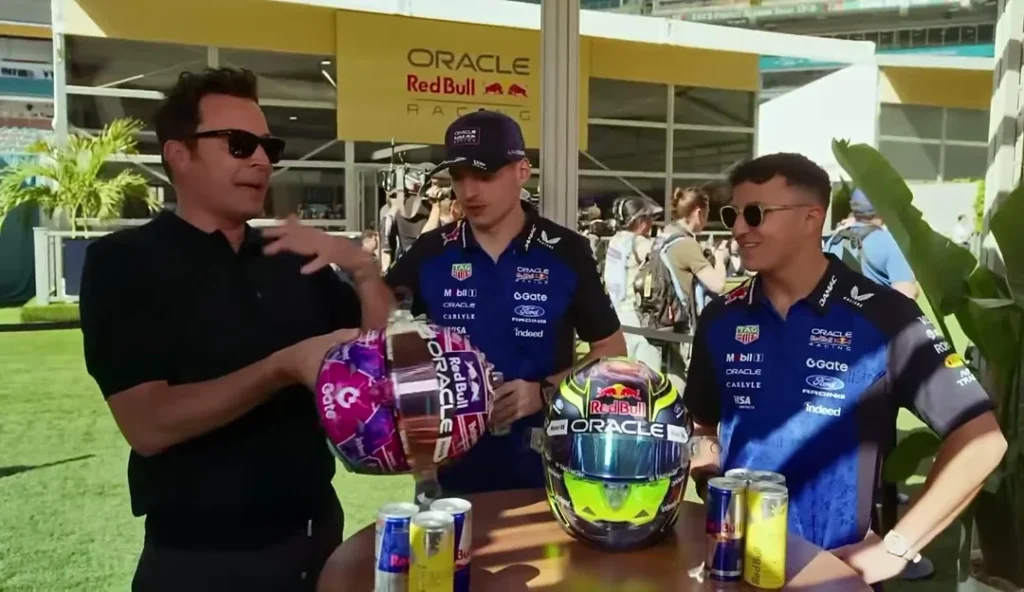
Away from the technical debate, F1’s Miami-adjacent celebrity machine offered a different kind of identity question.
Max Verstappen’s interaction with Jimmy Fallon became its own miniature case study in what happens when Formula 1’s global entertainment push collides with one of the least performative drivers on the grid. Fallon tried to play off Verstappen’s name — “Verstopping at the store, Verstopping to get coffee” — before Max deadpanned: “Ver-stopping this interview.”
It worked because it was so painfully on-brand. Verstappen has never been built for forced celebrity banter. His “I love being here” landed with exactly the kind of dry sarcasm that makes him compelling outside the car. The exchange turned into a reminder that F1’s biggest personalities do not always fit neatly into the American late-night promo machine, and that mismatch can be funnier than the planned bit.
The broader celebrity presence also drew attention. Colin Farrell and Patrick Dempsey were received more warmly because they came across as genuine racing fans rather than generic VIPs. Dempsey’s racing background gave his enthusiasm obvious credibility, while Farrell’s energy landed as that of someone genuinely excited to be there. That contrast matters. F1 has leaned heavily into celebrity culture, especially in the U.S., but fans can usually tell the difference between a guest who loves the sport and one who is simply being inserted into the broadcast.
Then there was Lewis Hamilton’s “VICE CITY RUN,” which captured a different side of F1’s modern appeal: aesthetics, nostalgia, and brand gravity.
Hamilton in Ferrari orbit already has a built-in cinematic quality, and putting him with a Testarossa-style visual language immediately pushed fans toward Miami Vice and GTA Vice City associations. The white Ferrari Testarossa, “In The Air Tonight,” the gated manual shifter, the retro-80s aura — it all hits a cultural nerve far beyond lap times.
That is part of the Hamilton-Ferrari value proposition. On track, Ferrari remains Ferrari: aspirational, chaotic, glamorous, and perpetually under pressure. Off track, the combination is a marketing machine. Ferrari gets the full force of Hamilton’s global celebrity, fashion sensibility, and storytelling power. Hamilton gets access to the mythology of the most famous team and car brand in motorsport.
The debate over why Hamilton joined Ferrari will continue. Some see it as legacy, some as money, some as marketing, some as a lifelong dream, and some as a late-career swing at turning around the sport’s most emotionally loaded team. What is undeniable is that the imagery works. Hamilton and Ferrari together produce moments that feel bigger than race-week content. They sell an idea of Formula 1 as culture, not just competition.
That may be the thread linking all of this together.
F1 is trying to be many things at once: a technology laboratory, a manufacturer showcase, a sustainability platform, a racing championship, a luxury entertainment product, and a global pop-culture engine. The tension comes when those identities pull against each other.
The 2027 power unit adjustment suggests the sport may finally be recognizing that racing has to come first. Road relevance can be useful, but it cannot be the master. Manufacturer politics can help fund the show, but they cannot define the show. Celebrity engagement can broaden the audience, but authenticity still matters. Ferrari glamour can sell the dream, but performance still decides whether the dream holds.
Formula 1 does not need to abandon innovation. It does need to stop pretending every innovation has to be justified by a road-car connection. The sport is strong enough to set regulations around what makes the best racing product and trust that manufacturers, sponsors, celebrities, and fans will still come along.
After all, one of its defining teams is still a fizzy drinks company.