

Formula 1’s 2026 season has reached one of those strange points where nearly every major storyline seems to be overlapping.
Kimi Antonelli leads the championship after 11 rounds. Lewis Hamilton has rediscovered himself at Ferrari. Honda is trying to drag its power unit program back toward competitiveness. More than half the grid has never raced at Sepang in Formula 1. Nico Hülkenberg is suddenly being discussed as expendable despite how much bad luck has shaped his season. Ollie Bearman’s Ferrari future might not be as straightforward as it once looked. And somewhere in the middle of all of that, Lando Norris apparently decided that after the Canadian Grand Prix the logical next step was flying to Indianapolis to drink with Conor Daly and Daniel Ricciardo until 4 a.m.
So, yes. Formula 1 remains Formula 1.
Sepang Is About to Expose Just How Young This Grid Really Is
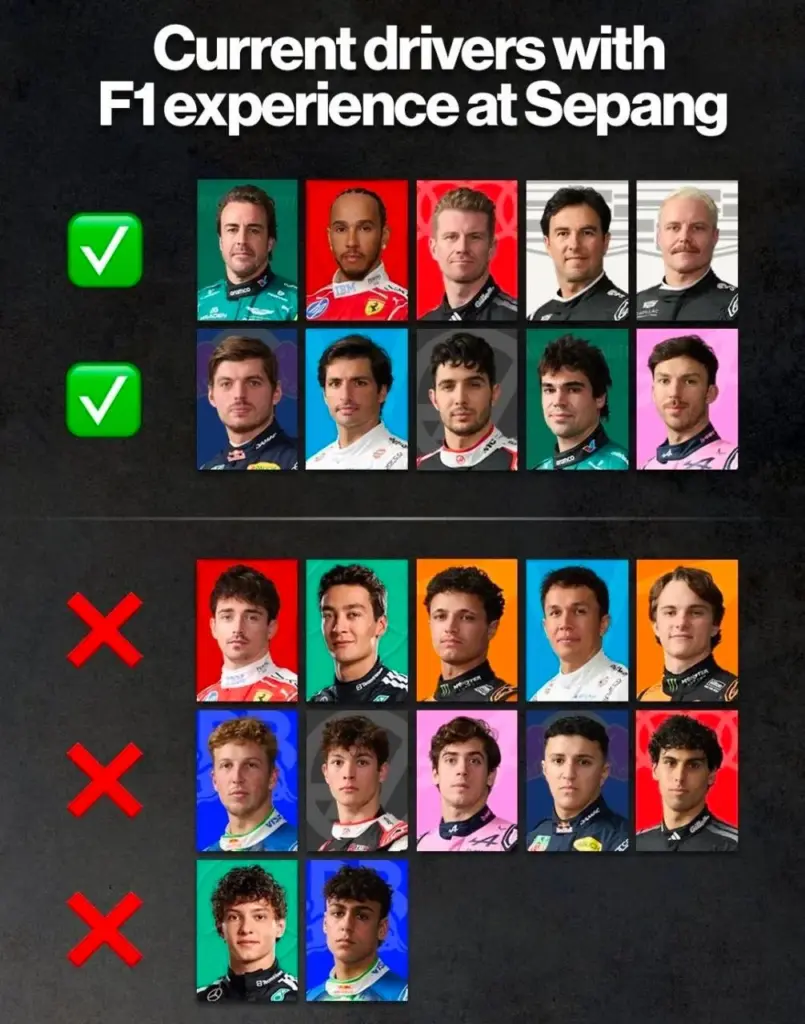
One of the strangest things about Formula 1 returning to Sepang is just how many current drivers have never actually raced there in F1.
Drivers with Formula 1 race experience at Sepang include Fernando Alonso, Lewis Hamilton, Nico Hülkenberg, Sergio Perez, Valtteri Bottas, Max Verstappen, Carlos Sainz, Esteban Ocon, Lance Stroll and Pierre Gasly. Those without F1 race experience there include Charles Leclerc, George Russell, Lando Norris, Alex Albon, Oscar Piastri, Liam Lawson, Ollie Bearman, Franco Colapinto, Isack Hadjar, Gabriel Bortoleto, Kimi Antonelli and Arvid Lindblad. There is one obvious caveat: Leclerc did take part in FP1 at Sepang in 2017, so saying he has absolutely no F1 experience there would be inaccurate.
There are also drivers who may have driven previous-generation cars or completed other forms of testing at the circuit, which makes the experience divide slightly less clean than a simple race-start list suggests. Still, the broader point remains. More than half of the current grid has never raced a Formula 1 Grand Prix at Sepang.
Which means, somehow, Alonso, Hamilton, Bottas and company have now become the elder statesmen arriving at an old venue ready to explain where everything is. Team Beard has an advantage. The entire thing has also inevitably produced one of the better side stories of the weekend: Lance Stroll suddenly being treated like a Sepang specialist.
A rainy race would apparently elevate the chances of a Stroll masterclass dramatically, although given the range of Stroll performances we have seen in difficult conditions, calling it a 50/50 proposition might actually be appropriate. Either something magical happens or something extremely Lance Stroll happens. There is no middle ground.
And given Sepang’s history, if the weather starts turning, nobody should get too comfortable.
The 2026 Championship Looks Like Somebody Rearranged 2025
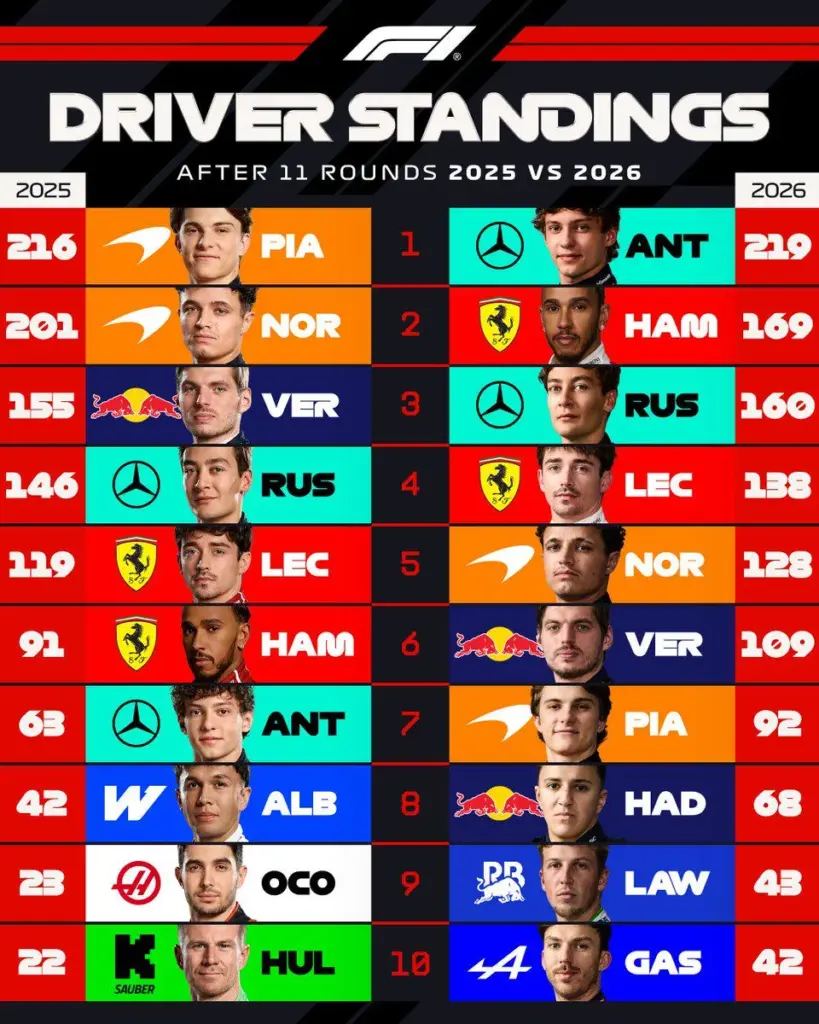
After 11 rounds last year, the top ten looked like this:
Oscar Piastri – 216
Lando Norris – 201
Max Verstappen – 155
George Russell – 146
Charles Leclerc – 119
Lewis Hamilton – 91
Kimi Antonelli – 63
Alex Albon – 42
Esteban Ocon – 23
Nico Hülkenberg – 22
After 11 rounds in 2026:
Kimi Antonelli – 219
Lewis Hamilton – 169
George Russell – 160
Charles Leclerc – 138
Lando Norris – 128
Max Verstappen – 109
Oscar Piastri – 92
Isack Hadjar – 68
Liam Lawson – 43
Pierre Gasly – 42
The symmetry is almost ridiculous. Piastri and Antonelli have effectively swapped positions. McLaren versus Verstappen is still happening, except much further down the championship.
Ferrari and Mercedes are still fighting each other, only now it is much closer to the front. And within those two teams, the internal order has flipped as well. Last season Russell was ahead of Antonelli while Leclerc was ahead of Hamilton. This season Antonelli leads Russell, while Hamilton leads Leclerc. The top seven names are also largely familiar, just shuffled into a completely different order.
Perhaps the most striking comparison is Antonelli. Piastri had 216 points after 11 rounds last season. Antonelli has 219 now.
That inevitably raises the uncomfortable question: could Antonelli suffer the same kind of second-half reversal that Piastri did? Last season Max Verstappen came back from an enormous deficit to Piastri. At one point after Zandvoort, Verstappen was 104 points behind him and still ultimately finished ahead. That does not mean Antonelli is destined to collapse.
But it does mean nobody chasing him can use the current gap as an excuse to concede the championship. The bigger problem for Antonelli’s challengers may simply be that they are taking points away from each other. Hamilton, Russell and Leclerc are all close enough to interfere with one another while Antonelli continues banking points.
The people chasing Kimi need to stop fighting each other long enough to actually fight Kimi.
The Midfield Is Scoring Very Differently This Year
Another interesting difference between the two seasons appears lower down the standings.
Ninth and tenth place currently have roughly twice the points they had at the equivalent stage last year. Part of that appears to be down to a larger field spread. The 2025 midfield was so compressed that teams regularly stole points from one another, and the pecking order could shift dramatically from weekend to weekend. A car that looked fifth-fastest at one track could suddenly be seventh or eighth somewhere else.
This season has been more defined. Racing Bulls have often established themselves clearly as the fifth-best team, while Alpine and Audi have also been capable of points. With Haas fading, there are fewer midfield teams consistently fighting over the same positions. That makes it easier for the strongest midfield runners to repeatedly finish inside the top ten.
And it helps explain why Hadjar, Lawson and Gasly have accumulated the totals they have.
Honda Has Finally Admitted Just How Bad Things Were
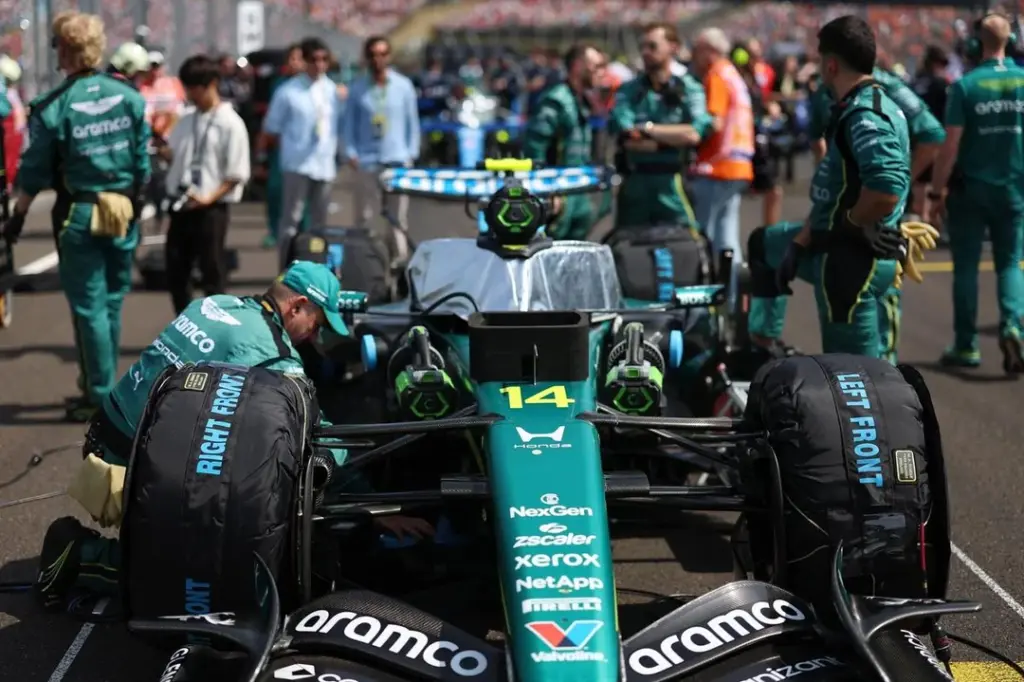
Honda has acknowledged that it did not fully appreciate the scale of its 2026 Formula 1 problems until January.
That is not exactly the sentence Aston Martin wanted associated with its new works partnership. But there is at least one encouraging part of the story: Honda has apparently reacted aggressively since realizing the situation. The recurring theme with Honda in Formula 1 is that it often seems to need a period of suffering before everything eventually clicks.
The 2000s program endured some deeply difficult seasons before Honda exited and the operation became Brawn GP. Honda’s early hybrid-era return with McLaren was disastrous before the company eventually turned things around with Red Bull and powered Max Verstappen to multiple championships. Which has created a running joke that Honda’s F1 cycle is basically:
Enter. Struggle horribly. Figure everything out.
Become excellent. Leave. Return.
Repeat. That history is simultaneously the reason for optimism and the reason Aston Martin should be nervous. The question is not necessarily whether Honda is capable of solving its current issues. The question is how long it takes.
Fernando Alonso may need that rumored rocking chair installed before the power unit reaches its final form.
The Honda-Aston Problem May Be Bigger Than One Bad Engine
The situation also appears more complicated than simply saying Honda built a bad power unit.
One major theme in the discussion around the project is vibration. The engine apparently did not produce alarming vibration levels on Honda’s test rig, but the issue became more severe once it was integrated into the Aston Martin chassis. That points toward a broader integration problem rather than a single defective component.
Aston Martin also produced its own transmission for the first time, while the 2026 regulations removed the MGU-H and created new drivability challenges. There has also been discussion around the unusual mounting of the MGU-K and whether the interaction between the power unit and chassis created resonance or vibration problems that were difficult to reproduce independently. The fact that a chassis eventually had to be taken to Honda for more direct testing reinforces the idea that the issue was in how the complete package behaved rather than something obvious in isolation.
Adrian Newey has reportedly made a similar broader point: parts that looked good independently produced unintended consequences once everything was assembled. That is perhaps the most concerning part. Formula 1 cars are not collections of independent engineering projects. Everything has to work together.
And if Honda and Aston Martin only truly discovered how badly those systems interacted after the finished package came together, the recovery becomes much more complicated than simply turning up the engine.
Honda’s History Is Both Encouraging and Terrifying
The comparisons with 2009 have inevitably returned.
Honda developed the car that ultimately became the championship-winning Brawn GP machine, although Brawn used Mercedes power after Honda withdrew. The exact reason for Brawn’s early advantage is still debated endlessly. The double diffuser receives most of the historical attention, although Brawn was not the only team using one. The BGP001 was also simply a highly sophisticated chassis, particularly aerodynamically.
The Mercedes V8 was another major piece of the equation. It offered strong power, compact packaging, good fuel efficiency, manageable cooling requirements and excellent drivability. But because the Brawn chassis had originally been designed around Honda’s own engine, installing the Mercedes unit required compromises and late reworking around the gearbox, cooling and rear of the car.
That makes simplistic claims about either the diffuser or the engine being solely responsible for Brawn’s success difficult to defend. What matters for 2026 is the larger Honda lesson. Honda has been here before.
It has looked lost before. It has recovered before. And it has also walked away at extremely inconvenient moments before. That is why nobody should completely write off Honda.
And nobody should completely trust the process yet either.
Audi Does Not Need to Panic About Hülkenberg
Another conversation gaining momentum is whether Audi should eventually replace Nico Hülkenberg with Carlos Sainz.
The argument is straightforward. Gabriel Bortoleto has increasingly matched and challenged Hülkenberg, and Hülkenberg will be 40 next season. If Audi wants to build around younger drivers for the long term, replacing him seems like an obvious discussion. But calling it obvious right now feels premature.
Hülkenberg has also been ridiculously unlucky. At one point this season, a pebble reportedly managed to hit his car’s kill switch. At some stage, that stops being motorsport and starts becoming slapstick.
There is also race-pace data suggesting Hülkenberg remained slightly ahead of Bortoleto across the first half of the season despite how impressive Bortoleto has been. And that is probably the larger issue with evaluating Hülkenberg right now. If Bortoleto improving enough to challenge him automatically means Hülkenberg should be replaced, then what happens if Bortoleto eventually does the same thing to Sainz? Bortoleto may simply be very good.
That is not necessarily evidence that Hülkenberg has suddenly become bad.
And Would Sainz Even Be Audi’s Long-Term Answer?
Sainz also previously declined the Audi opportunity when the project was still racing under the Sauber name.
That does not mean Audi would refuse to sign him later. Formula 1 teams are not high-school relationships keeping score over who rejected whom first. If Audi believed Sainz was the best available driver, the previous decision probably would not matter much. But there is another question.
If Audi truly becomes competitive enough to challenge at the front, would Sainz necessarily be its first choice? By then, drivers such as George Russell, Charles Leclerc, Oscar Piastri or another emerging star could potentially become more attractive targets. Audi has also indicated interest in developing its own drivers for the longer term.
So Hülkenberg versus Sainz may not actually be the decision Audi eventually faces. The real choice could be whether Audi wants another experienced veteran at all.
For now, though, there is little reason to rush Hülkenberg out of the seat.
Lewis Hamilton’s Comeback Has Created an Ollie Bearman Problem
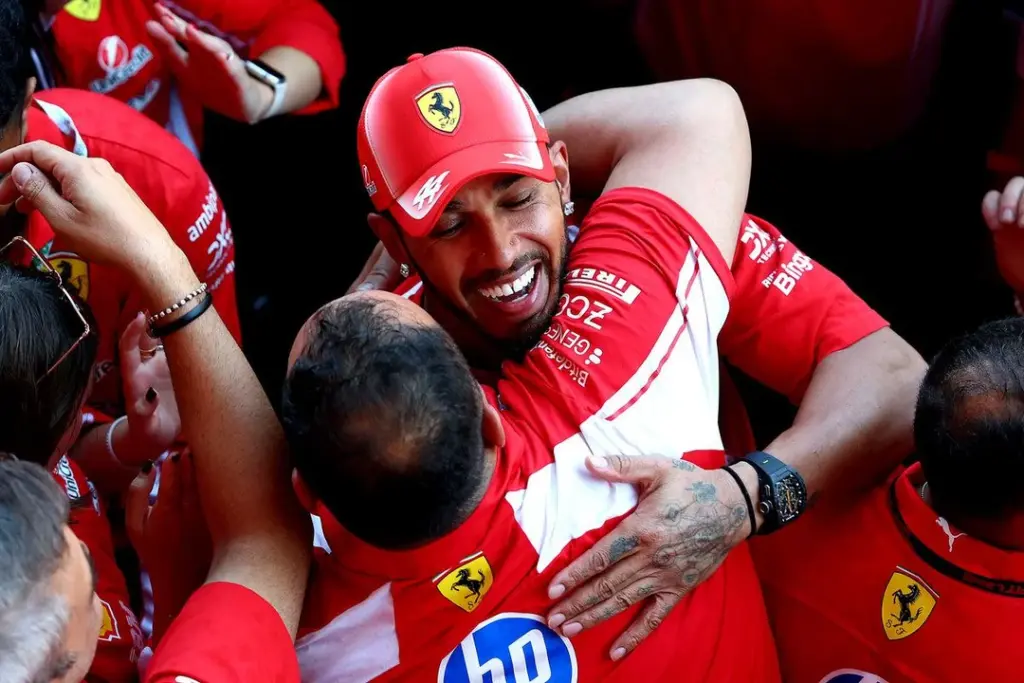
Lewis Hamilton finding his form at Ferrari is wonderful news for Lewis Hamilton.
It may be slightly more complicated news for Ollie Bearman. For a while, the assumed pathway seemed relatively straightforward. Bearman develops at Haas.
Hamilton eventually retires. Bearman moves to Ferrari. But that was always more assumption than guarantee.
Ferrari is Ferrari. When a Ferrari seat becomes available, practically every elite driver becomes part of the conversation. If Hamilton remains competitive and chooses to stay for several more seasons, Bearman’s timeline immediately becomes more complicated.
And even when Hamilton eventually leaves, Ferrari could theoretically pursue Antonelli, Norris, Piastri, Russell, Verstappen or whichever other elite driver is available at the time. Bearman being part of the Ferrari system does not automatically entitle him to a Ferrari seat.
He still has to become the best option.
Rafael Câmara Makes the Situation Even More Interesting
There is another complication: Rafael Câmara.
If another Ferrari junior reaches Formula 1 and ultimately performs better than Bearman, Ferrari’s succession plan could change very quickly. That does not necessarily mean Câmara is immediately getting the Haas seat. There have been suggestions that Haas may be reluctant to run two Ferrari juniors at once and could prefer a driver it can control independently for the long term.
Leonardo Fornaroli has been mentioned as another candidate, in part because of his performance in TPC testing. A direct comparison between Fornaroli and Câmara in another TPC test has also been discussed for later in August. For Haas, there are competing philosophies.
Running Bearman and Câmara could give the team access to two talented Ferrari juniors and increase the odds that at least one remains available longer than expected. Alternatively, Haas could choose a driver with fewer outside ties and attempt to build something more independent. Toyota’s involvement could eventually influence that direction as well, even if there is currently no obvious Japanese driver ready to take the seat.
Either way, Bearman’s future is not in danger. He is already one of only 22 Formula 1 drivers on the grid and has been putting together strong performances.
But the idea that Ferrari is simply holding Hamilton’s seat open for him until Lewis leaves has always been too simplistic.
Bearman’s Real Warning Might Be Sitting Across the Haas Garage
If Bearman wants an example of how quickly Formula 1 timing can work against a young driver, he does not have to look very far.
Esteban Ocon was once the highly regarded young driver tied to a top-team future. Then the timing never quite aligned. By the time opportunities changed, newer prospects had emerged and Ocon’s career went in a different direction.
Bearman could theoretically face the same issue. If he is still waiting by 2028 while another Ferrari junior becomes the new exciting prospect, his strongest route to a top seat may no longer be Ferrari. That does not mean he should panic. If anything, remaining at Haas while Hamilton absorbs the enormous pressure of driving for Ferrari may give Bearman more time to develop without the scrutiny that would come from stepping directly into Maranello.
But eventually potential has to become inevitability.
Meanwhile, Lewis Is Becoming a Genuine Championship Story Again
Perhaps the funniest part of the Bearman conversation is that it exists because Hamilton has ruined the retirement assumptions.
After 11 races, Hamilton sits second in the championship on 169 points. A year ago, at the same stage, he had 91. That is not a marginal improvement.
That is a different season. And suddenly the idea of Hamilton staying beyond 2026 no longer feels unreasonable. If he remains competitive, enjoys driving the car and genuinely believes he can chase an eighth championship, there is little obvious reason he has to retire immediately.
And if Hamilton ever did win another title with Ferrari, the historical significance would be enormous. Eight championships. Three constructors.
Multiple generations of Formula 1 machinery. That would be the kind of record that would immediately become one of the defining achievements in the history of the sport.
Ollie may have to keep waiting.
Kimi Antonelli Apparently Needs Max Verstappen’s Permission Before Starting Side Quests
Antonelli, meanwhile, is already discussing what might happen beyond Formula 1.
Asked about potentially following Verstappen into endurance racing one day, Antonelli said:
“We’ve already talked about it, but Max told me to focus on this year and we’ll see after that.”
That may be one of the most dad-coded answers Verstappen has ever given. Finish your championship homework first. Then we can talk about Le Mans.
It is also very good advice. Antonelli currently leads the Formula 1 World Championship. There is absolutely no reason he needs to be mentally allocating bandwidth toward endurance racing right now.
The endurance opportunities will still exist later. And if Antonelli wins the championship and establishes himself as Mercedes’ central driver, he may eventually gain enough leverage to request permission for selected endurance outings anyway.
For now, however, Verstappen seems to have appointed himself F1’s extracurricular activities counselor.
Max Verstappen Has Entered His Talent-Scout Era
The amusing part is that Verstappen’s endurance ambitions increasingly feel like one gigantic side project running alongside his Formula 1 career.
Antonelli gets mentioned. Fernando Alonso gets mentioned. Sebastian Vettel gets mentioned.
Nico Hülkenberg gets mentioned. At this point Max may just be walking around the paddock mentally assembling racing lineups. You can take Verstappen out of the center of the Formula 1 championship story, but apparently you cannot stop him from collecting side quests.
There is also something strangely wholesome about it. Verstappen has increasingly become one of those drivers who seems interested in helping younger drivers while simultaneously plotting what he wants to race once Formula 1 is no longer the only priority. It has shades of late-career Sebastian Vettel energy.
Except instead of environmental projects, Max is trying to recruit everybody into endurance racing.
Antonelli Probably Should Wait Anyway
Talent is not the concern with Antonelli.
Experience is. Endurance racing demands a very different type of patience from Formula 1. A driver has to accept traffic, multiclass racing, shared machinery, changing conditions, long stints and situations where a mechanical failure can erase hours of perfect driving.
Antonelli has shown enormous speed and development, but there are still moments when frustration affects him. Canada was one example raised when discussing whether he is emotionally ready for the demands of a 24-hour race. That is not an indictment.
He is still young. Several more years of Formula 1 experience will probably make him better prepared for endurance racing anyway. We have already seen drivers such as Verstappen and Norris become calmer as their careers progressed and they had less to prove.
Antonelli may follow the same path. First, though, he has a championship to finish.
Dad said so.
Lando Norris Is Apparently Living His Best 1980s F1 Driver Life
Then there is Norris.
Conor Daly recently talked about Norris flying to Indianapolis after the Canadian Grand Prix and drinking with Daly and Daniel Ricciardo until approximately 4 a.m. Apparently more Formula 1 drivers were out than IndyCar drivers. Which sounds dramatic until you realize the group may have essentially been Norris and Ricciardo versus Daly.
Technically correct remains the best kind of correct. The story has inevitably generated commentary about Norris partying, but the entire thing feels much less dramatic than people want it to be. He is a young, successful, wealthy Formula 1 World Champion spending an evening drinking with friends.
Until there is evidence that this affects his performance, it is difficult to see why anyone should care. Formula 1 history is filled with drivers who lived far more chaotic lifestyles. Calling Norris the reincarnation of James Hunt is probably going a little far.
“Hunt-esque” might be safer.
No, Staying Up Until 4 A.M. Does Not Automatically Mean Cocaine
The strangest part of the reaction was the immediate speculation that partying until 4 a.m. must involve drugs.
It does not. Plenty of people in their twenties can stay awake drinking until 4 a.m. without chemical assistance. Plenty of people in their forties apparently can too, judging by the passionate defense mounted on behalf of late-night drinking everywhere.
There was also an extensive debate over WADA rules, cocaine testing windows, whereabouts requirements and how frequently Formula 1 drivers are tested. None of that changes the central point. Nothing in Daly’s story establishes that Norris used drugs.
So there is no reason to pretend it does. The actual story is much simpler and much more entertaining: Lando flew from Canada to Indianapolis to party with Conor Daly and Daniel Ricciardo.
That is enough.
Motorsport Drivers Getting Along Is Actually Pretty Great
There is another part of the story worth appreciating.
Drivers from different championships genuinely seem to enjoy spending time together. Formula 1, IndyCar, NASCAR, endurance racing and other motorsport communities can sometimes feel fiercely territorial from the outside. The drivers themselves often appear much less interested in those divisions.
Motorsport is motorsport. A Formula 1 World Champion can fly to Indianapolis and drink with an IndyCar driver and a former F1 driver until four in the morning simply because they enjoy each other’s company. There does not need to be some deeper meaning.
Although we would absolutely like access to the hypothetical giant WhatsApp group containing every major racing driver on Earth.
Finally, Silverstone and COTA Managed to Unite F1 Fans in Disappointment
The strangest off-track story may have been the joint Silverstone/COTA tease.
The circuits built anticipation around a major announcement. Naturally, fans started imagining possibilities. A schedule change.
A replacement race. Some kind of wild doubleheader. Maybe something genuinely significant.
Instead, the announcement was a giveaway. One winner. Two races.
The 2026 United States Grand Prix and the 2027 British Grand Prix. That is objectively a good prize. It was also nowhere near the level of announcement many people had talked themselves into expecting. The reaction was brutal.
“My expectations were low” somehow became optimistic.
Rock bottom apparently had a basement. The real winner, naturally, was data mining.
And spam email.
Formula 1 Has to Stop Announcing Announcements
The giveaway itself is not really the problem.
If Silverstone and COTA had simply announced that somebody could win tickets to both races, most people probably would have reacted positively. The problem is the teaser culture around it. Formula 1 has become increasingly obsessed with announcing that an announcement is coming.
That creates a vacuum. Fans fill the vacuum with theories. Then the actual news arrives and is judged not against what it really is, but against three days of imaginary possibilities.
We recently saw a similar problem when vague hints about upcoming F1 news created confusion about what was actually being announced. At some point, everybody has to learn the lesson. If the announcement is a giveaway, just announce the giveaway.
Nobody needs 72 hours to emotionally prepare themselves for the possibility of winning race tickets. Still, from a social-media perspective, the strategy worked. People talked about it.
People speculated. People got angry. People shared it. Attention was generated.
So until everyone collectively stops engaging with announcement-of-an-announcement posts, they are probably not going anywhere.
Welcome to Formula 1 in 2026
And that basically sums up where Formula 1 sits right now.
Antonelli has gone from promising rookie to championship leader. Hamilton has gone from difficult first Ferrari season to legitimate title contender. Piastri has gone from championship leader to seventh in the standings.
Verstappen has gone from dominating Formula 1 to apparently recruiting drivers for future endurance-racing adventures. Honda has gone from discovering the scale of its problems to desperately trying to fix them. Bearman has gone from presumed Ferrari heir to one of several possible future options.
Hülkenberg has gone from celebrated veteran to the subject of replacement debates despite still showing competitive race pace. Lando Norris is simultaneously fighting Verstappen further down the championship and apparently living his best post-race life with Daniel Ricciardo and Conor Daly.
And Formula 1 fans are once again learning never to trust the words “big announcement.”
Sepang is next. Half the grid has never raced there. The veterans suddenly have an experience advantage.
Rain could make everything weird. And Lance Stroll might somehow win the whole thing.
Honestly, stranger things have already happened this season.