

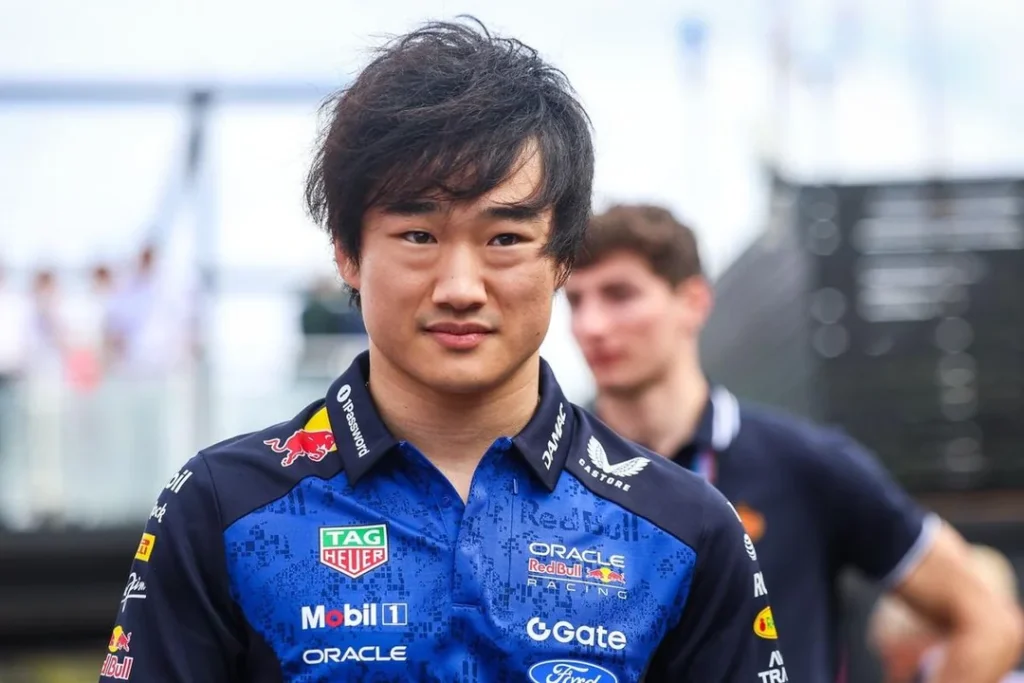
The latest wave of discussion surrounding Yuki Tsunoda’s future has quickly evolved beyond the original quote and into something far more revealing about how Formula 1 actually operates. What began as a seemingly supportive comment has instead exposed a recurring dynamic in the sport: public backing rarely translates into real opportunity.
At the center of the conversation is a familiar contradiction. When figures within the paddock suggest a driver “deserves another opportunity,” it is increasingly being interpreted not as a concrete endorsement, but as a form of diplomatic distancing. The sentiment echoes previous situations—most notably the long-standing support voiced for Mick Schumacher without any corresponding seat offers at the sharp end of the grid.
That comparison has become unavoidable. The pattern is clear: drivers are often praised in principle, while teams simultaneously look elsewhere when it comes to actual lineup decisions. The irony has not been lost—particularly in cases where teams publicly advocate for a driver’s place in Formula 1 while opting for younger prospects or alternative talents internally.
The Reality Behind “Deserving” a Seat
The broader reaction highlights a key tension within Formula 1: merit versus availability. The grid is finite, and the threshold for entry—or re-entry—is brutally high. Even drivers who are considered capable or “good enough” are competing in an ecosystem where marginal differences determine careers.
There is growing consensus that simply being competitive is no longer sufficient. Being “half decent” at this level is, in itself, exceptionally rare, and the current grid depth leaves little room for sentiment. Drivers who fail to clearly outperform their peers within a limited window often find themselves replaced—not necessarily because they lack ability, but because others present a stronger long-term proposition.
In this context, Tsunoda’s five-season tenure is increasingly framed not as unfinished business, but as a full evaluation period. The expectation is no longer patience—it’s immediate differentiation.
Nepotism, Narrative, and the Schumacher Effect
The discussion has also reignited debate around legacy and name recognition. The Schumacher surname continues to act as both an accelerant and a burden. On one hand, it likely opened doors; on the other, it amplified scrutiny when results did not consistently follow.
There is a strong view that without that legacy, Schumacher’s trajectory may have mirrored other highly rated junior drivers who never secured a Formula 1 seat at all. Comparisons to drivers like Théo Pourchaire or Felipe Drugovich—talents who succeeded in feeder series yet stalled at the final step—underscore how narrow the pathway truly is.
At the same time, the pendulum swings both ways. While nepotism is frequently criticized, the moment a recognizable name appears, there is often a parallel push to see that driver reinstated, regardless of prior performance. The contradiction reflects a fanbase—and paddock—that is not always aligned on what meritocracy should look like in practice.
Development Pathways and Missed Opportunities
Retrospective analysis has also focused on career decisions and environments. Schumacher’s move to Haas is widely viewed as a pivotal moment—one that may have limited his development trajectory. Alternative pathways, such as a reserve role with Alfa Romeo, are now seen as potentially more conducive to long-term growth.
The broader takeaway is that driver development in Formula 1 is highly context-dependent. Raw talent alone is insufficient; team structure, mentorship, and timing all play decisive roles. A misaligned first seat can have lasting consequences, particularly for young drivers entering unstable or underperforming teams.
Tsunoda’s Position: Between Opportunity and Saturation
For Tsunoda, the situation is less about capability and more about market dynamics. There is little argument that he could succeed in other categories—whether endurance racing, hypercars, or alternative single-seater series. The question is not whether he deserves to race, but where that opportunity realistically exists.
Formula 1, as it stands, offers limited pathways back once a driver exits the grid without a clear upward trajectory. The competition pool includes not only former drivers seeking returns, but also a constant influx of junior talent waiting for their first chance.
There is also skepticism about the intent behind public statements supporting Tsunoda. Some interpret the messaging as strategic positioning—potentially aimed at generating interest from other teams rather than signaling genuine reintegration plans. In a sport where contracts, affiliations, and manufacturer ties heavily influence decisions, such interpretations carry weight.
A System That Leaves Little Room for Sentiment
Ultimately, the discourse reinforces a fundamental truth about Formula 1: it is not designed to be fair—it is designed to be selective. Deserving a seat and securing one are entirely different equations.
For every driver who “deserves” another opportunity, there are multiple others who never received even a first. The system prioritizes performance, potential, timing, and commercial alignment in equal measure. When those factors do not converge, even capable drivers are left on the outside.
Tsunoda’s situation is not unique—it is simply the latest example of a pattern the sport continues to repeat.