

George Russell has 238 points. Lewis Hamilton has 229. Max Verstappen has 221.
Seventeen points separate three drivers whose fight for second in the championship carries very different implications. For Russell, it is an increasingly uncomfortable defense of a position that once looked like the minimum expectation. For Hamilton, it is an opportunity to turn Ferrari’s uneven season into a stronger result. For Verstappen, it is the chance to complete a recovery that would have looked considerably less plausible earlier in the year. Austin now becomes an important test of that contest. Ferrari has upgrades coming, Red Bull arrives with consecutive victories, and Mercedes has to consider how a season featuring eight wins for Kimi Antonelli and three for Russell has left its more experienced driver vulnerable to finishing behind both Hamilton and Verstappen. Beyond the standings, the approaching United States Grand Prix also brings a broader question into focus: what should Formula 1 offer the people who follow it?
COTA’s changing appearance and concerns about public access, Monaco’s refusal to alter its layout, the purpose of F1 Academy, and Franco Colapinto’s stand against online abuse all touch different parts of that relationship. The racing remains central, but access, opportunity, and the treatment of the people involved shape the sport around it.For McLaren, those questions are more immediate. The fallout from Singapore concerns how its drivers race each other, how the team assigns responsibility, and whether one costly collision is being asked to explain too much of an inconsistent season.
Russell’s championship position provides the clearest starting point.

Finishing second will never replace winning the title, but dismissing it as meaningless overlooks the circumstances. Russell entered the season with the experience advantage at Mercedes and the expectations that came with it. Antonelli’s success has changed the internal comparison. That does not establish that Russell’s place is under threat or that Mercedes has formally assigned him a supporting role. It does mean that retaining second would offer some protection against an especially difficult reading of his year: being beaten comprehensively by his teammate while also losing out to drivers from rival teams. The pressure is different for Verstappen. After winning the last two races, he has momentum on his side. Red Bull’s recent form makes him a compelling choice to overturn the 17-point deficit to Russell, although consecutive victories do not guarantee that its advantage will carry through every remaining circuit.
Hamilton is closer to Russell, just nine points behind, but Ferrari’s direction is harder to read. The Austin upgrades offer a potential opening. Their significance will depend on whether they deliver usable performance and help Ferrari address its recent difficulties. An aerodynamic improvement cannot automatically be assumed to resolve a straight-line limitation, and stronger qualifying pace alone would not settle concerns about tire degradation or race execution. Hamilton’s prospects therefore depend on more than his own driving. Ferrari needs to turn its development into a car it can operate consistently across a weekend. Verstappen currently has the strongest momentum. Hamilton has the smaller gap to close. Russell has the position to defend—and arguably the most uncomfortable consequences if he loses it.
McLaren’s challenge is collective rather than individual. Jolyon Palmer’s assessment of the Norris–Piastri collision in the Singapore sprint offers a more sympathetic interpretation of Norris’s attempted pass than the final impact alone might suggest.
“He gets a long way down the inside of Oscar, is under control when he gets to the apex, but he is backing out as he realises Oscar isn’t going to give him the space,” Palmer said.
Palmer regarded the move as a legitimate attempt and believed Piastri could have left more room.
“I think both drivers have their part,” he said. “I think they’re equally to blame.”
There are two separate judgments here: responsibility for the contact and the wisdom of attempting the move in those circumstances. The first requires care. Palmer’s interpretation is that Norris established enough overlap before trying to withdraw, with that withdrawal helping explain why he appeared farther behind as the corner developed. The competing interpretation is that Norris never established the position necessary to require Piastri to concede more room. Those readings cannot be resolved simply by declaring that an attacking driver deserves space because he attempted a pass, or that the defending driver bears no responsibility because he was ahead. Position, control, visibility, and the sequence of the maneuver matter.
The second judgment is less dependent on the precise overlap. This was a last-lap attempt on a teammate in a wet sprint, with one additional point available from exchanging positions. McLaren’s constructors’ position gave the team a strong reason to protect the combined result. Even an overtaking opportunity that is technically available can represent poor judgment when the potential gain is small and the consequences affect both cars. That is a reasonable criticism of Norris. It does not require turning the attempt into a moral failing or suggesting that drivers should stop taking risks.
Piastri’s role also deserves scrutiny without assuming that avoiding an accident and causing one are equivalent. A driver might have an opportunity to prevent contact without carrying equal responsibility for creating the situation. Equally, teammates have a shared interest in leaving enough margin to bring both cars home. McLaren’s management belongs in that assessment. If the team permits its drivers to race, it must account for the possibility that they will attempt passes. If particular conditions make that risk unacceptable, clear instructions are the available tool. The more difficult issue is how Singapore fits into McLaren’s season.
The lost points matter. They could become more painful if the constructors’ contest finishes closely. But a season includes strategy decisions, reliability, pit stops, development, and the performances of both drivers. One collision cannot reasonably carry responsibility for all of those. Norris’s contribution elsewhere does not exempt him from criticism for Singapore. The same principle applies to the team: his mistake does not exempt management from examining the points lost through its own decisions. A credible no-blame culture still requires accountability. Its value lies in allowing mistakes to be examined honestly and corrected. That standard has to extend throughout the operation, including the pit wall. McLaren can demand better judgment from Norris while recognizing that preserving third in the constructors’ championship requires a stronger collective performance.
Christian Horner’s latest account of Red Bull’s driver decisions raises a different question about managing two competitive cars.

Horner says he wanted Fernando Alonso or Charles Leclerc alongside Verstappen, but that someone within Red Bull opposed the move.
“I knew right away that that order didn’t come from Max,” Horner said.
“But someone had decided somewhere that it was not the right step for Red Bull. I was disappointed.”
His account does not identify who blocked the idea or establish how close either signing came to happening. It does, however, expose the strategic choice behind Red Bull’s second seat. An established driver of Alonso’s or Leclerc’s caliber could offer stronger results, another source of technical feedback, and greater protection against relying heavily on Verstappen. That driver would also arrive with competitive ambitions of his own. A stronger teammate might take points from rival teams. He might also take points from Verstappen. The balance would change from race to race, and no retrospective calculation can establish exactly how a championship would have unfolded.
Leclerc’s battles with Verstappen make that hypothetical pairing especially appealing. Their ability to produce close racing suggests the sporting potential of putting them in comparable machinery. It cannot guarantee harmony inside the same garage, where strategy, development priorities, and title ambitions would introduce different pressures. Alonso would present another formidable possibility. His racecraft and adaptability make the appeal clear, but admiration between drivers is no assurance that either would readily accept losing an internal contest. For Red Bull, the junior program complicates the decision further. Promoting from within gives its development structure a purpose and its prospects a destination. Recruiting an established star could strengthen the senior team while reducing those opportunities.
Neither approach is automatically correct. A team needs a productive second car, a viable succession plan, and enough organizational strength to manage competition between its drivers. That final requirement matters regardless of the names involved.
At COTA, the balance between competing priorities is becoming visible in the buildings around the circuit.
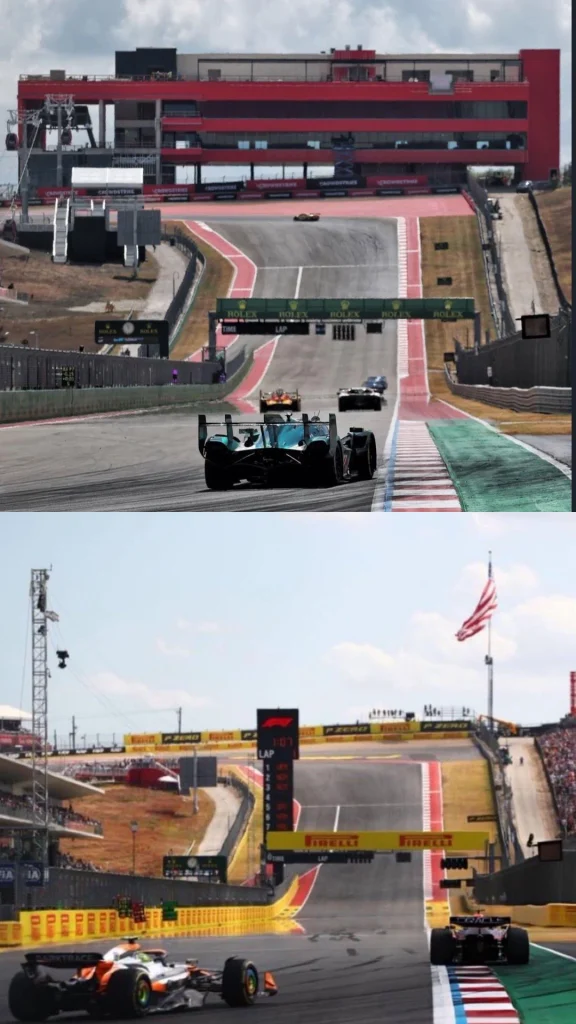
The new Turn 1 VIP development raises an aesthetic question, but the more consequential issue concerns what spectators can access and what the venue offers beyond its major race weekends. A hospitality building can provide an exceptional experience for the people inside it. Its presence alone does not establish that general admission viewing has been removed. The practical assessment needs to consider sightlines, walking routes, and the space available to ordinary spectators. Those distinctions matter because the accounts of the Turn 1 changes differ. Losing a familiar view, having a route altered, and losing a viewing area are separate impacts.
The concerns about COTA’s wider direction are more substantial: an increasingly exclusive private-club model, expensive membership, and the possible displacement of public driving and community activities. If public track days are removed in favor of members’ use, that would reduce an established way for enthusiasts to experience the circuit. The possible loss of cycling access would extend the issue beyond people who want to drive racing cars or supercars. Public financial support makes the question of community benefit particularly important. COTA being privately operated does not make public access irrelevant when taxpayer support forms part of the argument surrounding its activities.
A major-event venue can generate benefits without opening every facility to everyone. But the continued availability of Grand Prix tickets does not answer every concern about losing activities that previously connected local people to the track throughout the year. COTA’s appeal makes that tension especially frustrating. Its width, elevation changes, fast opening sector, and opportunities for overtaking give it a strong sporting identity. The Texas setting adds character. A circuit does not need the longest history on the calendar to become a meaningful part of Formula 1.
Preserving that appeal involves the experience of attending as well as the quality of the racing. Monaco approaches the same relationship from a different direction. With layout changes ruled out, its familiar limitations remain. Qualifying offers an unusually intense test, while the race can struggle to provide opportunities to pass.
Monaco’s setting and history are substantial parts of its value. Those qualities explain its appeal, including to committed racing followers. They do not remove the sporting problem. Proposals involving Portier, a longer acceleration section, or relocating the chicane deserve to be assessed as engineering and safety questions. The conflicting estimates of how much useful straight those changes would create make precise claims about their benefit premature. Removing the chicane altogether is also more complicated than drawing an uninterrupted line from the tunnel toward Tabac. Approach speed, the following corner, and the available escape space remain part of the problem.
Tire changes offer no guaranteed solution either. A softer compound can create strategic differences, but if a leader can slow the field enough to protect the tires and still prevent a pass, degradation does not necessarily produce better racing. Monaco’s identity can justify its place while still leaving room to demand a more competitive Sunday. Miami deserves the same separation between setting and sporting performance. Disliking its surroundings does not establish that its races are worse. Conversely, enjoying Monaco’s scenery does not make its overtaking limitations disappear. A strong calendar can contain different kinds of events. Each still needs to offer a convincing experience.
F1 Academy’s contribution should be examined with a similarly clear distinction between immediate results and longer-term purpose.

Wanting to reach Formula 1 is an ordinary ambition for a junior driver. A young woman expressing that ambition is not claiming that she has already earned a seat. Results remain essential. A driver’s performances in mixed competition provide meaningful evidence about readiness to progress. Individual struggles should be examined honestly, without turning them into a verdict on every girl who might enter karting. Increasing participation and developing an F1-ready driver are connected objectives, but they operate over different timescales.
Visibility can help girls imagine themselves racing and encourage families to take that interest seriously. Supported opportunities can also give drivers access to coaching, competition, and attention they might otherwise struggle to secure. The next step matters just as much. A prominent platform needs routes into further competition, funding that supports progression, and opportunities to measure development against stronger fields. Moving to faster cars would not automatically solve those problems. Higher costs and a smaller pool of ready drivers could undermine access. Remaining at an introductory level also requires a convincing answer about what follows. F1 Academy should be judged on both participation and progression. Its drivers deserve support and serious sporting assessment, including the freedom to aim higher without having that ambition treated as an offense.
Colapinto’s message provides an appropriate final reminder of what serious assessment should exclude.

He has called for an end to toxicity against others and spoken about its effect on his career and his withdrawal from social media. A driver can condemn abusive behavior and make clear that it is unwelcome. He cannot control every person who claims to support him. Responsibility for sending abuse remains with the person sending it. That standard should apply across the grid. Nationality does not explain away harassment, and allegiance to a driver does not justify threats against a rival or team member.
Criticism is part of following Formula 1. So are frustration, disagreement, and demanding better performances. None requires treating another person as a target. As Austin approaches, there is plenty to assess: Russell’s defense of second, Hamilton’s opportunity, Verstappen’s momentum, Ferrari’s upgrades, and McLaren’s response to Singapore. Those stories provide enough competitive tension on their own.
Colapinto’s request should be straightforward to honor: support the driver, debate the racing, and stop the abuse.