

The Formula 1 calendar may be in a lull, but the fanbase certainly is not. Between debates over whether the 2026 regulations have actually improved racing, rumors so absurd they were immediately labeled “fan fiction,” Mercedes launching yet another brightly-colored collection, and McLaren social media accidentally becoming the center of a generational marketing discourse, the community found plenty to argue about during the break.
And perhaps most notably, there’s a growing feeling that the early narrative around the 2026 regulations is becoming far more complicated than the doom-and-gloom many expected before the season began.
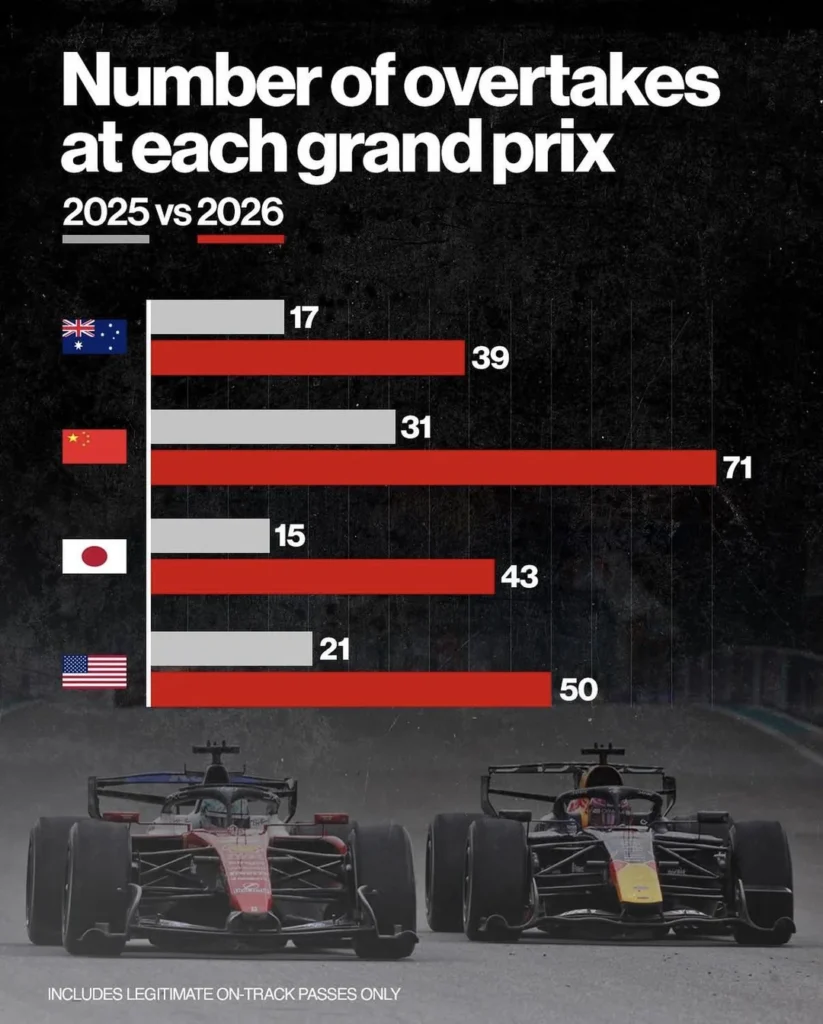
According to data shared by The Race, overtaking numbers have dramatically increased compared to 2025. Australia reportedly jumped from 17 legitimate on-track passes in 2025 to 39 in 2026. China increased from 31 to 71. Japan rose from 15 to 43, while Miami climbed from 21 to 50.
That immediately reignited one of the biggest debates surrounding the current regulations: are the races actually better, or are fans simply arguing over how the overtakes are happening?
Some fans questioned the methodology behind the numbers almost immediately, noting that Formula 1’s own graphics during the 2025 Australian Grand Prix claimed far higher totals. Others argued the discrepancy likely came from how overtakes are classified, with several pointing out that official counts only register when a position is maintained at the start of the next lap, while pit cycle changes and lapped traffic may inflate other statistics.
Suzuka became one of the biggest flashpoints in the conversation. Despite Japan 2026 showing a major statistical increase over 2025, many fans still remembered last year’s race as one of the most processional events in recent memory. Some joked they could barely remember a single pass in the top 10 during Suzuka 2025, while others argued fans are already engaging in revisionist history because of their dislike for the new regulations.
The broader discussion quickly evolved into a philosophical argument over what fans actually want Formula 1 racing to look like.
Some argued that while the new regulations still have flaws — particularly with qualifying and the infamous “superclipping” conversations surrounding battery deployment — the actual wheel-to-wheel racing has improved. Miami, in particular, was repeatedly highlighted as a circuit where the new rules appeared to work well because of the heavy braking zones that allow more energy recovery opportunities.
Others countered that the racing still feels artificial. Rather than drivers fighting organically through corners, many fans argued overtakes now feel dictated by deployment mapping, battery management, and optimized energy harvesting strategies. Several pointed to Formula 1’s long-standing issue of favoring straight-line DRS passes rather than encouraging side-by-side corner battles.
That criticism also tied into growing frustration with the current driving guidelines. Fans argued Formula 1 effectively discourages aggressive side-by-side racing by allowing drivers to force rivals off-line so long as they technically comply with the rules. As some noted, many of the sport’s best modern battles only happen when drivers ignore the written conventions entirely and simply race each other naturally.
At the same time, others pushed back on constant comparisons to series like WEC. While endurance racing was praised for producing cleaner multi-line racing thanks to traffic constantly sweeping marbles away from the racing line, many argued Formula 1 has never truly been built around that style of racing and likely never will be.
Still, even fans defending the new regulations often admitted the power unit side remains controversial. Several discussions centered around the balance between electrification and combustion power, with many suggesting the chassis regulations may actually be functioning better than expected while the engine formula continues to create awkward racecraft compromises.
That debate only intensified after comments from Ford and General Motors executives expressing support for a possible return to V8 engines in Formula 1.
GM president Mark Reuss admitted he loves V8s and the way they sound, while emphasizing respect for the investment manufacturers already made into hybrid V6 technology. Ford racing chief Mark Rushbrook similarly stated Ford would “love to see a V8” in Formula 1 given the company’s extensive naturally aspirated V8 heritage.
The comments immediately reignited the sport’s ongoing identity crisis between road relevance and entertainment value.
A large portion of fans argued “road relevance” has effectively become little more than a corporate justification tool used to explain enormous development budgets to shareholders. From their perspective, fans themselves rarely care whether an F1 power unit directly resembles a road car drivetrain.
Others countered that the issue is more nuanced. Formula 1’s manufacturer involvement brings prestige, sponsors, and financial stability to the entire sport, and road relevance — even if indirect — remains a major selling point for automotive companies. Several fans pointed out that while nobody walks into a dealership demanding “F1 tech” specifically, racing still shapes brand perception in subtle ways.
The larger frustration, however, centered on the belief that Formula 1 may have overcorrected toward electrification. Fans repeatedly criticized the 50% EV-heavy philosophy of the current regulations, particularly given how often drivers and engineers warned about energy management concerns long before the rules were finalized.
Some blamed shifting automotive industry priorities. When the regulations were first crafted, manufacturers strongly believed full electrification represented the future of the automotive world. Now, with sustainable fuels gaining traction and EV adoption slowing in some markets, many believe Formula 1 is already pivoting back toward a more combustion-focused future.
And naturally, once V8 discussions started, fans immediately began debating which engines sounded best historically.
Many championed naturally aspirated V10s as the definitive Formula 1 soundtrack, while others argued V8s actually have a longer and more historically significant place in the sport. Some even nostalgically referenced late-1990s CART engines, saying turbocharged high-revving V8s could bring older American open-wheel fans flooding back toward Formula 1.
The Cadillac Hypercar program also entered the conversation repeatedly, with fans praising the car’s uniquely guttural V8 sound in WEC competition and imagining what a modern F1 equivalent could sound like using sustainable fuels.
Elsewhere in the paddock discourse, fans spent much of the week collectively mocking a particularly outrageous rumor claiming Max Verstappen and Oscar Piastri were discussing a sensational driver swap.
The rumor was immediately shredded by much of the community, with many describing it as pure “fan fiction” rather than legitimate reporting. The discussion rapidly devolved into jokes about elaborate Archive of Our Own tags, fictional “slowburn” storylines, and increasingly absurd relationship memes involving nearly the entire paddock.
Even the phrasing of the rumor became a target. Fans joked that regular rumors apparently were no longer enough for modern F1 media, with “sensational” and “spectacular” now seemingly mandatory adjectives for any transfer speculation.
Still, beneath the sarcasm, some fans acknowledged there are at least understandable reasons why both names would theoretically appear in long-term discussions.
From Verstappen’s side, some pointed to Red Bull’s internal instability and the departure of key personnel around his championship-winning years. Others noted that any top driver would naturally explore options if another team appears to have the strongest package under a new regulation set.
From McLaren’s perspective, some argued signing Verstappen would eliminate the threat of racing against him entirely while maximizing a potentially dominant package.
But the overwhelming consensus remained disbelief. Most fans simply could not envision McLaren willingly dismantling one of the strongest driver lineups on the grid, nor Verstappen making such a dramatic move in the immediate future.
And then there was Mercedes.
The team’s upcoming blue collection somehow generated one of the strangest discussion threads of the week, largely because fans immediately became distracted by George Russell’s promotional photos rather than the clothing itself.
Russell’s awkward posing sparked endless jokes comparing him to everything from a haunted doll to an alien attempting to imitate human body language for the first time. Others joked he appeared permanently uncomfortable outside of expensive knitwear and polo shirts, while several fans suggested he looked like he was stuck halfway between standing normally and entering a full T-pose.
The collection itself also became part of a larger ongoing joke surrounding Mercedes constantly changing color themes for race weekends. Fans joked the team was gradually assembling an entire rainbow collection after previously running purple, green, yellow, and now blue aesthetics throughout the season.
Not everyone appreciated the experimentation. Some fans described the designs as looking like cheap 1990s football kits, while others argued the absence of Tommy Hilfiger’s previous influence on the team’s branding is becoming increasingly noticeable.
Andrea Kimi Antonelli’s styling choices also became a discussion point, with his choker generating comparisons to “the edgy girl in high school rumored to be into Wicca,” while others joked he looked like someone “one step closer to Wicca” every time Mercedes released another fashion shoot.
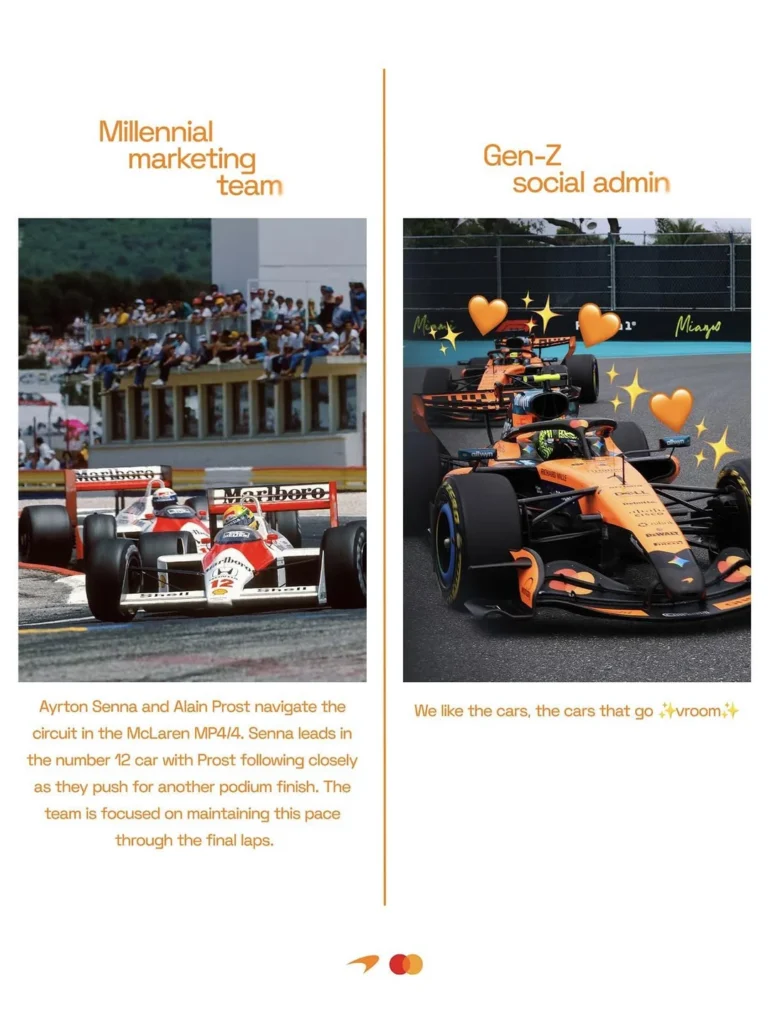
And finally, McLaren’s social media team accidentally found themselves at the center of an entirely different internet argument after posting a deliberately simplistic “cars go vroom” style meme.
Fans immediately began debating whether corporate social media teams are becoming increasingly homogenized through trend-chasing algorithms and marketing ecosystems. Many described the meme format as bizarre because, unlike most internet trends, it appeared to originate almost entirely from brands themselves rather than naturally spreading through meme culture first.
Others viewed the entire thing as little more than engagement bait designed to manufacture generational discourse between millennials and Gen Z audiences.
Ironically, several fans pointed out the meme itself didn’t even make chronological sense, since millennials would have been far too young to actually run McLaren marketing departments during the Ayrton Senna and Alain Prost era being referenced.
That only escalated into an even broader argument about how every generation eventually becomes labeled “old” by the next one — with many millennials now realizing they have apparently become the internet’s newest “boomer” equivalent.
Some fans defended the approach as harmless modern meme marketing, while others described McLaren’s recent social media output as outright abysmal. Several even argued Visa Cash App RB now feels like the only team genuinely capturing Gen Z internet humor naturally rather than forcing it through corporate templates.
Which, in many ways, perfectly summarizes Formula 1’s current online ecosystem.
Even during a quiet break in the calendar, the sport somehow still finds ways to turn overtaking statistics, engine philosophy, fashion shoots, driver rumors, and social media memes into full-scale civil wars.