

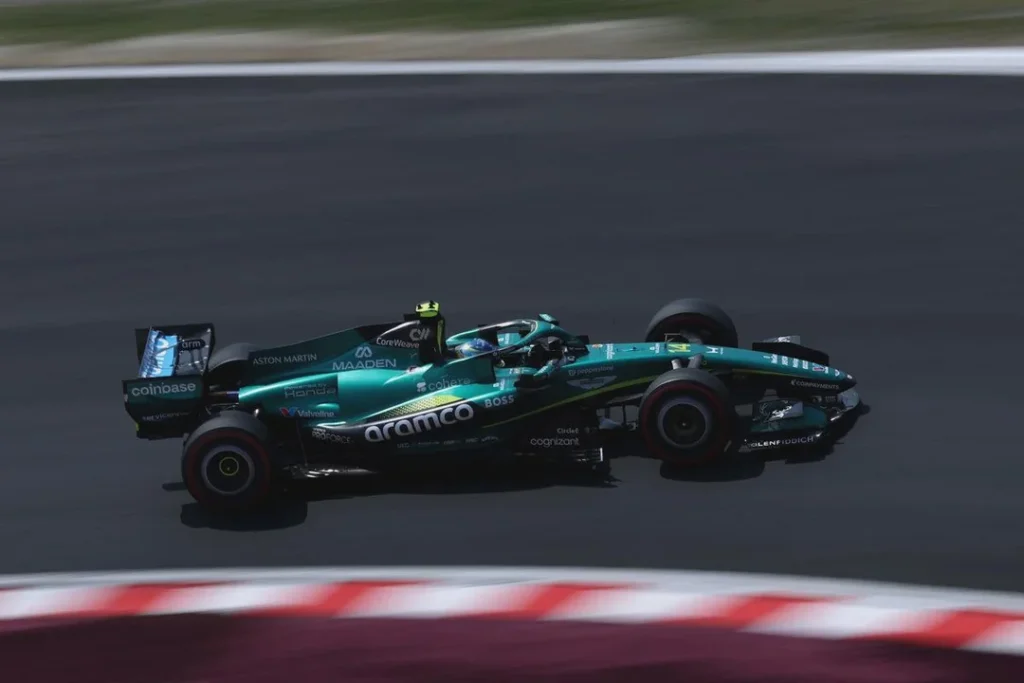
Formula 1 finds itself in a familiar place—caught between narrative and reality. Across the paddock, three very different storylines are unfolding: the relentless speculation around Max Verstappen’s future, Ferrari’s latest promise of a breakthrough, and Aston Martin’s sobering confrontation with just how far off the pace they really are.
Verstappen vs the Narrative Machine
Martin Brundle’s blunt assessment—either commit to Formula 1 or stop talking about leaving—cuts through the noise. But the reaction to that sentiment reveals a deeper frustration: this isn’t a story being driven by Max Verstappen as much as it is being manufactured around him.
The dominant view is that Verstappen is trapped in a media loop he didn’t create. He’s repeatedly asked about retirement, gives measured, non-committal answers, and those answers are then stretched into full-blown narratives. What begins as a few words quickly snowballs into days of headlines, analysis, and recycled speculation.
That dynamic has turned into a “no-win situation.” If Verstappen answers honestly, the story grows. If he refuses to engage, that refusal becomes the story. Even a neutral response risks being reframed as hostility or controversy.
There’s also a broader critique emerging: Formula 1 media is being accused of amplifying fragments into full narratives, prioritizing engagement over substance. The repetition isn’t coming from Verstappen—it’s coming from the ecosystem surrounding him. The result is a feedback loop where coverage creates the story it claims to report.
At its core, the frustration is simple: Verstappen isn’t publicly campaigning to leave the sport—he’s responding to questions about it. Yet the coverage suggests otherwise, reinforcing the idea that perception in Formula 1 is often shaped less by what is said, and more by how often it’s repeated.
Ferrari’s Eternal “Next Race” Promise
If Verstappen’s situation highlights how narratives spiral, Ferrari’s latest messaging shows how they persist.
Fred Vasseur’s claim that Miami could represent a turning point—effectively a “different championship”—has been met with immediate skepticism. The clarification is straightforward: upgrades are coming, and with them, the competitive order could shift.
But the reaction is telling. There’s little resistance to the idea that upgrades matter—every team brings them. The skepticism is specific to Ferrari. The expectation isn’t that they won’t improve, but that whatever gains they make will either fall short or arrive too late.
That skepticism is rooted in a long-standing pattern: optimism followed by inconsistency. The idea that Ferrari is “not far off” doesn’t inspire confidence—it triggers déjà vu. The expectation isn’t a breakthrough, but another cycle of promise, partial delivery, and eventual reset.
Even when the logic is sound—that a major upgrade phase can reshape the grid—the belief isn’t there. The prevailing view is that if everyone improves, the order likely stays the same. And if Ferrari does make gains, history suggests they won’t sustain them.
In that sense, Ferrari’s challenge isn’t just performance—it’s credibility. The gap they need to close isn’t only on track, but in perception.
Aston Martin: A Much Bigger Problem Than Honda
While Ferrari debates potential, Aston Martin is confronting reality.
Suzuka marked a milestone of sorts: the AMR26 finally completed a race distance. Fernando Alonso brought the car home in 18th, a lap down, but with something arguably more valuable than points—data.
Both Alonso and the team were clear-eyed about what that result means. Finishing the race is progress, but only in the most basic sense. The pace wasn’t there in any session, and it wasn’t there in the race.
Crucially, the issues extend well beyond the Honda power unit.
Yes, there is a significant deficit—estimated at around 100 kW (136 hp) during energy recovery phases. Yes, energy management remains a major limitation, with the internal combustion engine already operating near its limits. But even internally, Aston Martin is acknowledging that the problems are far more comprehensive.
The car is overweight. It struggles in high-speed corners. It lacks baseline performance across multiple areas.
Put simply: it’s not just a slow engine—it’s a slow car.
That distinction matters. Early narratives leaned heavily on Honda’s shortcomings, but the broader picture now points to systemic issues. The AMR26 isn’t being held back by a single weak link; it’s underperforming across the board.
Internally, there’s no attempt to mask that reality. Mike Krack described the situation as “a mountain to climb,” emphasizing that the team needs “giant steps,” not incremental gains. Even reliability—normally a given in Formula 1—has only just reached a baseline level.
There’s also a growing sense that organizational complexity may be contributing to the problem. Frequent restructuring, overlapping leadership roles, and the challenge of integrating multiple high-level engineers have created an environment where clarity and direction are difficult to maintain.
The expectation that a single figure—no matter how influential—could instantly transform the team is being challenged. Success at this level requires alignment across the entire organization, and right now, that alignment appears to be missing.
Escaping the Script: Why Fans Want Something Different
Against this backdrop of heavy narratives and technical struggles, another theme emerges—one that feels almost like an escape from the current structure of Formula 1.
The idea of drivers stepping outside the championship—into GT3 races, Nürburgring runs, or even informal karting events—has captured the imagination. What starts as speculation about Lance Stroll testing GT3 machinery quickly evolves into something bigger: a desire to see drivers compete in environments that feel less controlled and more authentic.
There’s a clear appetite for spontaneity. For racing that isn’t dictated by strategy models, regulatory constraints, or media narratives. Whether it’s a full-grid Nürburgring event, a Monaco kart race, or a throwback-style exhibition, the appeal is the same—strip the sport back to its essence.
That contrast is telling. While Formula 1 continues to grow in scale and complexity, there’s a parallel desire to see drivers in simpler, more direct forms of competition. Not as part of a narrative—but as racers.
A Sport Caught Between Reality and Narrative
Taken together, these storylines paint a clear picture of where Formula 1 currently stands.
Verstappen’s situation highlights how narratives can take on a life of their own, independent of the source. Ferrari’s latest optimism shows how long-standing patterns shape belief as much as performance. Aston Martin’s struggles reveal just how difficult it is to build competitiveness from the ground up, even with significant resources.
And beneath it all, there’s a growing tension between the sport as it is—and the sport as fans want to experience it.
Right now, Formula 1 isn’t lacking in stories. If anything, it has too many. The challenge is separating what’s actually happening on track from what’s being constructed around it.
Because in a season already defined by speculation, upgrades, and rebuilding efforts, the biggest battle might not be for positions—but for clarity.