

Formula 1 hasn’t turned a wheel in anger yet, but the discourse is already in mid-season form, from Kimi Antonelli’s San Marino crash to Fernando Alonso questioning whether modern F1 has optimized away its soul.
Antonelli’s 144-Meter Wake-Up Call
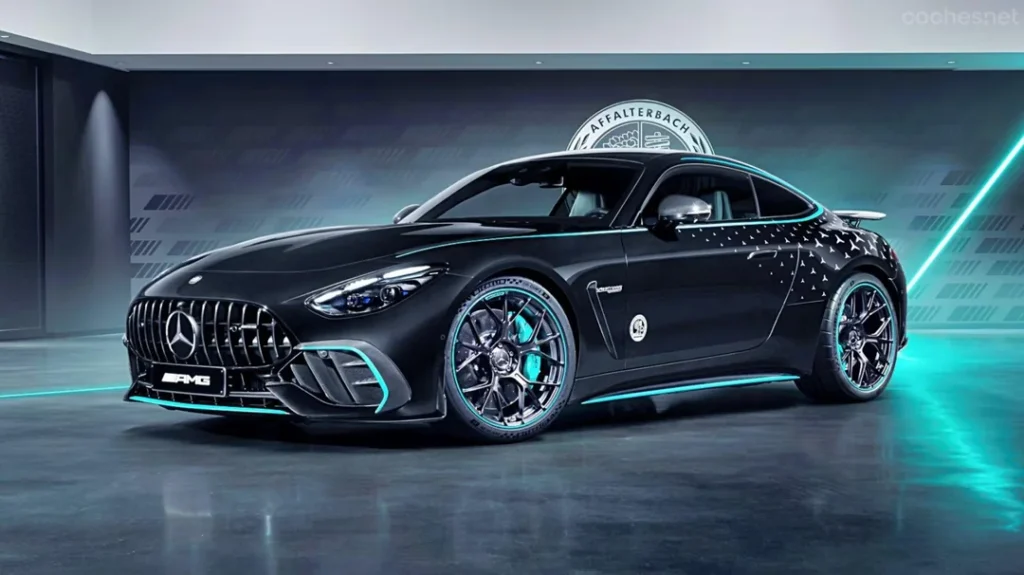
Mercedes confirmed that Kimi Antonelli was involved in a single-car traffic accident near his home in San Marino before the Bahrain Grand Prix. He was unhurt. The car was not.
Early reactions treated it lightly, the kind of “get the crashes out of the system before the season” narrative that tends to follow young drivers. But a more detailed reconstruction painted a sharper picture.
According to local authorities, Antonelli’s AMG GT 63 PRO Motorsport Collectors Edition first struck a roadside signpost, was redirected toward the center of the road, hit the guardrail twice, and finally came to rest against a containment wall. The total trajectory measured approximately 144 meters, a figure suggesting significant speed at the moment control was lost.
The location matters. The road, Via Cinque Febbraio on the “Superstrada di San Marino”, isn’t a flat-out autostrada. It’s a divided dual carriageway with residential and commercial buildings alongside it, bus stops, pedestrian crossings, and varying speed limits reported between 70 and 90 km/h. Locals were quick to clarify that “superstrada” does not mean “superhighway.” It’s a hybrid: faster than a city road, tighter than a motorway. Crashes there are not unheard of, especially involving powerful sports cars.
Still, the optics are unavoidable. Antonelli is 19. He had reportedly just received the car days earlier. And while F1 drivers are elite at the limit on circuit, public roads are different ecosystems entirely, pedestrian crossings, traffic signals, inconsistent surfaces, unpredictable drivers. Tracks don’t simulate that.
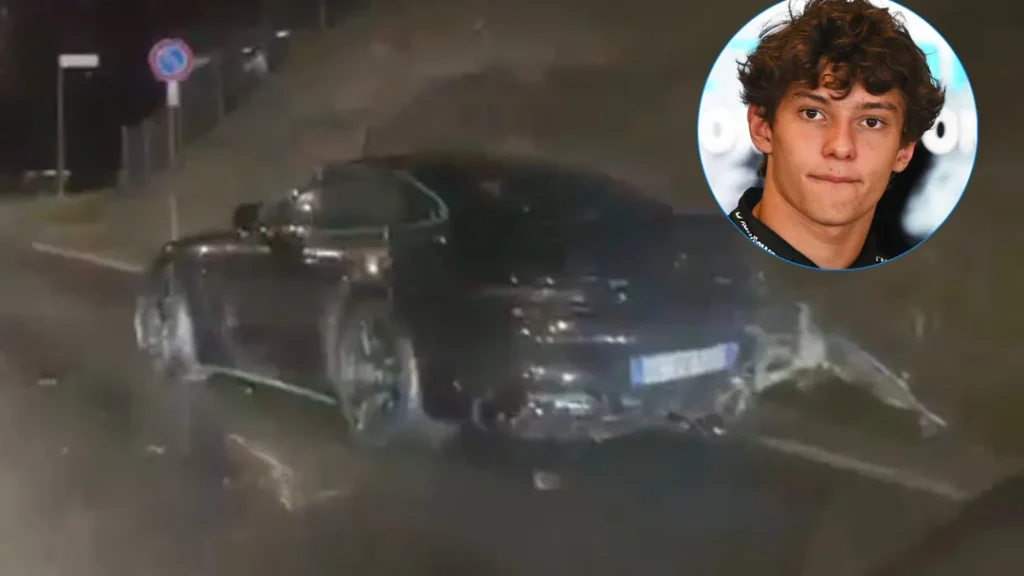
There was predictable sarcasm: when it’s a podium, the driver gets the credit; when it’s a crash, the car “lost control.” The official phrasing that the “powerful car suddenly lost control” drew immediate scrutiny. A 600-horsepower rear-wheel-drive supercar does not detach itself from its driver.
There was also context layered in from his past European results, last season’s European stretch was inconsistent and scoreless, fueling the tongue-in-cheek narrative that perhaps the “EU curse” extends beyond circuits.
And then came the family angle.
Discussion resurfaced around a prior incident involving Antonelli’s father, Marco, who was involved in a traffic altercation with a police officer in Italy. Online consensus suggested he avoided charges, with debate over whether influence played a role. Others pushed back on exaggerated phrasing, noting that describing it as “ran over” overstated what was shown in available footage.
The broader takeaway isn’t scandal. It’s perception. A teenage F1 driver, a limited-edition AMG, a 144-meter impact sequence, and a fanbase that oscillates between humor, concern, and fatalism.
Antonelli will participate in testing. Physically, he’s fine. Reputationally, it’s a reminder: talent at 300 km/h doesn’t immunize you at 70.
San Marino, Tax Havens and Licensing Loopholes
Antonelli’s residence also became a flashpoint.
San Marino, described alternately as Italy’s Monaco or a “tax paradise”, triggered debate about driver migration patterns. It’s not unique. Most of the grid lives in some form of tax-advantaged jurisdiction. Critics argue it normalizes opting out of contributing to the country that shaped you. Defenders point out proximity (he’s from Bologna), family residence history, and regulatory nuance.
One overlooked detail: Italy restricts new drivers to vehicles under 95 horsepower for the first year (and additional limits beyond that). San Marino does not. Antonelli reportedly obtained his license there, which legally allows him to drive high-powered machinery at a young age, including Mercedes’ road cars that would otherwise be off-limits under Italian rules.
Ironically, the same system that enabled him to drive the AMG also now fuels commentary that perhaps the restriction wasn’t entirely irrational.
Alonso: Has F1 Optimized the Joy Away?
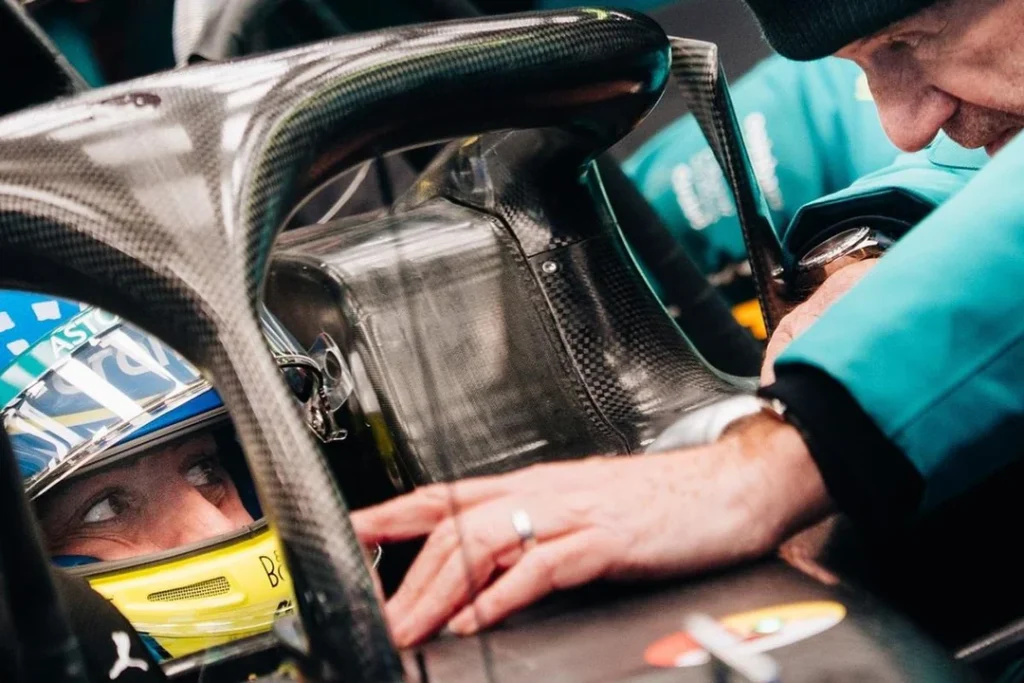
While Antonelli’s incident played out off track, Fernando Alonso ignited a philosophical one on it.
Speaking about modern Formula 1, Alonso suggested that the sport will never return to the late 1990s or early 2000s era, lighter cars, louder engines, more visceral connection, which he described as closer to the “peak of the Formula 1 DNA.” He didn’t call modern F1 worse. He called it different.
But one phrase stuck: driving now can feel like “overthinking,” and that’s “always a risk of having less joy behind the wheel.”
The headline framing triggered predictable backlash, accusations of clickbait, ageism, and reductive interpretations like “retire then.” But the full quotes reveal nuance. Alonso wasn’t attacking the value of F1 today. He was articulating a shift from raw limit-driving toward efficiency management: battery, tires, engine modes, telemetry. He compared it to IndyCar and WEC, similar dynamics.
Fans understood immediately.
The consensus theme: optimization.
Where strategy used to be a couple of engineers with pen and paper before a race, it’s now airtight simulation loops. Where early eras featured design variance and mechanical fragility, modern engines are bulletproof and convergence-driven. Regulation resets function like “major patches,” but teams carry forward analytical fundamentals that compress unpredictability.
The comparison to video games was strikingly consistent. In gaming, players eventually optimize the fun out of the system. Early phases feel magical because no one knows the meta. As skill levels rise and analytics refine decision-making, mistakes decrease, and with them, unpredictability.
The NBA’s three-point revolution. Speedrunning in gaming. Excel spreadsheets for Diablo builds. Automated astrophotography setups that remove the tactile joy. F1, some argue, is speedrunning reality, shaving milliseconds through exhaustive systems engineering.
Even sprint weekends were cited as more exciting precisely because they limit data accumulation. Less practice. Less factory data streaming. Less simulation certainty. In the 1990s, Schumacher learned Spa on a bicycle. Today, drivers arrive with thousands of simulator laps.
This isn’t decline. It’s convergence.
As one line summed it up: in the 1960s, drivers were lion tamers. Now they’re surgeons.
The question isn’t whether that’s impressive. It’s whether it’s entertaining.
Russell, Sass and the Internet Machine
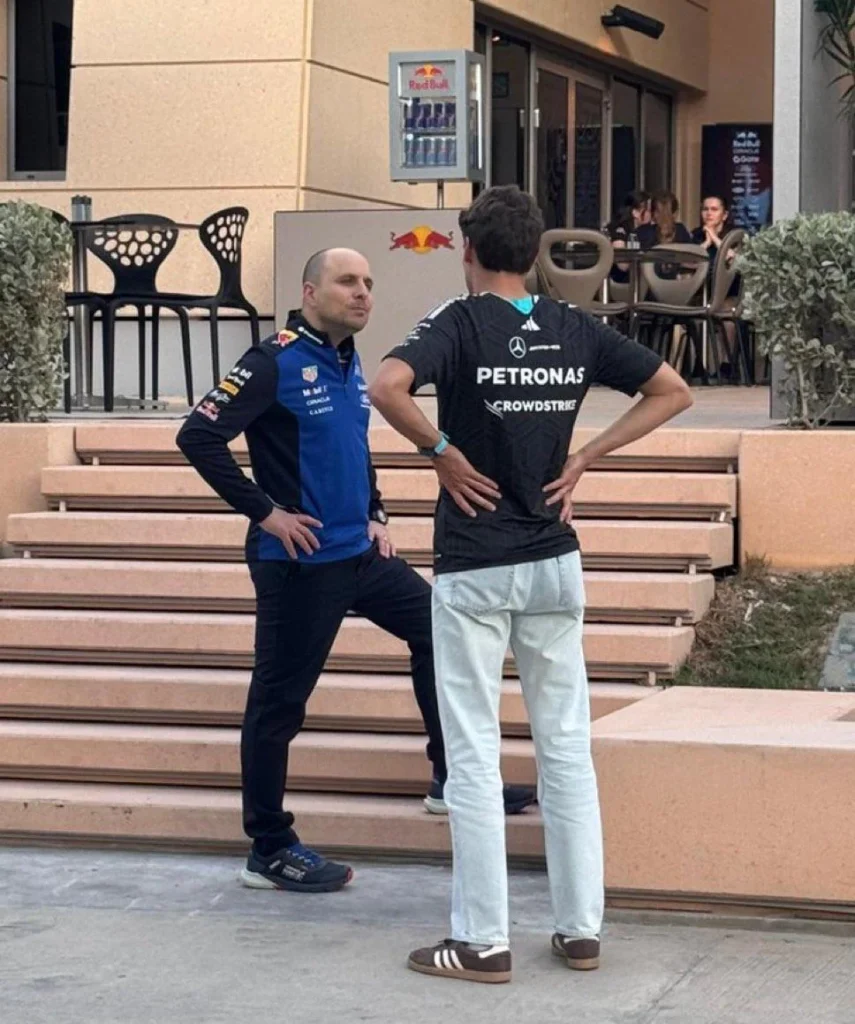
Meanwhile in Sakhir, George Russell and race engineer Gianpiero “GP” Lambiase became the center of a completely different type of discourse.
A simple image of the two standing near each other triggered layers of interpretation, from mock technical analysis of “front hip mount versus rear mount” to body-language breakdowns bordering on wildlife documentary narration.
It was unserious. But it was revealing.
Russell, often described as “extremely dad-coded,” somehow simultaneously 28 and 57, draws outsized reaction for posture alone. GP’s presence, welcomed after a difficult personal year as his wife battles cancer, grounded the moment in reality. Behind the memes and exaggerated dominance metaphors is a genuine appreciation that he’s back trackside.
The modern F1 ecosystem amplifies everything: stance becomes storyline; headline becomes battleground; chrome becomes controversy.
Cadillac’s Chrome Conundrum
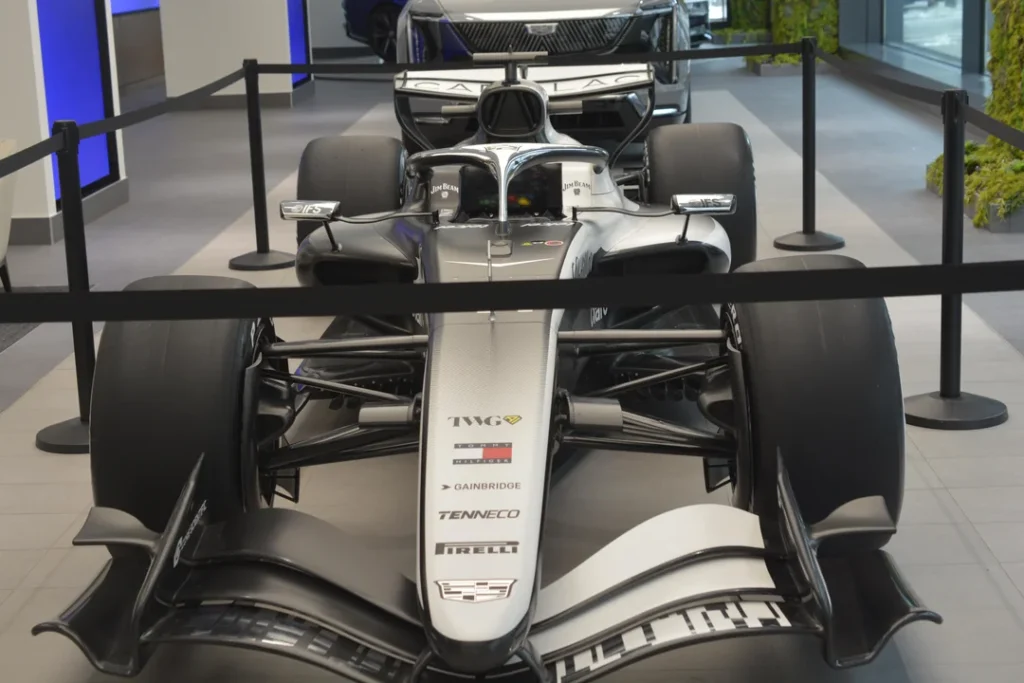
Which brings us to Manhattan.
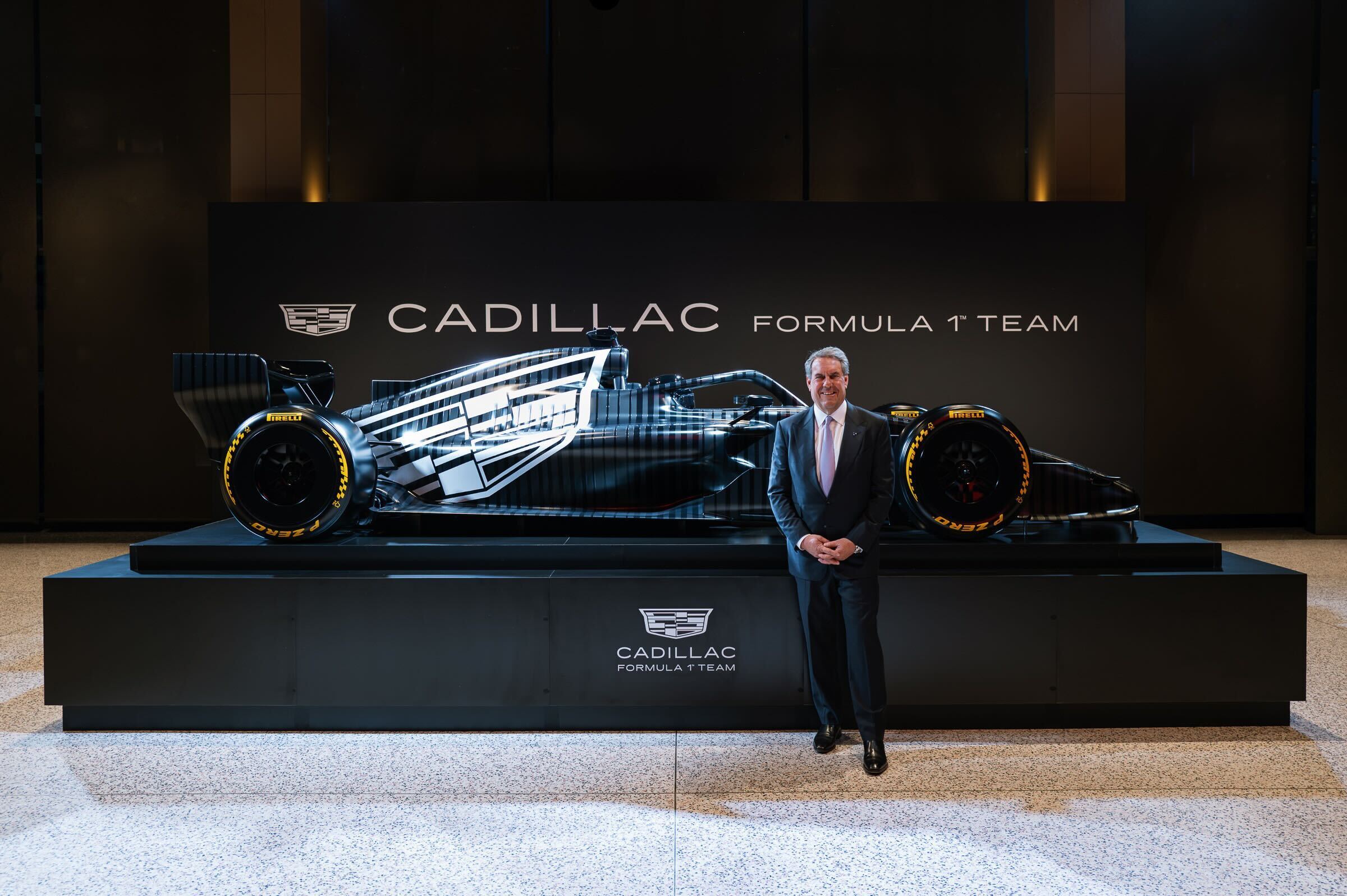

Cadillac’s F1 show car appearance at a Manhattan dealership reignited debate about its livery, specifically, chrome.
Fans widely agreed that the chrome accents, especially the rear stripes and the reflective halo treatment, elevate the design dramatically, tying black and white elements together and adding theatrical presence under lights. Without them, the pared-down version shown previously felt monochromatic, even placeholder-like.
There’s skepticism that the race car will carry the chrome at all. Observers noted that the Barcelona shakedown version lacked wheel covers initially, with components appearing later in the week, raising the question of what is final and what is staged.
Close inspection revealed that some “bare metal” effects are chrome stickers on carbon, not exposed material. The distinction matters less than the aesthetic impact.
But the bigger conversation was strategic.
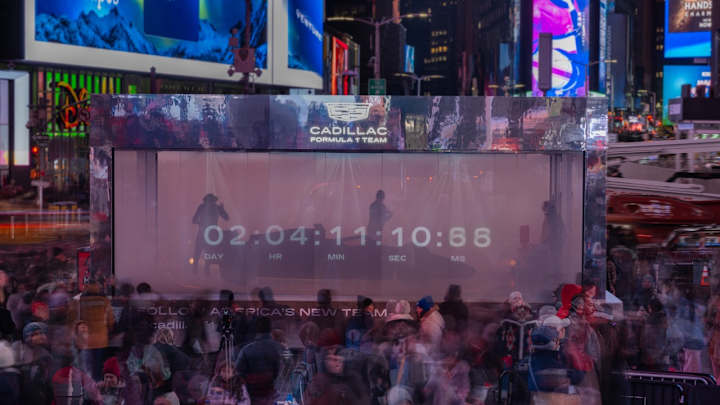
The Times Square activation reportedly lasted only hours, in freezing temperatures approaching -11°C windchill. Visibility was limited, the car elevated, crowds obstructed views. For New Yorkers, the brevity felt strange. For non-locals, the purpose of Times Square itself was unclear.
The logic is financial. A Times Square activation costs a premium per hour. Moving the car to a dealership extends exposure time and aligns with Cadillac’s commercial objective: selling road cars.
Still, some fans felt the moment lacked payoff. A countdown behind frosted glass, a Super Bowl commercial reportedly costing $20 million and now facing legal scrutiny, and no clear live reveal synergy. A lot spent. Uncertain efficiency.
Sound familiar?
Optimization, efficiency, brand calculus, even in livery launches.
F1 hasn’t started its season. But the themes are already clear.
A teenage driver learning that road physics don’t care about potential.
A veteran champion reflecting on whether progress erodes purity.
A grid that has engineered unpredictability out of itself.
A manufacturer balancing spectacle and sales metrics.
Formula 1 isn’t past its peak.
But it is different, and everyone can feel it.