

The 2026 Indianapolis 500 field continues to take shape, with Dreyer & Reinbold Racing confirming Conor Daly will drive the No. 23 DRR Chevrolet for the 110th running of the Indianapolis 500, backed by a new partnership with Kingspan. At the same time, Rahal Letterman Lanigan Racing unveiled the Mobil 1 livery for its No. 15 entry, a design that has already generated significant enthusiasm among fans.
Together, the announcements reflect two familiar threads heading into May: Daly’s recurring presence at the Speedway and renewed appreciation for corporate-backed liveries across the IndyCar grid.
Daly Secures Indy 500 Drive with DRR
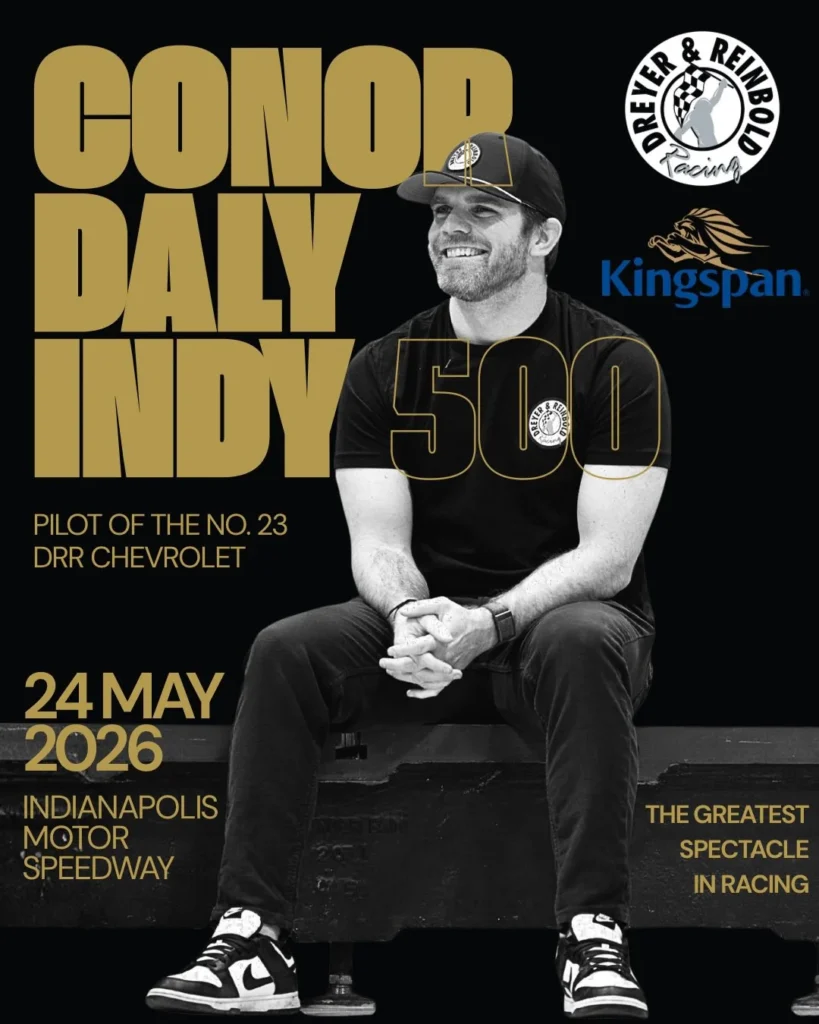
Dreyer & Reinbold Racing confirmed that Daly will once again return to Indianapolis Motor Speedway for the 500, piloting the team’s No. 23 Chevrolet under Kingspan branding.
For Daly, the deal continues a long-running pattern of Indianapolis-only appearances that have become a defining feature of his career. His name returning to the entry list was widely expected, with the arrangement rumored before being formally confirmed.
Even so, the announcement drew plenty of reaction. Daly remains one of the more recognizable personalities in the series, and many observers noted that his presence tends to inject a sense of character and familiarity into the grid. Whether fans love or criticize him, Daly’s personality and willingness to engage with the sport’s community make him a notable presence whenever he appears in the paddock.
From a competitive standpoint, Daly’s reputation on ovals remains central to why opportunities like this continue to materialize. His supporters point to his capability on high-speed oval tracks, particularly at Indianapolis, as justification for his regular returns to the 500 lineup. In their view, Daly remains one of the drivers capable of delivering a credible result on this type of circuit.
Others remain more skeptical, pointing to a career record they see as inconsistent. Critics argue that while Daly’s longevity in the series is undeniable, his results across full seasons have often been middle-of-the-pack. Yet even many of those voices acknowledge that the Indianapolis 500 is a unique environment, one where specialized experience and comfort on ovals can matter more than overall championship performance.
The debate also touched on the recurring “nepo baby” criticism sometimes directed at Daly due to his family connections within the sport. Some observers dismiss the label entirely, arguing it has become an overused phrase that ignores the reality of Daly’s career progression. While his background may have helped open doors early on, they contend that maintaining a presence in the sport, particularly by repeatedly securing funding and race opportunities, requires sustained effort and performance.
Others maintain that pedigree in motorsport inevitably invites scrutiny, especially in a competitive environment where seats are limited. Still, even critics generally concede that Daly’s performance at Indianapolis itself has often justified his inclusion in the race.
Regardless of where one falls in that debate, the practical outcome is clear: Daly is back at the Speedway once again.
Kingspan Sponsorship Raises Questions
While Daly’s return itself generated discussion, the sponsorship attached to the entry sparked even more conversation.
Kingspan, an Ireland-based manufacturing company with operations across the Midwest, will serve as the primary partner on the No. 23 car. For many observers, the sponsorship came as a surprise, largely because the company is not widely associated with IndyCar.
Some speculated that the connection may relate to Daly’s Irish ties, including family connections within Irish motorsport circles. That possibility led to a wave of comments from Irish fans celebrating the news, noting that Daly often feels like the closest thing the country has to a representative in the series.
However, the sponsorship also prompted criticism from some quarters due to controversies surrounding Kingspan’s past business practices and its reported connections to the Grenfell Tower fire in London, which killed 72 people. The company faced significant scrutiny in official reports related to the tragedy, and discussion of that history quickly surfaced in reaction to the announcement.
The broader reaction reflected the familiar tension in motorsport between financial realities and reputational considerations. Some observers argued that teams in Daly’s position cannot afford to turn away major sponsorship opportunities, particularly for an event as resource-intensive as the Indianapolis 500. From that perspective, rejecting funding would likely harm the team far more than it would affect a multinational corporation.
Others expressed discomfort with the partnership, viewing the association as troubling regardless of financial considerations.
In practice, the sponsorship appears unlikely to disrupt the entry itself. The economics of IndyCar, especially for part-time programs, often mean that funding availability ultimately determines which drivers and teams make the grid.
Mobil 1 Livery Wins Over Fans

While Daly’s announcement sparked debate, another development in the IndyCar paddock generated almost universal praise: Rahal Letterman Lanigan Racing’s Mobil 1 livery for the No. 15 car.
The design immediately drew positive reactions, with many observers describing it as one of the standout paint schemes revealed so far this season. The simple visual approach, large Mobil 1 logos placed prominently against a white base, was widely seen as clean, recognizable, and effective.
Mobil 1 liveries have developed a reputation for consistency across multiple motorsport series, and fans were quick to point out that the brand tends to deliver strong-looking designs regardless of whether the car is competing in IndyCar, NASCAR, or endurance racing.
Some noted that the look follows a familiar Mobil 1 template that has been used successfully across various categories. Rather than reinventing the visual identity each season, the company tends to refine and evolve existing designs, which many believe helps maintain a recognizable presence on track.
The approach appears to have continued here. According to one individual involved with the project, multiple concepts were explored during the design phase, including variations that leaned more heavily into the Pegasus branding commonly seen in NASCAR. Ultimately, the team opted to evolve the previous year’s design rather than pursue a more radical change.
The result was widely described as “fresh” and visually striking.
The livery also sparked broader appreciation for the return of major corporate brands to IndyCar cars. Automotive fluids and other industry-related sponsors have long been associated with racing, and many fans expressed enthusiasm about seeing those types of partnerships prominently displayed again.
In a sport historically shaped by iconic branding, from oil companies to tobacco and beer sponsors, such liveries evoke a sense of motorsport nostalgia while still fitting comfortably into modern sponsorship environments.
Some observers also pointed out the irony that Rahal Letterman Lanigan Racing previously carried Total branding on its cars, meaning the team has now featured two major competing oil companies within a relatively short span.
More broadly, the reaction reinforced a growing sentiment that IndyCar has delivered a particularly strong set of liveries this season. Across the grid, fans have increasingly commented on the visual quality of the cars, describing the current crop of paint schemes as some of the best in recent memory.
Momentum Builds Toward May
Taken together, the two developments highlight the many layers of IndyCar’s buildup to the Indianapolis 500.
On one side, Daly’s return underscores the complex ecosystem that surrounds the race, where sponsorship, experience, and opportunity intersect to shape the entry list each year. On the other, the enthusiastic reaction to RLL’s Mobil 1 design shows how much visual identity and brand partnerships still matter to fans.
As May approaches, the storylines will continue to evolve. But for now, Daly has secured his seat, the grid continues to fill out, and IndyCar supporters have already found something to celebrate in the form of another standout livery.