

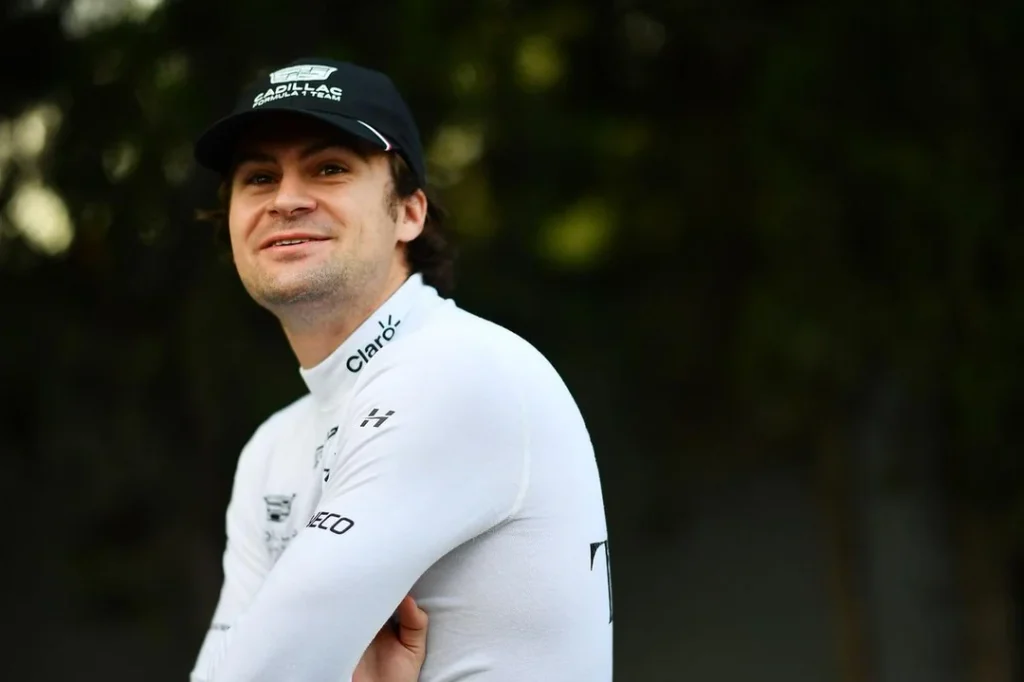
Colton Herta isn’t giving up on Formula 1.
Despite a difficult move from IndyCar to Formula 2, Herta is now aiming at F1 by 2028 and says he “still has a chance.”
Which immediately raises an obvious question: what happened to all that “one in a million” talk?
Because depending on how the next year plays out, Herta’s route to Formula 1 might not be nearly as dead as his results would suggest. In fact, the biggest obstacle may ultimately be less about convincing Cadillac that he deserves an F1 opportunity and more about satisfying the requirements that allow him to take one.
And that is where this gets complicated.
Herta’s Super License may be the real story
The Super License situation surrounding Herta has generated plenty of confusion, particularly because of his 2024 IndyCar points and how long those remain usable.
One interpretation is that Herta needs to get everything done before those 2024 points disappear from the normal three-season calculation. But there’s an important wrinkle: the rules allow drivers to qualify using points accumulated over either the previous three calendar years or the previous two calendar years plus the current year. More importantly for Herta, FP1 points appear to provide another route. Herta is currently sitting on 36 points, according to the information being discussed, with a clean FP1 appearance potentially adding another point. Herta has mentioned the possibility of participating at COTA, which could move him to 37.
From there, suddenly the math becomes much more interesting. The comparison being made is Franco Colapinto, who accumulated 39 points across multiple seasons before an FP1 appearance at Silverstone supplied the final point he needed. Herta could potentially follow a similar path.
There’s disagreement over exactly how the FP1 provisions interact with the competitive-season calculation, but the important distinction is that FP1 points have been described as usable separately from the normal competitive-season window. There is also a maximum of 10 Super License points available through free-practice participation. If that interpretation holds, Herta doesn’t necessarily need to spend another full season racing in Formula 2 simply to preserve his Formula 1 eligibility.
And that could completely change what 2027 looks like.
Another F2 season might actually make things harder
Normally, the answer would seem obvious.
Herta has struggled in Formula 2. If he wants to prove that he’s capable of Formula 1, come back for another season, learn the Pirelli tires and demonstrate that the first year was an adaptation problem rather than a reflection of his ultimate ability. But another F2 season creates its own problems. If participating in another competitive season changes which years can be used for Herta’s Super License calculation, then racing more could potentially be less useful than racing less.
That’s a bizarre situation. Instead, 2027 could become a development year centered almost entirely around Cadillac and Formula 1. Herta could become a full-time test or reserve driver, spend significant time in the simulator, participate in FP1 sessions and potentially conduct private testing. Rather than learning Formula 1 indirectly through F2, he could immerse himself directly in Cadillac’s F1 operation.
There could theoretically still be opportunities for selected races outside a full championship campaign: Daytona, the Indianapolis 500, Le Mans, Petit Le Mans or even GT racing have all been floated as possibilities. That would produce one of the strangest seasons of Herta’s career, but it might also be the most direct route toward his actual objective. If Formula 1 is the only thing Herta is chasing now, spending a year embedded inside an F1 team may accomplish more toward that specific goal than another season fighting an F2 car he clearly hasn’t gotten along with. There is also the possibility of additional FP1 appearances before 2026 ends. COTA has already been discussed, while Mexico, São Paulo and Las Vegas would theoretically provide additional opportunities around the remaining F2 schedule.
There doesn’t appear to be an urgent need to collect every available point immediately if Cadillac isn’t planning an F1 seat for Herta in 2027 anyway. But reducing the remaining Super License work before next season certainly wouldn’t hurt.
But avoiding F2 doesn’t answer the biggest question
Getting a Super License and proving you’re ready for Formula 1 are two very different things.
That’s the uncomfortable part of this entire Herta experiment. His Formula 2 results haven’t strengthened the argument for putting him into an F1 car. They’ve done the opposite. Before this season, there was always an unanswered question about how Herta’s IndyCar speed would translate to the European ladder and, specifically, Pirelli tires.
Now we’re getting an answer, and so far it isn’t particularly encouraging. That doesn’t erase what Herta accomplished in IndyCar. He won an IndyCar race at 18 years old and established himself as one of the series’ fastest drivers. But the concern now isn’t whether Herta can drive a race car quickly.
It’s whether he can adapt quickly enough to a very different one. That makes another F2 season tempting. Herta wouldn’t necessarily need to win the championship to rehabilitate the experiment. A major improvement that demonstrated he’d figured out the tires could change the conversation considerably. There are problems with that strategy too.
The F2 car is receiving an updated aerodynamic package for 2027, which introduces another variable. Hitech was chosen in part because of its performance with the current car. Ritomo Miyata’s season has provided some evidence that the team itself isn’t necessarily the explanation for Herta’s difficulties. Switching teams wouldn’t guarantee anything either. A move to an organization such as Invicta could look attractive based on previous performance, only for the new regulations to shuffle the competitive order. We’ve already seen how quickly a traditionally strong F2 team can end up somewhere unexpected when the technical package changes. So another F2 season could either be Herta’s opportunity to prove everyone wrong or another year making his Formula 1 case look worse.
And the incoming competition wouldn’t make that easier. Drivers such as Freddie Slater and Ugo Ugochukwu would create another measuring stick against which Herta would inevitably be judged.
Cadillac would face a difficult decision
This ultimately isn’t just about whether Herta can obtain the paperwork.
It’s about whether Cadillac would actually put him in the car. There has been a belief throughout this process that Dan Towriss wants Herta in Formula 1 and that the Super License is the primary obstacle. If that’s really the case, 2028 remains entirely plausible as the target. But Cadillac would still have to decide whether replacing an experienced F1 driver with Herta makes competitive sense.
That’s a much harder argument after this F2 season. Experienced midfield-level F1 drivers provide something particularly valuable to a developing team: feedback. They can help identify what the car is doing, guide development and capitalize when an opportunity for a result appears. Replacing that experience with a driver coming off a season struggling to consistently reach the front of Formula 2 would be a major gamble.
And Herta isn’t the only American option. Names including Ugochukwu, Jak Crawford and Kyle Kirkwood have all entered the broader discussion. Logan Sargeant’s junior record has also become relevant simply because his F2 performance provides an interesting benchmark: Sargeant finished fourth as an F2 rookie. That makes the idea that F2 results simply don’t matter difficult to accept.
There are exceptions. Kamui Kobayashi’s GP2 record wasn’t extraordinary before circumstances gave him his F1 opportunity following Timo Glock’s injury. Kobayashi then impressed once he actually got the chance. Junior formulas aren’t a perfect predictor of Formula 1 performance.
But careers like that are memorable precisely because they’re unusual. Herta could theoretically be another driver whose abilities are much better suited to an F1 car than an F2 car. His previous testing also raises an interesting question. McLaren apparently rated Herta highly from its F1 testing work, including relative to Pato O’Ward and Álex Palou. So what exactly did McLaren see? Maybe Herta is significantly better in an F1-style car than he is in Formula 2. Maybe his problem really is specific to the F2 package and its Pirelli tires. Or perhaps the testing environment simply didn’t expose the weaknesses that an entire F2 season has.
That’s something Cadillac can investigate far more thoroughly if Herta spends 2027 working directly with its F1 operation.
2027 could become Herta’s longest audition
There’s another layer to all of this: Herta may not have been desperate to leave IndyCar in the first place.
Kevin Lee previously reported that Herta would have preferred to remain in IndyCar, with Towriss pushing for the move that also created room for Will Power. From the IndyCar team’s perspective, that decision may have worked out. For Herta, it has produced a much more uncertain career path.
Returning immediately to IndyCar doesn’t seem like the obvious move if the entire purpose of leaving was to pursue Formula 1. Another F2 season carries both sporting and Super License complications. A full-time Cadillac reserve and development role therefore increasingly looks like the logical middle ground. And calling that a wasted year might miss the point. If Herta spends 2027 doing simulator work, testing F1 machinery, participating in FP1 sessions and working directly with Cadillac engineers, then Cadillac gets something far more valuable than public perception: its own data.
They can compare him internally. They can see whether he adapts. They can determine whether the speed that made him so exciting in IndyCar appears when he’s placed in machinery closer to what he’d actually race in Formula 1.
And Herta gets an entire year to prove that Formula 2 isn’t telling the whole story. The optics might still be awkward. Moving a driver into Formula 1 after a poor F2 campaign would inevitably look like Herta was being pushed through a pathway regardless of results. But Cadillac isn’t choosing its driver based on internet approval.
If Towriss and Cadillac are already committed to Herta, then another F2 campaign designed largely to improve the public perception of him may offer less value than a year spent preparing him specifically for their car.
Herta still has a chance — but now he has to prove why
That’s really where Herta’s latest comments leave us.
Technically, he may still have a chance. Perhaps a much better one than his F2 results would make you think. The Super License puzzle appears solvable. Cadillac can give him FP1 opportunities. A reserve and development role offers a logical bridge through 2027. And if the organization remains committed to eventually putting Herta in an F1 seat, 2028 provides plenty of time to prepare him.
But there’s now a second question that didn’t exist to the same extent when this experiment began. Should Cadillac still want to? Herta’s IndyCar career provided the original reason to believe he could make the jump. His Formula 2 season was supposed to move him closer to Formula 1 while solving the Super License problem and teaching him the Pirelli tires.
Instead, it has introduced considerably more doubt. That doesn’t mean Herta can’t eventually succeed in Formula 1. Kobayashi is a useful reminder that junior-series records don’t always tell us what happens once somebody gets the opportunity. Herta’s previous F1 testing provides another reason not to treat his F2 results as an absolute verdict. But exceptions aren’t a development strategy.
If Cadillac wants Herta in its F1 car in 2028, 2027 may need to become something much more important than a year spent collecting the last few Super License points. It needs to be the year Herta proves, inside Cadillac’s own Formula 1 environment, that the driver they believed they were getting from IndyCar is still there.
Because at this point, “I still have a chance” may be completely accurate.
The more interesting question is what Herta does with it.