

Formula 1’s 2026 season keeps finding new ways to turn technical regulation into front-page drama, and the latest two flashpoints fit together more neatly than they first appear. On one side, a VIP attending the Chinese Grand Prix reportedly recorded the parc fermé weighing process after qualifying, with fuel drained, exposing figures that immediately sent fans into analysis mode, most notably the claim that the RB22 was 19kg overweight. On the other, Ferrari’s belief that its 2026 power unit could still qualify for an allowed performance upgrade has reopened debate over the sport’s new engine development controls. Taken together, the two stories point to the same underlying tension: F1 has built a ruleset obsessed with controlling competitive imbalance, yet in doing so may have created a championship where the most important advantages are the ones teams are least able to correct once the season begins.
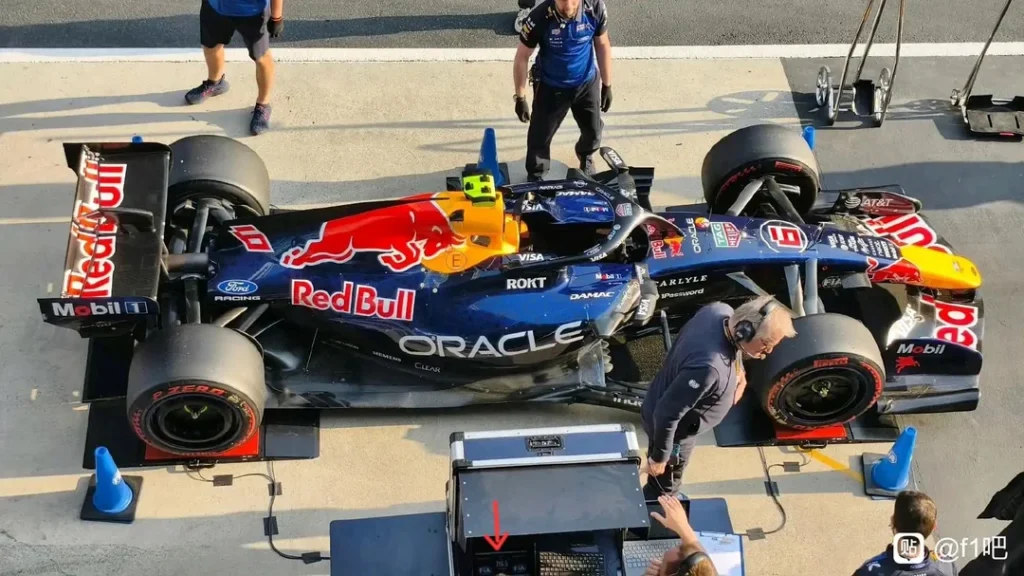
The weighbridge leak landed like gold dust because it appeared to reveal something teams and the FIA would clearly rather keep tightly managed. The immediate reaction was not just fascination with the numbers themselves, but the sense that this sort of visibility probably will not happen again. The prevailing read was that access around the weighbridge will almost certainly be tightened after this, whether by moving VIPs farther away, blocking sightlines, or adding some kind of privacy protection. The entire episode made the operation look oddly exposed, especially because, as fans noted, it was apparently taking place right below the podium in full view. That led to an obvious question: if this information is so sensitive, why is it still possible for spectators or guests to glimpse it at all?
That question matters because the leaked number attached to Red Bull was not trivial. The post circulating with the footage claimed Hadjar’s RB22 had a total weight of 787kg, 19kg above the 768kg minimum in the regulations. Even within the discussion itself, there was immediate caution about how to interpret those figures properly. The most important caveat is that total car weight includes ballast used to offset differences between drivers under the 82kg combined driver-plus-seat minimum, which means raw numbers are not directly comparable unless both the car and the driver’s relevant weight details are known. That is why the discussion quickly turned from simple outrage about a number on a scale into a much more technical argument about what the number actually means.

Even with that uncertainty, nobody treated 19kg as insignificant. The headline conclusion was straightforward: if Red Bull really is carrying that much extra mass, then it is hard to frame it as anything other than a real competitive handicap. Some fans immediately tried to convert that into lap-time loss, estimating a penalty in the range of roughly half a second or more, while others pushed back that such estimates are too simplistic because not all excess weight is equal. That rebuttal is an important one. Extra mass is not some abstract block dropped into the chassis for no reason; the performance cost depends heavily on where the weight sits and what functionality it is tied to. In other words, being overweight is bad, but the exact damage cannot be reduced to a neat seconds-per-kilo formula without knowing what parts are carrying that burden.
What made the Red Bull figure especially interesting in the context of the 2026 cars is the argument that weight is now a double penalty. It is not just a pure mass problem; heavier cars are also seen as less efficient in energy usage under these regulations. That is a crucial layer because it turns overweight design into something more punishing than a conventional setup compromise. It potentially affects not only outright pace but also how effectively a team can live within the broader power and energy demands of the new formula. That is why this leak resonated beyond the usual curiosity about weighbridge data. Fans were not just staring at a number; they were trying to decode whether it exposed a structural weakness in one of the grid’s most important cars.
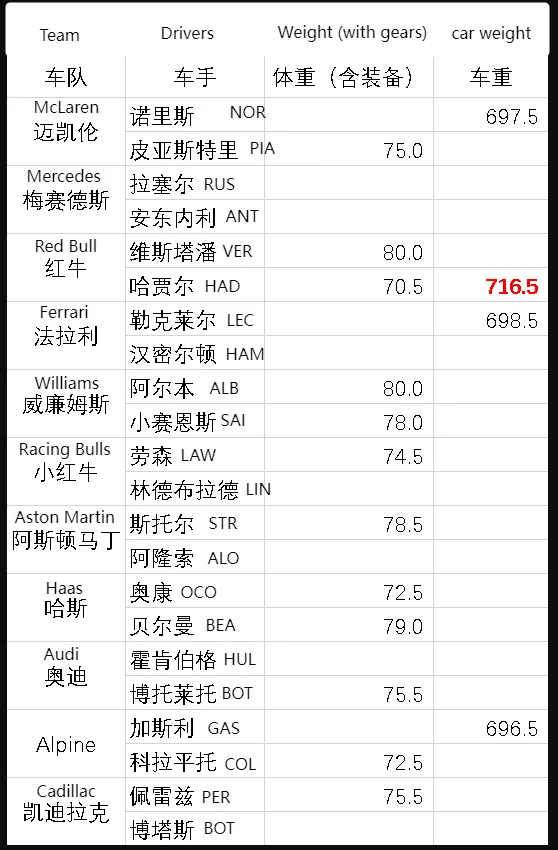
The discussion also fed directly into one of F1’s least comfortable technical realities: the driver weight rules may have reduced one kind of unfairness, but they have not eliminated the physical tradeoffs altogether. Several comments pointed to taller or heavier-framed drivers still living much closer to the limit than smaller drivers, even with the current combined driver-and-seat minimum. The broad argument was that someone around 80kg has effectively no flexibility, while lighter drivers allow a team more ballast freedom. That turns body type into a continued engineering and comfort issue, not just a sporting footnote.
That line of analysis expanded into a wider point about what the limit asks of certain drivers physically. The examples raised in the discussion all orbit the same theme: being tall, broad, or naturally heavier still appears to bring penalties in comfort, preparation, and perhaps even career trajectory. Alex Albon was repeatedly invoked as a driver whose frame leaves very little margin. George Russell was mentioned in similar terms. Nico Hülkenberg was cited as the classic example of a taller, fuller-built driver who would have been even more exposed under earlier interpretations of the rules. Valtteri Bottas’ past struggles were also brought up as evidence that the pressure to stay ultra-light could veer into unhealthy territory. The sharpest takeaway from this entire branch of the conversation is that the regulation may have moved the sport in a better direction, but it has not fully solved the age-old F1 problem of drivers having to shape their bodies around engineering demands.
There was also an oddly cultural subplot to the leak, which says a lot about how fans process technical stories now. Alongside the genuine performance analysis came amusement over the Chinese naming conventions visible in the material, particularly the contrast between Red Bull and Racing Bulls being referred to as “big bull” and “little bull.” That detail became part joke, part shorthand, part recognition that local fan culture often captures competitive dynamics better than official branding ever does. The punchline, of course, was that “little bull” may not be all that much smaller than “big bull” anymore. Even in a story about homologation, ballast, and overweight cars, F1 fandom still finds room to turn technical exposure into character study.
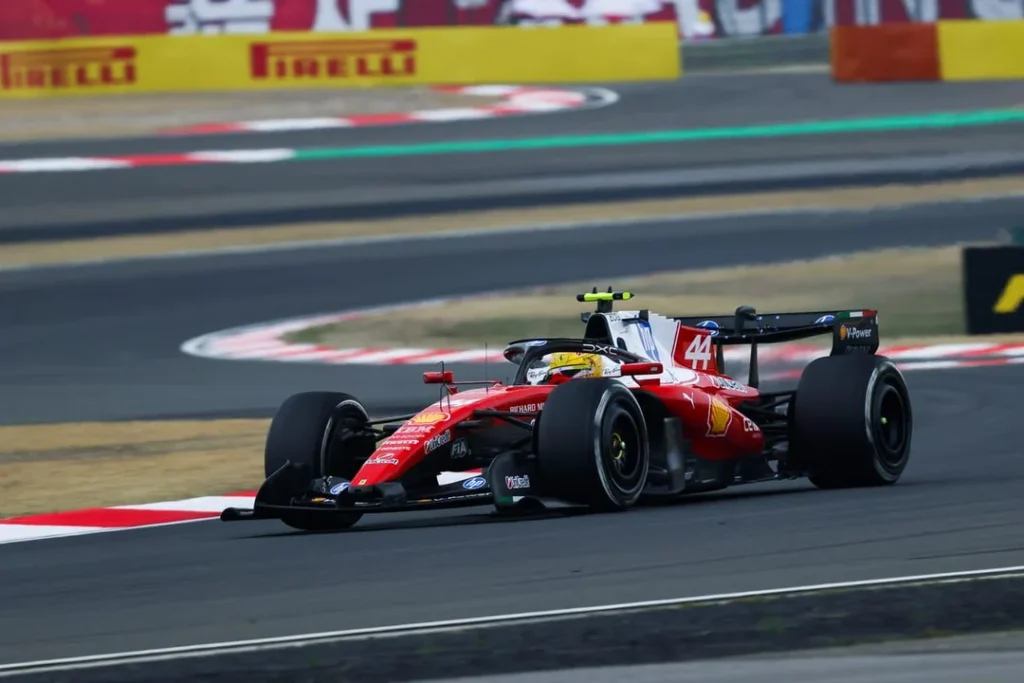
If the weighbridge leak was a story about a competitive weakness becoming visible by accident, Ferrari’s latest engine position is a story about whether the rules will allow a weakness to be corrected on purpose. The central debate here is not simply whether Ferrari is behind, but whether the sport’s Additional Development and Upgrade Opportunities system makes sense at all as a response mechanism. A lot of the frustration surrounding Ferrari’s hopes was not actually Ferrari-specific. It was a broader rejection of the idea that brand-new regulations should lock in first-shot advantages so aggressively. The dominant sentiment was simple: if one manufacturer nails the formula immediately, the current structure risks baking that edge into the season instead of letting rivals develop their way back.
That is why so many reactions converged on the same complaint: F1 has a cost cap, so why continue to layer so much development control on top of it? The argument was that teams should be allowed to develop as aggressively as they can within financial constraints, rather than being funnelled through tightly managed upgrade windows and thresholds. The criticism here is not hard to follow. Cost control already exists as a mechanism to prevent runaway spending. Freezing or semi-freezing power unit evolution on top of that can start to look less like competitive balance and more like regulatory preservation of whoever got the first draft right.
The counterargument, which also surfaced in the discussion, is that power units sit in a different ecosystem from chassis and aero. Customer-team relationships complicate everything. If a manufacturer can keep developing freely, its customer teams would potentially benefit from fresh hardware without carrying the same burden of designing and financing the engine programme themselves in the same way. There is also the logistical issue of when suppliers finalize specifications, how customer teams package around them, and whether open engine development would distort the competitive economics between works and customer operations. In that reading, the restriction is not only about stopping dominance; it is also about keeping the supplier structure from becoming even messier.
But even those arguments did not erase the dissatisfaction. The deeper frustration is that F1 appears to have landed on a system that is neither elegantly open nor cleanly frozen. Instead, it has created a technical maze. Fans in the discussion wrestled with separate cost caps, uncertainty over what exactly counts as a meaningful upgrade, confusion over whether teams can game the thresholds, and debate over how the FIA even measures eligibility. That level of opacity is part of the problem in itself. When a ruleset is so complex that the fan conversation immediately devolves into arguments over definitions, hidden procedures, and non-public calculations, it becomes harder to sell the system as either intuitive or fair.
The ADUO mechanism, at least as discussed in the comments, only sharpened that concern. The system described was based on three six-race periods, with manufacturers getting extra development opportunities depending on how far they trail the benchmark in internal combustion engine performance. The threshold discussed in the thread was 2% to 4% down for one additional upgrade, and more than 4% down for two. That instantly produced two reactions. First, some fans thought the threshold sounded low enough that it could be realistically reachable. Second, others worried that if the metric is not public or fully transparent, suspicion will inevitably follow, especially if one manufacturer appears to be managing its true performance carefully.
That suspicion is what fuels all the sandbagging talk. If the sport introduces a catch-up mechanism, fans immediately start asking whether the leading engine supplier can conceal some of its advantage, or whether a trailing manufacturer can position itself to qualify for help. But even within the thread, that point was contested. Some argued that the system would be pointless if it could be manipulated so easily, and that the FIA must surely be assessing real power rather than just race pace. Others argued that the whole discussion is filled with assumptions and rumor, with too many people speaking confidently about procedures they do not actually know. That disconnect is telling. The system is meant to reassure the paddock that performance gaps can be addressed without opening the spending floodgates. Instead, it seems to be producing equal parts confusion and mistrust.
The cancellations in April only made the ADUO picture murkier. A significant chunk of the discussion focused not on the principle of upgrades but on timing: if the first assessment window covers rounds one to six, what happens when cancelled events remain numbered on the schedule? Is the relevant cutoff the sixth scheduled round, even if some of those events never take place, or the sixth competition that actually happens? That is an incredibly technical question, but it goes to the heart of whether Ferrari’s hope is realistic in timing terms. More importantly, it shows how brittle these systems become when a regulation built around neat race-count intervals collides with the messiness of a real season.
What links Ferrari’s engine story to the Red Bull weighbridge leak is that both have exposed how punishing first-version design mistakes can be in 2026. If a car is dramatically overweight, that is not something easily hidden once the numbers get out, and it may not be easily fixed if the architecture causing that excess mass is deeply embedded in the package. If an engine supplier begins the era at a deficit, the route back may depend less on ingenuity than on satisfying a tightly controlled regulatory escape clause. In both cases, the conversation circles back to the same discomfort: the new rules seem to magnify the consequences of getting the initial concept wrong, while making recovery unusually bureaucratic.
That is not necessarily what fans want from a fresh technical era. New regulations are supposed to create possibility. Instead, what these two stories suggest is a season increasingly defined by locked-in advantages, hidden numbers, and a growing obsession with what cannot be changed. The weighbridge leak was fascinating precisely because it let the public glimpse one of the sport’s hidden truths. Ferrari’s ADUO talk is fascinating for the opposite reason: it highlights how much of F1’s competitive future now depends on processes the public cannot fully see.
And that is the real through-line here. Whether it is a VIP accidentally exposing car weights in parc fermé or a team trying to work out if it qualifies for a power unit upgrade under a dense and partially opaque framework, Formula 1 is wrestling with the same contradiction. It wants a tightly managed competitive ecosystem, but it still thrives on the drama of advantage, weakness, and technical catch-up. Fans can live with complexity. What they struggle to accept is a sport where the biggest performance stories are either hidden behind the curtain or frozen in place by design.
For now, the Chinese GP leak has given everyone something concrete to chew on, even if only for one weekend before the sightlines disappear. Ferrari’s engine situation, by contrast, remains a fight over interpretation, process, and intent. But both stories have already done one thing very effectively: they have exposed how much of the 2026 championship may hinge not just on raw engineering brilliance, but on whether the rules leave enough room to recover once the first answers turn out to be wrong.