

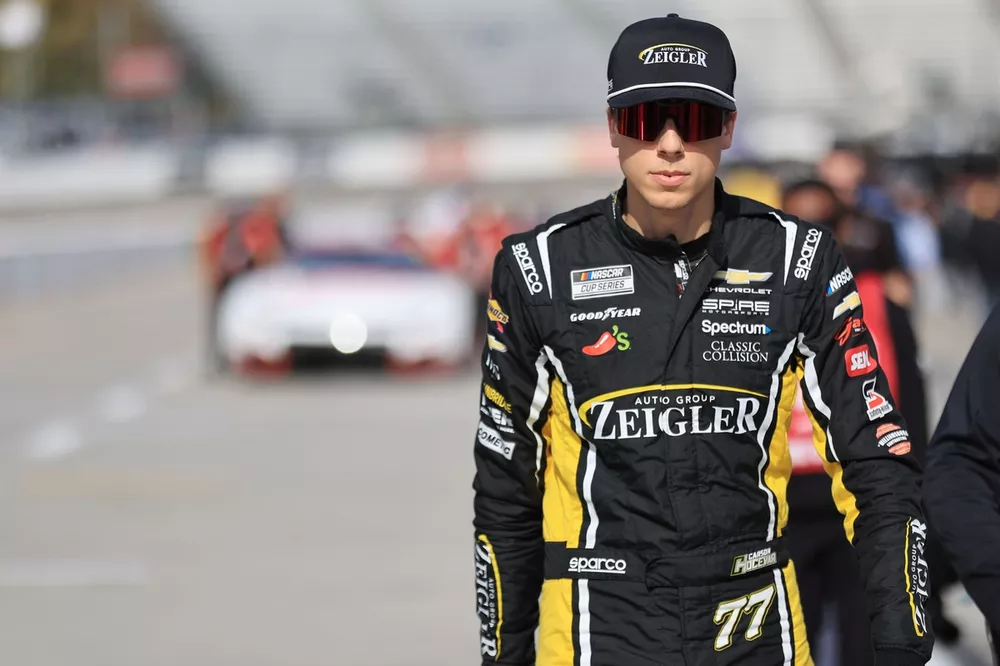
Carson Hocevar has been linked to a two-year Indianapolis 500 program with Andretti Global, but a conflicting report has immediately cast doubt on whether the proposed NASCAR crossover is happening.
Tony Donohue claimed that Hocevar is set to compete in the 2027 and 2028 editions of the race in a fourth Andretti entry.
“I’m told Carson Hocevar is set to run the 2027 & 2028 Indy 500 with Andretti Global in a 4th entry for the team,” Donohue wrote.
However, Matt Weaver subsequently reported a direct denial from Hocevar’s NASCAR organization.
“Spire’s entire leadership group just told me there’s nothing to this,” Weaver wrote.
That leaves a significant distinction between an intriguing possibility and an established program. Donohue’s claim outlines a specific team, entry, and two-year commitment. Weaver’s reporting challenges the premise itself. With those accounts in direct conflict, Hocevar’s participation cannot be treated as confirmed.
The denial also deserves prominence equal to the original claim. A potential NASCAR-to-IndyCar crossover is an easy story to get excited about, especially when it involves a driver capable of attracting attention well beyond the usual Indianapolis audience. But the appeal of the idea does not resolve the reporting discrepancy.
An Intriguing Crossover With Plenty to Prove
As a hypothetical signing, Hocevar would give an additional Andretti entry an immediate identity. His personality and aggressive approach offer the ingredients for a crossover that could generate interest before he ever turns a lap.
The sporting question is more demanding: how would that approach translate to Indianapolis? There is a difference between having the confidence to attempt the race and demonstrating the patience necessary to build toward it. A driver crossing over would need to learn the car, develop trust with the engineers, and recognize when another lap of preparation is more valuable than an early attempt to establish speed. For Hocevar, the most compelling version of an Indianapolis appearance would be one in which his ability receives as much attention as his personality. The concern would be a buildup dominated by expectations that outpace his preparation. Neither outcome should be assumed. Predicting a practice crash or dismissing his potential before a program even exists is no more useful than declaring him a likely contender on name recognition alone. An Indianapolis attempt would have to be judged on the work behind it and the performance it produces.
The same applies to motivation. An interest in the Indianapolis 500 can make a crossover feel meaningful, but enthusiasm alone cannot answer questions about readiness. Respect for the event would ultimately need to show up in the preparation and decisions made throughout the program.
A Shared Corporate Connection Is Not a Race Agreement
One argument surrounding the claim is that a connection between the organizations would make the move straightforward. Even where teams share a corporate umbrella, however, that should not be confused with an automatic agreement for a driver to compete across their programs.
A NASCAR contract and an Indianapolis entry are separate commitments. A proposed crossover would still require the relevant organizations to align on the driver’s availability, responsibilities, and the resources needed to support the attempt. That is why Weaver’s account matters so much. If Spire’s leadership says there is nothing to the story, the corporate connection cannot reasonably be used as evidence that the arrangement is already in place. The reported fourth Andretti entry also raises questions beyond the identity of its driver. An additional car needs a credible operational plan. The value of a recognizable name would have to be matched by the people, equipment, and preparation required to make the entry competitive.
A claimed commitment covering two editions of the race makes those questions more substantial. It suggests a program extending beyond a single appearance, yet the material currently available does not establish how such a program would work.
Indianapolis Would Need to Be More Than a Publicity Exercise
NASCAR crossover attempts invite comparisons, particularly with Kyle Larson. But those comparisons can quickly become an argument over personalities instead of an assessment of what another driver would need to succeed.
One driver’s experience does not establish another’s ceiling. Nor should a difficult outing become proof that NASCAR drivers have no place at Indianapolis. The more useful standard is whether an entrant approaches the race with sufficient preparation and a realistic understanding of the challenge. For IndyCar, the appeal is clear: a crossover can bring another audience into the event. The sporting value depends on what follows that attention. A well-supported effort gives those viewers a reason to stay invested beyond the announcement. Even the discussion about Hocevar’s height points toward a practical consideration beneath the novelty. Cockpit fit and comfort would need to be addressed as part of any serious evaluation. Comparisons with taller drivers from the past may be entertaining, but they cannot establish whether a particular driver is properly accommodated in a particular car. For now, all of those considerations remain hypothetical. The central story is a specific claim about Hocevar joining Andretti for two Indianapolis 500s, followed by a reported denial from Spire’s leadership.
Hocevar at Indianapolis is an interesting prospect. The available reporting does not yet make it an established plan.