

Formula 1 may be in its summer break, but apparently nobody informed Cadillac.
The newest team on the grid has delivered one of the more surprising personnel changes of the season, replacing Graeme Lowdon with Marcin Budkowski as Team Principal after only half a year of racing. That would already have been enough to generate questions. Then Cadillac owner Dan Towriss made clear that Lowdon did not choose to leave.
“It was my decision. It wasn’t a mutual decision,” Towriss said.
So much for the quiet summer break.
Elsewhere, the 2026 championship increasingly looks capable of producing history regardless of who ultimately wins, Lewis Hamilton has generated another absurd statistical reminder of how differently his career could have looked, Alpine is apparently preparing to trade BWT pink for Gucci, Max Verstappen has learned that posting the word “Soon…” is enough to send half the internet into conspiracy mode, and a 2002 Renault launch has reminded everyone that Formula 1 fashion has always been deeply unserious.
Cadillac Moves on From Graeme Lowdon
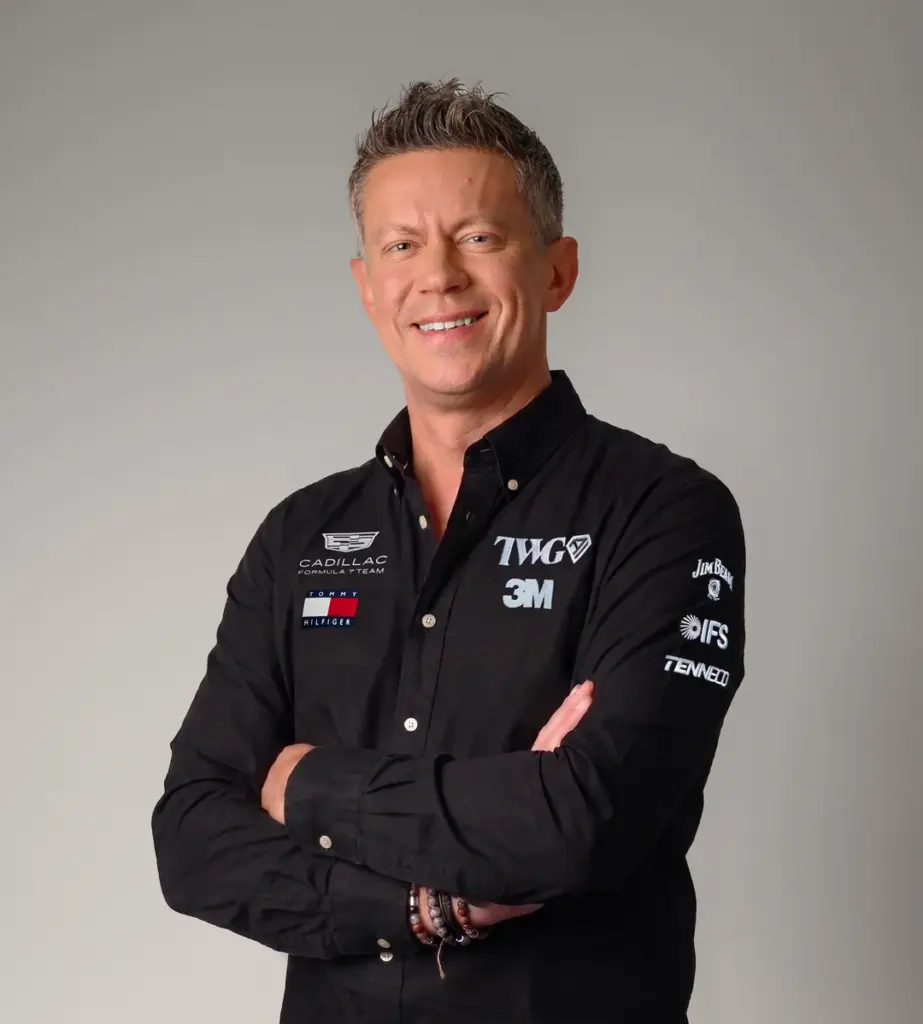
Cadillac has appointed Marcin Budkowski as its new Team Principal, replacing Graeme Lowdon during the team’s debut Formula 1 season.
On first impression, the timing feels abrupt. Lowdon was announced as Team Principal in late 2024 and played a major role in getting Cadillac from concept to an actual Formula 1 operation. That means judging his tenure exclusively by half a season of racing misses a large portion of what he was hired to do. He spent years helping establish the team and its facilities before Cadillac ever lined up on a grid.
And from that perspective, it is difficult to argue the entire project has been a failure. Cadillac made it to Formula 1. It got through testing.
It arrived in Australia capable of qualifying within the required pace. Its updates have, according to the information circulating around the team, delivered performance. It has not spent every weekend completely detached from the rest of the field.
There was even an opportunity to score a point before Sergio Perez received a penalty. For a completely new Formula 1 team trying to build far more internally than Haas did when it entered the championship, that does not exactly sound catastrophic.
The recurring brake fires are another matter.
At Some Point, the Brakes Have to Stop Catching Fire
There is a difference between normal first-year teething problems and repeatedly producing the same alarming mechanical issue.
Cadillac has had a remarkable number of brake-related problems this season. A brake fire in your first Grand Prix can be filed under embarrassing new-team growing pains. If the brakes are still regularly catching fire by summer break, someone eventually has to ask why the problem has not been solved.
There have also been other reliability issues, including races where Cadillac’s cars have suffered major sensor problems or seemingly fallen apart without an obvious explanation. That may be more significant than where the team sits in the standings. Nobody rationally expected Cadillac to arrive and immediately challenge Ferrari, Mercedes or McLaren. The issue may instead be whether leadership demonstrated a sufficiently convincing path toward solving recurring operational problems.
A Team Principal does not personally design the brakes. But the Team Principal is ultimately responsible for ensuring the right people and processes exist to stop the brakes from becoming a recurring barbecue.
That is where the argument for change becomes more understandable.
Towriss Says the Decision Began Months Ago
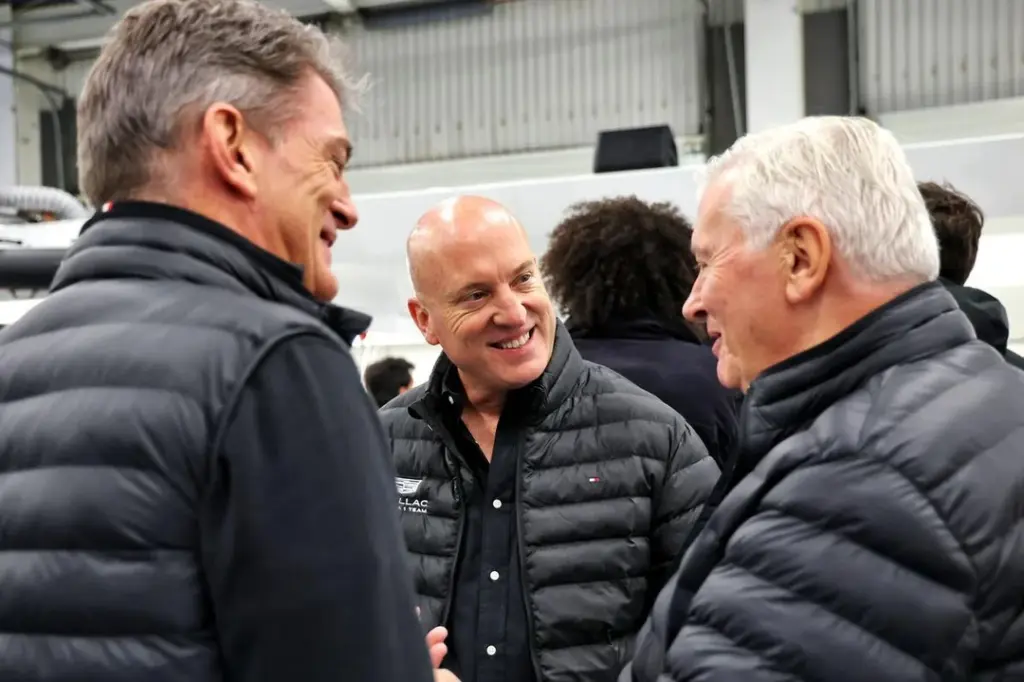
Towriss offered additional context that makes the timing slightly less impulsive than the announcement initially appeared.
“Really, the process started a few months ago, to explore really thinking about what the next phase for Cadillac Formula 1 looks like,” he explained.
That included evaluating the timing of a change, the capabilities Cadillac needed and the available candidates. Budkowski ultimately emerged from those discussions. Towriss also explained why Lowdon himself only learned about the decision shortly before the announcement.
“So Graeme and I spoke this morning. It is a very recent conversation from that perspective, but there’s no easy way to make this transition within Formula 1,” he said.
The secrecy, according to Towriss, was deliberate.
“Can you imagine the press if Marcin is strolling through for a tour of the factory or we’re having these conversations?”
His argument is that publicly conducting the search while Lowdon remained in charge would have destabilized the organization anyway. That does make the suddenness more understandable. It does not make the dismissal mutual.
Towriss was explicit about that.
Was Lowdon Always the Builder Rather Than the Long-Term Leader?
Cadillac’s official framing is that Budkowski’s appointment follows a “planned leadership transition” as the team moves from its initial build phase into its next stage focused on racing performance.
There is a legitimate organizational concept behind that. The person who is excellent at building something from scratch is not necessarily the same person best suited to optimize it once it exists. Lowdon’s experience was unusually relevant to Cadillac’s original problem.
Very few people in modern Formula 1 have experience establishing an entirely new operation and navigating the process required to actually reach the grid. Cadillac reportedly leaned on that expertise so heavily during the planning stages that Lowdon’s advisory role eventually became the Team Principal position itself. And at that job, he succeeded.
There is now a Cadillac Formula 1 team. The question is whether the team believes Budkowski is better suited to the next stage. Budkowski comes with extensive experience in executive Formula 1 roles, including Renault/Alpine, alongside previous work involving Ferrari, McLaren and the FIA.
He is also another figure with links to the Cyril Abiteboul-era Renault organization, making the appointment less random internally than it might appear externally.
The Wording Still Makes Cadillac Look Ruthless
The problem is that Cadillac’s “planned transition” language sounds much cleaner than what actually happened.
If this were always intended as an orderly handover, you would normally expect Lowdon to participate in the announcement, move into another role or at least leave through a mutually agreed transition. Instead, Cadillac thanked him for helping form the team and wished him well. Then Towriss confirmed he had fired him.
That sounds less like succession planning and more like Cadillac decided the builder had finished building. There is a strong argument that moving now is actually smarter than waiting. If Cadillac has already shifted significant attention toward 2027, installing the person who will lead that project during the summer break gives Budkowski more time to influence development before next season.
Waiting until December would potentially mean changing leadership in the middle of the development process. If Lowdon was not the long-term choice, delaying simply for the optics of allowing him to finish the year might not accomplish much. But there is an opposite risk.
Teams cannot build stability if every difficult stretch produces another senior-management reshuffle. Alpine has already provided Formula 1 with a useful case study in what happens when leadership becomes disposable.
Cadillac probably does not want to become the American version.
What Exactly Was Cadillac Supposed to Achieve This Quickly?
This is where the decision remains difficult to judge from outside.
Cadillac is a completely new Formula 1 operation. Those are extraordinarily difficult to create. The three new teams that entered Formula 1 in 2010 demonstrated how quickly a new project can become structurally compromised. Lowdon’s experience from that era was valuable precisely because he had firsthand knowledge of what could go wrong.
Cadillac has not looked absurdly out of place. It has occasionally been faster than Aston Martin. It has remained within contact of the grid.
And it has already successfully completed the hardest part of a new-team project: existing. If Towriss expected points and regular midfield contention immediately, that would appear wildly ambitious. If he instead concluded that internal processes were not progressing quickly enough, then the decision becomes easier to understand.
Unfortunately, Formula 1 fans cannot see the internal meetings. So the visible evidence is awkward. Cadillac has fired the person who spent years getting the team onto the grid after approximately half a season of actual racing.
That is going to look harsh regardless of how sensible the internal reasoning may be.
Please Do Not Start the Christian Horner Rumors
Naturally, the moment an F1 Team Principal gets fired, Christian Horner’s name enters the conversation.
It is practically an automatic feature of the 2026 news cycle. There is no information here suggesting Horner was actually part of Cadillac’s process. And there are obvious reasons the fit might be questionable anyway.
A figure like Horner would seemingly want significant control and possibly equity. Cadillac exists within a much larger corporate structure, which could create exactly the kind of governance arrangement someone seeking broad independence might avoid. Budkowski is therefore a much more straightforward appointment. Cadillac does not need to create another circus.
It already has enough going on.
And Then There Is the Wider TWG Question
The broader Cadillac ownership environment has also become part of the discussion.
TWG Global owns the team, with Dan Towriss serving as CEO of its motorsports group while also leading Group 1001, a TWG subsidiary. Questions have been raised around TWG following reports of an investigation involving $16 billion in private loans, while Mark Walter has also recently sold the Los Angeles Lakers. There has been speculation about whether any of that could ultimately affect Cadillac.
At this point, that remains exactly that: speculation. Nothing provided here establishes a direct connection between Lowdon’s dismissal and those wider financial questions. It would therefore be irresponsible to connect the two as fact.
For now, the simplest explanation remains the one Towriss actually gave: he evaluated the next phase of the Formula 1 project, chose Budkowski and dismissed Lowdon.
Cadillac’s Driver Future Is Already Becoming Another Question
The management change has also revived discussion around Cadillac’s long-term driver lineup.
Valtteri Bottas’ future has again become a subject of speculation, partly because of his increasing involvement in cycling. But there is nothing here establishing that Bottas intends to leave Formula 1. Cycling has been a major interest of his for years, and his participation in it should not automatically be interpreted as evidence that he has emotionally checked out of racing.
If anything, Bottas has spent significant effort positioning himself to remain involved in Formula 1. Cadillac’s future driver choices may eventually become part of the broader rebuild. But replacing the Team Principal does not automatically mean everyone else is heading for the exit. For now, Cadillac has changed its leader.
That is dramatic enough.
Meanwhile, the 2026 Championship Could Make History Almost Regardless
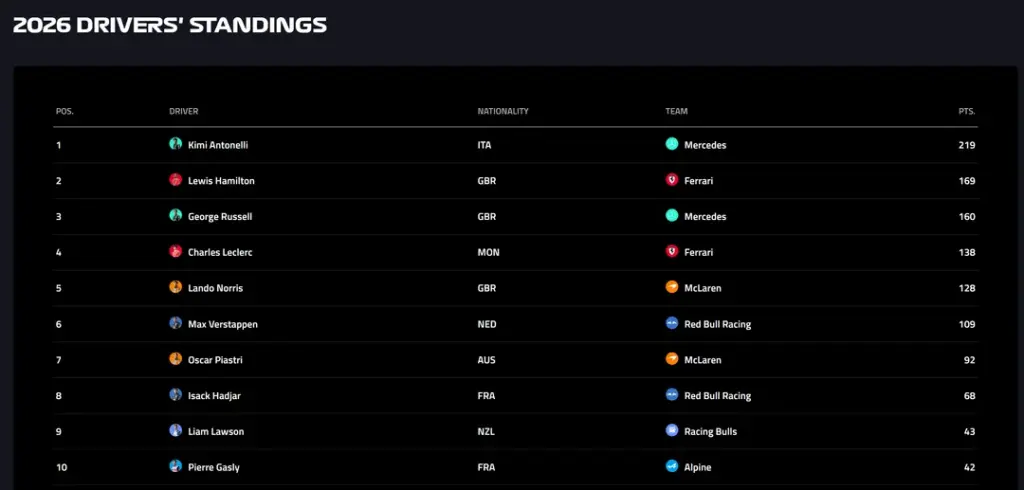
While Cadillac restructures, the championship itself is developing into something unusually fascinating.
The current standings are:
Kimi Antonelli — 219 points
Lewis Hamilton — 169 points
George Russell — 160 points
Charles Leclerc — 138 points
Lando Norris — 128 points
Max Verstappen — 109 points
Oscar Piastri — 92 points
Isack Hadjar — 68 points
Liam Lawson — 43 points
Pierre Gasly — 42 points
There are still 12 races remaining and a maximum of 316 points available. That makes declarations about the championship being finished extremely premature. Antonelli is unquestionably in the strongest position.
He has won six races. Everyone else combined has won five. But this is also the first season under a new technical era, and reliability has already played a major role.
One or two DNFs can change everything.
If Kimi Wins, He Makes History
The obvious historic outcome is Antonelli.
If he converts his current championship lead into the title, he would become the youngest Formula 1 World Champion in history. That alone would make 2026 an enormous season. And his advantage is substantial.
He currently leads Hamilton by 50 points and Russell by 59. That is not insurmountable with 12 races remaining. It is still extremely valuable.
The important question is whether Mercedes’ current balance continues. Antonelli has been getting results while Russell has struggled much more severely with the car.
That gap between teammates is one of the reasons Russell’s championship position feels worse than the raw mathematics suggest.
Lewis Hamilton’s Eighth Would Be Even More Obvious History
Hamilton is second in the standings on 169 points.
If he wins the championship, he becomes the first driver in Formula 1 history to win eight World Championships. There is not much interpretation required there. That would be one of the defining records in the sport.
Hamilton has also been remarkably consistent from a reliability perspective. His Ferrari has not suffered a car-caused DNF, and he is the only driver who has scored points in every race. That consistency is a major reason he currently sits ahead of Russell. But it would be a mistake to assume Hamilton is automatically the clear second favorite simply because he occupies P2. Russell remains only nine points behind him.
And Ferrari’s internal picture is also much closer than the championship standings might suggest.
Lewis and Charles Are Much Closer Than the Points Suggest
Hamilton leads Leclerc by 31 points.
That number can create the impression that Hamilton has clearly outperformed his teammate. The reality appears considerably closer. Their qualifying and race pace has been tightly matched, with each driver enjoying stronger weekends at different points of the season.
Leclerc has also suffered two mechanical DNFs compared with Hamilton’s zero. That accounts for much of the championship gap. Without those failures, even conservative estimates place Leclerc significantly closer.
That does not erase Hamilton’s advantage. Reliability is part of Formula 1. But it changes the interpretation. This has not been Hamilton destroying Leclerc.
It has been two extremely closely matched Ferrari drivers experiencing very different reliability outcomes.
George Russell May Have the Strangest Championship Path of All
Russell sits 59 points behind Antonelli.
That gap has caused a lot of people to mentally remove him from contention. But with 316 points still available, he is nowhere near mathematically finished. The more interesting question is whether Mercedes can solve whatever is preventing Russell from extracting the same performance from the car. If he suddenly understands the 2026 package after the break, his deficit is still small enough that a championship comeback remains possible.
And if he were to pull it off, it could potentially represent the largest comeback to win a World Championship in Formula 1 history. At one point, Russell was reportedly 68 points behind Antonelli. Hamilton would also potentially produce a historic comeback if he overturned his own deficit.
So even the alternatives to Antonelli becoming the youngest champion could create records of their own.
Lando Norris Is Not Completely Dead Either
Norris sits 101 points behind Antonelli.
That sounds enormous. It is enormous. But 12 races remain.
The new regulations have already produced reliability uncertainty, and development remains a major variable. If McLaren or Ferrari delivers a major upgrade while Mercedes stagnates, the competitive hierarchy could change quickly. Norris’ path requires far more things to go right.
But Formula 1 has already seen championship situations change dramatically after a driver appeared finished. The more interesting point is that the top five remain close enough that development, reliability and driver adaptation can still reshape the entire second half. Antonelli should be considered the favorite.
He should not be considered inevitable.
Max Verstappen Is Apparently Driving Something From Another Dimension
Verstappen sits sixth on 109 points.
Normally, that sentence alone would produce immediate warnings about never counting Max out. There is one problem. The RB22.
Even Isack Hadjar has said he does not trust the car enough to push it fully. That is not exactly what you want to hear from someone trying to extract championship-winning performance. Verstappen has developed a reputation for producing ridiculous results from difficult situations.
But even miracles eventually require some cooperation from the machinery. A 110-point deficit is already significant. A car the drivers do not trust makes it much worse. Of course, because this is Verstappen, someone will probably save this paragraph and send it back to us in December if he somehow wins.
That would be fair.
Lewis Hamilton Has Somehow Lost Four Championships by Only 30 Combined Points
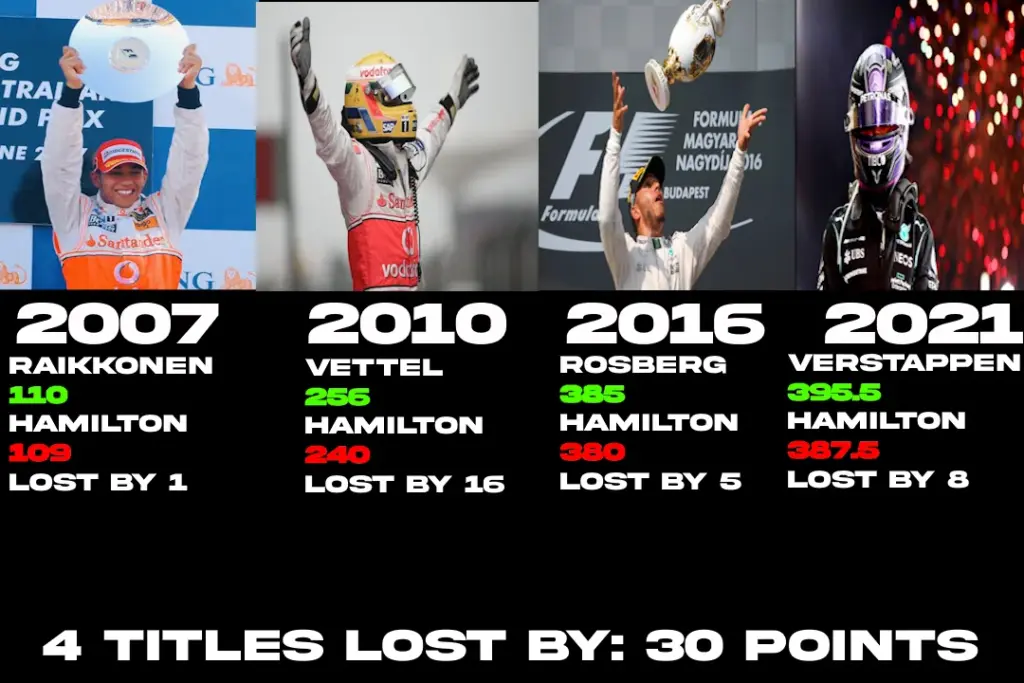
Summer break inevitably creates stat archaeology.
This year’s discovery is particularly brutal. Hamilton has lost four World Championships by a combined 30 points. In 2007, Kimi Räikkönen beat him 110-109.
In 2010, Sebastian Vettel scored 256 points to Hamilton’s 240. In 2016, Nico Rosberg won 385-380. And in 2021, Max Verstappen finished on 395.5 to Hamilton’s 387.5.
Add the deficits together: 30 points. Four titles. In an alternate universe, Hamilton is an 11-time World Champion.
That sounds ridiculous until you look at the margins.
And Alain Prost Somehow Makes It Worse
Then someone inevitably asks for the Prost version.
That is where things become truly absurd. Using the historical scoring systems, Prost was reportedly just 29.5 additional points away from becoming a 10-time World Champion across the seasons in which he narrowly missed the title. With a modernized scoring comparison, the exact number changes.
The larger point does not. Prost was repeatedly within tiny margins of accumulating an almost incomprehensible championship total. He finished his career as a four-time champion and four-time runner-up.
That alone should probably elevate him even further in discussions about Formula 1’s greatest drivers. Championship totals are real. They matter.
But sometimes the difference between four titles and seven is a handful of races spread across an entire career.
Alonso Is Another Member of the Alternate-Universe GOAT Club
Fernando Alonso receives the same treatment.
By one calculation, he was only around 11 additional points away from having five World Championships once necessary tie-breaking margins are considered.
That adds him to Formula 1’s enormous collection of “what if?” careers.
A few decisions. A few mechanical failures. A few positions.
Suddenly entire historical reputations change. The amusing inevitability, of course, is that Aston Martin will finally build an unstoppable championship car approximately five minutes after Alonso retires. Lance Stroll 2028 World Champion.
We have seen enough Formula 1 to know how these things work.
Max Verstappen Posts “Soon…” and Immediately Breaks the Internet

Verstappen’s official site posted a mysterious image with one word:
“Soon…”
That was enough. Formula 1 fans immediately began trying to decode it like an intercepted military transmission. New racing series?
Hypercar? Career announcement? Red Bull exit?
Special event? Apparently even ostrich racing was considered. The more mundane explanation is probably also the most plausible.
The image shows Verstappen wearing his Formula 1 racing gear, appearing to be at roughly the stage where he has put on his balaclava but not yet his helmet. Verstappen frequently uses special helmets at races like Spa, Spielberg and Zandvoort. With this year’s event being the final Zandvoort, a helmet reveal would make considerable sense.
It would also explain why the teaser is framed dramatically. Ambiguity creates engagement.
Mission accomplished.
But What If Max Is Preganante?
Naturally, the internet reached a different conclusion.
Max Verstappen is pregnant. Or gregnant. Or prengan.
Or pregananante. Or perhaps pregnart. This eventually evolved into proposed baby names including Fernando Sebastian Juan Manuel Lewis Michael Verstappen.
Kimi was initially excluded because apparently the naming committee only accepts multiple World Champions. Harsh. There was even an important motorsport safety question raised:
Can you race when gf is pregananat? We do not have the answer.
We suspect the FIA regulations also do not.
Hypercar Speculation Is At Least Slightly More Plausible
Among the less biologically ambitious theories was the possibility of Verstappen appearing in another racing category.
Ford is developing a hypercar program for 2027, which naturally led to speculation about Verstappen potentially being involved somehow. His conversations with Zak Brown also got folded into the conspiracy machine. Again, nothing in the information provided confirms any of this.
The teaser could simply be merchandise. It could be a helmet. It could be another Verstappen.com racing project.
It could be absolutely nothing remotely connected to his Formula 1 future. That is part of why the post worked.
People are now discussing every possible interpretation.
Alpine Is Apparently Trading BWT Pink for Gucci
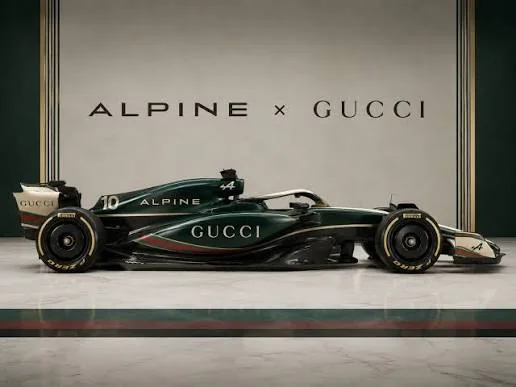
Another major visual change could arrive in 2027.
BWT is leaving Alpine, while Gucci is set to replace it. That means one of Formula 1’s most identifiable colors may disappear from the grid. The blue-and-pink Alpine combination has always been somewhat divisive.
On its own, blue and pink can work beautifully. On Alpine, it sometimes felt like two different liveries were attempting to occupy the same car. The earlier Racing Point interpretation remains arguably the definitive BWT Formula 1 look.
The pink cars were instantly recognizable. The RP20 in particular became memorable not only because of the “Pink Mercedes” jokes but because Sergio Perez won in it and Lance Stroll put it on pole in the wet. BWT’s pink did something increasingly rare in modern Formula 1.
It gave a car an identity.
BWT Deserves More Credit Than It Gets
It is easy to make fun of a sponsor that forces a racing team to paint its car bright pink.
But BWT spent heavily in motorsport during periods when many companies were reluctant to do so. That money helped keep teams competing. And the visual branding was extremely effective.
You did not need to read a logo. If you saw pink in your peripheral vision, you knew what car you were looking at and you knew who sponsored it. That is successful branding.
It is also amusing how many F1 fans apparently spent years staring at BWT logos without knowing what BWT actually does. Water treatment. Specifically, Best Water Technology. The company has major commercial applications, including filtration systems used in restaurants and coffee shops.
So somewhere out there, there is probably an espresso machine running championship-caliber water filtration.
Formula 1 Needs More Color, Not Less
The loss of pink matters because Formula 1’s grid has increasingly become a collection of black carbon, dark blue, silver, white and dark green.
There are exceptions. Ferrari is obviously red. McLaren remains papaya.
Aston Martin’s racing green is distinct in daylight. Red Bull has a recognizable combination. Racing Bulls has strong white elements.
Audi’s grey with bright neon red can stand out. But several cars become surprisingly anonymous in certain lighting. Cadillac.
Haas. Mercedes. Williams.
And potentially Alpine once the BWT pink disappears. A great livery should work at 200 mph on television. Not just in a studio render. That is why some beautiful one-off designs fail once the cars are actually moving together.
If you have to stare at the onboard identifier to figure out which team just passed through the shot, the livery has failed at one of its most basic jobs.
Gucci Alpine Could Be Elegant — Maybe Too Elegant
The expected Gucci direction appears far more restrained.
That will appeal to people who hated the pink. It may also create the opposite problem. The Gucci concept looks elegant.
Possibly extremely elegant. But elegance and memorability are not automatically the same thing. BWT pink had charm.
Gucci may produce sophistication. Formula 1 probably benefits from having both. There is also the important question of uniforms.
If Gucci does not dress the Alpine pit crew in outrageously branded tracksuits and monogrammed caps, then what exactly are we doing here? We want Pierre Gasly standing on the grid looking like he is about to either race a Formula 1 car or sell someone a wildly overpriced handbag.
Commit to the bit.
Formula 1 Fashion Has Always Been Weird Anyway
Anyone worried that Gucci might make Formula 1 fashion too ridiculous should revisit Renault’s 2002 car launch.
Images resurfaced this week showing Fernando Alonso and Jenson Button dressed in outfits that can best be described as: Stylish Fremen. There are scarves.
Sleeveless looks. Flip-flops. Young Fernando looks like the antagonist in a 2000s high-school movie who challenges the protagonist to an illegal street race.
Button looks considerably more comfortable with whatever fashion experiment was happening. Alonso, meanwhile, looks like he would rather be literally anywhere else. Which makes sense. He was Renault’s reserve driver that season, meaning he was there to do promotional work without getting the reward of actually racing.
For a young Fernando Alonso, that may have been a form of psychological torture.
Please Put Fernando Alonso in Dune
The images naturally created another conclusion.
Fernando Alonso needs to appear in Dune. Apparently some people already think he looks enough like Stilgar that casting would almost be redundant. Given Alonso’s ability to survive Formula 1 politics across multiple decades, perhaps Arrakis would actually be easier.
He already understands resource management. He understands alliances. He understands betrayal. He can drive anything.
Give the man a sandworm.
And Finally: The Ferrari Senior Parking Spot
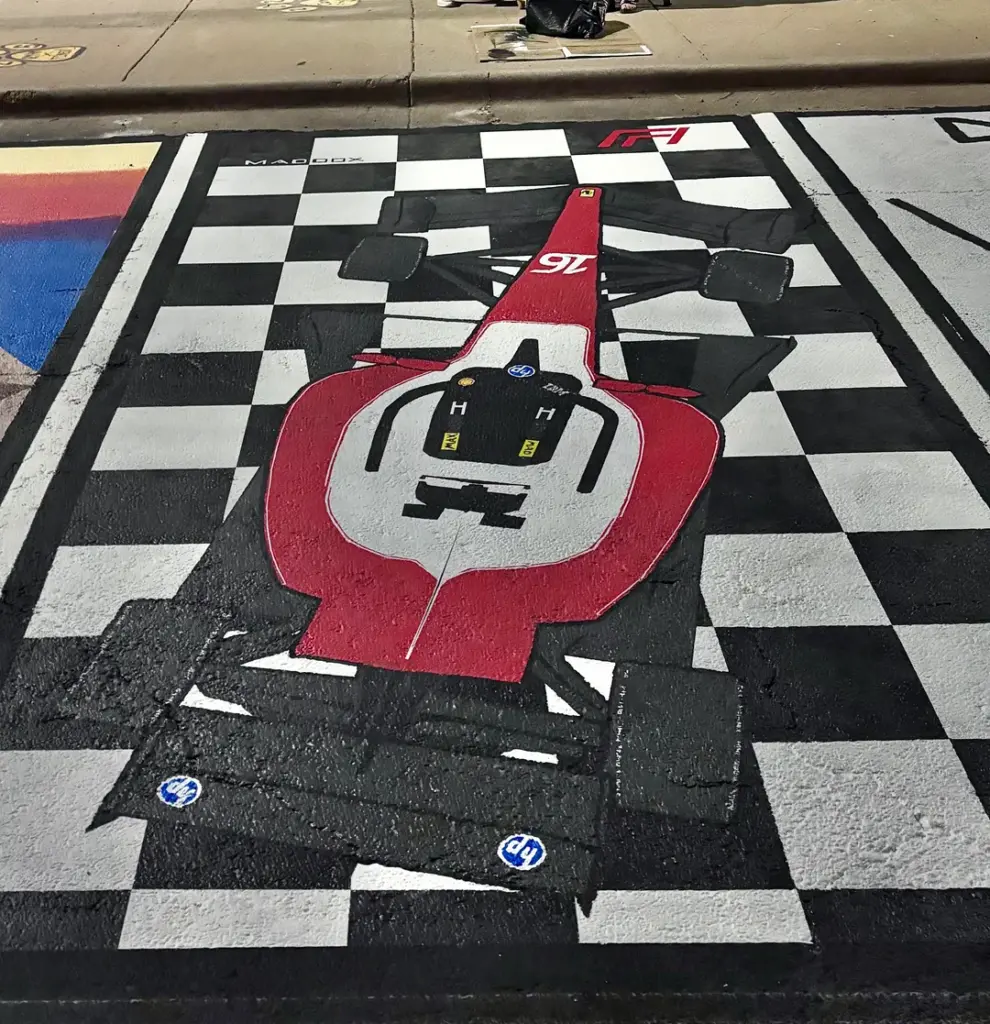
One American high school student spent four to five days working in temperatures above 100 degrees Fahrenheit painting their senior parking spot to resemble the Ferrari SF26.
That is commitment. The finished design turned an ordinary parking space into a huge Ferrari tribute. Naturally, the internet’s first instinct was not to admire it.
It was to make fun of Charles Leclerc’s parking. Because even when Charles is represented exclusively through painted asphalt, apparently he still cannot escape. In fairness, the famous parking image often used against Leclerc deserves some contextual defense. The neighboring car was parked directly on the line, the spaces were tight and the parking itself may have been angled.
So perhaps Charles was innocent all along. We owe him an apology.
Maybe.
There Are Still Not Enough HP Logos
The painted SF26 also faced one major authenticity problem.
Not enough HP logos. If you truly want to reproduce the Ferrari experience, there should probably be another logo every six inches. Still, the project is genuinely impressive.
Four or five days painting outside in 100-plus-degree heat is far more dedication than most of us would bring to any high-school parking space. It also produced one of those wonderfully American cultural moments that confuses international Formula 1 fans. Students can pay for their own parking spaces.
They can paint them. They can drive Dodge Challengers to school.
For Europeans accustomed to teenage drivers paying enormous insurance premiums on tiny hatchbacks, the entire concept sounds borderline fictional.
Summer Break Has Not Been Quiet
The Formula 1 summer break is supposed to be the period where everyone disappears.
Instead, Cadillac fired the man who built its team. The championship conversation turned into a debate over which record will be broken. Lewis Hamilton became an alternate-universe 11-time champion.
Alain Prost somehow became even more terrifying statistically. Max Verstappen typed one word and convinced people he might be entering hypercars, leaving Red Bull or becoming pregnant. Alpine is trading bright pink for Gucci.
Fernando Alonso resurfaced dressed like a desert warlord. And a high-school student painted an SF26 onto a parking space. We still have plenty of racing left.
Antonelli leads. Hamilton is chasing number eight. Russell is still mathematically alive.
Ferrari’s drivers are closer than the standings suggest. Verstappen is attempting to negotiate with a car even Hadjar does not completely trust. And Cadillac has already decided the person who got it into Formula 1 is not necessarily the person it wants leading the next phase. So yes.
The summer break is going normally.