

Formula 1 returns to Baku this weekend, and while much of the attention will naturally turn toward what happens on one of the calendar’s most unpredictable circuits, some of the most interesting conversations heading into the Azerbaijan Grand Prix have been happening away from the track.
Yuki Tsunoda has offered a remarkably candid assessment of what went wrong during his season alongside Max Verstappen at Red Bull, including an admission that attempting to copy Verstappen’s setups may have been his “biggest mistake.”
Meanwhile, the unusual timing of this year’s Azerbaijan Grand Prix has accidentally created what appears to be a historic moment for New Zealand’s Formula 1 fans: a Grand Prix they can actually watch live on a Saturday night.
And as Baku approaches, fans have also been looking back at one of the funniest moments of the 2025 weekend — an extremely enthusiastic grid kid who managed to leave several Formula 1 drivers desperately trying not to laugh during the Azerbaijani national anthem.
Tsunoda Admits Trying to Copy Verstappen Was a Mistake
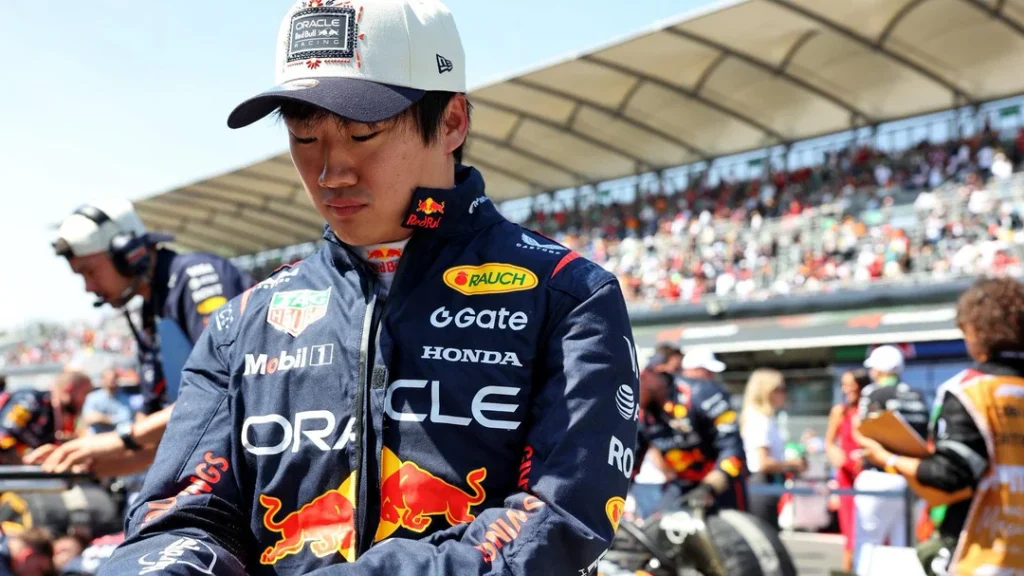
Of the three stories, Tsunoda’s comments are easily the most revealing.
Tsunoda explained that he initially considered changing his driving style to become more like Verstappen, but when he examined the data, he didn’t necessarily see an enormous difference between them.
“My core driving is the same,” Tsunoda said. “And at some time, probably the first year out of any years since I started, I thought about changing driving style and trying to do something similar to Max. But in my perspective, if I just look at data, I didn’t really see a huge difference in terms of driving.”
Instead, Tsunoda believes his bigger mistake was elsewhere.
“What I did most – and what I think now was the biggest mistake last year – was to try to replicate the set-up, what he’s doing; even knowing that sometimes, if I feel the car very oversteer, Max’s [set-up] in theory makes the car worse, more sensitive in the direction change, or makes the car slide more.
“I tend to choose the set-up, even though I’m already struggling with oversteer. It can happen sometimes the opposite way as well: even though I’m struggling with understeer, his car is more understeer. I try to replicate that.”
That is a fascinating admission because it helps explain why simply having access to Verstappen’s setup and data isn’t necessarily an advantage. In fact, it could become a trap. If Verstappen can extract performance from a car that is more sensitive, slides more or exaggerates a characteristic that another driver already dislikes, copying his setup doesn’t solve that driver’s problem. It potentially magnifies it.
One analogy is the difference between stability and maneuverability in an aircraft. A very stable aircraft can be easier to control but less responsive. Move toward something less inherently stable and there can be performance benefits, but only if the person controlling it can actually manage that instability. Another comparison is mouse sensitivity in a first-person shooter. Extremely high sensitivity theoretically allows faster reactions and smaller physical movements, but it also makes precision much more difficult. A player capable of controlling it might gain something. Someone who can’t is simply making the game harder for themselves. Verstappen appears capable of operating much closer to that edge.
A strong front end can make a car exceptionally responsive and help it rotate, but that can come at the expense of rear stability. Likewise, finding performance at the edges of a car’s aerodynamic behavior can produce more downforce while simultaneously making the car far more sensitive to yaw, pitch and roll. The fastest theoretical setup therefore isn’t necessarily the fastest setup for every driver.
And that’s where Tsunoda’s mistake becomes understandable.
The Verstappen Teammate Trap
It is easy from the outside to ask why Tsunoda would attempt something that previous Verstappen teammates had already struggled with.
But put yourself in the position of an elite racing driver. You have spent virtually your entire life believing you can compete with anyone if you’re given the opportunity. You finally get into the same team and machinery as Verstappen. He’s faster. You try to solve it your way, yet the gap remains. Then you have access to what he’s doing.
Why wouldn’t you try it? Professional athletes almost need that level of confidence. Nobody reaches Formula 1 by assuming the other guy possesses abilities they can never replicate. That may be what makes being Verstappen’s teammate psychologically difficult as much as technically difficult. There can eventually come a point where a driver has to determine whether the answer is hidden somewhere in Verstappen’s data or whether trying to reproduce what Verstappen is doing is itself part of the problem.
Tsunoda’s comments suggest he eventually reached the latter conclusion. There is also an important unanswered question here: how much quicker could Tsunoda have been had he abandoned the attempt to replicate Verstappen earlier and concentrated entirely on finding a setup that worked for him? We don’t know.
An easier car isn’t automatically a faster car. Tsunoda could theoretically have found something more comfortable only to discover that he had sacrificed performance in the process. Copying Verstappen may have been unsuccessful, but that doesn’t mean the alternative would necessarily have closed the gap. And Verstappen himself isn’t immune to an uncooperative car. As we saw during his difficult races, there have been times when neither Verstappen nor Red Bull appeared to fully understand what the car was doing.
That makes Tsunoda’s next admission particularly striking.
“I Still Don’t Understand the Car”
Tsunoda said that even after Abu Dhabi, he couldn’t completely explain the car he had just spent the season driving.
“Normally I’m able to understand the car, what I’m driving, what kind of characteristic,” he explained, “but it feels like even after Abu Dhabi, I didn’t know what kind of car I was driving.
“I still don’t understand what was the issue and what things made me very struggle to learn about this car and get used to the car. I thought confidence was there, but some race I just somehow lost the confidence. I still don’t understand the car, to be honest.”
That may ultimately be more significant than the admission about copying Verstappen. Setup experimentation requires a driver to understand what the car is doing well enough to communicate what needs to change. If Tsunoda couldn’t establish that baseline understanding, simply moving away from Verstappen’s settings wouldn’t necessarily have solved everything. It also makes the situation more nuanced than saying Red Bull simply built a car for Verstappen.
Tsunoda himself describes instances where Verstappen’s setup would seemingly make the characteristic Tsunoda was already fighting even worse. Verstappen wasn’t necessarily being handed an easy car while Tsunoda struggled with something fundamentally different. Verstappen could apparently live with — and extract performance from — behavior that Tsunoda found increasingly difficult to decipher. Perhaps the best lesson for any Verstappen teammate is that his setup should be treated as information rather than an instruction manual.
Having the answers to Verstappen’s test doesn’t mean somebody else can show the same work.
Baku Gives New Zealand F1 Fans a Rare Gift
While Tsunoda is looking backward at what went wrong, New Zealand Formula 1 fans have a much simpler reason to celebrate Baku.
They can watch a Grand Prix on Saturday night. Based on the calculations circulating among New Zealand fans, this appears to be the first Grand Prix to start on a Saturday in New Zealand time. That might sound insignificant to fans accustomed to races conveniently landing on weekend mornings or afternoons. For New Zealand, it is apparently anything but.
Fans described the normal routine as races beginning around 1 a.m. Monday, forcing them to choose between sacrificing sleep, watching highlights before work, waking extremely early for a replay or spending the entire workday avoiding spoilers before finally watching the race Monday evening. One fan even admitted that Formula 1 viewing times were genuinely a small part of the reason they moved from New Zealand to the United Kingdom. That’s commitment.
The Azerbaijan GP therefore offers something remarkably rare: a guilt-free night of live Formula 1 without work looming the following morning. There is also no need to juggle Formula 1 with Bathurst, something New Zealand motorsport fans have previously had to contend with when the Japanese Grand Prix and Bathurst 1000 fell on the same weekend. Sometimes being an F1 fan isn’t about technical regulations, championships or controversies. Sometimes the luxury is simply being able to watch the race live at a vaguely reasonable hour.
And judging by the reaction from New Zealand, Baku has inadvertently created a minor national holiday for sleep-deprived Formula 1 fans.
Baku’s 2025 Grid Kid Deserves a Return
Baku also has another act to follow this weekend.
Before the chaos of the 2025 Azerbaijan Grand Prix even began, one grid kid provided one of the weekend’s most memorable moments by absolutely belting out the Azerbaijani national anthem while standing alongside the drivers. Calling it singing almost undersells the commitment. It was delivered with the sort of intensity normally reserved for someone attempting to ensure the entire circuit could hear the anthem without amplification.
The drivers’ reactions made it even better. Oscar Piastri appeared determined to hold himself together. George Russell and Lando Norris were less successful. Liam Lawson seemingly recognized the danger and looked away, which was probably the smartest possible strategy when laughter threatened to spread down the grid. Russell’s critical error appeared to be looking toward Norris.
Once that happened, it was over. Others were apparently fighting their own battles. Charles Leclerc was trying to keep it together, Kimi Antonelli was biting his lip, Carlos Sainz was attempting to maintain composure and Lewis Hamilton was grinning. Fernando Alonso, meanwhile, looked like a man who had been in Formula 1 long enough that absolutely nothing could surprise him anymore.
The entire thing was funny precisely because the kid wasn’t trying to be funny. There was nothing cynical about it. It was just a child enthusiastically participating in a huge moment, apparently determined to give the Azerbaijani anthem absolutely everything available. There was even speculation that the grid kids alongside Norris and Russell had entered an unofficial competition to determine who could sing loudest.
If so, Formula 1 may have discovered a support series it didn’t know it needed.
Welcome Back to Baku
Perhaps that’s a fitting way to enter another Azerbaijan Grand Prix weekend.
Baku has developed a reputation for producing memorable Formula 1 moments, but they don’t always require a car to be moving. This weekend already arrives with Tsunoda providing one of the more interesting explanations we’ve heard about the challenge of becoming Verstappen’s Red Bull teammate. His experience suggests that access to Verstappen’s setup isn’t necessarily a shortcut to Verstappen’s performance — and attempting to reproduce something designed around another driver’s extraordinary ability to manage an unstable car may actually send a teammate further in the wrong direction. Thousands of miles away, New Zealand fans have a considerably less complicated challenge: stay awake until the checkered flag, enjoy the almost unheard-of luxury of watching Formula 1 live on a Saturday night, and remember that daylight saving time arrives afterward.
And Baku itself has one remaining responsibility. Find that grid kid.
We need an encore.