


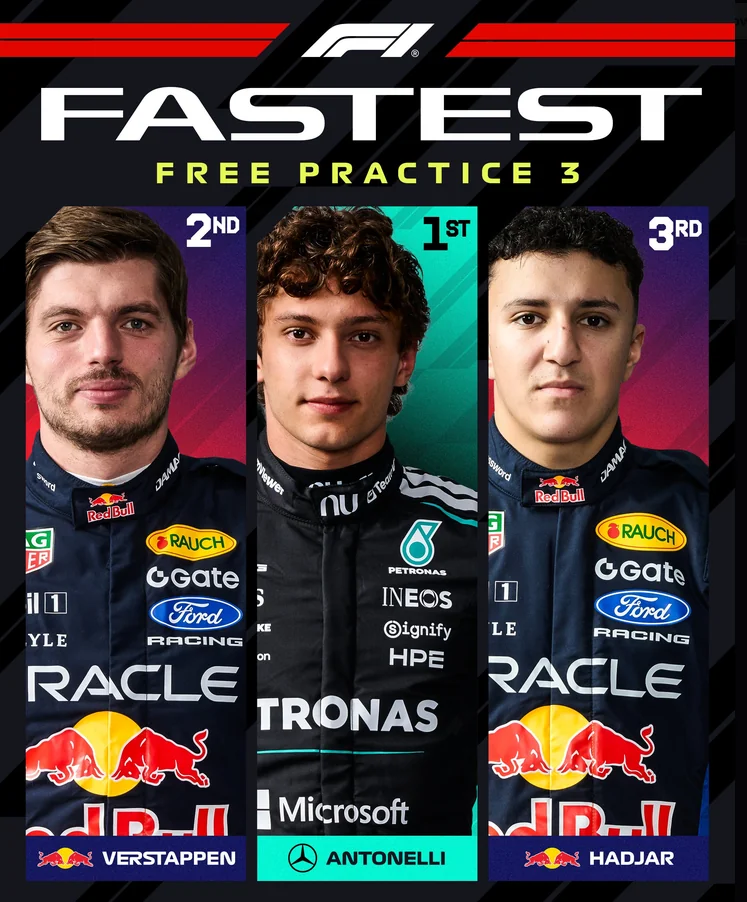
Kimi Antonelli put Mercedes on top in final practice for the 2026 Bahrain Grand Prix in Malaysia, beating Max Verstappen and Isack Hadjar as the competitive picture at Sepang became simultaneously clearer and more difficult to predict.
Antonelli set a 1:36.302 to lead Verstappen, Hadjar and Mercedes teammate George Russell. Charles Leclerc and Lewis Hamilton followed in fifth and sixth, with Lando Norris, Oscar Piastri, Franco Colapinto and Arvid Lindblad completing the top 10. It means three practice sessions have now produced three different fastest drivers from three different teams: Verstappen in FP1, Leclerc in FP2 and Antonelli in FP3. It is the first time this season that every practice session at a Grand Prix weekend has been topped by a different driver.
Good luck predicting qualifying.
Mercedes Finally Shows Its Hand

Mercedes entered FP3 with plenty of questions surrounding its true pace after Friday, but Antonelli’s performance offered the clearest indication yet that the team could be a major factor in qualifying.
The Italian went fastest while Russell finished fourth, and the underlying numbers were arguably even more encouraging than Antonelli’s position at the top of the classification. Mercedes had been making repeated cooling adjustments during the weekend, while there had also been experimentation inside the car. That complicates attempts to compare its performance directly across the three sessions. Straight-line performance has also fluctuated between the two Mercedes drivers. Russell had been faster than Antonelli on the straights on Friday, only for that relationship to reverse on Saturday.
That raises the possibility that Mercedes still hasn’t shown one completely representative configuration across both cars. The expectation should therefore be that the two cars converge toward a more common specification for qualifying. There was already considerable suspicion that Mercedes had more available after Friday, particularly given the characteristics of Sepang’s long straights and the team’s biggest upgrade of the season. FP3 did little to calm those suspicions.
Instead, Antonelli may have dropped a few of the sandbags on his way out of the garage. But Mercedes’ strength wasn’t confined to one part of the circuit. Verstappen recorded the fastest first sector at 24.911 seconds and Norris the fastest third sector at 39.567, but Antonelli owned the middle sector with a 31.661.
His advantage in Sector 2 was particularly notable. Rather than dominating one specific characteristic of Sepang and surviving everywhere else, Antonelli appeared competitive across the lap. Verstappen owned Sector 1. Norris owned Sector 3. Antonelli simply seemed to be everywhere.
That could make the Mercedes particularly difficult to beat over a complete qualifying lap.
Verstappen and Red Bull Are Getting Uncomfortably Close
Mercedes may have emerged as the favorite, but Verstappen ensured there will be no sense of comfort heading into qualifying.
The Red Bull driver finished second to Antonelli after topping FP1, continuing a weekend in which Red Bull appears increasingly capable of challenging Mercedes rather than merely sitting behind it. The telemetry provided another interesting distinction between the cars. Red Bull appears particularly strong toward the end of the straights, while Mercedes is gaining significantly when accelerating away from slower corners.
That could create an intriguing battle depending on how each team chooses to prioritize its setup. Energy deployment can also move performance around the lap: gaining in one area can come at a cost elsewhere. Verstappen’s progression through the weekend tells its own story. He was fastest through Sector 3 in FP1. By FP3, he was fastest through Sector 1.
Red Bull is finding speed in different areas of the circuit as the weekend develops. Hadjar finishing third only strengthened the impression. It is increasingly tempting to declare Red Bull the second-fastest team at Sepang, especially after strong performances at consecutive high-speed circuits. But practice remains practice, and qualifying is where that conclusion needs to survive its first serious test. Still, seeing two Red Bulls near the front is itself significant.
For anyone hoping for a Verstappen victory, FP3 provided just enough evidence to become dangerous.
Don’t Believe McLaren’s P7 and P8 Just Yet

McLaren finished FP3 seventh and eighth with Norris and Piastri, a result that looks worrying at first glance.
The details tell a very different story. Norris’ fastest lap was set on the medium tire early in the session rather than the soft, and he was also experimenting with a different setup during his soft-tire running. Most importantly, Norris produced the fastest Sector 3 of anyone in the session with a 39.567 — and did it on the mediums.
There are several possible explanations for why that tire worked so well late in the lap. With degradation a factor at Sepang, the medium may simply have been holding together better by Sector 3. Energy deployment could also have influenced the sector comparison. What we can say with confidence is that P7 does not tell the full story of Norris’ FP3. A clean representative soft-tire lap could have placed him substantially higher.
McLaren’s bigger concern may instead be straight-line performance. If Norris and Piastri qualify behind cars with similar overall race pace but superior straight-line speed, passing them could become extremely difficult. That makes qualifying particularly important even if McLaren ultimately has excellent tire management and stronger race pace than its Saturday classification suggests. The ingredients for Norris to be considerably faster than seventh are clearly present. Whether they’re enough to challenge Antonelli over a complete qualifying lap is another question.
And after three sessions with three different leaders, dismissing the possibility of a McLaren pole would seem rather brave.
Ferrari Has Gone From Friday Hero to Saturday Question Mark
Ferrari occupied fifth and sixth with Leclerc and Hamilton, one day after Leclerc topped FP2.
It is becoming something of a pattern: Ferrari looks spectacular on Friday, everyone gets excited, and then Saturday arrives. At least fifth and sixth is hardly disastrous, and this weekend has already demonstrated how dangerous it is to interpret a practice classification without understanding tires, setups and run plans. But Mercedes moving Antonelli to first, Red Bull placing Verstappen and Hadjar second and third, and McLaren having obvious hidden pace behind its P7/P8 classification leaves Ferrari in a difficult position to read.
The old joke about Ferrari waiting for “next year” has practically become its own recurring season.
Perhaps Ferrari really is becoming the Friday team.
Or perhaps everyone else is simply better at hiding what they have.
Hamilton Gets a Taste of Friday’s Impeding Controversy

Hamilton also found himself on the opposite side of an impeding incident after his situation involving Gabriel Bortoleto on Friday.
This time it was Lindblad who impeded Hamilton. The circumstances were notably different. Hamilton and Bortoleto had both been on outlaps during Friday’s incident. Hamilton was on a push lap when he encountered Lindblad in FP3.
That distinction makes attempts to simply label Saturday’s incident “karma” overly simplistic.
There is also a broader reality surrounding practice impeding. It matters because allowing drivers to obstruct each other without consequence would quickly become unmanageable, but practice incidents generally do not carry the same significance as impeding during qualifying. For many, it is difficult to become particularly outraged about an FP3 obstruction. The more interesting question was consistency after Hamilton had been investigated and warned on Friday while the Lindblad incident initially did not even appear to be noted.
Either way, there may have been no better possible summary of the weekend than Hamilton being impeded one day after becoming the center of an impeding discussion himself.
The FP3 Classification Doesn’t Tell the Whole Story

Liam Lawson provided perhaps the best example of why simply reading the timing screen can be misleading.
Lawson was sixth-fastest in Sector 1 and ninth-fastest in both Sectors 2 and 3, yet finished only 15th on overall lap time. His session included a red flag, traffic, a major steering snap and further traffic, preventing him from combining his potential into one representative lap. The sector numbers don’t prove what his ultimate lap time would have been — fastest sectors are not necessarily recorded on the same lap — but they do demonstrate why the FP3 classification cannot be treated as a straightforward ranking of the cars. Lawson was also faster than Lindblad through each individual sector without putting the complete lap together.
FP3 is free practice for a reason.
Strategy Could Matter More Than Pole
All of this uncertainty could become even more important on Sunday.
Sepang is 5.543 kilometers long, with Sunday’s Grand Prix scheduled for 56 laps and 310.417 kilometers. Sebastian Vettel’s 1:34.080 from 2017 remains the lap record. Turn 11 has already emerged as one area worth watching. From trackside, drivers were taking a striking variety of lines and using different shifting patterns through the corner during FP3. But perhaps the biggest takeaway from practice is that outright qualifying speed might not decide this Grand Prix.
With tire degradation already part of the discussion around the weekend, the people making decisions inside the garages could ultimately become as important as the people driving the cars. Pole may matter less than getting the strategy right.
That thought probably won’t provide much comfort to Ferrari supporters.
Sepang Is Showing Why It Was Missed
Beyond the competitive order, watching the current generation of Formula 1 cars attack Sepang has again highlighted just how highly regarded the Malaysian circuit remains.
It is difficult to watch cars through these corners without questioning why circuits of this quality disappeared from the calendar while less celebrated venues arrived over the past decade. The answer is not necessarily about which track produces the best racing. The economics of hosting Formula 1 inevitably play a major role in determining which circuits survive.
But Sepang’s return — even under the wonderfully confusing banner of the “Bahrain Grand Prix in Malaysia” — has been a reminder of what Formula 1 had been missing.
Even the event itself has produced an unusual international mixture, with on-track commentary reportedly involving English and Arabic while the race takes place in Malaysia.
“Bahrain Grand Prix in Malaysia” still sounds like somebody failed a geography exam.
The racing circuit, however, needs no explanation.
Three Sessions, Three Winners — Now Try Predicting Qualifying

FP1 belonged to Verstappen.
FP2 belonged to Leclerc. FP3 belonged to Antonelli. Behind Antonelli in final practice came Verstappen, Hadjar, Russell, Leclerc, Hamilton, Norris, Piastri, Colapinto and Lindblad.
Mercedes looks extremely quick, but Red Bull is getting closer. McLaren’s classification disguises Norris’ true pace. Ferrari has gone from the top of the timing sheets to fifth and sixth. Hadjar is suddenly sitting third. And the fastest sectors were split between three different drivers from three different teams. If anything, Antonelli’s FP3 performance gave us more information without providing many more answers. Mercedes may now be the favorite.
But if the first three sessions of the 2026 Bahrain Grand Prix in Malaysia have established anything, it is that anyone feeling confident about predicting qualifying probably hasn’t been paying enough attention.