

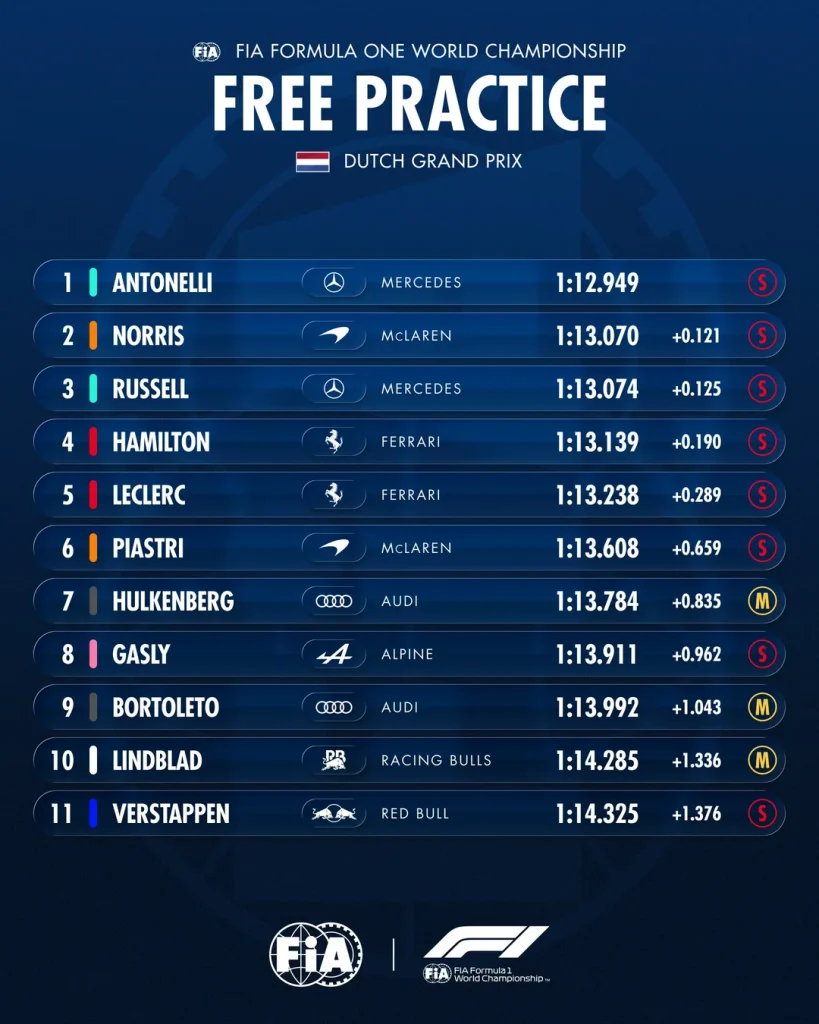
Formula 1 returned from its break at Zandvoort with Andrea Kimi Antonelli setting the pace in the opening and only practice session ahead of the 2026 Dutch Grand Prix Sprint, while Lando Norris and George Russell completed the top three.
Antonelli finished FP1 with a 1:12.949, ahead of Norris, Russell, Lewis Hamilton and Charles Leclerc. Oscar Piastri was sixth, followed by Nico Hulkenberg, Pierre Gasly, Gabriel Bortoleto and Arvid Lindblad. The full top ten was:
- Andrea Kimi Antonelli — 1:12.949
- Lando Norris
- George Russell
- Lewis Hamilton
- Charles Leclerc
- Oscar Piastri
- Nico Hulkenberg
- Pierre Gasly
- Gabriel Bortoleto
- Arvid Lindblad
For a Sprint weekend where teams have only one practice session before Sprint Qualifying, it was an intriguing start — particularly because Mercedes, Norris and Ferrari all appeared to have reasons for optimism.
Red Bull, meanwhile, did not.
Antonelli leads, but Norris may have left time on the table
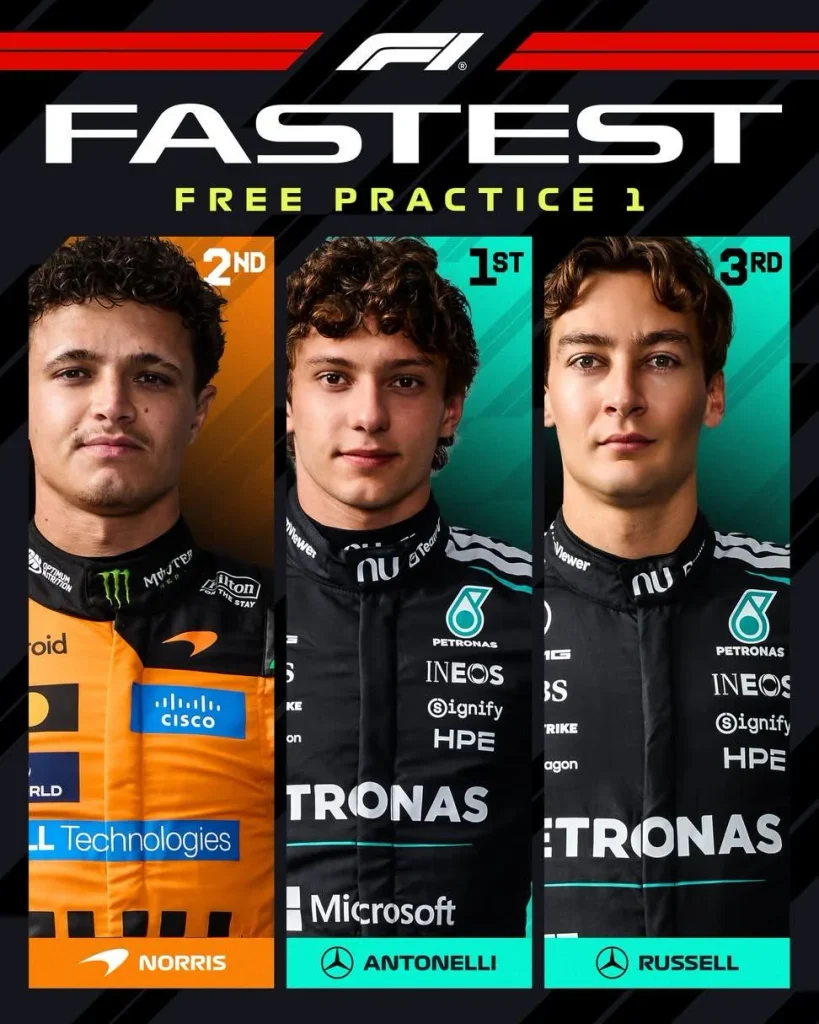
Antonelli’s P1 naturally makes him one of the early drivers to watch heading into Sprint Qualifying, but the sector data suggests Norris could be an even bigger threat than the classification showed.
Norris set the fastest first sector at 24.957 and the fastest second sector at 25.529. Leclerc was fastest of anyone in Sector 3 with a 22.056. Combining each driver’s best sectors produced a theoretical 1:12.806 for Norris, 0.076 seconds ahead of Leclerc’s 1:12.882 and 0.143 ahead of Antonelli’s actual 1:12.949. Russell’s theoretical best was 1:13.074, with Hamilton at 1:13.139.
That leaves the theoretical top five separated by only 0.333 seconds, but the distribution of the performance is perhaps more interesting than the gap itself. Norris owned the opening two sectors while Ferrari was particularly strong in the final sector. Leclerc’s advantage there was enough to bring his theoretical lap remarkably close to Norris despite losing time earlier around the lap. If Norris can put all three sectors together without traffic, there is an argument that he enters Sprint Qualifying as at least one of the favorites alongside Antonelli. McLaren’s obvious area to find more performance is the final sector.
Ferrari, conversely, may be hoping that conditions come toward it. If a warmer track helps with getting the soft tires into their window, the apparent Mercedes-McLaren-Ferrari battle could become even tighter. Piastri was noticeably further away on theoretical performance. His 1:13.459 left him 0.653 seconds behind Norris, although the Australian also had to negotiate plenty of traffic during the session.
And traffic at Zandvoort was very much back.
Welcome back to the “traffic paradise”
Valtteri Bottas once described Zandvoort as a “traffic paradise,” and FP1 offered another reminder of why that phrase has endured.
With a short lap and cars attempting to manage their own programs, finding clear space became an issue. Piastri in particular seemed to encounter traffic everywhere he went. It is hardly ideal on a normal Grand Prix weekend. On a Sprint weekend, it becomes more significant because FP1 is the teams’ only practice opportunity before the competitive sessions begin.
Traffic also makes some of the raw lap-time comparisons difficult to interpret, which is particularly important when looking at Red Bull.
Red Bull starts with Verstappen P11 and Lawson P14
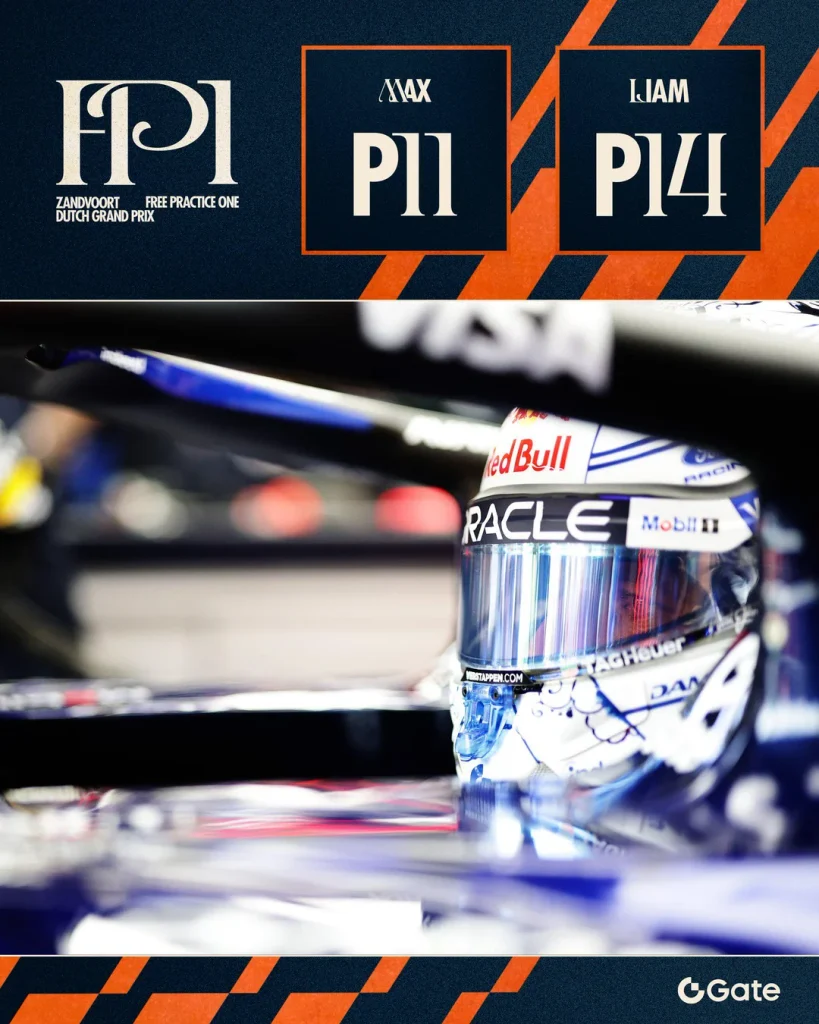
Max Verstappen finished only 11th, while Liam Lawson was 14th in his first session in the main Red Bull.
On paper, that’s alarming. Verstappen’s theoretical best was a 1:14.325, 1.519 seconds away from Norris. Lawson’s was a 1:14.700, another 0.375 seconds behind Verstappen. The car did not appear particularly confidence-inspiring either. Both drivers seemed reluctant to fully commit at points, while Red Bull spent a significant portion of the session in the garage.
There are enough caveats that declaring Red Bull genuinely that slow would be premature. Neither Verstappen nor Lawson completed a clean qualifying simulation. Lawson combined a mistake and traffic on the same lap, while both drivers encountered a mixture of traffic, errors and unimpressive soft-tire running. Red Bull has also developed something of a habit of looking questionable in practice before finding considerably more when qualifying arrives. But there was one problem that sounded very familiar. Verstappen was once again unhappy with the car’s downshifts.
“I was almost in the wall because of that downshift. It’s ridiculous,” Verstappen reported.
At this point, complaints about downshifts are becoming one of the constants of a Verstappen weekend. Unlike the stereotypical race-day complaint about dead tires, downshift problems can make themselves known from the very first practice session. And this isn’t merely Verstappen being unhappy for the sake of it. A problematic downshift under braking or during turn-in can seriously unsettle a car, and Verstappen was describing an instance where he believed it nearly put him into the wall.
So while P11 itself may prove meaningless once Sprint Qualifying begins, a driver lacking confidence in the behavior of the car is harder to dismiss.
Lawson’s first Red Bull session offered some encouragement
Lawson’s P14 also deserves context.
At the halfway point of the session, Lawson’s deficit to Verstappen was similar to the gap Isack Hadjar had previously managed to Max, while Yuki Tsunoda was around a tenth away from Lindblad. Considering the circumstances surrounding both drivers this week, that was a respectable start. Lawson even briefly appeared P3 while running the hard tire.
His ultimate position therefore doesn’t tell the whole story. This was his first time in the main Red Bull, he didn’t get a clean qualifying simulation, and the team’s overall program was disrupted by time in the garage. Sprint Qualifying should give a much better indication of where he actually stands. There was, however, one unquestionable Red Bull failure from FP1: its graphic design.
The team’s post-session font rendered Liam’s name closely enough to “IJAM” — or perhaps “LJAM” — to become almost as much of a talking point as its P11 and P14. Red Bull’s fondness for unusual fonts continues to create problems nobody asked it to solve.
The performance issues may disappear in qualifying. IJAM may be forever.
Hamilton tops the long-run averages
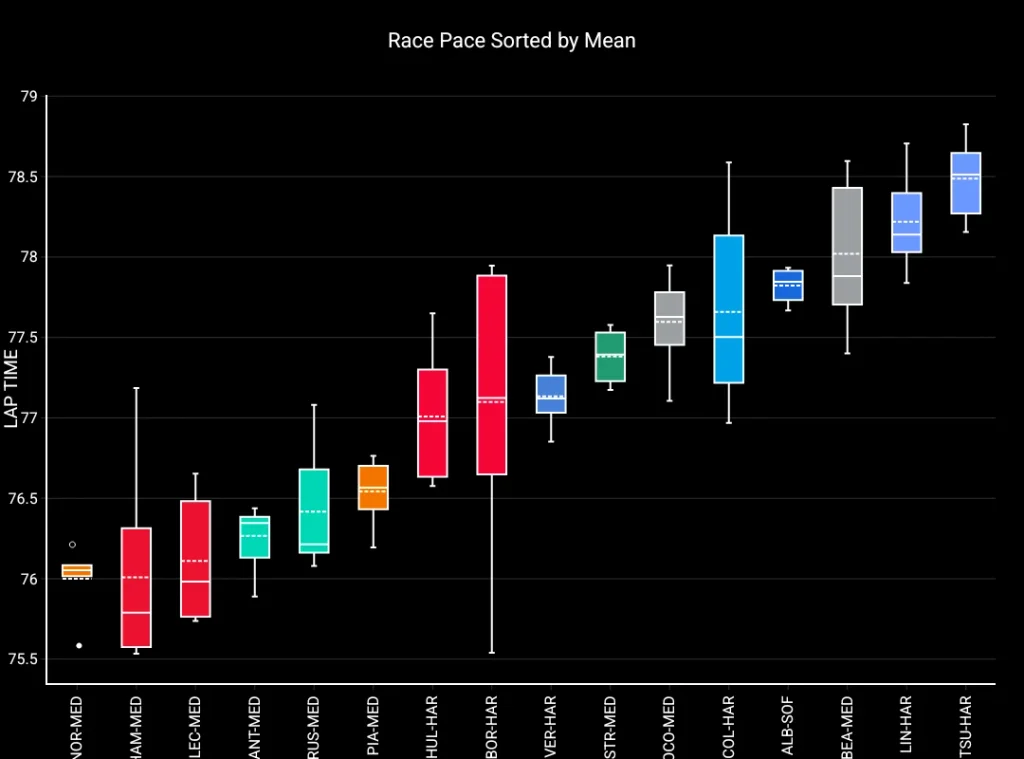
While Antonelli topped the headline classification, Hamilton led the supplied long-run averages on the medium tire.
The averages were:
- Lewis Hamilton — 15.941, medium
- Lando Norris — 15.987, medium
- Charles Leclerc — 16.111, medium
- Andrea Kimi Antonelli — 16.267, medium
- George Russell — 16.418, medium
- Oscar Piastri — 16.650, medium
- Max Verstappen — 17.134, hard
- Liam Lawson — 17.967, hard
The obvious warning is that Verstappen and Lawson were using the hard while the six drivers ahead were on mediums, so their numbers should not be directly compared as if everyone was running identical programs. Even among the medium runners, practice long-run averages come with plenty of variables. Russell, for example, was running tires that were already 14 laps old during the stint represented in the data, making his average more respectable than the raw number might initially suggest.
Still, Ferrari has plenty to like. Hamilton was fastest in the supplied long-run averages, Leclerc was third, and both Ferraris finished inside the top five on outright FP1 times. Leclerc also produced the fastest final sector and had the second-fastest theoretical lap. That is enough evidence to make Ferrari worth watching rather than simply dismissing its FP1 pace. It is also enough evidence for Ferrari supporters to begin dreaming about a 1-2 — which naturally means there is plenty of time for those dreams to turn into fifth and sixth by the end of the weekend.
Summer break is over, and because this is a Sprint weekend, everyone gets twice as many opportunities for disappointment.
Sainz discovers quite a lot of the Zandvoort gravel
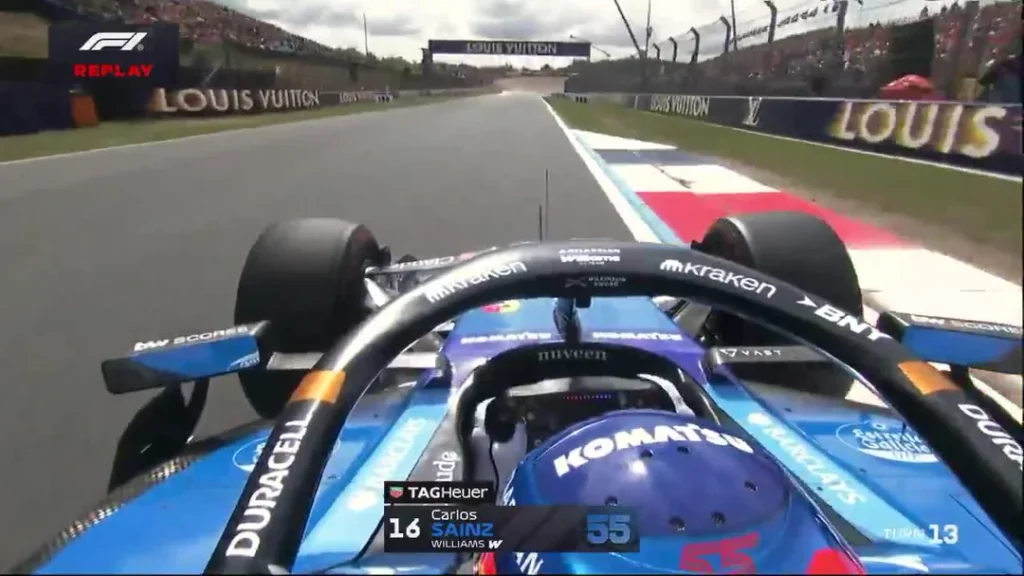
Carlos Sainz had a much less encouraging session.
Sainz repeatedly found the gravel during the opening portion of FP1, going off three times and eventually suffering floor damage. One excursion on the approach to the banking also resulted in him bringing plenty of gravel back onto the circuit. Going off once at Zandvoort can happen. Doing it repeatedly within roughly 20 minutes starts to become expensive, particularly when there is only one practice session available to prepare the car. Williams’ overall result wasn’t much more encouraging either, with neither of its drivers appearing among the top 18 in the theoretical best-sector table supplied from the session.
For Williams supporters, it was the kind of morning that encourages the time-honored sporting coping mechanism of deciding that next year will definitely be the year.
Antonelli completes a 360 and carries on
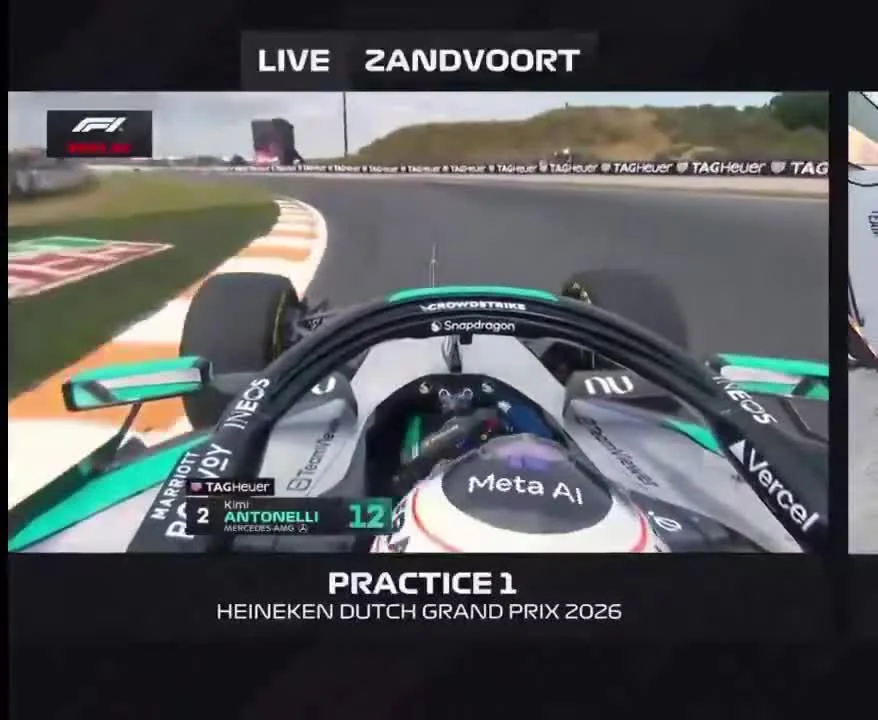
Antonelli’s fastest session wasn’t entirely clean.
The Mercedes driver completed a full 360-degree spin during FP1 before carrying on as though very little had happened. It looked almost more like an extremely aggressive tire-warming procedure than a session-threatening mistake. Considering he subsequently finished P1, perhaps everyone else has simply been warming their tires incorrectly.
Russell had an adventure of his own. At one point, the live map appeared to show one of the Mercedes taking such an enormous trip away from the circuit that the obvious question became whether Russell was searching the Netherlands for stroopwafels. The telemetry data later produced an even better oddity: Russell apparently registering 0 km/h. Given that he nevertheless finished third, Mercedes may have finally discovered the ultimate technical innovation. Why worry about straight-line speed when the car can simply teleport?
More seriously, the telemetry appeared to show notably different approaches between the leading teams, including differences in full-throttle percentages. Mercedes was reportedly at full throttle almost five percentage points more than McLaren and close to ten more than Red Bull, suggesting differing deployment or running strategies could be another reason to avoid drawing definitive conclusions from FP1 alone.
Audi catches the eye
One of the quieter surprises came from the Audi drivers.
Hulkenberg finished seventh and Bortoleto ninth, putting both cars inside the top ten, while Hulkenberg’s theoretical 1:13.726 was also quicker than either Red Bull. Seeing an Audi ahead of Red Bull on theoretical performance is certainly an eye-catching way to return from the break.
One practice session is nowhere near enough evidence to declare a fundamental change in the competitive order, but performances like this at least offer encouragement that Audi can develop into a serious contender over the coming years.
One session down, straight into Sprint Qualifying
Zandvoort’s FP1 ultimately produced more questions than answers.
Antonelli owns the fastest lap, but Norris produced the quickest theoretical lap and topped two of the three sectors. Ferrari showed pace over both a single lap and the supplied long-run data. Russell completed a Mercedes top-three despite an eventful session, and Audi put both cars into the top ten. Then there is Red Bull. P11 for Verstappen and P14 for Lawson looks terrible in isolation, and Verstappen’s downshift complaint suggests there were genuine drivability concerns beyond the stopwatch. But significant garage time, messy qualifying simulations and traffic mean the classification may exaggerate just how much trouble the team is actually in.
Lawson, in particular, showed enough flashes on the hard tire to make his first Red Bull session more encouraging than P14 suggests. There won’t be another practice session to figure any of it out.
After just one hour of running, Zandvoort goes straight from experimentation to Sprint Qualifying — and the early evidence suggests Mercedes, Norris and Ferrari could be separated by very little when everyone finally has to show what they’ve got.