


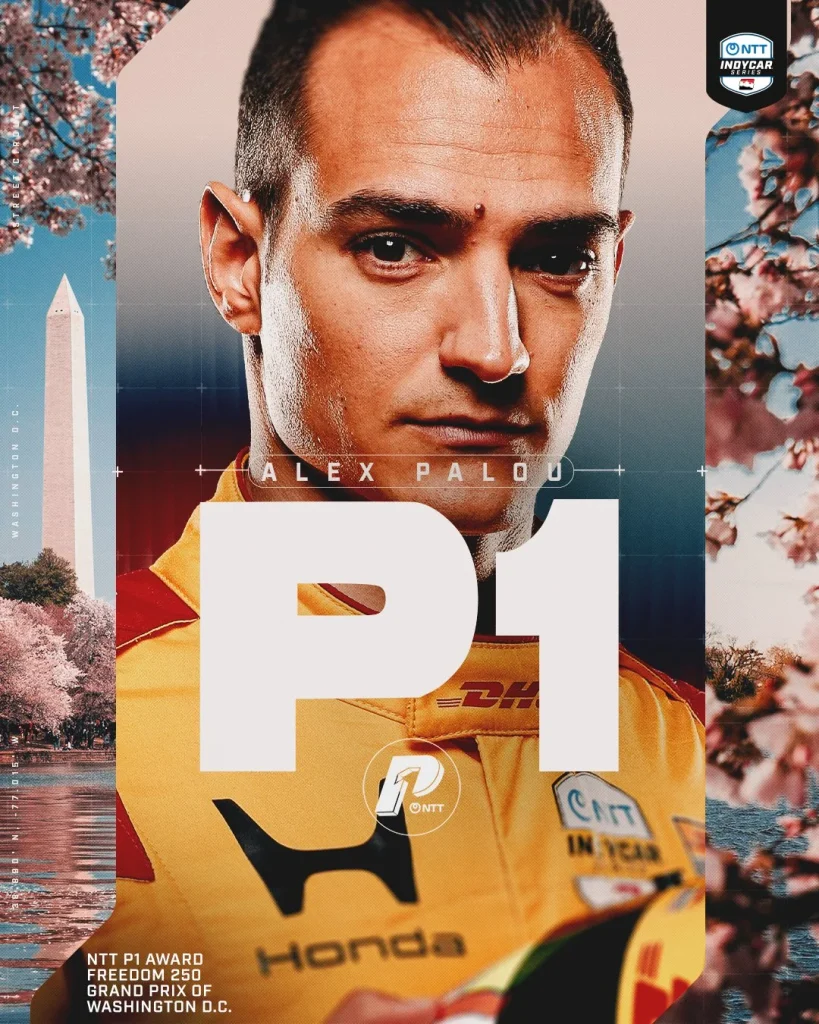
Álex Palou will start the inaugural Freedom 250 Grand Prix of Washington, D.C. from pole after delivering another example of why one of his former weaknesses has become another weapon.
Palou won the NTT P1 Award with a 56.8993, beating Kyle Kirkwood to pole. Scott McLaughlin qualified third, Christian Rasmussen produced an excellent session to take fourth, Marcus Armstrong was fifth and David Malukas completed the Fast Six.
Pato O’Ward will start seventh, followed by rookie Dennis Hauger, Christian Lundgaard and Felix Rosenqvist.
For Palou, this was his seventh pole of the 2026 season and the fourth street-course pole of his career.
There was a time when qualifying could legitimately be described as one of the weaker parts of Palou’s game. Now he is collecting poles at a remarkable rate.
And perhaps the most worrying part for everyone else is that he still appears to be getting better.
Palou Has Turned a Weakness Into a Strength
It says something about Palou’s current level that seven poles in a season can become another chapter in the broader discussion of his improvement.
Qualifying was specifically an area he focused on improving last year. The results of that work are becoming difficult to ignore. The same applies to the old characterization of ovals as another Palou weakness. His oval record included an Indianapolis pole and a second-place finish during his first season with Chip Ganassi Racing, while bad luck and Penske’s strength on ovals helped create a perception that perhaps overstated his deficiencies there. The larger trend is that Palou has become increasingly complete across different types of circuits.
He was already the benchmark, and instead of merely maintaining that level, he appears to have improved areas where the rest of the field could previously hope to find an advantage. There is one amusing counterpoint to all those poles: he hasn’t converted all of them into victories.
But dismissing him as a “qualifying merchant” at this stage requires a considerable amount of sarcasm.
The Freedom 250 also isn’t a race anyone should award him before it begins. As we saw throughout both practice sessions, Washington’s bumps and unusual surface features could introduce enough chaos to disrupt even the cleanest race plan. For now, however, Palou has put himself in the best possible place to avoid it.
Again.
Turn 1 Showed Why Palou Is So Difficult to Beat
The most revealing part of Palou’s Fast Six performance may not have been the final time.
It was how he approached Turn 1. Other cars were locking their brakes entering the corner. Palou appeared considerably more conservative, to the point where his entry initially looked almost too slow. Then the lap developed.
With tire temperature not fully established, attacking the braking zone as aggressively as possible wasn’t necessarily the fastest approach. Palou prioritized keeping the car under control and maximizing what happened after the corner rather than trying to win everything on entry. Slow in, fast out. That philosophy appears particularly effective for a driver whose exit speed is already one of his biggest strengths. While others were powersliding onto the circuit’s longer straights, Palou was able to get the car pointed and accelerate cleanly. Even a small speed advantage at the beginning of a straight continues paying dividends all the way down it.
There was at least one lockup from Palou during the session, but it wasn’t on a push lap. When the lap mattered, he delivered. That distinction becomes particularly important under the pressure of single-car qualifying. Palou has repeatedly demonstrated an ability to produce an enormous lap with minimal preparation. We saw another example at Markham, when a caution left him needing one major lap to advance despite cold tires.
Washington required another version of that skill. He delivered again. At a certain point, watching Palou do this stops being frustrating and starts becoming an appreciation of just how high his current level is. Trackside, his car appeared to be on rails compared with much of the competition.
Kirkwood’s own assessment after qualifying was similarly straightforward: they simply didn’t have anything for him.
Christian Rasmussen, P4
Palou taking pole may have been predictable.
Christian Rasmussen qualifying fourth was not. Rasmussen put together one of the standout qualifying performances of the day to earn a place on the second row, behind only Palou, Kirkwood and McLaughlin. It creates one of the more entertaining possibilities heading into the race: imagine if Rasmussen somehow wins this thing.
After the repeated use of “sketch” throughout the broadcasts, perhaps the Sultan of Sketch finding a way through Washington’s bumps to win the Freedom 250 would be a fitting conclusion.
And if it doesn’t happen in Washington, there is always Milwaukee for Rasmussen to attack. Armstrong qualifying fifth also created an interesting visual for Chip Ganassi Racing, with Palou at the very front and Armstrong toward the other end of the Fast Six.
But Rasmussen was unquestionably the surprise among that group.
The Qualifying Groups Were Ridiculously Uneven
Not everything about Saturday’s qualifying session worked nearly as well as Palou’s lap.
The initial groups appeared extremely lopsided, with Group 1 particularly stacked. The disparity was large enough to renew the argument for splitting qualifying groups according to practice times. Alexander Rossi has already complained about the issue, and Washington provided a strong illustration of why the current method can produce frustration. A street circuit evolves as cars run. Ordinarily, you would expect the track to improve rather than produce some of the differences seen between these groups.
When one side of the draw is packed with many of the strongest contenders, progression can depend too heavily on which group a driver happens to land in rather than simply how they compare with the field as a whole. Group 1 in Washington looked particularly brutal. That doesn’t diminish the performances of the drivers who advanced. It does raise a question about whether IndyCar has a better method available for creating balanced groups.
Practice times would at least provide an objective basis for doing so.
Single-Car Fast Six Was a Much Bigger Problem
The bigger criticism concerned the Fast Six itself.
Single-car qualifying sounds appealing in theory. Every driver gets the circuit to themselves, television can focus entirely on one lap, and the pole shootout becomes easy to follow. In Washington, the execution exposed several problems. Drivers didn’t receive what felt like a proper warmup lap. Tire temperatures became an important variable. And commercials interrupted the Fast Six, meaning not everyone was effectively operating under identical circumstances.
That last point is particularly difficult to justify. If IndyCar is going to use a single-car shootout specifically to isolate six drivers and determine pole, putting commercials in the middle undermines one of the supposed advantages of the format. The final moments of conventional qualifying also naturally create drama as multiple drivers improve simultaneously and the clock expires. Single-car running sacrifices that excitement. And once a major contender goes early, makes a mistake or simply posts an uncompetitive time, some of the suspense disappears immediately. Instead of everyone having until the final seconds to respond, that driver’s qualifying is simply over.
Washington provided plenty of reason to question whether the tradeoff is worthwhile.
Tire Temperature Creates a Fairness Problem
If single-car Fast Six qualifying remains at street courses next season, IndyCar may need to address tire preparation.
One possible solution would be for Firestone to provide six sets of alternates specifically for the Fast Six, removing tire choice as a variable between competitors. Providing tire blankets for those sets could also help keep temperatures relatively consistent. The goal would be simple: if six drivers are each being given one isolated opportunity to determine pole, their starting tire conditions should be as equal as reasonably possible. Otherwise, running order itself can create an advantage.
That doesn’t change what Palou accomplished. Everyone faced the format that existed, and Palou managed it better than anyone else. In fact, that ability to adapt to imperfect circumstances is part of what made his performance impressive.
But a qualifying system should ideally determine who is fastest rather than who happened to receive the most favorable tire preparation.
Even the Broadcast Had an Eventful Qualifying Session
The television coverage provided its own entertainment.
After spending Practice 2 discussing everything from candy bars to Washington landmarks, Will Buxton apparently arrived at qualifying with enough obscure D.C. history to host an entire happy-hour trivia night. Finding ways to discuss the history of the National Mall without explicitly wandering into its more colorful past became almost an event within the event.
Then came perhaps the most ambitious linguistic claim of the weekend: apparently, the letters in “Palou” can be rearranged to spell “pole.”
They cannot. Washington qualifying was already strange enough without inventing additional letters.
Tim Cindric selecting third in the qualifying order provided another wonderfully unexplained moment. Sometimes strategy requires complex analysis. Sometimes the apparent reasoning is effectively: third sounds fine.
The Sponsors Are Always Along for the Ride
Another detail that became particularly noticeable in the post-qualifying interviews was just how thoroughly drivers incorporate sponsors into the names of their cars.
Those sponsors can change from week to week, yet drivers reliably work the full branding into their answers. It can sound unnatural, but it is also part of the job. Drivers are handed branded watches, hats and drinks, and the car itself is one of the most valuable pieces of advertising inventory in the sport. Remembering exactly which sponsor needs to be mentioned during an interview is another piece of the professional racing-driver skill set.
At the Freedom 250, that commercial element is particularly relevant. As we discussed after Practice 1, Washington has already demonstrated its significance to sponsors, with major executives choosing to attend the event and the location providing unusual corporate visibility.
The drivers remembering the name painted on their cars is part of the same ecosystem.
Washington Still Looks Ready for Chaos
None of this guarantees Palou anything on Sunday.
Practice 1 showed just how violently the bumps can throw cars offline and toward the walls. Practice 2 introduced us to “THE Crosswalk” and the Turn 6 launch pad, both of which could become much more problematic once drivers are racing side-by-side instead of choosing their preferred lines.
Qualifying didn’t make those concerns disappear. If anything, starting deeper in the field could make them more important. There is already concern that someone could end up hitting the wall around Turn 6 particularly hard. Romain Grosjean could also be especially entertaining over all those bumps. The possibility of attrition remains very real.
That is why declaring Palou the winner Saturday night would be premature. He may be operating at another level, but Washington has enough variables to punish anyone.
Palou Has the Best Possible Starting Point
Still, there is something fitting about Palou starting first for a race that could become unpredictable.
If the biggest threats are traffic, bumps, crashes and being forced onto bad lines, pole position offers the simplest defense: start ahead of as much of that trouble as possible. Kirkwood will be alongside him and has looked like Palou’s most consistent challenger throughout the weekend. He led Practice 1, finished second in Practice 2 and now starts second. McLaughlin sits immediately behind them.
Rasmussen is the wildcard in fourth. And then there is Palou, collecting a seventh pole in an area of his driving that was once considered relatively weak. Perhaps that is the most remarkable part of his 2026 qualifying performance. The rest of the field isn’t simply chasing the driver who was already the best.
They’re chasing a driver who keeps finding new ways to get better.