

The Dutch Grand Prix weekend is over, but Zandvoort left Formula 1 with considerably more to talk about than the result itself.
Lando Norris is suddenly talking like a world champion who knows exactly how good he is. Yuki Tsunoda and Liam Lawson have complicated the way we should evaluate Red Bull’s recent driver carousel. Oscar Piastri is facing increasingly uncomfortable questions about whether the 2026 regulations have exposed one of his biggest weaknesses. Ferrari somehow turned a potentially strong weekend into another debate about its pit wall. And the stewards managed to take something as simple as a red light and make it controversial. Away from Zandvoort, Toto Wolff is already playing the development game with McLaren, construction footage from Qiddiya has reminded everyone that Formula 1 is apparently building Mario Kart tracks now, and perhaps most importantly for the sport’s long-term health in America, the move from ESPN to Apple TV is being blamed for plunging U.S. viewership.
There is a lot to unpack.
Lando Norris Is Finally Giving Lando Norris Credit
Maybe the most important thing Norris said all weekend came after he had already won.
“For once I will give myself a little bit of credit that I feel I am doing a better job than everyone.”
For Norris, that almost feels revolutionary. For years, one of the defining characteristics of Norris has been how quickly he identifies his own mistakes. Now we are watching a version of him that appears increasingly comfortable acknowledging when he has simply been exceptional. And at Zandvoort, he was.
The most impressive part wasn’t merely winning. It was what he was able to do with the tires. Late in the race, Norris was circulating on older hard tires while Kimi Antonelli had newer softs, yet Antonelli couldn’t make meaningful progress toward him. Earlier, Norris had spent significant time in dirty air and still managed his tires well enough to retain enormous pace later. Even George Russell apparently reached the point where Norris’ lap times made the situation obvious: if Norris could produce those numbers on those tires, Mercedes wasn’t really racing him anymore.
Then there was Norris’ move on Antonelli. He braked extraordinarily late, yet the car barely appeared disturbed. It was the sort of move that Norris might not have attempted with the same conviction a couple of seasons ago. That’s what feels different. The speed was always there. The tire management has long been one of his strengths. What appears to have changed is the confidence with which he is applying everything.
Winning a world championship may have removed the final psychological barrier. Norris has previously talked about needing to accomplish something before truly believing he can do it. Well, now he has done it. There is no hypothetical anymore. He knows he can be world champion because he is one.
And that could be bad news for everyone else. There is still a long way to go if anyone wants to talk seriously about another championship charge, especially considering how much McLaren lost during the opening part of the season. But the Norris currently driving the car looks capable of making things interesting if McLaren continues giving him opportunities. The next question is whether this translates to Monza. McLaren’s shorter gear ratios could leave it vulnerable in a straight line, although battery management, setup and its new rear wing could all become important. But right now?
It’s difficult to argue with Norris saying he is doing a better job than everyone else.
Oscar Piastri Has a 2026 Problem
Unfortunately for McLaren, Norris’ rise is making Piastri’s struggles increasingly difficult to ignore.
Piastri’s stock has probably fallen more than almost any other leading driver this season, and Zandvoort only intensified the discussion. Former F1 drivers Heikki Kovalainen and Mika Salo discussing Piastri’s performance prompted speculation about whether something beyond the car might be affecting him. But we don’t need a conspiracy to explain what we’re watching. There is a much simpler possibility:
The 2026 cars don’t suit Piastri nearly as well as the previous generation did. Piastri’s tire management has historically been one of the weaker parts of his game relative to Norris. That weakness appeared less damaging when McLaren had a car that was exceptionally kind to its tires. Now that advantage isn’t there to the same extent.
At the same time, the 2026 regulations have reduced aerodynamic load through high-speed corners, while the power delivery appears to make traction management increasingly important. In other words, some of the characteristics that previously played toward Piastri’s strengths have been reduced while areas that favor Norris have become more important. Zandvoort made the contrast brutal. Piastri complained that the hard tires weren’t offering much improvement over the mediums in degradation. Meanwhile, Norris was making old hards look almost indestructible.
Fernando Alonso stretching his tires deep into stints only made Piastri’s difficulties stand out further. That doesn’t suddenly make Piastri a bad driver. Drivers struggle with regulation changes. Even elite drivers can encounter cars whose characteristics don’t naturally suit them. The real test is adaptation.
Max Verstappen and Charles Leclerc have also had to deal with cars that may not maximize the strengths they previously enjoyed, yet both have still produced strong performances. Piastri needs to find his version of that. There is also a danger in allowing a couple of recent weekends to rewrite the entire season. Norris and Piastri have been much closer at other points this year. But the trajectory is becoming difficult to dismiss. Norris appears to understand this generation of car increasingly well.
Piastri still appears to be solving it.
Yuki Tsunoda Reminded Everyone That He Can Actually Drive

The reaction to Tsunoda’s return at Zandvoort was fascinating because some of it seemed to assume he had spent months sitting on a sofa.
He hadn’t. Tsunoda is an experienced former full-time F1 driver and a reserve who has continued doing simulator work. He has five years of Formula 1 experience behind him. Of course he was capable of getting into a car and being competitive. That doesn’t mean his performance wasn’t impressive.
With limited preparation, no real-world testing in the new car and only one practice session, Tsunoda remained surprisingly close to Arvid Lindblad throughout the weekend. He also showed legitimate racecraft. When cars became grouped together, Tsunoda worked himself into contention for points, and late in the race he defended strongly against Pierre Gasly. He ultimately missed out, but the result doesn’t entirely describe the drive.
There is a reasonable argument that Racing Bulls’ strategy hurt him too, which would be an almost comically appropriate way for Tsunoda’s return to unfold. More importantly, his performance should force some reconsideration of what happened to his reputation at Red Bull. Failing to match Verstappen in a notoriously difficult car does not mean a driver suddenly forgets how to drive.
Tsunoda was never an elite F1 driver. But there is a huge distance between “not elite” and “not good.”
Zandvoort reminded everyone where he probably belongs.
Liam Lawson May Have Proven the Same Thing
Lawson might have done even more for his reputation.
His performance raises an uncomfortable question about Isack Hadjar’s success: how much of the difference between them is driver performance, and how much is simply that Hadjar entered Red Bull at a far better time? Lawson struggled badly when he received his opportunity in the previous Red Bull. Tsunoda struggled too. Sergio Perez struggled. The second seat became infamous for making competent drivers look completely lost. Now Lawson has returned to a Red Bull and looked perfectly capable.
That doesn’t prove Hadjar isn’t excellent. It does suggest comparisons between Hadjar and his predecessors need context. The 2026 Red Bull appears considerably more manageable than the previous car. Hadjar may simply have received his opportunity under far better circumstances than Lawson or Tsunoda did.
Zandvoort therefore rehabilitated two reputations at once. Tsunoda reminded everyone that he remains a capable F1 driver.
Lawson demonstrated that his disastrous first Red Bull opportunity may have told us far more about that car than it did about him.
The Driver Stock Market Looks Very Different
If we were buying and selling driver stock after Zandvoort, several names have moved dramatically.
Norris is clearly up. Lawson is up. Tsunoda is up after one weekend.
Gabriel Bortoleto continues climbing quietly in the background. His rookie season was already encouraging, but his ability to remain competitive in machinery that isn’t consistently near the front has continued to build his reputation. There are questions about how often he moves forward during races, but recent results suggest he has generally extracted something close to what the car allows. Nico Hulkenberg deserves recognition too. His Zandvoort performance, including avoiding the incident involving Bortoleto and then fighting his way forward, was another reminder of how quietly strong he can be. Lewis Hamilton’s stock has also recovered enormously compared with where it stood last year.
Piastri is clearly down, although there is plenty of season left for that assessment to change. Carlos Sainz has also attracted criticism, not necessarily because his pace has collapsed, but because recent incidents and his reactions to them have damaged some of the polished reputation he previously carried. And then there are drivers like Leclerc and Russell, whose reputations haven’t necessarily collapsed but who aren’t dominating the conversation in the way many expected.
The 2026 regulations are reshuffling more than the competitive order. They’re changing how we evaluate the drivers themselves.
Hamilton Apologized. Ferrari Still Has to Fix the Actual Problem
Hamilton’s post-race statement was strikingly self-aware.
After listening back to his radio and television comments, he admitted that his frustration had gotten the better of him.
“That wasn’t the best version of me.”
He took responsibility and promised to be better. Fair enough. But Ferrari shouldn’t allow Hamilton’s apology to obscure why he was frustrated.
The pit wall created much of this mess. Hamilton was extremely quick during his second stint and rapidly closed the gap to Leclerc. At that point, Ferrari had a straightforward problem: two teammates effectively running different races, with one approaching significantly faster. The obvious solution was communication.
Tell Leclerc what Hamilton’s strategy is. Tell him Hamilton is coming through. Let Hamilton attack while he has the pace.
Instead Ferrari complicated everything. Leclerc was apparently confused by the timing of his own strategy calls. Hamilton felt like a guinea pig. Rather than clearly explaining what each car was doing, Ferrari managed to compromise the situation enough that both drivers ended up frustrated. This isn’t about declaring Hamilton the number one driver.
It isn’t about declaring Leclerc the number one driver either. It’s about maximizing the team’s result. Ferrari has already shown that both drivers can follow team orders. Hamilton has moved aside for Leclerc. Leclerc has moved aside for Hamilton. There is little reason to believe either would refuse a properly explained instruction when their strategies diverge.
The problem wasn’t the drivers. It was the pit wall’s apparent reluctance to make a decisive call. We’ve seen versions of this story before with Ferrari. Fernando Alonso questioned strategy from inside the car. Sebastian Vettel did it. Now Hamilton is doing it.
At some point, when generations of world-class drivers repeatedly encounter similar problems, the drivers stop being the common denominator. Hamilton may not have shown the best version of himself over the radio.
Ferrari hasn’t shown its best version for quite a while.
Lance Stroll Was Right About the Red Light
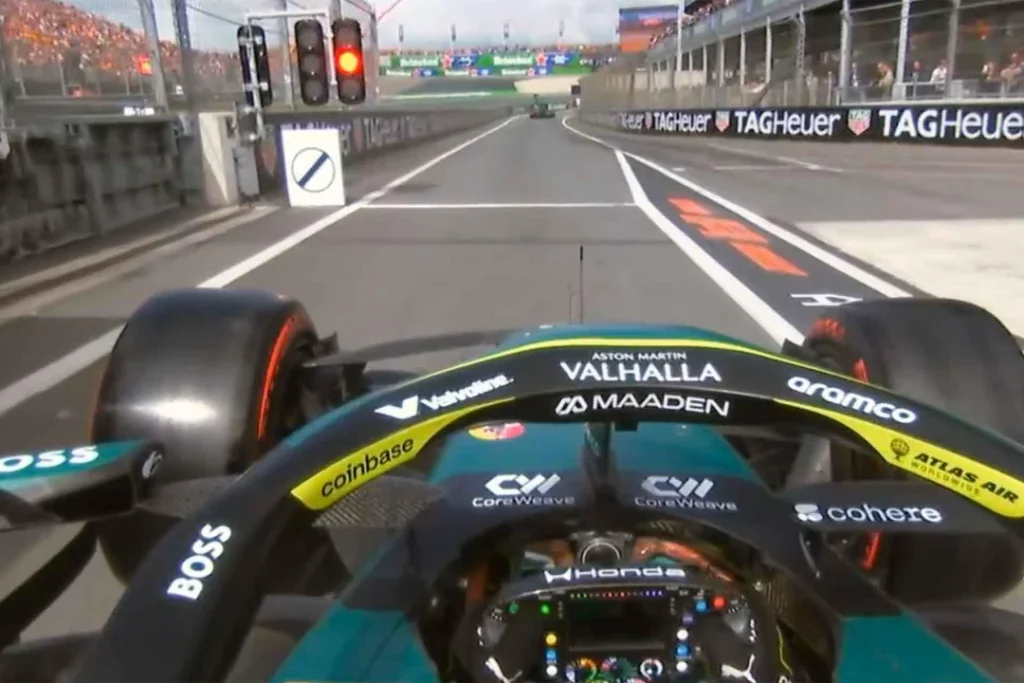
Of all the controversies from the weekend, this should have been the easiest.
A red light means stop. Oliver Bearman and Gabriel Bortoleto passed a red light at pit exit. Lance Stroll noticed it immediately and repeatedly told his engineer they should receive 10-second stop-and-go penalties. Instead, the stewards issued reprimands.
That decision is difficult to understand. Formula 1 can debate racing incidents endlessly because racing incidents involve judgment. Pit exit lights shouldn’t. Red means stop.
Historically, drivers have faced extraordinarily severe consequences for ignoring them. Felipe Massa and Giancarlo Fisichella were disqualified in Canada in 2007 after exiting under a red light. Montreal itself has plenty of history demonstrating why pit-exit procedures matter. The justification that this wasn’t effectively a live racing situation doesn’t make the decision more reassuring. It arguably makes it worse.
Drivers don’t know why race control has activated a red light. There could be marshals, recovery vehicles, track workers or another hazard ahead. The entire purpose of the signal is that the driver isn’t supposed to decide whether the reason behind it seems important enough. The driver stops. That’s it.
F1 is willing to enforce tiny pit-speed violations and microscopic technical measurements with essentially no discretion, yet somehow a red light became contextual. That is exactly backwards. Even if race control activated the light unnecessarily, the answer should still be that drivers obey it and questions are asked afterward.
Otherwise you’ve transformed a command into a suggestion. Justice for Lance Stroll. And yes, we know he retired anyway.
We stand by it.
Toto Wolff Says Mercedes Can’t Match McLaren’s Development Spending
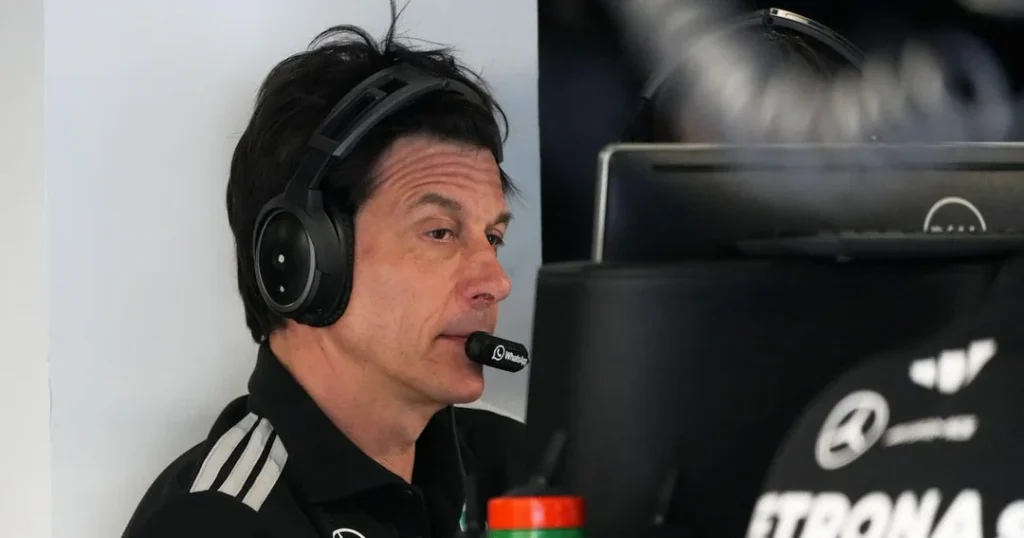
Toto Wolff saying Mercedes doesn’t currently have the development money to respond to McLaren was always going to produce one reaction:
Sure, Toto. Anyone who watched Mercedes during its dominant years remembers the routine. Another team looked incredibly dangerous.
Mercedes expected a difficult weekend. Ferrari looked fast. Red Bull looked fast.
Then Mercedes qualified at the front and disappeared. The eternal-underdog messaging became almost as recognizable as the team’s dominance itself. But the headline here appears more dramatic than the actual explanation.
The issue isn’t that Mercedes has somehow run out of money while McLaren discovered a vault beneath Woking. It’s about how the cost-cap development budget has been allocated. Mercedes has apparently spread its planned spending across the season, with money already committed to later upgrades. McLaren deployed more of its resources earlier. That means Mercedes can’t simply respond immediately to every McLaren development without compromising what it already plans to introduce later.
That is considerably more believable than “Mercedes is broke.”
It also means we’ll eventually find out whether Wolff’s claim holds up. If Mercedes produces substantial upgrades later while McLaren’s development rate slows, the strategy will make sense. Until then, however, nobody can blame F1 fans for hearing Toto Wolff explain why Mercedes is disadvantaged and experiencing a little historical déjà vu.
Someone start the GoFundMe.
Qiddiya’s “Blade” Is Actually Being Built
For years, the Qiddiya circuit looked like one of those concepts designed primarily to generate spectacular renderings.
Then construction footage appeared. And apparently they really are building this thing.
The first corner, known as “The Blade,” climbs onto an elevated section in a way that looks less like traditional circuit design and more like something unlocked after completing every cup in Mario Kart.
The immediate reaction is obvious: what happens if a car goes off? But the renderings provide more context than the construction footage alone. The actual racing surface occupies only part of the elevated platform, with substantial runoff, barriers and fencing before the edge. It’s also an uphill approach into a heavy braking zone, leading to comparisons with COTA’s Turn 1.
So while it looks completely absurd, the visual spectacle doesn’t automatically mean the corner is uniquely dangerous. Still, the fact that we have to discuss whether an F1 car can fall off the side of a racetrack tells you everything about Qiddiya. There are other potential issues.
The circuit is expected to be extremely long. Simulator versions have produced lap times around the two-minute range, although we don’t yet know how accurately those versions represent the final circuit. A long lap means fans see the cars less frequently, while safety cars consume a larger proportion of the race and strategy can become less flexible. On the other hand, longer circuits reduce qualifying congestion and give designers room to create a wider variety of corners. Whether Qiddiya produces good racing remains completely unknown. But we’ll give it this:
It definitely doesn’t look boring.
F1’s Apple TV Gamble Has an Obvious Problem
The most consequential story of all may have nothing to do with what happened on track.
F1 viewership in the United States has reportedly plunged following the move from ESPN to Apple TV. And if that is the case, it shouldn’t surprise anyone. F1 spent years trying to turn Americans from casual viewers into regular fans. Then it moved its U.S. broadcasts behind a streaming service that many of those casual viewers did not already use.
That’s a dangerous trade. The dedicated fan will find Formula 1. The casual viewer won’t necessarily subscribe to another service just because a race happens to be there.
That’s the audience F1 risks losing. Several fans described exactly that behavior: rather than moving to Apple TV, they’re watching highlights, following results online or simply watching less often. The strange early-season schedule, including cancellations and gaps between races, appears to have compounded the problem by preventing viewers from establishing a regular habit.
There is important context. Some races previously aired on ABC, giving F1 access to an enormous potential audience that can’t be replicated by a subscription streaming platform. And the U.S. still represents only one part of F1’s global audience. Apple may also judge the deal differently from F1. Sports can help convert occasional Apple TV users into year-round subscribers. Someone who previously subscribed for a month to catch up on a show might remain subscribed because F1, soccer, baseball and other programming collectively make the service worth keeping.
From Apple’s perspective, that ecosystem can make sense even if individual F1 audiences don’t resemble ESPN’s. But F1 has a different question to answer. Does maximizing the rights fee today damage audience growth tomorrow?
We’ve already seen versions of this elsewhere. Fans pointed to Germany’s move from widely available RTL coverage to Sky as an example of what can happen when accessibility collapses. Whatever the immediate rights revenue, rebuilding a lost casual audience can be much harder than maintaining one. That should matter enormously in the United States because F1 has invested so heavily in growing the market.
The American expansion wasn’t built solely on existing hardcore fans. It was built on accessibility, cultural momentum, new races, social media, Netflix and people discovering the sport almost accidentally. Every additional paywall makes that accidental discovery less likely.
Sponsors may not panic immediately. Many F1 partnerships are global, many are B2B, and hospitality and networking are enormous parts of the commercial ecosystem. But audience size still matters because attention is ultimately part of what Formula 1 sells. Apple gave F1 money. ESPN gave F1 distribution.
Those aren’t necessarily the same thing.
Zandvoort May Have Told Us More About 2026 Than We Realized
The Dutch Grand Prix wasn’t merely another race.
It exposed several trends that could define the rest of the season. Norris looks more complete and more confident than perhaps ever before. Piastri needs to prove he can adapt to a regulation set that isn’t naturally flattering his strengths.
Lawson and Tsunoda have both given us reason to reconsider how harshly their Red Bull struggles should be judged. Hamilton remains extremely fast, but Ferrari still has to become decisive enough to take advantage of that speed. The stewards have somehow made stopping at a red light a philosophical question.
Mercedes and McLaren are entering a development battle that could determine whether Norris gets a genuine opportunity to make the championship uncomfortable. And Formula 1 itself is facing the uncomfortable possibility that chasing a lucrative American television deal has made the sport harder for Americans to watch. Meanwhile, somewhere in Saudi Arabia, they’re building a racetrack in the sky.
Welcome to Formula 1 in 2026.