

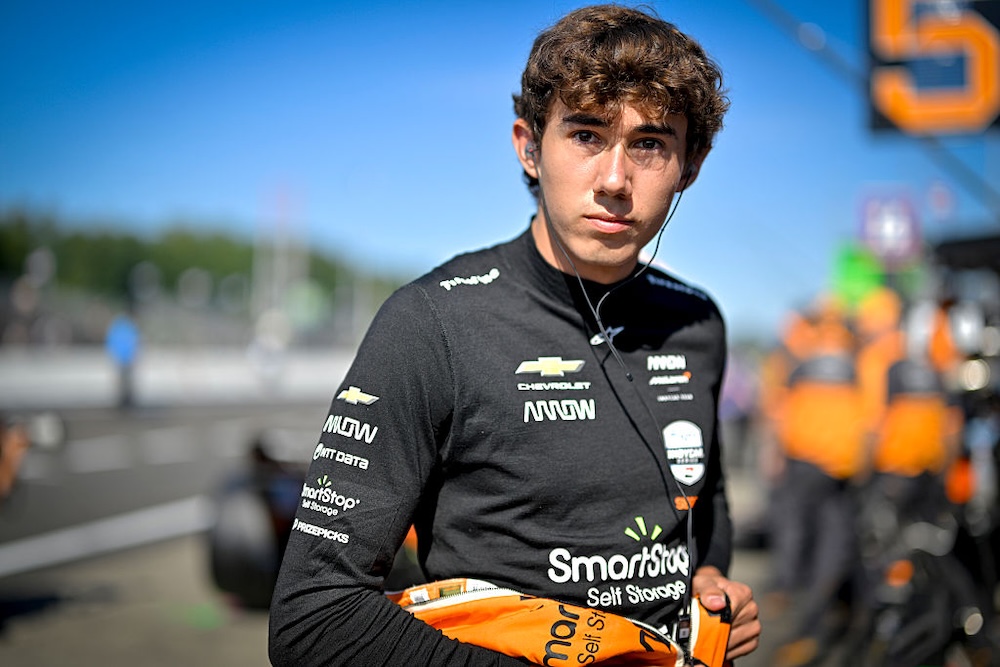
Nolan Siegel is expected to race alongside Rinus VeeKay in 2027 as Ricardo Juncos prepares to sell his stake in the IndyCar team he founded. RACER reports, citing multiple sources, that Brad Hollinger is set to take full control of Juncos Hollinger Racing. The sale is expected to close before year’s end, with Siegel’s signing and a rebrand under Hollinger’s name, including a new logo and colors, to be announced afterward. The team declined to comment to RACER.
It’s an unexpected combination of outcomes. Earlier reporting had both owners wanting VeeKay back, with Hollinger favoring Caio Collet for the second car and Juncos preferring Siegel. If the deal closes as described, Hollinger will get control of the team and the driver previously identified as his partner’s choice.
For VeeKay, the value of a resolution is straightforward. Both owners wanted him as the driver they could build around. Knowing who will run the team finally gives him some idea of what he’ll be coming back to. For Siegel, the appeal is more personal. The team that gave him a start on his way to Arrow McLaren could now give him a chance to show what he learned there.
The step Siegel might have taken first
Siegel’s earlier stint filling in at Juncos Hollinger was part of the sequence that took him out of Indy NXT and into an Arrow McLaren seat at Théo Pourchaire’s expense. At the time, Siegel had a chance to see an NXT title fight with Louis Foster through to its conclusion. Taking the McLaren opportunity meant leaving that question open.
That unfinished season matters when assessing Siegel against Sting Ray Robb, the driver he would effectively replace. Robb’s best finish in the feeder championship was second, one place better than Siegel’s. But Siegel gave up the opportunity to improve on his third-place season when he left early. Staying in NXT would also have given him more time to develop before anyone expected him to measure up to Pato O’Ward. A move to Juncos Hollinger after a full title bid would have made for a more gradual introduction to IndyCar. Siegel could now get that intermediate step in reverse.
His time at McLaren gives Hollinger reason to be cautious. Siegel struggled relative to his teammates and often found himself racing near Robb despite having the McLaren seat. There were flashes on road courses, but they came too infrequently to make him an obvious upgrade. Robb also has performances worth weighing beyond the laps he led at Indianapolis with Foyt. At Long Beach in 2025, he made the strategy work long enough to lead double-digit laps and came away with a top-10 finish. That’s precisely the kind of result Hollinger would want his second driver to salvage when an opportunity opens up.
A different car, with VeeKay as the reference
The most interesting sporting question is how much of Siegel’s deficit follows him out of McLaren. One possible explanation is the way the car responds on corner entry. A sharp front end that lets O’Ward place the car exactly where he wants it can be difficult for another driver to trust. If that was a meaningful part of Siegel’s struggle, working with a different engineering group could help him turn his occasional road-course pace into something repeatable. His results alone can’t tell us how much time he lost to the setup.
VeeKay makes that question worth following. Siegel could finish in roughly the same part of the field as before and still show progress if he qualifies closer to VeeKay and stays with him over a race distance. Conversely, a persistent gap across two teams would make the McLaren setup a less persuasive explanation. Siegel is three years younger than Robb, which gives Hollinger some reason to bet on further development. The comparison with VeeKay would give the team something more useful than age on which to judge it. There’s a financial case for the move, too, though the terms remain undisclosed. Whatever backing Siegel brings could help Hollinger fund a two-car operation and put competitive equipment around VeeKay. How much it influenced the choice, or whether any of it would go toward VeeKay’s salary, remains unknown. Collet offered an intriguing alternative on pace, even if questions remained about how consistently he could convert that speed into results. Losing this particular opening would narrow his options for 2027. It tells us little about whether he’ll get another IndyCar opportunity.
If the sale and signing go through, Hollinger’s first lineup under his own name will pair the driver both owners already trusted with one whose best case still rests partly on an unfinished NXT season. The most telling result for Siegel may come on an ordinary road-course weekend. When VeeKay gets the car working, can Siegel be there with him?