

By my third day walking SEMA, a familiar badge was becoming a poor guide to what I would find underneath it. A Toyota Tacoma had a Honda race engine in its bed. A Civic Type R wore exposed carbon fiber across its exterior. A Bugatti EB110 had been dramatically widened without sacrificing the original panels.
Then there was the 14-liter V16 sitting on a stand, waiting for the equally ambitious car being built around it.
The variety made November 5 another rewarding day on the floor. Some projects completely changed a vehicle’s purpose. Others concentrated on materials, proportions, or preserving the option to return to stock.
A Tacoma with a very different job
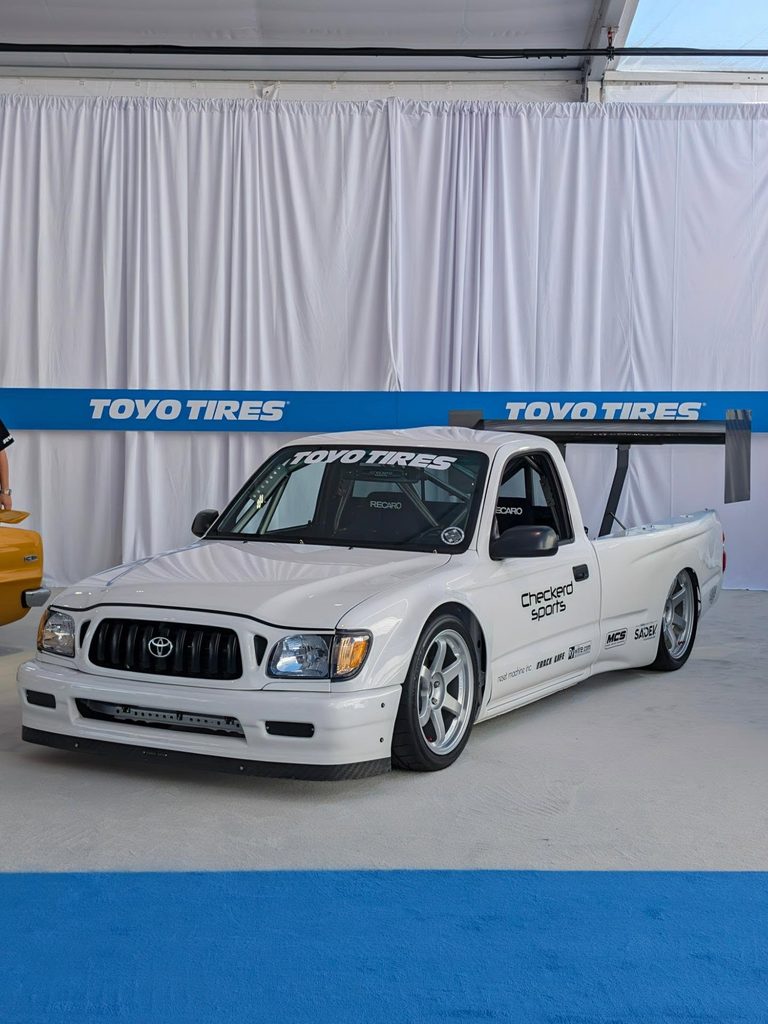
Checkerd Sports’ first-generation Toyota Tacoma was one of my favorite concepts in this group.
Its Honda K-series race engine sits in the bed beneath the rear wing, turning a compact pickup into a track-focused machine with an entirely different layout. The quoted figures are 450 horsepower and just 1,700 pounds.
That combination puts the emphasis on far more than an engine swap. Moving the powertrain and stripping away weight changes how the whole vehicle has to work, from its packaging to its balance.
I like that the Tacoma remains recognizable. There is something especially entertaining about taking an ordinary pickup and pursuing a racing idea this thoroughly. The familiar body draws you in; the engine placement gives you a reason to keep looking.
An EK9 dressed in carbon
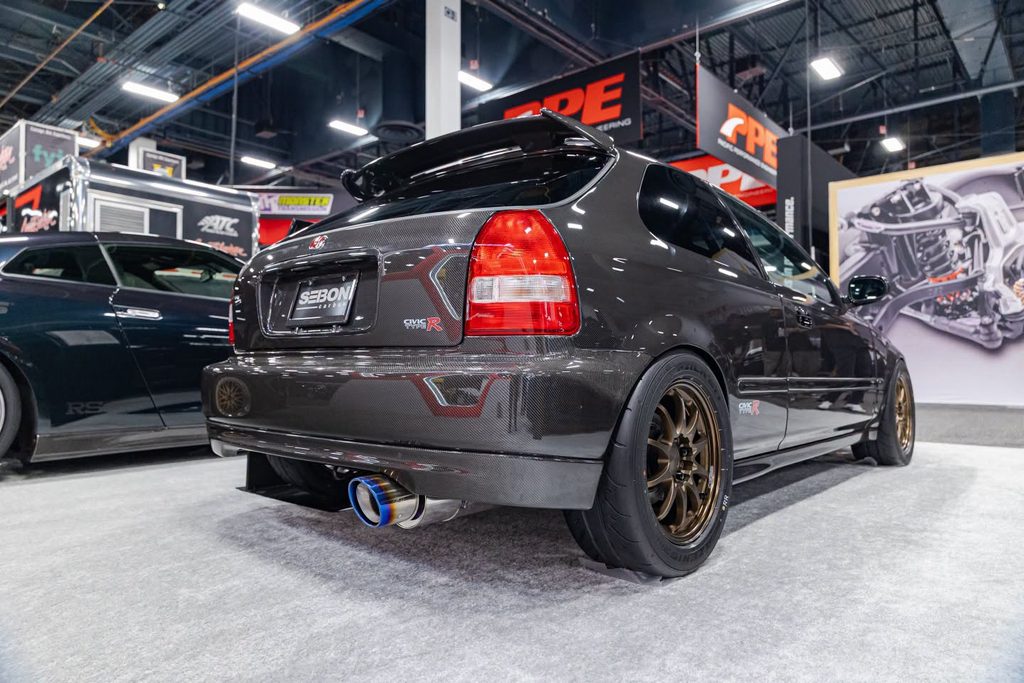
Mickey Andrade and Round Cat Garage’s EK9 Civic Type R at Seibon followed a different route toward a lighter build.
Exposed carbon-fiber panels define the exterior, with bronze Volk Racing CE28 wheels, blue Spoon brake calipers, and an A’PEXi exhaust tip adding contrast. Through all of those changes, the Civic keeps its familiar shape. The final weight is still to be revealed, so there is no measured number to attach to the completed car yet. That leaves an interesting question for the finished build: how much weight has the extensive material change actually removed?
Even before that answer, the visual effect works. The carbon weave becomes the defining finish without requiring an oversized body kit to make the car stand out. It is still clearly an EK9, with its character expressed through the material rather than a radically different silhouette.
A widebody EB110 with a way back
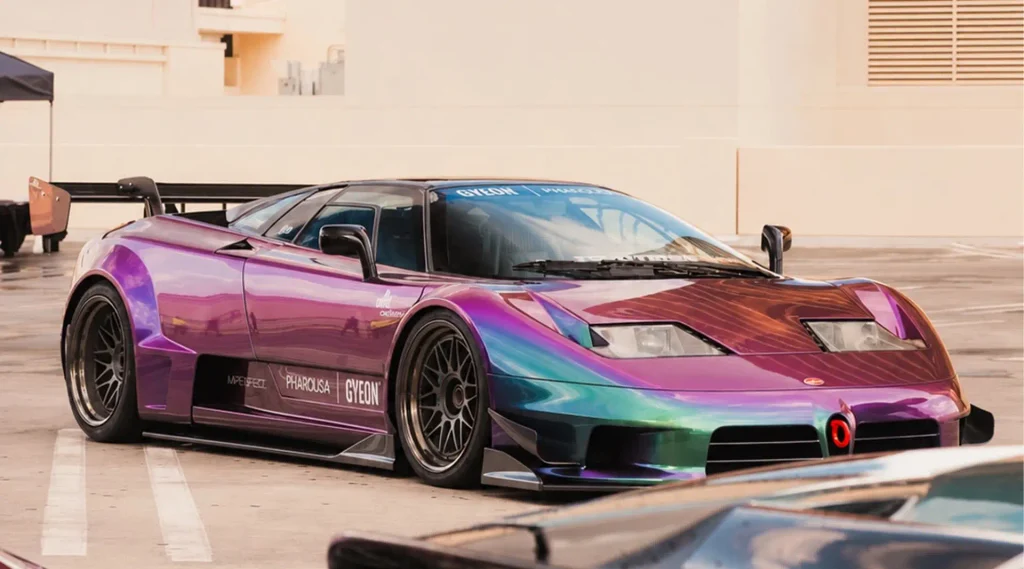
Greg Park’s Bugatti EB110 brought one of the more thoughtful construction decisions of the day.
Jon Sibal designed the widebody, and Phiaro Bespoke developed the replacement panels using 3D scanning. The original exterior panels were removed and retained, allowing the car to return to its factory configuration. The design dates to February 2020. Roughly six years later, it exists as a complete car with widened bodywork, custom MV Forged wheels, an APR Performance rear wing, and a finish that shifts between purple, blue, and green. The reversibility is what makes the project particularly interesting to me. The owner can enjoy a highly personal interpretation of the EB110 while retaining the parts needed to restore its original appearance.
That kind of flexibility has to be engineered into the process. Preserving the factory panels shaped how the conversion was approached, and it gives the build a longer-term perspective beyond its SEMA appearance.
Fourteen liters of ambition
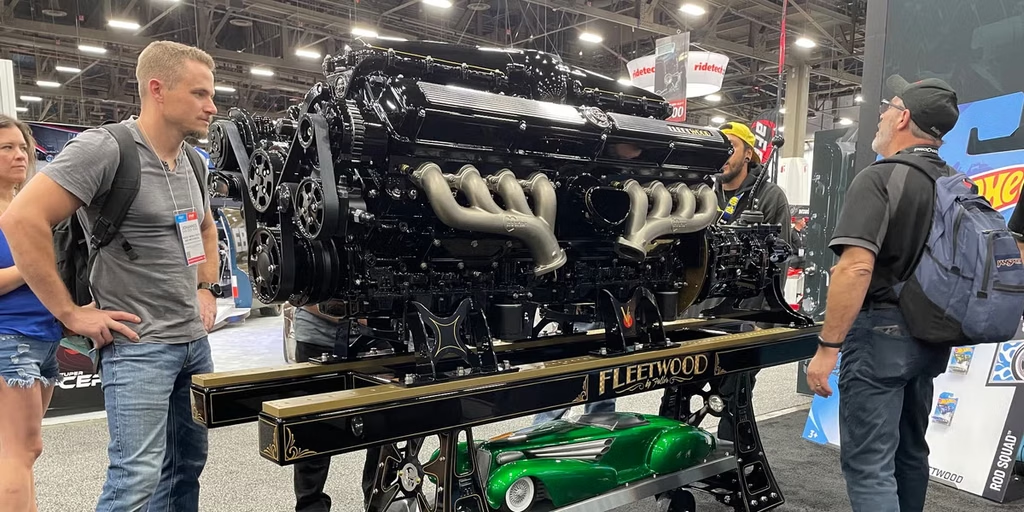
Bryan Fuller’s V16 at BluePrint Engines made an impression before it even had a vehicle wrapped around it.
The assembly combines two 427-cubic-inch LS-based V8s for a total of 854 cubic inches, or approximately 14 liters. The claimed output is 1,250 horsepower. Its destination is a one-off Cadillac-inspired roadster developed with Hot Wheels design involvement. The car is still under construction, with chassis completion and final assembly ahead. For me, the engineering is the attraction. Familiar V8 components become a much more complicated proposition when two engines need to operate together and send their output through one drivetrain. Timing, structural connections, cooling, and packaging all become part of the same problem.
Seeing the engine separately also gives it room to be appreciated as a project in its own right. The finished roadster will eventually provide the context, but the V16 already communicates the scale of the ambition.
Foose puts his stamp on the modern sport truck
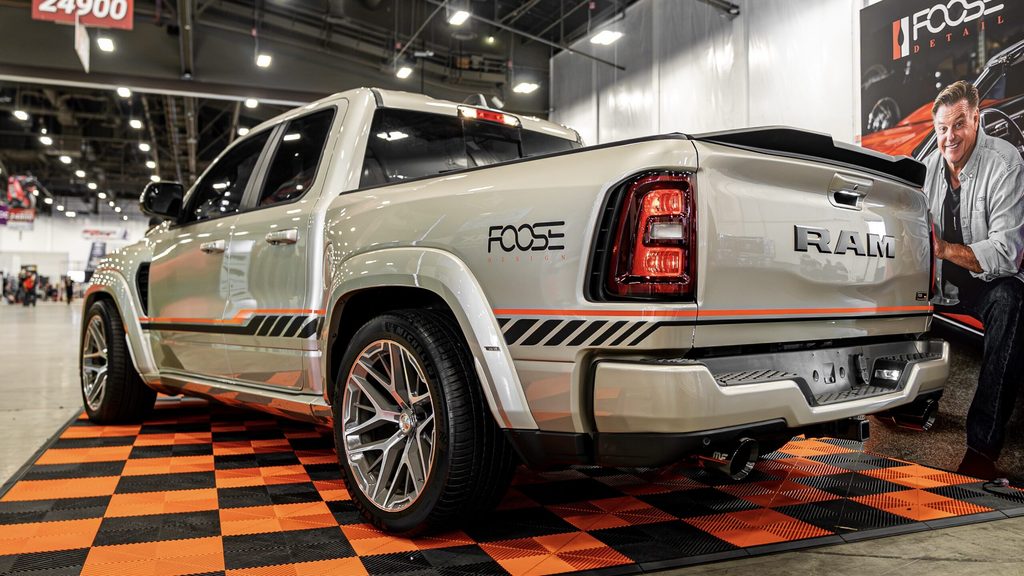
The Ram Rumble Bee Foose Edition brought the focus back to a complete vehicle.
The first collaboration between Chip Foose and FOX Factory Vehicles uses the Ram 1500 platform and proposes two performance configurations: a 392 Track Pack with an estimated 705 horsepower and an SRT version with an estimated 1,000 horsepower. Those figures remain subject to validation before production. Foose-designed 22-inch wheels work with a front splitter, side skirts, tailgate spoiler, and coordinated graphics. The interior receives its own upholstery and signature details, while the announced equipment includes Ridetech lowered suspension on applicable configurations and a MagnaFlow exhaust with Direct Connection tips. Final specifications, pricing, and availability are still being developed.
The street-focused stance was a good change of pace from the lifted and heavy-duty trucks elsewhere in the show. The design uses the Ram’s size and body lines to create a modern performance pickup, with the wheels and ride height doing much of the visual work.
A different reason to stop at a 787B
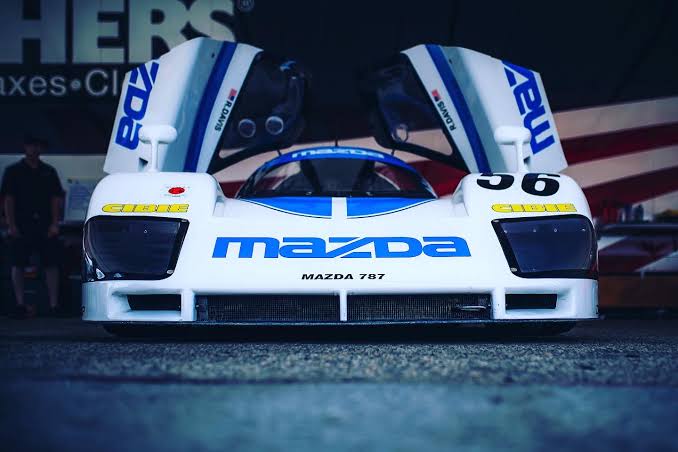
At XPEL, the Mazda 787B brought motorsport history into a discussion about preservation.
The displayed Le Mans racer is covered with ULTIMATE PLUS paint protection film, helping protect its recognizable livery. The Bugatti Vision Gran Turismo concept shares the display, with both paint protection film and ceramic coating applied. The pairing made this an interesting stop beyond the products themselves. So much of SEMA centers on changing cars, but caring for their existing finishes is another major part of the aftermarket.
After looking at replacement carbon panels and completely reimagined bodywork, it was useful to spend a moment with vehicles where the goal was to preserve what was already there.
Design starts before the fabrication
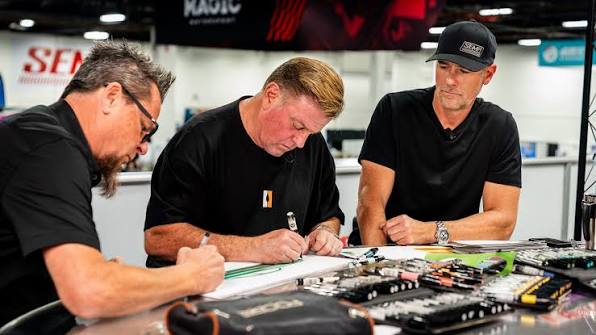
One of the smaller moments worth including was Chip Foose and Dave Kindig drawing a 1949 Mercury together on SEMA Live. The finished sketch was auctioned for charity.
It connected neatly with the cars around the show. Sibal’s EB110 began as a design years before the physical build came together. Foose’s truck carries a coordinated approach from its wheels to its upholstery. Fuller’s engine is waiting for a roadster whose design is just as ambitious.
Those stages of the process are part of what makes SEMA interesting to walk. A finished car can hide years of decisions, revisions, and fabrication. The best stops give you a reason to look past the surface and understand how the idea became real.