

Lando Norris led the opening practice session for the 2026 São Paulo Grand Prix, putting McLaren ahead of Kimi Antonelli and Max Verstappen while delivering a race simulation that made an even stronger impression than his position on the timing sheet.
Norris was fastest through the first two sectors at Interlagos, and his average pace on a soft-tire stint was more than a second quicker than the other soft-tire averages supplied in Daniel Valente’s comparison. Taken together, those were encouraging signs for a McLaren whose speed has too often been difficult to access consistently. But Friday’s opening session also left a familiar question: can McLaren reproduce that performance when qualifying determines its starting position and the race leaves fewer opportunities to escape traffic? Behind the leading contenders, Gabriele Minì finished seventh, Rafael Câmara’s home debut added another Brazilian storyline, and Luke Browning’s opportunity was restricted to just 12 laps by the condition of Carlos Sainz’s power unit. The opening top 10 was:
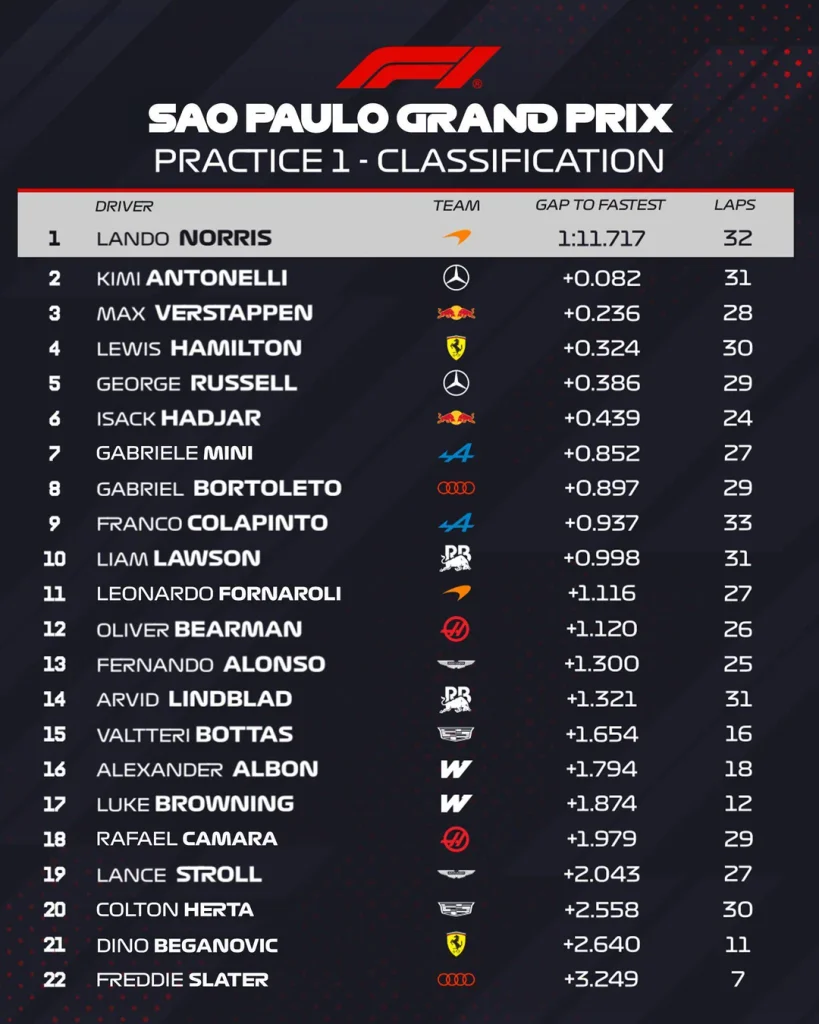
Norris arrived at a circuit where he won on Formula 1’s previous visit, having also taken pole with a 1:09.511. His opening practice performance offered an encouraging start to the attempt to repeat that success. The sector figures supplied by F1BigData showed where he was making his strongest impression:
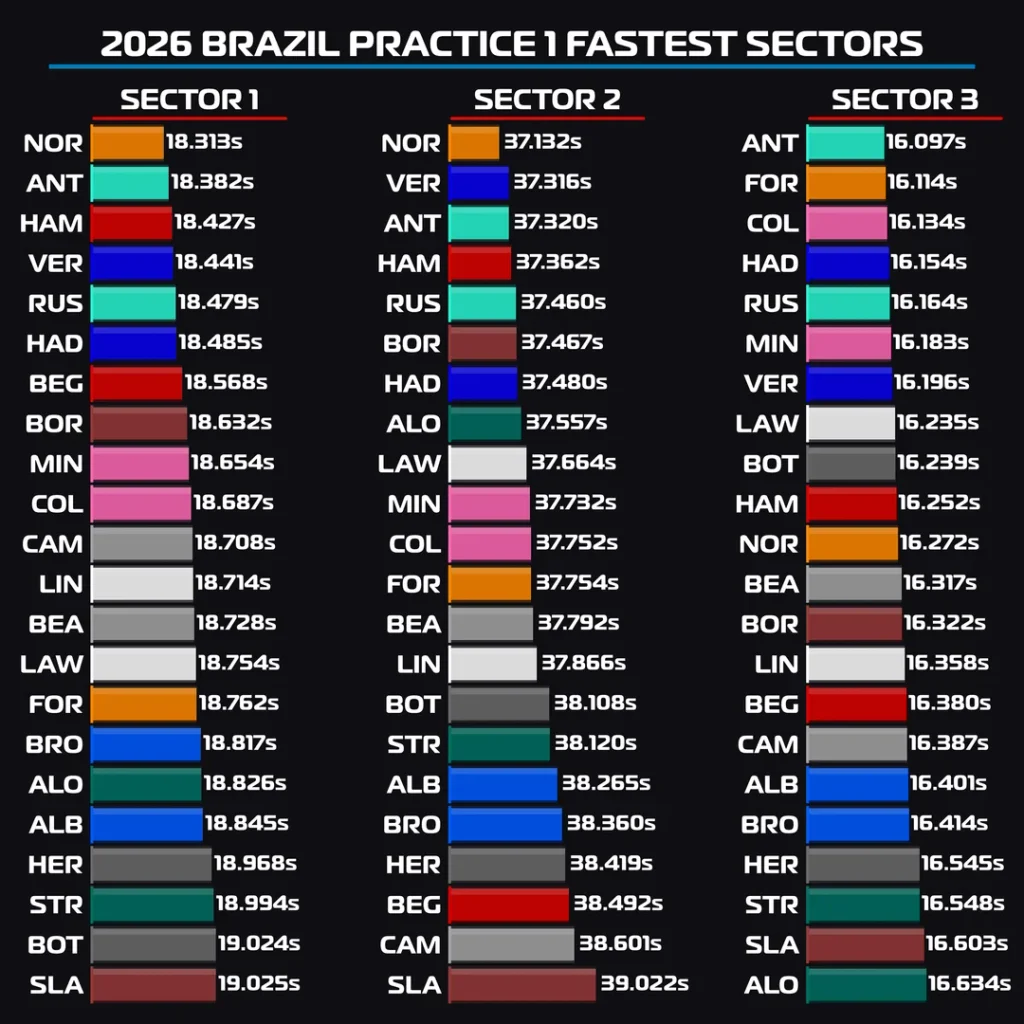
Leading both of the opening sectors suggested that McLaren had found useful performance through the cornering portions of the lap. After recent difficulties accessing its low- and medium-speed potential, that was a particularly welcome sign. It did not, however, establish that McLaren had suddenly become the best car through every type of corner, or that Ferrari’s chassis strengths had disappeared. An opening practice session provides a snapshot of different programs, setups, and operating conditions. Norris’ advantage was real on the timing sheet; the extent to which it represented the underlying competitive order remained open. His final sector added another layer to the picture. Leonardo Fornaroli, driving Oscar Piastri’s McLaren in FP1, was around a tenth and a half quicker than Norris through that section despite being more than a second behind across the opening two sectors.
That leaves room to consider whether Norris had more time available, but it does not mean the difference could simply be added to his lap as an obvious improvement. Different deployment schedules or setup choices could produce exactly that kind of split: one car gains earlier in the lap while the other recovers time on the uphill run toward the line. The possibility of different wing configurations also complicates a direct comparison. Without a confirmed explanation for the sector discrepancy, the useful conclusion is that Norris was particularly strong over the first two sectors—not that his final-sector deficit represented guaranteed untapped pace. The long-run figures were more striking still. Although the supplied race-simulation post was labeled a top-eight comparison, five drivers’ averages were provided:
| Driver | Tire | Average stint lap |
|---|---|---|
| Lando Norris | Soft | 1:14.883 |
| George Russell | Soft | 1:15.920 |
| Lewis Hamilton | Soft | 1:16.024 |
| Max Verstappen | Soft | 1:16.059 |
| Kimi Antonelli | Medium | 1:16.352 |
Source: Daniel Valente.
Norris’ average was 1.037 seconds quicker than Russell’s, 1.141 seconds quicker than Hamilton’s, and 1.176 seconds quicker than Verstappen’s. Antonelli was 1.469 seconds behind, although his use of the medium tire makes that comparison less direct. Those are substantial differences around the 4.309-kilometer Interlagos circuit. They justify interest in McLaren’s potential, but they do not justify projecting a similarly large advantage into Sunday’s race. Fuel loads and run structure are central to interpreting the numbers. If Norris completed his qualifying-style lap and longer run without refueling between them, the fuel remaining during that stint could have differed significantly from what rivals carried. Without comparable fuel information and a fuller account of the runs, the averages cannot isolate the cars’ underlying race pace.
There is still an encouraging possibility for McLaren in that scenario. Carrying enough fuel for a subsequent run while setting the session’s fastest lap would suggest a competitive short-run package. But that, too, depends on details that the timing sheet alone cannot establish, including when the lap was set and how conditions evolved. The sensible reading sits between dismissing the run entirely and treating it as proof of a dominant weekend. Norris was fast over a lap and over the supplied stint sample. McLaren now needs to show that the performance survives changes in conditions and the transition to qualifying. That has been the more persistent concern.
Norris’ apparent transformation between his medium-tire running and his soft-tire pace raised questions about how readily McLaren could find its operating window. The soft-tire performance was impressive, but the contrast also fit the broader problem of a car whose behavior can change sharply with tires, setup, wind, or track temperature. A narrow operating window can make a quick car difficult to trust. A driver may find a successful approach to a corner, then struggle to reproduce the same response on the following lap. When qualifying offers only a limited number of attempts, that inconsistency becomes especially costly. The distinction between available pace and usable pace matters. A strong race simulation does not solve a qualifying problem if the car starts farther back than its potential warrants. Nor does it guarantee a straightforward recovery if straight-line performance makes overtaking difficult.
That is why Norris topping FP1 was useful beyond the headline position. McLaren needs both parts of the weekend to work together: a qualifying lap that earns track position and race pace that can be deployed once it has it. Fornaroli’s appearance in Piastri’s car also meant this session did not provide a direct comparison between McLaren’s regular drivers. Norris supplied the clearest evidence of the team’s front-running potential, while Fornaroli’s sector-three performance offered an interesting contrast rather than a complete explanation of the package. Mercedes, meanwhile, remained firmly in the picture.
Antonelli finished second and set the fastest final sector, while Russell was fifth and recorded the quickest soft-tire stint average behind Norris among the figures supplied. Antonelli’s medium-tire run should be considered separately from those soft-tire averages rather than treated as evidence that he was the slowest of the leading contenders. The opening order also reflected an important distinction in the competitive picture. McLaren’s best moments can be extremely convincing, but consistency determines how often that speed becomes a result. Mercedes’ ability to remain near the front when another team produces the standout performance gives it a different kind of strength. Nothing in FP1 settled which of those qualities would matter most across the São Paulo weekend. Norris delivered the most eye-catching session, but Antonelli’s second place ensured Mercedes was close to the center of the story.
Hamilton placed Ferrari fourth, immediately behind Verstappen and ahead of Russell. His supplied soft-tire average was just 0.035 seconds quicker than Verstappen’s, a small separation within a comparison that still carries the usual practice uncertainties. Ferrari’s final-sector performance also deserved a more careful reading than simply blaming the power unit. The supplied discussion included a comparison showing Hamilton at 329 km/h on the main straight, against 320 km/h for Norris and 328 km/h for Verstappen. It also identified a loss of nearly a tenth for Hamilton at Turn 12, with further losses on the back straight and the shorter run between Turns 4 and 5.
On that comparison, a straightforward claim that Ferrari was losing the final sector because it lacked top speed would be incomplete. Corner performance and the way speed is built and sustained across different sections of the lap matter alongside the maximum number reached on a straight. A higher peak speed does not automatically produce a quicker sector. Equally, a slower sector does not by itself establish an engine deficit. Farther down the top 10, Minì’s seventh place was one of the notable results of the session. He finished behind Hadjar and ahead of Bortoleto, Colapinto, and Lawson, placing himself prominently in a practice session featuring several opportunities for young drivers.
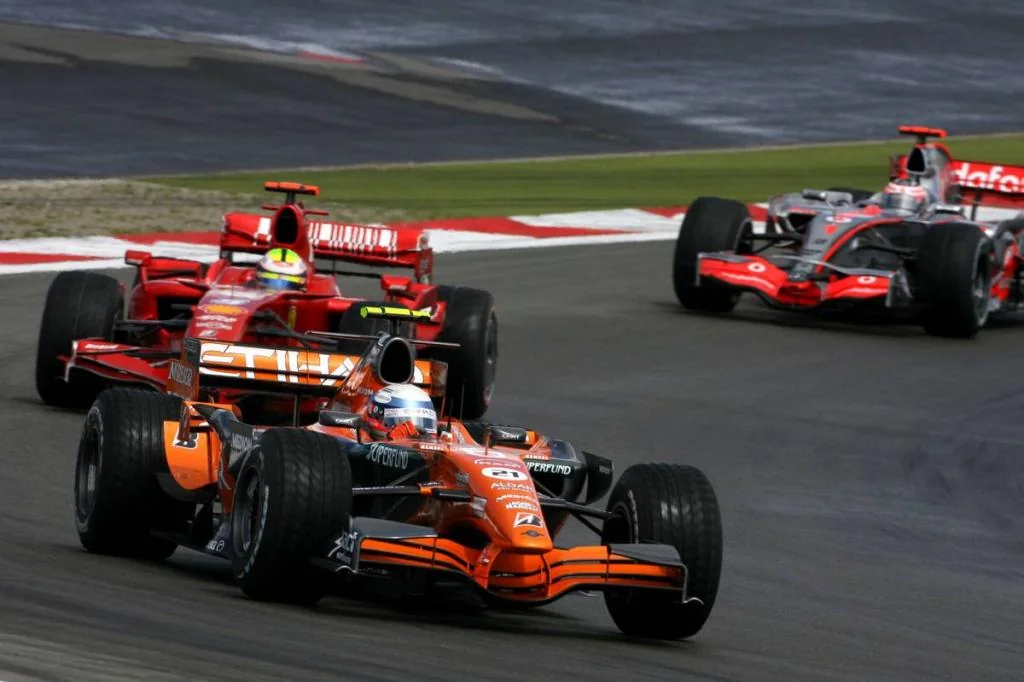
Câmara’s home debut gave the Brazilian weekend another point of interest. Making an opening appearance in front of a home crowd carries its own significance, even before the session produces a result worth discussing. The comparison drawn with Markus Winkelhock’s 2007 appearance at the Nürburgring added a historical angle, but an FP1 debut and a first Grand Prix start are different milestones. The claim that Câmara was the first driver to make his Formula 1 debut at home since Winkelhock therefore needs that distinction before being presented as a like-for-like record. For this session, the immediate story was Câmara’s opportunity to take part on home soil. Browning’s opportunity was much more limited.
According to Adam Cooper, Sainz confirmed that he was “mileage limited” at Interlagos because of a well-used power unit. That restriction explained why Browning, standing in for him during FP1, was permitted only 12 laps.
For a young driver, such a small allocation limits both the chance to establish a rhythm and the opportunity to demonstrate progress across a session. It also makes any judgment based on the final classification less useful: the amount of running available is part of the performance context. For Williams, the restriction introduced a compromise before Sainz had even returned to the car. Conserving engine mileage means giving up some of the running that could otherwise help the team understand its setup and prepare for the rest of the weekend. The obvious question is why Williams would not take another power unit and accept the consequences. But Sainz’s explanation established the mileage restriction, not the reasoning behind every available alternative.
Suggestions involving spending priorities, future engine specifications, or uncertainty over the remaining calendar do not provide a confirmed explanation for the decision. The concrete issue was simpler: the condition of the existing unit reduced Browning’s session to 12 laps and left Williams managing its available mileage. That was a frustrating contrast with the opportunity FP1 offered elsewhere. Minì earned a place in the top seven, Fornaroli contributed a useful McLaren comparison, and Câmara appeared at home. Browning had far less running with which to make his case. At the front, Norris gave McLaren an opening session full of promise. He led the classification, controlled the first two sectors, and produced the standout stint average among the supplied figures.
The next test is whether McLaren can make that speed repeatable. If it can carry Friday’s performance into qualifying and secure the track position its race pace needs, Norris will have a stronger foundation for converting an encouraging practice session into a competitive weekend at Interlagos.