

Walking through SEMA on opening day, I kept coming back to the stories behind the cars. The finished builds get your attention, but how they reached the Las Vegas Convention Center—and why someone committed to building them—gives you a reason to stay.
An abused BMW restored because of a childhood memory. An $800 ranch truck turned into a vision of what a Raptor might have looked like in 1985. A miniature Skyline with a surprisingly serious price tag. My November 3 walk through the show brought together very different projects, each with a clear sense of purpose.
Larry Chen’s E36 M3: Saving a childhood memory
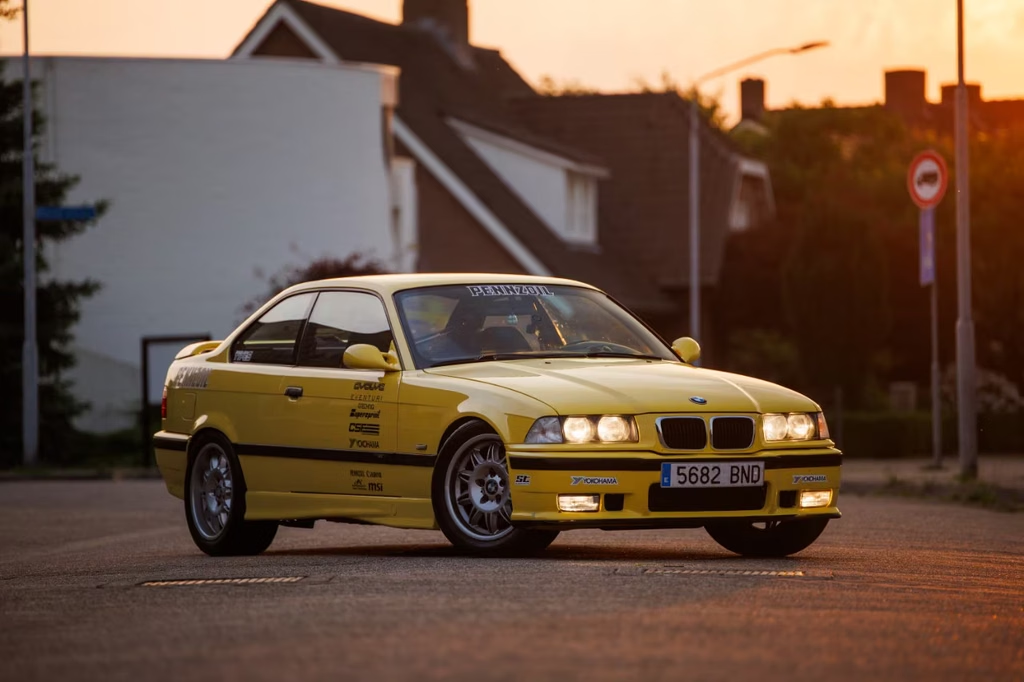
Larry Chen’s Dakar Yellow BMW E36 M3 at the APG Performance Brakes display carried one of the strongest stories of the day.
The car began as a purchase in Spain that went badly wrong. It arrived with a blown engine, and Imran Arshad helped source and install a replacement in time to keep a European road trip alive. Underneath, though, the BMW needed considerably more than an engine swap. Chen’s list of problems was extensive: three layers of paint, poorly repaired collision damage, front frame rails measuring two centimeters out of alignment from side to side, and a passenger-side shock tower coming apart. The driver’s door was steel; the passenger door was the aluminum lightweight version. Inside, panels were loose or missing, and the upholstery was torn or worn out. Enthusiast Auto Group stripped the car to a bare shell and completed the restoration in 85 days, according to Chen. Drew Leslie led the project at EAG, while VAC Motorsports rebuilt the European-spec S50B32 engine. VAC’s work included inspection, precision machining, and assembly aimed at preserving the engine’s character while improving its underlying condition. The reason for going that far was personal. An E36 M3 was the first sporty car Chen rode in as a child.
“It felt like a rocket ship,” he recalled.
That memory helps explain why this particular project mattered. A car with this much damage could easily have become a parts donor. Instead, Chen and EAG used it to demonstrate what a comprehensive restoration could accomplish.
“Sure we could have scrapped this car, but we just made lemonade out of lemons instead,” Chen said.
For me, that was the appeal: a familiar BMW with a deeply personal reason to exist, and an enormous amount of work beneath its finished appearance.
An $800 F-250 becomes a 1980s Raptor tribute
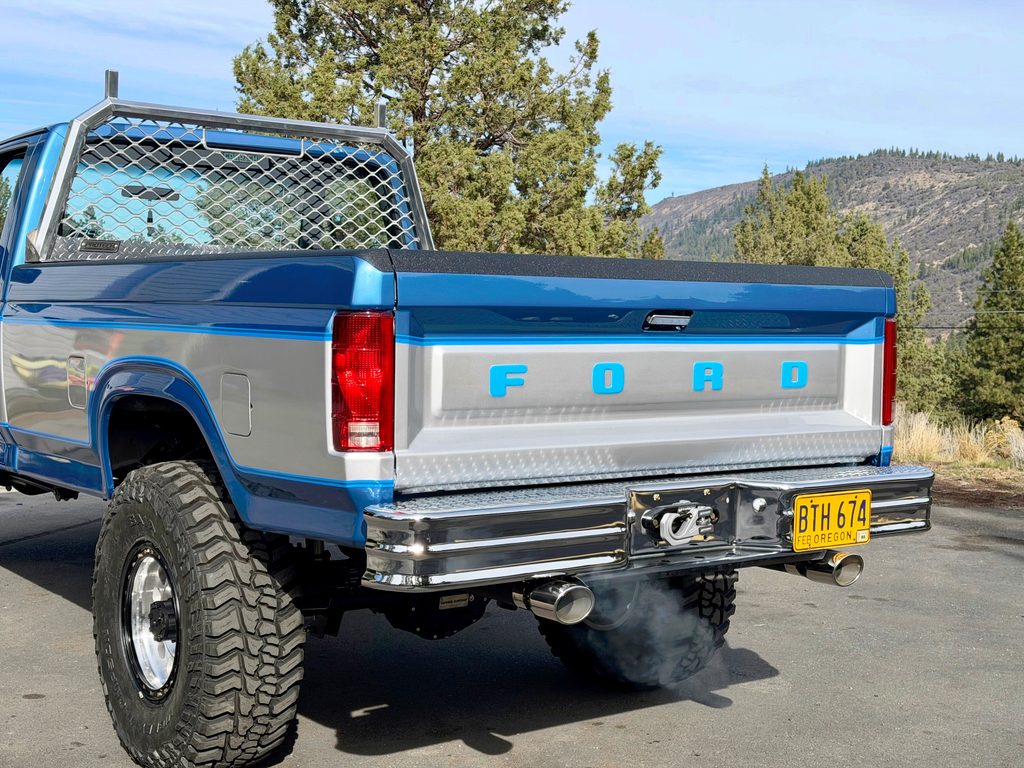
Doc Johnson Restorations’ 1985 Ford F-250 approached nostalgia from a different direction. Its starting question was simple: what if Ford had built a high-performance off-road pickup like this in the mid-1980s?
Matt Johnson’s project began with an abandoned ranch truck bought for $800. He intended to use it around the shop, but an overheating failure left it sidelined. The conversation that eventually brought it to SEMA originally concerned another vehicle entirely. Johnson had approached Ford about putting a 2.3-liter EcoBoost into a Toyota FJ40 Land Cruiser. When the discussion shifted toward a Heritage small-block engine, he suggested putting it in a classic Ford instead. The bullnose F-250 became the platform. It now carries a 460-cubic-inch Ford Racing small-block crate engine, with Johnson quoting 575 horsepower and 575 lb-ft of torque. Carrick Customs supplied its reengineered Twin Traction-Beam suspension approach, and the build retains the truck’s original chassis.
A full MagnaFlow exhaust completes another part of the mechanical package. The 460 designation deserves attention here: this is a large-displacement small-block crate engine. That choice is central to the truck’s combination of familiar Ford architecture and modern performance.
I liked the way the concept stayed rooted in the original pickup. The bullnose shape gives it a believable period identity, while the engine and suspension explore how much more capability could fit underneath it.
Petrolheadonism’s Z3 M Coupe arrives with miles behind it
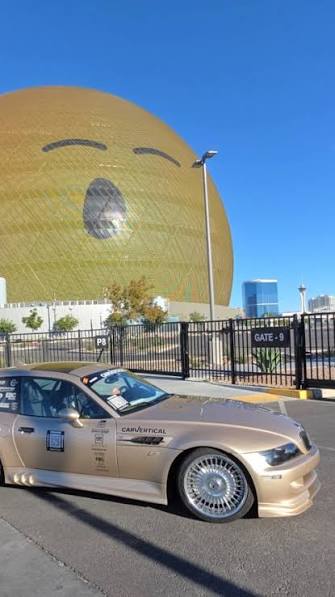
Petrolheadonism’s BMW Z3 M Coupe at EBC Brakes brought a different strand of automotive nostalgia to the floor.
The team’s concept draws on Max Power-era customization and Club Sport influences, giving the BMW a clear connection to the enthusiast culture that helped make modified cars an expression of individual taste. The carVertical-backed build also arrived with a road-trip story. It formed part of the Road2SEMA adventure before taking its place at EBC’s display. Organized by Ciro Ciampi and Petrolheadonism, the wider convoy set out from Miami on an approximately 3,500-mile journey toward California and Las Vegas, with a $25,000 fundraising goal for Make-A-Wish America. That journey adds something to the presentation. The booth is one stop in the car’s story, with the travel and the people involved providing context for the finished build.
Between this BMW and Chen’s E36, there were two very different reasons to revisit an older M car: restoring a cherished connection and using a distinctive platform to express a particular era of customization.
Pocket Bunny: A tiny Skyline with serious ambition
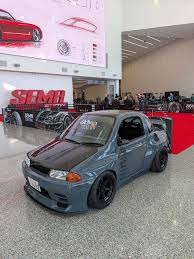
The Pocket Bunny R32 brought a much more playful interpretation of a familiar shape.
Built by Hardcore Tokyo and TRA Kyoto, it uses a Suzuki Twin as the foundation for a miniature take on the R32 Skyline GT-R. The custom bodywork compresses the Skyline’s recognizable features into the Suzuki’s tiny proportions, creating something that looks remarkably close to a toy made full-size. Chen puts this latest version at 120 wheel horsepower from a turbocharged 1.0-liter engine. He also quotes $96,000 for a comparable complete build. That price gives the little car an unexpectedly substantial presence. The appeal, though, starts long before the specifications enter the conversation. Its proportions make you stop, then the details invite you to work out how the transformation was achieved.
It also captures something I enjoy about SEMA: the freedom to commit fully to an unusual idea. A miniature R32 does not need a practical justification. The craftsmanship and the reaction it creates are a large part of the point.
Crazy K Kustomz brings a young builder’s perspective
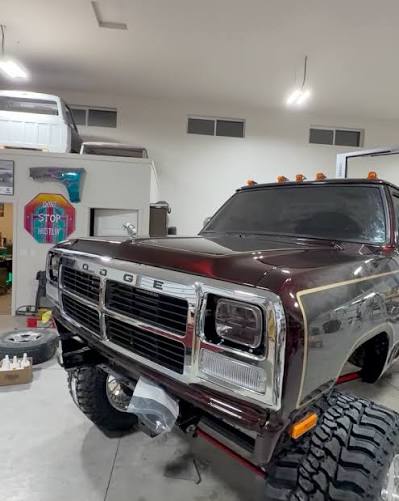
Crazy K Kustomz’s first-generation Dodge brought the focus back to the people establishing themselves in the industry.
Founder and custom painter Keaton Lee built her business around the skills she began developing in high school. In describing her work, she has emphasized how much running a small paint shop involves beyond the paint itself: preparing projects, finding customers, handling marketing, managing the business, and cleaning up afterward. That background gives her presence at SEMA weight. A vehicle on the floor can represent years of learning, reinvestment, and taking on jobs that push a builder’s abilities further.
Among the major company displays and established names, these are the stories I want to make time for. They show how the next generation is finding its place in the industry, one finished project at a time.
Medusa makes the fabrication the centerpiece
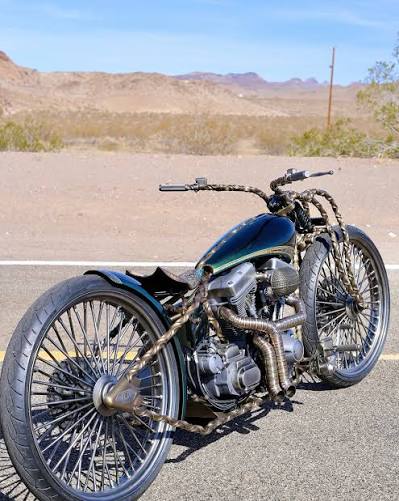
Corey Mauck’s Medusa, from Aero Precision Metal Works, provided a reason to spend some time with two wheels.
More than 45 feet of solid square stock went into the motorcycle’s frame, girder front end, and handlebars. The twisted metalwork establishes the design, with antique bronze plating across the exposed surfaces and an antique nickel Cerakote finish on the engine. Custom gas and oil tanks follow the bike’s silhouette. Real abalone-shell accents add detail to the paint, while a hand-tooled and airbrushed Medusa portrait on the seat completes the theme. Medusa reached the inaugural SEMA Bike Builder Shootout’s Top 10, announced on November 3. What stood out to me was the consistency of the idea. The metalwork, plating, paint, and leather all contribute to the same motorcycle. There is plenty to absorb from a distance, but the smaller details are just as central to its character.
By the end of Day 1, those were the builds staying with me: the BMW saved for a childhood memory, the Ford given an alternate history, the tiny Suzuki transformed into a Skyline, and the motorcycle shaped around a mythological figure. Each gave me something more to think about than a horsepower number—and another reason to keep walking.