

Kimi Antonelli’s championship should have given Mercedes an uncomplicated reason to celebrate. Instead, the aftermath of the Mexican Grand Prix offered a reminder that even a title-winning season can look very different from the other side of the garage.
George Russell’s candid assessment of his year, coupled with his decision to congratulate Antonelli’s family personally, provided the human center of a weekend filled with uncomfortable questions. Ferrari faced renewed scrutiny over its handling of Lewis Hamilton and Charles Leclerc. Liam Lawson remained uncertain about his future despite a strong season. Oliver Bearman’s reported pursuit of a pathway to Ferrari highlighted another version of the same problem: performing well does not necessarily give a driver control over what happens next.
Meanwhile, Max Verstappen’s sustained run of competitive results has made Red Bull increasingly difficult to dismiss, even as the drivers’ complaints about overtaking suggest that Formula 1’s technical frustrations extend well beyond any individual team.
Russell Acknowledges Both Bad Luck and His Own Shortcomings
Russell did not present his season as a story in which everything had been done to him.
“Now feels like a pretty suitable moment to speak from the heart,” he wrote in his social media statement. “This season started off exactly how I had hoped but it very quickly unravelled with tough luck and poor performances.”
That distinction matters. Reliability problems have been part of his frustration, but Russell also acknowledged that his own driving has not consistently reached the required level.
“It’s been the first proper season of my career where I’ve had more bad days than good,” he continued. “Has it been tough to deal with? Yes, very. Has it been tough to pick myself up week in, week out? Yes, very. Confusion at times? Often.”
A difficult season in an uncompetitive car can be explained through the limitations of the machinery. A difficult season while a teammate wins the championship is harder to process. The potential is visible every weekend, making each missed opportunity more painful. Russell nevertheless made his view of Antonelli’s achievement explicit.
“I want to sincerely congratulate Kimi on what has been an absolutely incredible season. You truly deserve the Championship.”
He also thanked Mercedes for producing what he described as the best car and power unit of the season, crediting the work that had brought the team back to the top after four difficult years. That is a more balanced account than either extreme of the debate surrounding him. His setbacks do not erase Antonelli’s achievement, and Antonelli’s championship does not mean every problem Russell encountered can be reduced to a performance deficit. Nor do unequal reliability outcomes establish that Mercedes deliberately undermined one driver to support the other. Frustration with the pattern is understandable; treating it as proof of a coordinated plan goes beyond the evidence.
Russell’s stated objective is straightforward: rediscover the performance he believes he has demonstrated through most of his career, while hoping his luck improves.
A Gesture Toward Antonelli’s Family Carries Its Own Weight
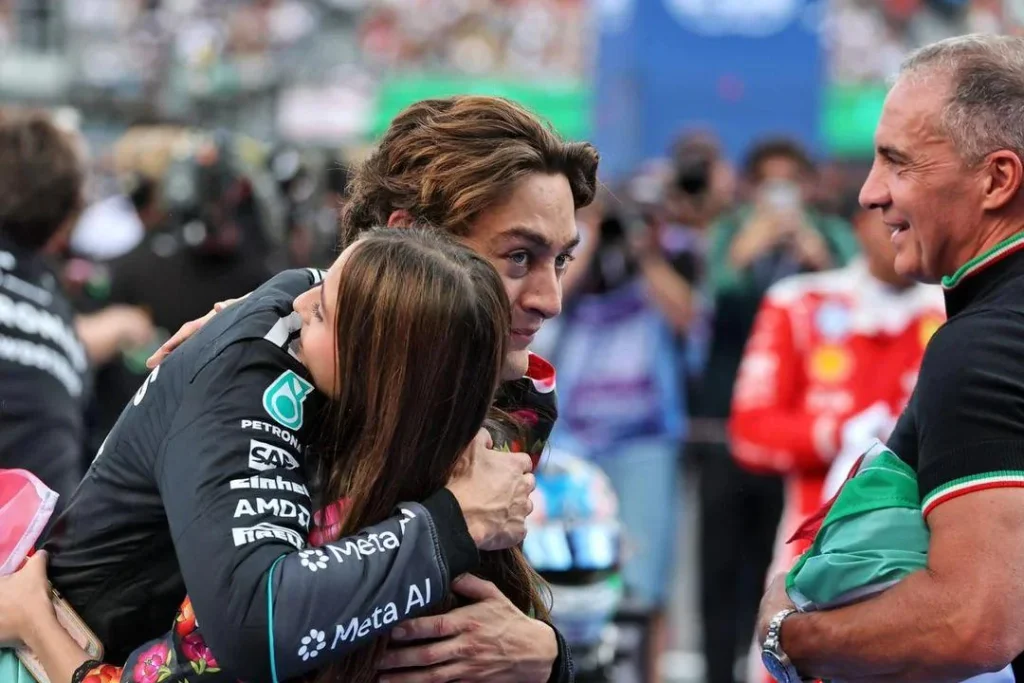
Russell’s visit to the Antonelli family after the race gave that statement a visible counterpart.
He went over to congratulate them and hugged Kimi’s younger sister, Maggie. The distinction is worth preserving: Russell initiated the interaction, approaching the family during a celebration that also marked the end of his own championship hopes. There is no need to turn one gesture into a sweeping judgment of his character. It was simply a considerate thing to do under difficult circumstances. It also challenges the tendency to interpret every frustrated radio message as a complete portrait of a driver. Russell can be disappointed, angry about another technical problem, and gracious toward his teammate. Those reactions are compatible.
Criticism of his past conduct, including his reaction to the collision with Valtteri Bottas at Imola, does not have to disappear. But neither should one incident become a permanent explanation for everything he does afterward. The same standard should apply across the grid. His role as a GPDA director offers another part of the picture, as does his response to Zhou Guanyu’s Silverstone accident. Assessing a driver fairly requires room for both mistakes and responsible behavior. The broader problem is that discussion often turns into a contest over which driver deserves sympathy. Supporters defend behavior from their favorite that they condemn elsewhere, while a rival’s disappointment becomes entertainment.
Russell’s statement leaves room for a more useful conversation. He has acknowledged poor performances, credited his teammate, thanked the team, and described how difficult the season has been. None of that requires declaring him either a victim who was denied a championship or a driver whose ability has suddenly vanished.
Wolff’s Praise for Antonelli Goes Further Than the Evidence Can Support
Toto Wolff’s celebration of his new champion introduced a different argument about character.
“This notion of win at all costs, selfish, opportunistic, ruthless for your own benefit, that model of racing driver has died,” Wolff said in remarks reported by The Guardian. “We have a new champion that represents values—humility, integrity, loyalty, respect.”
The praise for Antonelli is understandable. The declaration that a whole model of racing driver has died is much harder to sustain. Winning a championship with respect for others is worth celebrating. But one season cannot establish that ruthlessness has disappeared from Formula 1, or that a champion will respond identically to every competitive situation. A sustained, closely matched title fight creates different pressures from a campaign in which an early advantage provides breathing room. Antonelli should not be presumed incapable of handling those pressures well. Equally, his conduct this year cannot settle a test he has yet to face in that form.
Norris also complicates the suggestion that Antonelli represents an entirely new approach. His championship already provided an argument against the idea that a driver must cultivate a deliberately hostile persona to succeed. More fundamentally, competitive ruthlessness and personal decency are not opposites. A driver can demand everything from a team, attack aggressively within the rules, and still treat people with respect. Wolff’s own history in intense championship battles makes the sweeping language particularly vulnerable to scrutiny. The political exchanges of 2021 demonstrated how quickly the tone changes when every decision appears capable of affecting the title.
Antonelli’s achievement is substantial enough without requiring a claim that he has permanently changed the moral character of the sport. And Russell’s conduct in defeat deserves recognition alongside the values being celebrated in victory.
Ferrari Needs Clear Limits, Not Necessarily a Permanent Number One

At Ferrari, the discussion is less about how to celebrate success than how to stop compromising it.
John Elkann was reportedly irritated by what he saw and heard in Mexico, with the Hamilton–Leclerc battle renewing questions about whether Ferrari can continue leaving its rules of engagement so heavily in the drivers’ hands. The potential victory was not guaranteed. Neither was a one-two finish. But Ferrari had a strong opportunity, and the opening-lap fight made converting it more difficult. The distinction between allowing teammates to race and allowing them to expose each other to rivals is central. Hamilton and Leclerc could compete firmly through the opening corners without automatically sacrificing the team’s position. The Turn 4 sequence, with both going off track and Hamilton becoming vulnerable to Verstappen, carried a different cost.
From a spectator’s perspective, it was dramatic. From Ferrari’s perspective, it created a problem that clear instructions might have helped prevent. That does not necessarily mean appointing a permanent number-one driver. One workable principle would be to protect the team’s position during the opening phase, establish separation from the opposition, and then allow the drivers to compete. Another would be to give the better-qualified driver initial priority while retaining the ability to respond to a clear pace difference.
Neither approach guarantees harmony. Both would at least define what Ferrari expects before the drivers arrive at the same corner with different interpretations. There is a separate argument that Hamilton’s earlier championship position justified stronger support when he held a meaningful advantage over Leclerc. But that strategic question should not obscure the more immediate one: a team can remain committed to two competitive drivers while setting enforceable limits on how they race each other. McLaren’s approach provides a useful comparison. Its rules have attracted criticism, and the execution has not always been smooth. Yet the underlying idea—that two ambitious drivers can compete within a shared framework—is hardly unreasonable.
The difficult part is making the consequences clear and applying them consistently. A rule that exists only until a driver dislikes it offers little protection. Ferrari also cannot dismiss the problem merely because the drivers’ championship is no longer at stake or because its constructors’ position appears comfortable. Wins still matter to the people preparing the cars, and habits established now could become costly in a closer campaign. There is no basis to assign a specific financial loss to Mexico without the relevant contractual details. The sporting loss is clear enough: Ferrari finished second and fourth after putting itself in a position to pursue more.
If the team believes it can challenge more seriously next year, this is the time to settle how its drivers will work together.
Bearman’s Reported Request Exposes the Limits of an Academy Pathway
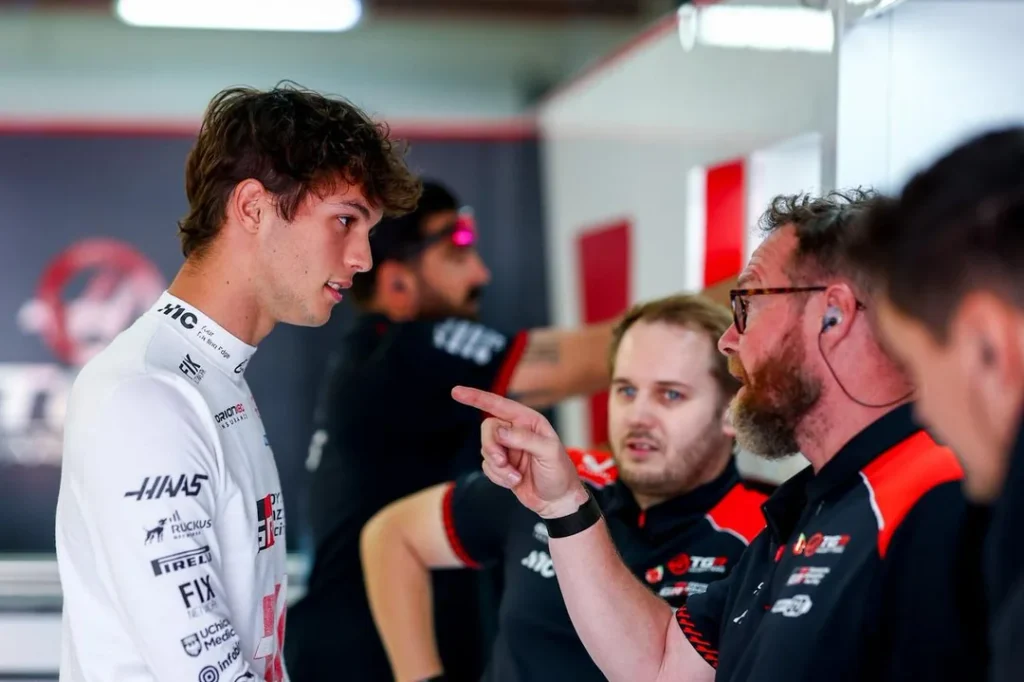
Ferrari’s present driver relationship also shapes its future planning.
According to the report attributed to Ferrari sources, Bearman’s representatives are seeking guarantees of a pathway to a Ferrari seat in 2028 as part of renewal discussions. That request reportedly rests on the assumption that Hamilton will retire. An assumption is not a vacancy. Hamilton’s future cannot be treated as settled simply because a younger driver’s career plan would benefit from an opening. Ferrari must assess the performance and value of its existing lineup alongside the progress of its prospects.
Bearman’s management nevertheless has an understandable reason to seek clarity. A development relationship becomes less attractive if it restricts a driver’s alternatives without establishing when a promotion might realistically occur. There are several different arrangements that could address that concern. A guaranteed race seat would be the strongest commitment. A defined review point, or freedom to explore other options if no promotion becomes available, would preserve more flexibility. Those possibilities should not be confused. Seeking a pathway does not necessarily mean demanding Hamilton’s removal.
Bearman’s performances against Esteban Ocon and his seventh-place Ferrari appearance in 2024 help explain why he is taken seriously. They do not, by themselves, establish that Ferrari should commit a seat well in advance. His short-notice Ferrari debut demonstrated that he could handle a difficult introduction. It was not a complete assessment of his championship potential. Similarly, outperforming an experienced teammate is valuable evidence, but the size and consistency of that advantage still matter. Rafael Câmara adds another consideration to the longer-term picture. If he establishes a stronger claim, Ferrari would have reason to consider it. External candidates could also become available.
Speculation about Antonelli eventually joining Ferrari carries obvious emotional appeal, but nationality and heritage do not establish a likely move, much less a timetable. A competitive Mercedes seat gives him substantial reasons to remain where he is. For Bearman, the immediate issue is therefore less about being an inevitable Ferrari driver than ensuring he does not spend years waiting for an opportunity that remains conditional.
The salary speculation should also be treated cautiously. The supplied discussion includes a reported denial from Ayao Komatsu; it does not justify presenting a specific salary demand as an established cause of the negotiations.
Lawson’s Uncertainty Reveals Racing Bulls’ Conflicting Priorities
Lawson faces a different version of the same uncertainty.
Asked when he would receive news about next year, his answer was: “I don’t know.”
Peter Bayer’s translated Sky Germany interview did little to resolve that uncertainty. The Racing Bulls CEO praised Nikola Tsolov’s Friday appearance, calling his performance “superb” and saying he had integrated into the team “absolutely perfectly.”
On the driver decision, Bayer said it rested with Alan, who would make or announce it when he felt the time was right. The more revealing exchange came when Bayer was asked whether Lawson had already done everything required to earn his place.
“Well, certainly. That’s the general consensus in the paddock,” Bayer replied. “At the same time, our role, as the leading developer of talent in Formula 1, is to continuously bring new drivers through.”
He cited the program’s introduction of 22 drivers to Formula 1, including Sebastian Vettel and Verstappen. That answer explains why the debate is so difficult. Lawson can be performing well enough to justify retention while still being vulnerable under the organization’s broader priorities. For a team focused on maximizing its own immediate results, retaining a productive driver provides an obvious benefit. For a team also tasked with identifying future Red Bull candidates, another season of Lawson may be weighed against the opportunity to evaluate Tsolov.
Understanding that logic does not require accepting every outcome it produces. A development program needs a credible way to distinguish a driver who has reached his ceiling from one who would improve with more time. If drivers are promoted quickly, judged against Verstappen, and then moved aside before they fully mature, the process risks confusing an unsuccessful introduction with a final verdict on ability. Lawson’s recovery at Racing Bulls makes that question especially relevant. His difficult senior-team experience does not erase what he has subsequently demonstrated.
There is also a legitimate reason to assess Lindblad differently: he is in his rookie season. Allowing a younger driver more time is not inherently inconsistent. The harder question is whether retaining Lawson as an established benchmark would help evaluate the next prospect more effectively. Tsolov, meanwhile, should not become the target of resentment over a decision he does not control. His strong junior performances and Bayer’s positive assessment give Red Bull reasons to consider him. What they do not provide is proof that he will become the next Verstappen or Antonelli. Practice-session comparisons cannot settle that argument. A small gap to one driver in FP1, or a larger gap to Lawson’s FP2 time, cannot be interpreted cleanly without knowing the relevant conditions and programs. Selecting whichever comparison supports a preferred conclusion creates confidence without establishing much.
Most importantly, Bayer’s remarks are not an announcement that Lawson has lost his seat. They explain the competing considerations. The decision remains unconfirmed in the material available.
The Ownership Question Goes Beyond One Driver
Lawson’s situation has also reopened the broader argument over Red Bull owning two teams.
The concern is not simply that Racing Bulls might replace a popular driver. It is whether a constructor’s decisions should primarily serve its own competitive interests or the talent requirements of another team. Red Bull’s investment in the former Minardi operation deserves recognition. Keeping a struggling team alive and funding it over many years has value. That history does not make the present structure immune from scrutiny. The commercial environment has changed, and the question of sporting independence remains legitimate.
Equally, calling Racing Bulls unserious because it develops drivers overlooks its competitive results. A team can outperform several rivals while also operating under objectives that differ from theirs. Those two observations can coexist. Racing Bulls can be an effective racing operation, and its relationship with Red Bull can still create questions about independent decision-making. A forced sale would be a major step, with consequences extending beyond this ownership arrangement. More focused scrutiny of independence, governance, and shared operations offers a separate avenue for debate. None of that should be confused with proof that every Racing Bulls decision is designed to assist Verstappen directly. The distinction between common ownership and ordinary customer relationships also matters. Buying an engine or permitted components does not, by itself, establish that two teams share the same competitive priorities.
Lawson’s predicament makes the structural issue visible because his results may not be the decisive factor in whether he stays.
A Strong Season Does Not Make the Rest of the Driver Market Simple
It is tempting to respond by listing other drivers Lawson should replace. That creates another set of oversimplifications.
Comparing his points with those of Alex Albon or Nico Hülkenberg does not isolate driver performance. Machinery, reliability, teammate strength, and the objectives of each team all influence the picture. Albon’s comparison with Carlos Sainz is relevant to Williams in a way that a direct comparison with Lawson’s results is not. Audi may place a different value on Hülkenberg’s experience and continuity than Racing Bulls places on retaining an established driver. Those considerations do not prove that either driver is better than Lawson. They explain why the market does not operate as a single ranking in which the lowest scorer automatically makes way.
The same applies to suggestions involving Aston Martin, Cadillac, Haas, or McLaren. A potentially suitable destination is not the same as an available seat, and the supplied material does not establish Lawson’s freedom to negotiate or the precise restrictions in his contract. There is a defensible case that he deserves to remain in Formula 1. Making it does not require declaring every veteran in a slower car undeserving.
His situation instead illustrates a familiar weakness of the system: a driver can demonstrate value while the combination of timing, contracts, and team priorities leaves no obvious place to use it.
Verstappen and Red Bull Are Giving Their Rivals Reasons to Worry
Away from the driver-market arguments, Verstappen’s sustained form provides a warning for the teams planning next season.
The supplied sequence of results since Austria contains ten podium finishes across twelve starts, interrupted by two retirements. Whatever the precise competitive order on an individual weekend, that is a substantial run of results. The discussion around Austria’s upgrade, including the effort to shed excess weight, also provides context for how much Red Bull’s position has improved. It would be misleading to explain every subsequent podium as Verstappen overcoming the same level of car disadvantage. A car can improve, and its position relative to Ferrari, Mercedes, and McLaren can change from track to track.
That does not diminish his contribution. It makes the combination of driver and team more significant. Mexico’s strategy offered another example. Following Leclerc into the pits rather than automatically extending the medium-tire stint represented an assertive attempt to shape the race. The alternative of seeking an advantage on newer softs later might have appeared safer, but it was not necessarily the better route to victory. The original strategic paths were not all allowed to play out unchanged, so the result cannot prove every element of the calculation. Still, Red Bull’s willingness to commit, and its confidence that Verstappen could execute, were evident.
Credit belongs to the operation as well as the driver. Strategy creates opportunities; extracting their value still requires the performance behind the wheel. That combination makes Red Bull difficult to leave out of any serious discussion of the next championship. Predictions that place Mercedes, Ferrari, and McLaren ahead by default fail to account for the improvement already on display.
But strong results should not be mistaken for evidence that Verstappen has changed his opinion of the regulations. Enjoying competitive success and disliking aspects of the racing are entirely compatible positions.
The Overtaking Complaints Remain Bigger Than the Result
Mexico also produced direct criticism of how the cars behaved at the end of the straights.
“It’s tough to overtake around here, especially in this generation of cars,” Piastri said before the race. “Everyone’s kind of stuck in this speed limiter on the straight because of the MGU-K rules.”
Hamilton described a similar frustration.
“We have this clip at the end of the straight where you can’t go past a certain speed, so everyone just follows,” he said. “It’s the silliest thing when you are behind and you have a little bit more power in the slipstream. You should be able to go past that to have a chance to overtake.”
He went further, calling it “the worst engine profile setting that I think they’ve probably ever had in this sport” and arguing that it did not provide good racing.
Those comments identify the competitive complaint clearly: a following driver can arrive with an apparent opportunity, only to find that the end-of-straight behavior prevents the expected advantage from developing. They do not, on their own, provide a complete technical explanation of every regulatory or operational cause. The racing consequence is nevertheless central to the drivers’ criticism. Difficult overtaking also increases the importance of everything surrounding the battle: the launch, the opening corners, pit execution, and strategic position. That helps explain why Ferrari’s first-lap confrontation carried such weight.
When a compelling fight does develop, the broadcast needs to show it. The complaints about coverage of Leclerc defending against Norris point to that obligation, although the supplied accounts differ over which feeds showed the duel prominently. That distinction matters. A viewer’s experience should not automatically become a claim about every broadcast. The underlying editorial priority remains sound: sustained, consequential racing deserves attention over cars circulating without an immediate contest. Mexico crowned a champion, but its aftermath was defined by how the rest of Formula 1 responded. Russell acknowledged his own shortcomings while honoring Antonelli. Ferrari faced the consequences of leaving too much unresolved between its drivers. Racing Bulls confronted the tension between rewarding performance and searching for something greater.
The next decisions will matter more than the rhetoric: whether Ferrari establishes enforceable boundaries, whether Lawson receives a clear answer, and whether Formula 1 addresses the racing limitations its drivers are describing.