

Lewis Hamilton delivered his first pole position since the 2023 Hungarian Grand Prix with a 1:16.514 lap in Mexico City, beating George Russell by just 0.009 seconds as Ferrari converted its practice promise into a result that mattered.
Charles Leclerc finished third, 0.119 seconds behind his teammate, while Max Verstappen and Kimi Antonelli completed a top five separated by only 0.193 seconds. Verstappen’s one-place grid penalty moves Antonelli onto the second row alongside Leclerc, leaving the Red Bull driver fifth for the start. On a weekend when Antonelli can clinch the championship, Hamilton and Russell took the front row. The championship stakes remained substantial, but Saturday belonged to Hamilton: career pole number 105, his first for Ferrari, and a reminder of what he can still produce at 41.
McLaren experienced the opposite trajectory. After Norris led FP3 and Piastri finished fourth, they qualified sixth and 13th respectively. Racing Bulls initially put both cars in the top nine, only for Liam Lawson’s disqualification over an MGU-K infringement to send him to the back of the grid.
Hamilton Finds the Lap Ferrari Needed

The buildup to qualifying had centered on whether Ferrari could put its strongest sectors together on the soft tire. Leclerc had been fastest through the opening and final sectors in FP3, but the team’s ability to reproduce that pace across a complete lap remained uncertain.
Hamilton answered that question with a pole-winning effort that left Russell nine thousandths short. It was a dramatic reversal from the uncertainty earlier in qualifying, when Hamilton had been close to elimination in Q2. By the end of Q3, he had delivered the fastest lap of the session and ended a pole drought stretching back to Hungary in 2023. The result also gave Hamilton pole positions with all three teams he has raced for in Formula 1: McLaren, Mercedes, and Ferrari. The significance extended beyond the statistics. Ferrari had entered qualifying with ample evidence of speed but questions about execution. Hamilton’s lap demonstrated that the performance could be accessed when it counted. The challenge was no longer explaining why promising practice sectors had failed to become a competitive qualifying result. Ferrari now had first and third on the grid and an opportunity to turn that into a major race result.
That changes the expectations for Sunday. A double podium is a realistic target from those positions, but securing it will require the team to manage the start, tire strategy, and its two drivers effectively. Pole has given Ferrari an opportunity; it has not completed the job.
An Answer to the Age Debate
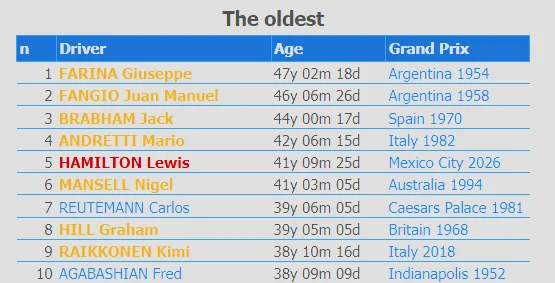
Hamilton’s performance gave particular weight to comments he had made about longevity, motivation, and the assumptions attached to his age.
The Briton said Formula 1 had “never had anyone like me in the 70 years” of the sport and described himself as “built differently.”
“Of course there are challenges up ahead that I can’t foresee that come with age. But along this journey there have been so many pre-conceived ideas like that your reaction time drops off,” Hamilton said.
“Did you see my reaction time in the last race? It was faster than some of the youngest people here.”
His position was not that age presents no challenges, but that his willingness to make the necessary sacrifices remains intact.
“As long as you are willing to sacrifice everything, which I am right now—I can’t say in four years whether I will want to continue doing what I’m doing—but I am still all in. I will be for the foreseeable future.”
Hamilton also made clear that continuing indefinitely was not the objective.
“Time will tell whether I’m here in the 2030s. I never want to overstay my welcome in the sense of not having the performance,” he said.
“I don’t want to be driving around with that having really dropped off.
“Everyone assumed that last year and I have proved everyone wrong. I’ll continue to try to do so.”
Mexico City offered a particularly convincing response. This was a closely contested qualifying session in which five drivers finished within two tenths, and Hamilton emerged ahead of all of them. At 41 years, nine months, and 25 days, he became the oldest official pole-sitter since Mario Andretti at the 1982 Italian Grand Prix, 44 years earlier.
The historical distinction matters. Michael Schumacher set the fastest qualifying time at Monaco in 2012 at 43, but his five-place grid penalty meant he was not credited with the official pole. Hamilton’s achievement belongs to that official statistical record without diminishing what Schumacher accomplished on track.
Russell Misses Pole by Nine Thousandths
Russell came closer than anyone to denying Hamilton.
His final result was an especially strong turnaround from FP3, where he had finished seventh while Antonelli challenged Norris at the top. Practice had left questions about Russell’s representative pace; qualifying supplied a much clearer answer.
“So close to pole but happy to be on the front row. Congrats Hammy on the pole,” Russell posted afterward.
The message captured both sides of his afternoon. Missing pole by 0.009 seconds is an obvious frustration, but second place puts him ahead of Antonelli and directly alongside Hamilton for the start. It also creates an intriguing opening-lap contest. Hamilton has the clean side of the grid, while Russell starts on the dirty side but has the possibility of benefiting from the tow toward the first corner. Leclerc, starting third, adds another variable immediately behind them. There is no single starting position that guarantees control of that sequence. The launch, positioning, and decisions approaching the first corners will matter more than any assumption that pole is either secure or inherently vulnerable.
For Russell, the front row is also valuable in the fight for second in the drivers’ championship. Hamilton, Leclerc, and Verstappen are all close enough on the road to make Sunday consequential beyond the battle for victory.
Leclerc Third as Ferrari’s Opportunity Comes Together
Leclerc finished 0.119 seconds short of Hamilton, giving Ferrari two cars in the top three but leaving him with reasons to feel that more had been available.
His practice sector times had established a strong case for pole contention. The disappointment was that his best qualifying lap did not bring all of that potential together. That is a more useful explanation of his frustration than reading teammate resentment into a post-session expression. The supplied account of his interview described repeated criticism of his own performance. For a driver who had shown the speed to contend, third could represent both a strong team result and a personal missed opportunity. Ferrari nevertheless emerged in a much stronger position than the cautious expectations surrounding its soft-tire performance had suggested. The team had spent practice looking capable of producing outstanding individual sectors. In qualifying, Hamilton completed the lap Ferrari needed, while Leclerc remained close enough to make the second row a genuine platform for attacking the lead.
The unofficial “Free Practice Championship” subplot from earlier in the weekend could now take a back seat. Ferrari had delivered in qualifying.
The Leading Qualifying Times
| Qualifying position | Driver | Time / gap |
|---|---|---|
| 1 | Lewis Hamilton | 1:16.514 |
| 2 | George Russell | +0.009s |
| 3 | Charles Leclerc | +0.119s |
| 4 | Max Verstappen | +0.178s |
| 5 | Kimi Antonelli | +0.193s |
Verstappen’s one-place penalty reverses his and Antonelli’s positions on the starting grid.
Verstappen’s Final Attempt Ends in Frustration
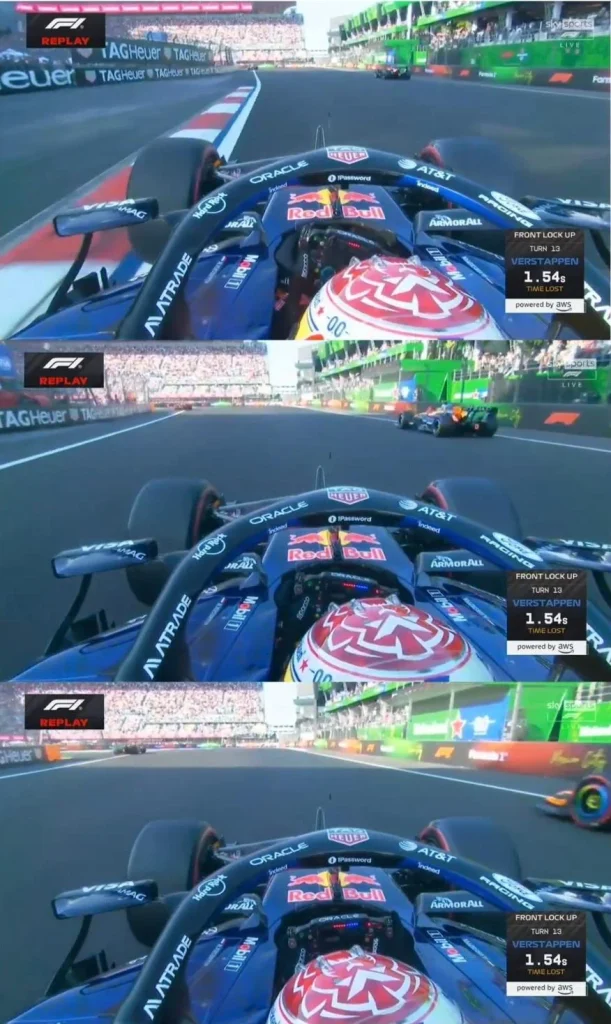
Red Bull finished qualifying with Verstappen fourth and Isack Hadjar seventh.
“Ahhhh, that last lap was looking good, Max. It’s P4 and P7 for the Bulls in Qualifying. Max will take a one-place grid penalty for tomorrow’s race,” the team posted.
Verstappen’s last attempt became a major talking point after he encountered Norris, who had abandoned his own lap and moved toward the edge of the circuit. Verstappen locked up, leaving an unresolved question about how much the lap might otherwise have improved. There is an important distinction between encountering an awkwardly positioned car and establishing that the other driver committed an impeding offense. Norris was described as being at the edge of the track, leaving space for Verstappen to pass. The presence of another car could still affect a driver’s reference points or perception of the corner, but that alone does not establish blame.
Verstappen’s reported explanation was consistent with that more measured interpretation: the angle was awkward, and having a car on the inside affected his reference. That is different from claiming Norris deliberately obstructed him or that a penalty was necessarily warranted. The accounts of earlier Red Bull lockups at the same corner also make it difficult to attribute the entire outcome to Norris’s presence. The traffic may have complicated the attempt, but an exact division between distraction, braking difficulty, and driver error cannot be established from the supplied material. Nor can the abandoned opportunity be converted into a hypothetical pole. Verstappen was competitive, and the final lap was promising, but his final-sector performance remained part of the calculation. An improving lap is not a completed one. Earlier in Q1, Verstappen had been seen studying what appeared to be a printed telemetry graph while sitting in the cockpit. It was a small detail from a session in which Red Bull was working to extract more performance, and an unusually visible glimpse of the analysis taking place between runs.
He will start fifth, with Hadjar seventh. Both remain positioned to influence the race, even if Saturday did not deliver the result Red Bull had hoped to secure.
McLaren’s Practice Promise Disappears
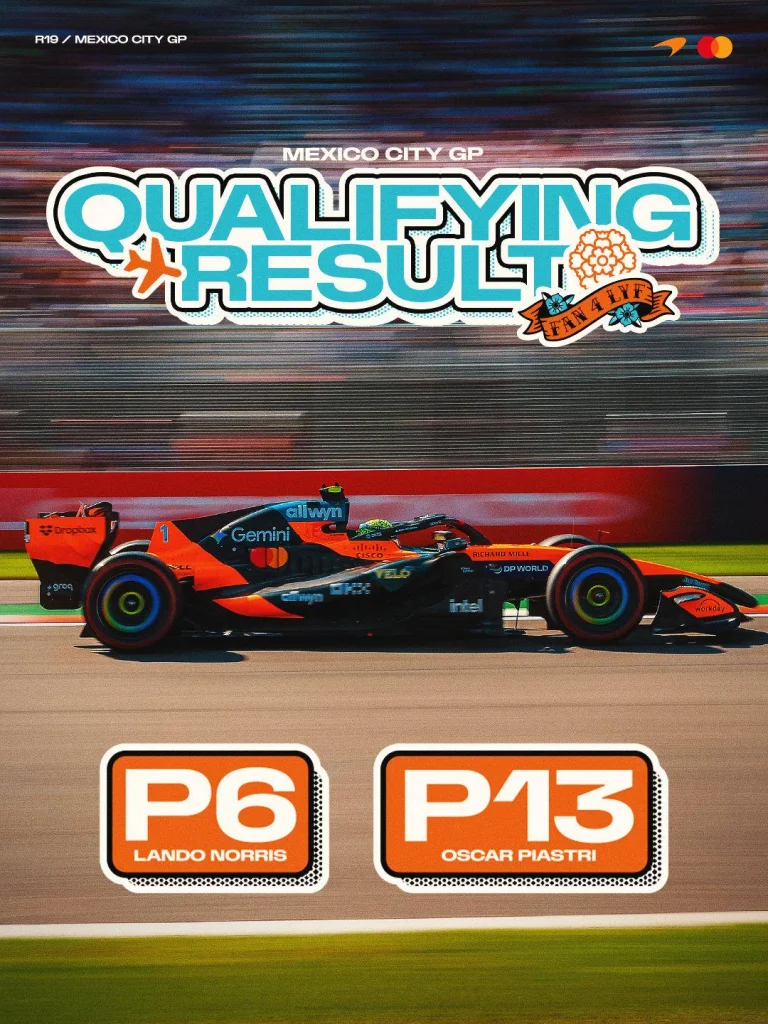
“A frustrating Qualifying for our duo,” was McLaren’s summary.
The contrast with FP3 was stark. Norris had topped the final practice session by 0.001 seconds over Antonelli, while Piastri’s fourth place suggested a more comfortable and competitive afternoon was developing. Qualifying produced sixth for Norris and a Q2 exit in 13th for Piastri. Norris’s final attempt was complicated by traffic through the middle sector. The supplied accounts disagree over whether Hadjar impeded him or whether Norris simply caught the Red Bull at an unfortunate point on the circuit. Without a confirmed finding, the stronger conclusion is that traffic compromised the opportunity rather than that a specific offense occurred.
Questions about release timing and tire preparation remain relevant. When the margins are small, positioning the car for a clean attempt is part of qualifying execution. McLaren’s practice pace had created the possibility of a much stronger result, but the team did not turn that possibility into a front-running grid position. The result does not, by itself, prove that the car lacked speed. It instead reinforces the concern that McLaren is struggling to access its performance consistently. That distinction also matters in the wider assessment of the team. Car development, setup, strategy, and pit-lane execution are related parts of a race weekend, but they are not interchangeable. A compromised qualifying run cannot establish that the engineering group has lost its way, just as a competitive car does not excuse operational errors.
Mexico City supplied a clear example of the gap between potential and outcome: first and fourth in FP3 became sixth and 13th when the grid was decided.
Piastri: “I Had No Rear Grip”
Piastri’s elimination was one of qualifying’s most disappointing developments because his earlier running had offered reasons for optimism.
“I’m afraid that lap’s not good enough to get through,” race engineer Tom Stallard told him.
“Mate, I don’t know what happened. I had no rear grip,” Piastri replied.
That radio exchange provides the clearest account of his immediate problem. The more detailed explanation remained uncertain. The supplied discussion identified McLaren’s use of used tires for the opening Q2 run as a factor that increased the importance of getting the final attempt right. Saving a fresh set can carry a benefit later in qualifying, but that benefit disappears if the driver fails to reach Q3. There was also speculation that Piastri had lost too much tire temperature after backing off and completing a cooldown lap. That offers a possible explanation for the sudden lack of rear grip, but it was not established as the confirmed cause.
The distinction between the team’s run plan and the driver’s execution is important. A strategy that leaves little margin can make an imperfect final attempt more costly; the driver still has to deliver that attempt. Neither consideration eliminates the other. Piastri’s broader difficulties this season give the result additional weight, but comparisons with other drivers’ difficult years cannot diagnose what happened here. The immediate story was frustrating enough: he had looked competitive in FP3 and Q1, then failed to carry that performance through Q2.
Starting deep in the field turns Sunday into a recovery exercise for a driver who had appeared capable of much more.
Norris Clinches Another Qualifying Head-to-Head
Despite McLaren’s disappointing session, Norris secured his season-long qualifying head-to-head against Piastri.
It marks the eighth consecutive season in which Norris has beaten his teammate across qualifying, extending that record through every full season of his Formula 1 career. The supplied statistical comparison places him alongside Ayrton Senna, Michael Schumacher, Giancarlo Fisichella, and Charles Leclerc as the only drivers to achieve that across their first eight full seasons. That consistency deserves attention even on a day when sixth place fell short of expectations. A qualifying head-to-head measures something different from absolute grid position: how regularly a driver extracts more than the person in the other car.
It does not answer every question about performance, circumstances, or the size of individual gaps. But maintaining the advantage across eight seasons is a substantial record, and Mexico City added another difficult chapter to Piastri’s side of the comparison.
Lawson Loses Eighth After Technical Disqualification
Racing Bulls initially had one of the strongest team results outside the leading group, with Lawson eighth and Lindblad ninth.
Lawson’s final run had secured a valuable position, and both cars appeared well placed to capitalize on trouble ahead. That result changed after an MGU-K infringement during Q2 led to Lawson’s disqualification from qualifying. The FIA identified a breach of Articles C5.12.6 and C5.12.7 after the control line at the end of his fastest Q2 lap, recorded at 15:47:36. According to the stewards, evidence accepted by all parties showed that Lawson did not lift off the power immediately after crossing the line. As a result, the required regulated step-down in MGU-K deployment was not achieved. The technical report stated that driver maximum power demand and the electrical DC power of the ERS-K were reduced at rates greater than permitted.
The issue therefore concerned the required behavior of the power system after the timed lap, rather than a finding that Lawson had exceeded an allowed lap time or track limit. Racing Bulls argued that the breach provided no performance advantage. The team also disclosed it itself. Neither point changed the stewards’ conclusion.
“The team argued that this did not provide any performance advantage however it is clear that non-compliance with the Technical Regulations is not excused if no performance advantage is gained,” the ruling stated.
The stewards also emphasized that the car must comply with the regulations throughout the event and cited precedents requiring disqualification despite mitigating circumstances. That produces an understandably difficult outcome to reconcile with the sporting performance: Lawson had completed a lap good enough for eighth, but the car’s subsequent noncompliance removed him from the qualifying results. The absence of a claimed advantage and the team’s self-report are relevant context. They explain why the punishment feels severe, but they do not undo the technical basis of the decision. Racing Bulls subsequently confirmed the outcome:
“The team acknowledges the stewards’ decision to disqualify Liam Lawson from qualifying for tomorrow’s race. On his in-lap during Q2, the required rate of reduction in MGUK deployment was not achieved. While no advantage was gained, Liam will start tomorrow’s race from the back of the grid.”
The ruling supersedes the earlier grid listing Lawson ninth after a one-place penalty. Lindblad remains eighth, while Gasly moves into ninth following Lawson’s removal from that position.
For Racing Bulls, it changes a promising two-car starting position into two very different assignments: Lindblad can attack from the top 10, while Lawson must recover from the back.
Hirakawa’s First Qualifying Ends in Q1
Ryo Hirakawa was eliminated in Q1 alongside Alex Albon, Fernando Alonso, Lance Stroll, Sergio Pérez, and Valtteri Bottas.
Hirakawa’s first Formula 1 qualifying appearance required a measured assessment. He had driven in FP1, so this was not his first running in the car that weekend, but stepping into qualifying as Ocon’s replacement still presented a substantial challenge. His earlier practice appearance also came in a different context. Running a scheduled FP1 session in another driver’s car is not the same preparation as approaching the weekend knowing that qualifying and the race will be your responsibility. The supplied accounts described consistent running, with a small mistake in the middle sector and some pace still available. His use of three new sets of soft tires also complicates a simple comparison with Bearman across individual attempts.
The result was a Q1 exit, but there was enough in the performance to make a clean and consistent race a reasonable next objective. For Aston Martin, both cars going out in the opening session continued a difficult weekend. Alonso remained ahead of Stroll, but neither reached Q2.
Cadillac also lost both cars in Q1. The raw gap between Pérez and Bottas requires context because Bottas was seen providing his teammate with a tow. Treating that difference as a straightforward measure of their respective pace would overlook the role he was performing.
Hamilton Leads the Grid as Antonelli Faces His Championship Opportunity
The front of the starting grid now reads:
| Starting position | Driver |
|---|---|
| 1 | Lewis Hamilton |
| 2 | George Russell |
| 3 | Charles Leclerc |
| 4 | Kimi Antonelli |
| 5 | Max Verstappen |
| 6 | Lando Norris |
| 7 | Isack Hadjar |
| 8 | Arvid Lindblad |
| 9 | Pierre Gasly |
| 10 | Nico Hulkenberg |
This order accounts for Verstappen’s one-place grid penalty and Lawson’s disqualification. Racing Bulls confirmed Lawson will start from the back. Antonelli’s championship opportunity remains the central season-long storyline, but qualifying ensured that the race has several competing interests at the front. Hamilton has a chance to convert a landmark pole into victory. Russell starts alongside him with his own ambitions and championship position to protect. Leclerc has the pace and starting position to challenge both, while Antonelli moves up to fourth after Verstappen’s penalty. Behind them, Verstappen and Norris have reasons to believe their qualifying positions did not capture everything available, and both will be looking to move forward.
For Ferrari, the moment demands execution. Hamilton has already delivered the lap that ended the wait. On Sunday, the team must give that achievement the best possible chance of becoming something more.