

Lando Norris topped the final practice session for the 2026 Mexico City Grand Prix by just one thousandth of a second over Kimi Antonelli, giving McLaren reason for optimism before qualifying while leaving little room for confidence about who held the advantage.
Charles Leclerc finished third ahead of Oscar Piastri, with Max Verstappen fifth and Lewis Hamilton sixth. George Russell placed seventh, followed by Isack Hadjar and the Racing Bulls pair of Liam Lawson and Arvid Lindblad. The order offered several competing interpretations. McLaren had both drivers in the top four, Antonelli delivered the fastest middle sector, and Leclerc led the opening and final sectors. Ferrari’s individual sector speed suggested more potential than third and sixth alone conveyed, but turning that potential into a complete lap remained the central question.
With Norris and Antonelli separated by the smallest possible margin on the timing sheet, FP3 provided a closely matched contest at the front rather than a clear favorite.
Mexico City FP3

McLaren Finds Encouragement on Both Sides of the Garage

“Looking good out there. Bring on Quali,” was McLaren’s assessment after a session that put Norris first and Piastri fourth.
Norris supplied the headline result, but Piastri’s performance was an important part of McLaren’s afternoon. He appeared more comfortable with the car toward the latter stages of practice, giving the team encouragement beyond the pace of its leading driver. That matters because McLaren’s challenge is not simply whether its car can produce a competitive lap. Finding a setup that allows both drivers to access that performance consistently is just as important. First and fourth represented a promising indication that the team was moving in the right direction. Piastri’s wider comparison with Norris remains a subject of scrutiny. His strongest stretch of 2025 established expectations that make subsequent gaps harder to overlook, but this session offered a more useful immediate takeaway: he was in the leading group and showing signs of greater confidence.
It would be premature to treat one practice session as a resolution to that broader debate. Equally, reducing a solid fourth place to another unfavorable comparison with Norris would overlook the progress visible within the session itself. For Norris, the sector breakdown also challenged the idea that his opening sector was the obvious area requiring attention. He was only around half a tenth away from the best first-sector time; the larger opportunity relative to the sector benchmark lay in the middle portion of the lap.
The prospect of a McLaren pole challenge was therefore credible. A front-row result, double podium, or victory remained a possibility to pursue rather than an outcome FP3 could promise. Converting this pace would require a clean qualifying session and, beyond that, effective execution from both the drivers and the pit wall.
Antonelli’s Middle Sector Keeps Mercedes Firmly in the Fight
Antonelli’s second place came with the standout middle-sector performance of the session.
The fastest sector figures supplied via F1GuyDan showed how the leading benchmarks were split:
| Sector | Fastest driver | Time |
|---|---|---|
| Sector 1 | Charles Leclerc | 27.032s |
| Sector 2 | Kimi Antonelli | 30.436s |
| Sector 3 | Charles Leclerc | 19.858s |
Antonelli’s 30.436-second middle sector was particularly striking, with the supplied comparisons placing him around half a second ahead of Russell through that section. That is a substantial difference, but the circumstances limit how confidently it can be interpreted. Russell did not record a completed lap in the final 12–13 minutes, leaving his first soft-tire push lap as his counting effort. His seventh place therefore did not provide a clean comparison with a teammate who had extracted more from the session. The reason Russell failed to improve was not established in the supplied material. Assigning the gap entirely to driving, setup, or deployment would go beyond what the session information supports. Antonelli’s own performance required fewer qualifications. He was within 0.001 seconds of Norris overall and had a clear area of strength through the middle sector. Improving the final part of his lap offered a possible route to overturning that almost nonexistent deficit.
There was also an expectation that Mercedes could find more performance in qualifying. That remained an expectation, however, rather than something the practice times could establish. Antonelli had already shown enough pace to be a serious contender without relying on assumptions about what Mercedes might have held back.
Ferrari Has the Sectors, but Can It Assemble the Lap?
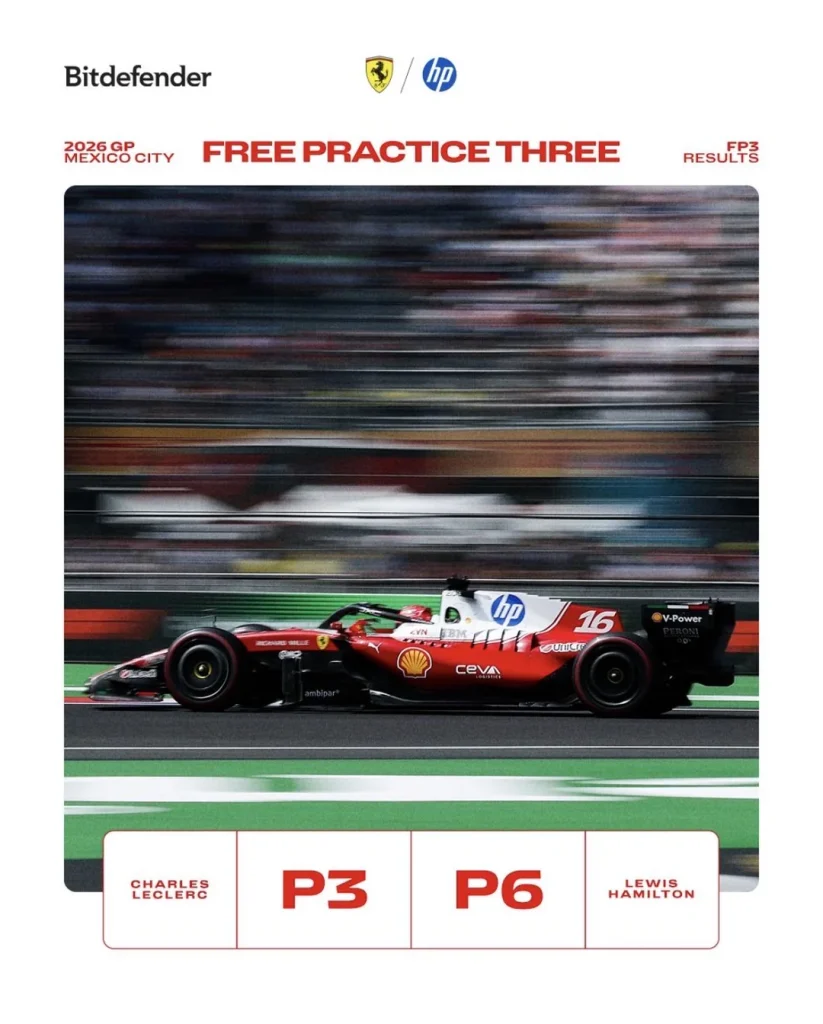
Ferrari’s third and sixth places captured the familiar tension between visible potential and uncertainty about how much of it would survive into qualifying.
“Dialing it in before we get set for Quali in Mexico,” the team posted.
Leclerc’s fastest times in sectors one and three made the case that Ferrari belonged in the fight. The problem was combining its strongest sections into one clean lap. Across his better attempts, a compromised opening or middle sector prevented the individual pieces from consistently coming together. That distinction is important. Two fastest sectors demonstrate genuine speed through those parts of the circuit, but they do not automatically make Ferrari the fastest complete package. Qualifying rewards the lap a driver actually completes. The soft tire remained the main concern. Ferrari’s performance suggested a narrow operating window: when the car and tires worked together, the pace was evident; when they did not, the lap became much harder to assemble.
That makes the issue more nuanced than simply declaring that Ferrari cannot use the soft compound. The speed was there in sections. The concern was whether Leclerc and Hamilton could reproduce it across an entire qualifying attempt. Hamilton’s sixth place also left unanswered questions. His soft-tire running featured one counting push effort amid preparation laps, limiting what could be concluded about his ultimate pace. It was reasonable to see room for improvement, but there was insufficient evidence to attribute the result to a particular setup change or to assume that improvement would arrive automatically.
Ferrari’s task heading into qualifying was therefore clear: turn its sector performance into repeatable lap time. Another strong practice showing would offer little consolation if the team could not access the same potential when grid positions were decided.
Verstappen Fifth, With Racing Bulls Together in the Top 10
Verstappen finished fifth, ahead of Hamilton and Russell, while Hadjar placed eighth.
Red Bull’s practice performance did not provide the same obvious case for favoritism as Norris’s overall benchmark, Antonelli’s middle sector, or Leclerc’s two fastest sectors. Even so, fifth place alone was not enough to dismiss Verstappen from the qualifying contest. The supplied discussion also referenced a grid penalty for Verstappen. That added a distinction between setting the fastest qualifying time and actually starting from pole, although the penalty’s size and cause were not included in this material. Behind Hadjar, Lawson and Lindblad gave Racing Bulls consecutive places in ninth and tenth. Both cars reaching the top 10 was an encouraging result and provided a basis for considering whether the team could pressure the cars immediately ahead.
Moving further forward in qualifying remained an ambition rather than a conclusion, but Racing Bulls had put itself in a useful position to capitalize if others failed to deliver clean laps.
Why Practice Leaves Room for Different Answers
Much of the uncertainty centered on how much performance each team had still to reveal.
Engine settings, fuel loads, setup choices, tire preparation, and conditions can complicate comparisons between practice and qualifying. The supplied discussion raised all of those issues, but it did not establish the settings used by any particular team. It would therefore be too strong to conclude that Ferrari had already shown everything while Mercedes and Red Bull had substantial reserves. That interpretation might explain the order, but the timing sheet alone could not prove it. Even comparing practice and qualifying across multiple weekends would require care. Changes in setup, temperature, traffic, and track evolution would prevent a simple lap-time difference from serving as a precise measure of engine performance held in reserve.
The strongest conclusions were the directly observable ones: Norris led, Antonelli was almost inseparable from him, Leclerc had the best first and final sectors, and Piastri put a second McLaren in the top four.
Leclerc Takes the Lead in an Unofficial Championship
There was also a lighter subplot to Ferrari’s practice form.
Leclerc moved to the top of the unofficial “Free Practice Championship” for the third time this season, reaching 682 points ahead of Russell on 673 and Antonelli on 667.
Those standings carry no official championship significance, but they neatly captured the frustration surrounding Ferrari’s practice performances. Being consistently competitive before qualifying is encouraging; converting that speed into meaningful results is the challenge that follows. In Mexico City, Ferrari had another opportunity to make that conversion. McLaren had the fastest lap and two competitive cars. Mercedes had Antonelli within one thousandth of the lead and a formidable middle sector.
FP3 ended with Norris on top, but the fight heading into qualifying remained open.