

Fernando Alonso is questioning the standards of the drivers around him. Carlos Sainz is questioning whether their position on the grid tells us much about their ability at all. George Russell’s qualifying struggles have raised an even stranger question: what happens when driving faster through a corner costs you time?
As Formula 1 heads into the Mexico weekend, these discussions overlap more than they initially appear to. They all concern how much credit, blame, and responsibility belongs to the person in the cockpit—and how much depends on the machinery, regulations, and circumstances surrounding them. Andrea Kimi Antonelli’s illness adds an unexpected complication to the championship picture, while Lewis Hamilton is already treating the remaining races as preparation for Ferrari’s next attempt. Elsewhere, McLaren’s expanding commercial portfolio offers a reminder that rebuilding a team involves considerably more than finding lap time. Alonso, however, has ensured that the most pointed conversation remains about the drivers themselves. Following his collision with Alex Albon at the United States Grand Prix, Alonso has stood by his criticism of driving standards.
“I think we all know which ones we talk about and which ones felt hit by that comment,” he said, as reported by The Race. “So that tells you everything.”
The expanded remarks shared by Formula Directa leave little doubt about his frustration.
“I still can’t wrap my head around what opportunity Alex thought he saw in that moment,” Alonso said.
“It’s not just Austin. I’ve had the bad luck of being in that part of the track all season long and I see things from the car that…I can’t comment on here.”
He also questioned the ambitions of the drivers involved.
“But what ambition do these drivers have for the future? If they want to stick around in F1 longer and want a shot at a top team or if they’re happy just crashing.”
Alonso acknowledged that cars become harder to drive further down the order and highlighted the consequences of damage under a spending cap. His conclusion remained cutting: “But if the teams are happy with the cost and the broken parts in every race, go right ahead.”
There is a reasonable argument within that criticism. Avoidable contact carries consequences beyond the immediate result, particularly for teams already struggling for performance. Frustration with repeated incidents does not become invalid simply because the person expressing it has a reputation for being outspoken. But questioning a particular decision and questioning whether a group of drivers belongs in Formula 1 are substantially different arguments. The first can be assessed against an incident. The second requires much more than anger after another difficult afternoon. Sainz offered the most substantial response by explaining what racing at the back actually involves.
“I have enormous respect for Alex,” he said. “He’s a driver I love racing against and with whom I’ve never had any problems or lack of respect. I also enjoy battling with Fernando.”
Rather than turning the discussion into a choice between defending his teammate and respecting Alonso, Sainz described the circumstances that can make those battles so messy.
“For the first time, I find myself battling at the back of the midfield, and it’s certainly not a pleasant situation,” he said.
“It’s not so much a question of the quality of the drivers themselves, but rather the fact that you find yourself battling with drivers who truly have nothing to lose.”
His explanation extended beyond frustration or willingness to take risks. More dirty air, a stronger concertina effect, and cars arriving three or four abreast create a different environment from the one experienced by drivers who emerge from the opening corner in single file. That distinction matters. A driver at the front and a driver at the back may be competing in the same race, but they are not necessarily facing comparable situations. Sainz’s argument does not excuse every collision. It does challenge the assumption that a higher concentration of incidents automatically proves a lower concentration of talent.
“In my opinion, none of us at the back of the grid deserves to occupy those positions,” he said. “We all have the talent to fight for podiums, top five finishes, and wins.”
He specifically included Alonso, Albon, Sergio Pérez, and Valtteri Bottas alongside himself. On the overall standard of the field, Sainz was unequivocal.
“I’ve been in F1 for 12 years, and this is, without a doubt, the year with the highest level of talent ever. I can’t think of a single driver who isn’t up to the level of Formula 1, and even the rookies who have arrived in recent years are excellent.”
That is Sainz’s assessment, rather than something a championship table can prove. But his central point is persuasive: finishing near the back does not erase what a driver has demonstrated in competitive equipment. His closing observation captured the personal cost of that disconnect.
“It’s extremely frustrating to think that two years ago I was winning here in Mexico, and this weekend I’ll probably start 17th, despite being the same driver I was then, if not even better.”
There is also room to appreciate Sainz’s answer without pretending that every decision he makes on track is beyond criticism. Praising a thoughtful explanation and criticizing a separate incident are perfectly compatible. Drivers do not need to be assigned permanent roles as either the reasonable one or the villain. The same standard should apply to Alonso. His frustration can be understandable while his broader judgment remains excessive. His achievements give his views weight; they do not make every conclusion unanswerable. The uneven treatment of outspoken drivers is part of this story, too. Bluntness is frequently celebrated as authenticity when it comes from a popular figure, then condemned as arrogance or immaturity when someone else expresses it. A consistent assessment should consider what was said and whether it was justified, rather than whether the speaker already enjoys a reputation for entertaining controversy.
The discussion inevitably returns to a familiar wish: put everyone in the same car and find out who is really fastest. It is an appealing thought experiment. It would remove an enormous variable from a sport in which drivers can move dramatically up or down the order without undergoing an equivalent change in ability. Yet identical equipment would still leave questions about setup, preparation, familiarity, and driving preferences. A common car would provide a useful comparison of performance in that car, on that occasion. It would not necessarily produce a definitive ranking for every circuit and every generation of machinery.
Even the comparisons with series using more standardized equipment come with qualifications. Shared components do not eliminate differences in how teams prepare, understand, and operate their cars. That relationship between driver and machine is particularly relevant to Russell. Anthony Davidson’s explanation of his Austin qualifying performance highlighted an uncomfortable feature of the current cars: carrying more speed through a corner can leave a driver worse off over the complete lap because of the consequences for energy recovery and subsequent deployment.
The instinctive objection is obvious. A driver negotiates a demanding section faster, only to lose the benefit elsewhere because the energy balance no longer works in his favor. For drivers whose strengths include commitment and speed through fast corners, that creates a difficult adjustment. An approach developed over years can require revision when the quickest complete lap rewards a different sequence of inputs. Antonelli and Russell both have to learn what these cars require. Russell may also have to unlearn habits that previously delivered results.
That helps explain the challenge. It does not remove the responsibility to respond to it. Disliking the regulations and adapting effectively to them are separate matters. Russell can reasonably be frustrated by what the cars demand while Mercedes still expects him to extract more performance from the package. Nor is the solution likely to belong to one person. The driver has to execute the lap, but understanding where time is being exchanged between corner speed, recovery, and deployment is a shared engineering problem. Simply telling a driver to adapt does little to explain what must change.
Equally, the material provided does not establish whether Russell lacked information, understood the trade-off but struggled to reproduce it, or was pursuing a compromise that failed to work. Assigning the fault to his engineer, simulator preparation, or a particular manager would go beyond what is available. What Davidson’s explanation does expose is the difference between speed through an individual section and speed over a lap. Whether that is a satisfying test of a driver is a legitimate debate. Under the current demands, it is also a performance problem Mercedes and Russell have to solve. The discussion about Hamilton’s age raises another version of the same difficulty: separating the driver’s underlying ability from the circumstances in which we observe it. Asked about Hamilton in comparison with Antonelli, Verstappen drew a distinction between maintaining performance and having further room to improve.
“Age shouldn’t play a role nowadays, but he probably won’t get any faster,” Verstappen said, according to Sportskeeda.
“Don’t get me wrong: I’m not saying Lewis is getting slower, just that he isn’t getting any faster. With Kimi, it’s different. There’s still a lot more in him.”
That qualification is important. Verstappen was discussing their potential trajectories, rather than declaring Hamilton incapable of competing. The wider debate often bundles several different issues together: raw speed, reactions, consistency, adaptability, motivation, and willingness to take risks. A driver can change in one area without experiencing an identical change in all the others. The claims about precisely when Hamilton peaked, or which earlier version of him would have won a particular championship, remain counterfactual judgments. They cannot be settled by moving an imagined younger Hamilton into a different car.
Likewise, an impressive start does not by itself resolve every question about aging. Comparing Hamilton’s reactions with another driver’s is different from comparing his current performance with his own earlier level. Aggression deserves similar care. Being more selective about an overtake can reflect a different appetite for risk, but it can also reflect better judgment about whether the move is worth attempting. Experience may change the calculation without removing the ability. A driver who waits for a better opportunity has not necessarily lost the instinct to attack. The value of the position, the likelihood of completing the move, and the consequences of failure all matter. Hamilton’s own attention is increasingly directed toward what Ferrari can change.
“I think these next five races are like test races,” he said in comments carried by GPblog. “For me, I’m really focused right now on next year’s car, looking at the good things from this year and making sure we don’t lose them, but instead add to the chassis.”
He added: “And then, of course, in the background, I’m pushing as hard as I can to make sure we come with a power unit that can compete with Mercedes and Red Bull.”
The inevitable jokes about Hamilton personally designing an engine miss the more useful question: how does a driver help a team turn its technical resources into a better car? His statement does not claim that he is replacing Ferrari’s engineers. Providing feedback, identifying priorities, and pushing for weaknesses to be addressed are credible ways for a driver to contribute without specifying the engineering solution. The comments supplied from Toto Wolff and Charles Leclerc support the value of Hamilton’s input.
Wolff described Hamilton as having an almost “genetic connection to the machinery.” Leclerc, meanwhile, said he continues to learn from studying Hamilton’s data and working methods.
“I’ve got my notebook with a lot of notes and probably more notes than ever since Lewis joined the team,” Leclerc said.
Those observations do not guarantee Ferrari will produce a competitive power unit. They do make it difficult to dismiss Hamilton’s contribution simply because he is not an engine designer. The development debate also requires a distinction between restricted development and a complete freeze.
The detailed explanations supplied describe scheduled opportunities to update selected components, alongside ADUO allowances and approval routes for changes related to reliability, safety, or cost. That is more nuanced than either “nothing can change until 2030” or “everyone can build an entirely new power unit every winter.”
The discussion contains conflicting interpretations of the precise allowances, so it does not support a sweeping claim about everything Ferrari can replace. The useful point is narrower: Hamilton’s reference to power-unit work does not inherently contradict a regulated development framework. Nor does a promising internal improvement establish that Ferrari will catch its rivals. Progress has to be measured against competitors who are also developing. For Antonelli, the immediate concern is recovery rather than next year’s machinery.

Autosport reported that the championship leader would miss Thursday’s media duties while recovering from a viral illness. Missing those commitments does not establish that he will miss the race, and the two should not be conflated. His championship advantage nevertheless creates the possibility of an unusual title-clinching weekend. With the supplied figures putting his lead over Russell at 123 points and the remaining available total at 125, his rivals have almost no margin left. The discussion raises the prospect that Antonelli could become mathematically uncatchable even without participating, depending on their results.
It would be an unconventional way to settle the championship, but the decisive work would still have been done across the season. A title secured while its leader recovers would reflect the scale of the advantage already established. McLaren’s commercial position offers a different measure of how far a team can travel. The team’s reported total of 60 sponsors and technical partners is a striking contrast with the sparsely branded cars recalled from 2018. For all the debate surrounding Zak Brown’s public style, the scale of that turnaround deserves recognition.
Commercial success is part of rebuilding an organization. A crowded partnership portfolio illustrates the appeal McLaren has developed, even if counting partners alone cannot tell us the value or terms of those relationships. It also creates the familiar tension between financial strength and visual identity. An uncluttered car can look beautiful while raising uncomfortable questions about the business behind it. A heavily sponsored one can communicate commercial health while leaving fans nostalgic for an earlier livery. The naming discussion—whether Mastercard McLaren sounds better than McLaren Mastercard—belongs to that same balance. Sponsor recognition and team identity have to share the same space, sometimes more comfortably than others.
Even the safety-car discussion touches on this intersection of engineering and commerce. A GT3 car might appear an obvious choice because it is built for a circuit. But the safety car’s job includes being ready for deployment with little warning and operating outside the sustained racing conditions for which a competition car is intended. The supplied discussion raises cold tires and brakes, operating requirements, onboard equipment, maintenance, and cost. It also contains disagreements about specific claims, including idling behavior and cooling, so those details should not be treated as settled simply because they sound plausible.
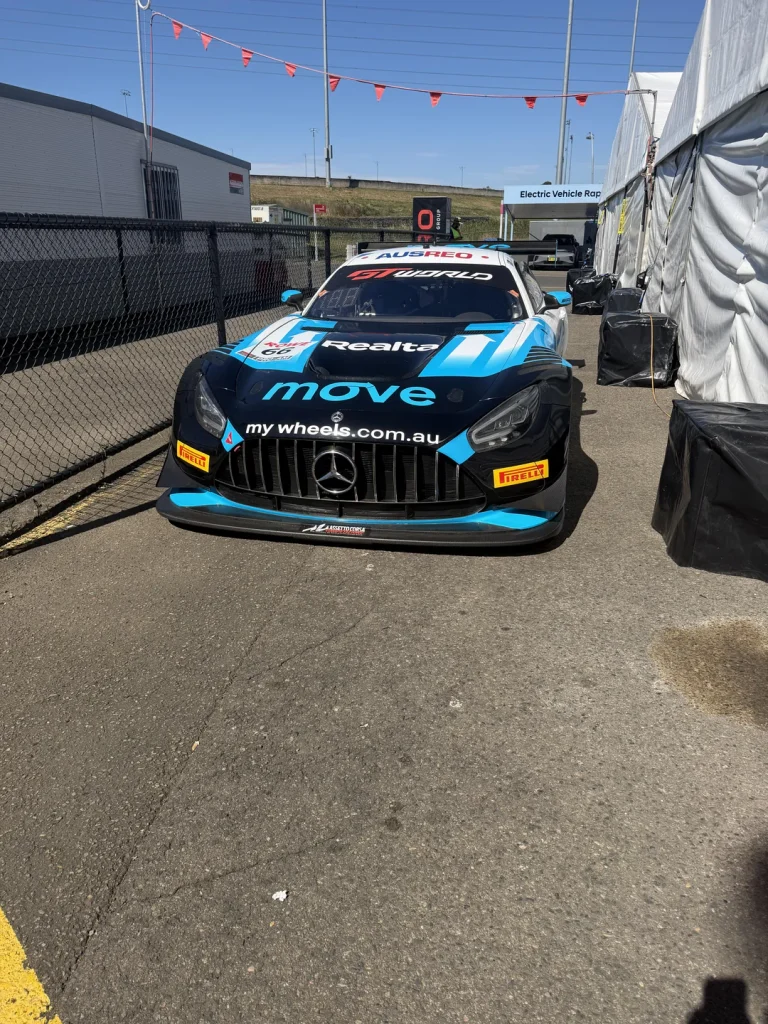
The broader principle is straightforward: suitability involves more than maximum pace. Readiness and dependable operation matter, while the manufacturers supplying the cars also receive a highly visible platform for their road vehicles. Finally, the resurfaced footage of Patrick Stewart joining Daniel Ricciardo for a shoey on the Canada 2017 podium offers a welcome reminder of a less technical part of F1’s appeal. Ricciardo’s delight and disbelief are central to why the moment remains memorable. It is a spontaneous interaction that needs little explanation.
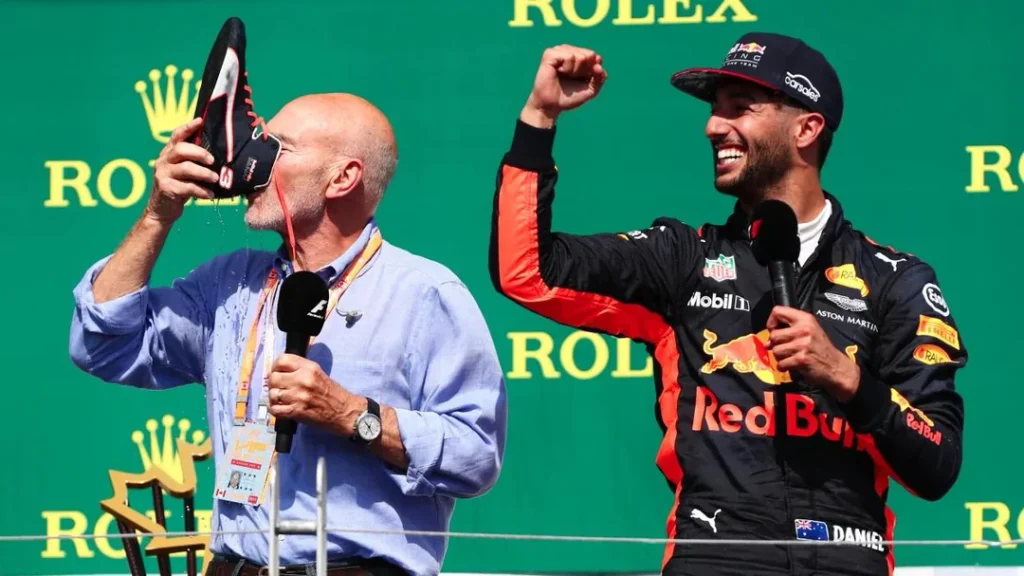
The accompanying nostalgia for Stewart’s BBC introduction and Fleetwood Mac’s “The Chain” points to a similar attachment. The appeal lies in the combination of music, anticipation, racing footage, and history.
The BBC’s coverage theme and Brian Tyler’s official F1 theme serve different purposes, but the emotional comparison is understandable. For longtime viewers, an introduction that connects past and present can make a race feel like the next chapter of something they have followed for years. That sense of continuity also makes the current arguments so charged. Fans bring memories of particular drivers, cars, and ways of racing to every judgment about the present. Sainz’s response provides a useful discipline amid all of it. The driver preparing to start near the back can be the same driver who previously won. The car, the traffic, the risks, and the opportunities have changed around him.
Understanding those circumstances makes criticism more precise. It also makes the performances worth celebrating easier to recognize.