

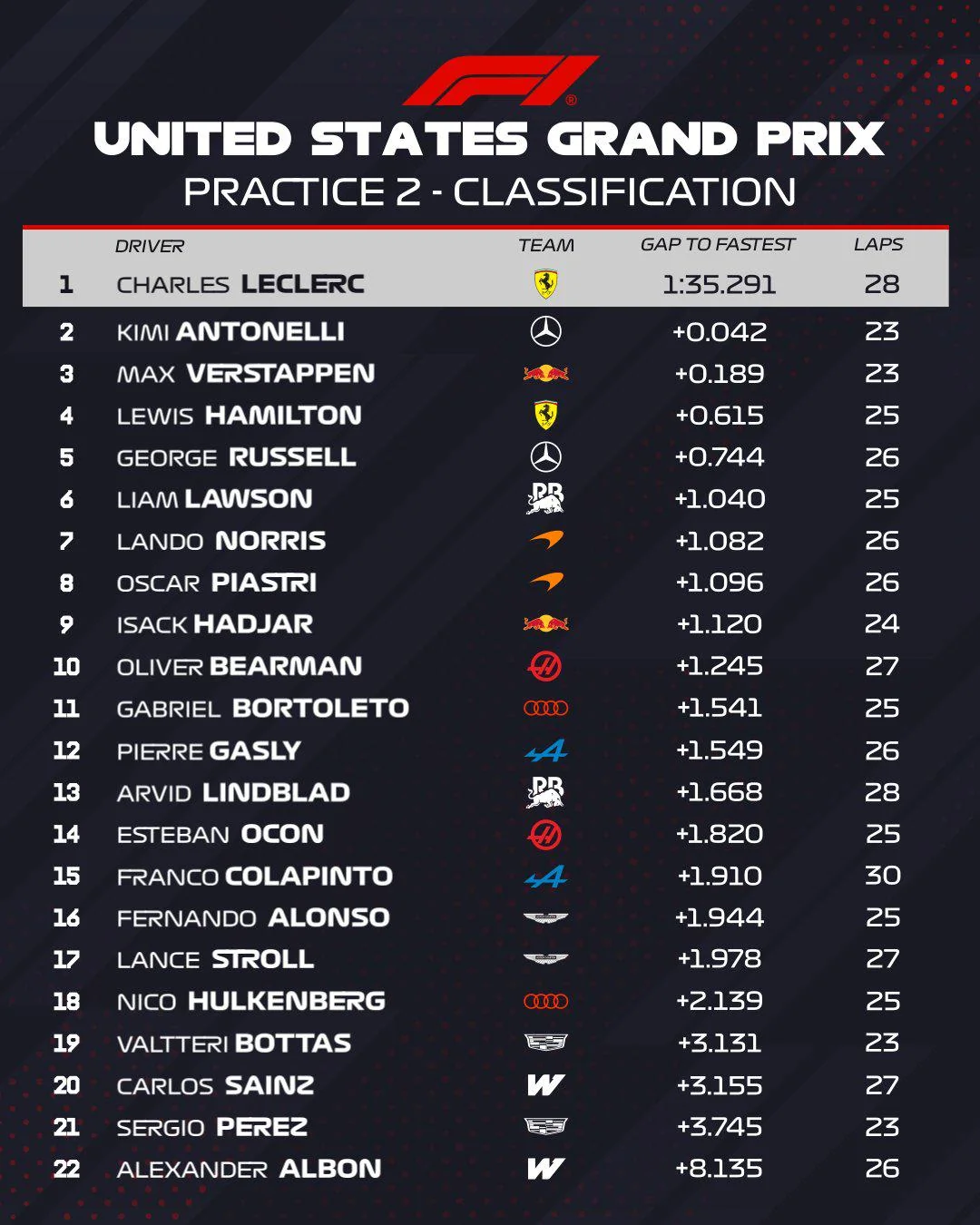
Charles Leclerc completed a sweep of Friday practice at the 2026 United States Grand Prix, following his FP1 benchmark with a 1:35.291 in the second session at Circuit of The Americas. Kimi Antonelli finished second ahead of Max Verstappen, while Lewis Hamilton and George Russell completed the top five.
Ferrari had another encouraging hour, Mercedes remained firmly in contention, and McLaren’s position was considerably more complicated than seventh and eighth might suggest. Lando Norris set his fastest time on hard tires after a lockup spoiled his soft-tire attempt, then produced the quickest average in the supplied long-run comparison. Liam Lawson added another notable performance in sixth. At Williams, however, the problems continued, with Alex Albon again struggling to translate his running into representative, legal laps. The classification offered the outline of a competitive weekend. Tire differences, deleted times, and cars visibly struggling for grip ensured it was still an incomplete picture.
| Position | Driver |
|---|---|
| 1 | Charles Leclerc |
| 2 | Kimi Antonelli |
| 3 | Max Verstappen |
| 4 | Lewis Hamilton |
| 5 | George Russell |
| 6 | Liam Lawson |
| 7 | Lando Norris |
| 8 | Oscar Piastri |
| 9 | Isack Hadjar |
| 10 | Oliver Bearman |
Leclerc’s second consecutive session at the top strengthened Ferrari’s Friday credentials. His FP2 time was 0.761 seconds quicker than his opening-session benchmark, and his early switch to long runs suggested a productive program rather than an hour spent repeatedly chasing a headline lap. After one push lap, Leclerc told the team they could move on to the long run. That was an encouraging indication of his immediate comfort, although it could not establish how much of the improvement came from the upgrades. The greater challenge is familiar. Ferrari has repeatedly offered enough practice pace to create expectations without consistently delivering the same result when qualifying and race day arrive. Another Friday at the front therefore brings excitement accompanied by considerable caution.
There is some reason to view Austin as more than another false dawn. Ferrari has shown strength at COTA before, and Leclerc’s pace was supported by his performance across different corner types. But a promising circuit and two practice sessions still leave the decisive work ahead.
The comparison from TracingInsights illustrated both Ferrari’s strength and the vulnerability that could complicate its weekend.
| Section type | Share of lap | Fastest driver |
|---|---|---|
| Straights | 53% | Kimi Antonelli |
| Low speed | 30% | Charles Leclerc |
| Medium speed | 5% | Kimi Antonelli |
| High speed | 12% | Charles Leclerc |
Leclerc led the low- and high-speed sections, while Antonelli was quickest on the straights and through the medium-speed sections. Ferrari’s cornering performance was therefore doing substantial work to produce its overall advantage.
With straights accounting for 53% of the lap in this breakdown, Ferrari’s relative weakness there remains difficult to overlook. If Mercedes, Red Bull, or McLaren finds more time through the corners, Leclerc’s margin could become harder to defend. It would nevertheless be too simplistic to attribute every straight-line difference to engine performance. Drag, setup, deployment, and the exit from the preceding corner all affect how a car travels down a straight. The differing profiles discussed for Esteban Ocon and Bearman, despite sharing an engine supplier with Ferrari, reinforce the need to consider the whole package. Ferrari’s Friday performance demonstrated that the car could put together a fast lap at COTA. It did not isolate the cause of every gain or loss along the way.
Hamilton’s fourth place gave Ferrari a second car in the leading group, but his session appeared less comfortable than Leclerc’s. Sliding through the second and third sectors pointed toward a lack of confidence in the rear, while the long-run comparison showed a meaningful difference between the two Ferraris on the same compound. Leclerc averaged 1:41.508 on soft tires, compared with Hamilton’s 1:41.949—a gap of 0.441 seconds per lap in the figures provided by F1GuyDan. That broadly matched the impression of Leclerc holding an advantage of around four tenths, although it remains a comparison between practice programs rather than a controlled test. Fuel loads, tire age, and setup differences were not established.
The question for Ferrari is whether Hamilton’s difficulties can be reduced through setup changes or whether COTA’s demands are exposing a balance characteristic that Leclerc is managing more effectively. The opening sector’s demands on the tires offer one possible explanation for trouble later in the lap, but the session did not establish a single cause.
The long-run figures also showed why Norris’ seventh place should not be interpreted as evidence that McLaren was simply off the pace.
| Driver | Tire compound | Average stint pace |
|---|---|---|
| Lando Norris | Hard | 1:41.289 |
| Max Verstappen | Soft | 1:41.481 |
| Charles Leclerc | Soft | 1:41.508 |
| Kimi Antonelli | Medium | 1:41.521 |
| George Russell | Medium | 1:41.602 |
| Lewis Hamilton | Soft | 1:41.949 |
| Oscar Piastri | Soft | 1:41.997 |
| Isack Hadjar | Medium | 1:42.031 |
Long-run averages via F1GuyDan.
Norris headed that comparison on the hardest compound, averaging 0.192 seconds quicker than Verstappen and 0.219 seconds quicker than Leclerc. At one point, he also produced the fastest second sector on hards while many others were using mediums.
Those were encouraging signs. His missing soft-tire benchmark made his position in the classification particularly misleading: a major lockup on his first soft-tire lap prevented a proper qualifying-style comparison, leaving that work for FP3. The section breakdown also needs to be read with that tire difference in mind. Comparing Norris’ hard-tire lap with a teammate’s soft-tire effort can exaggerate differences through the corners. Straight-line performance is less directly dependent on grip, but it still reflects corner exits as well as deployment and drag. Norris’ speed did not make his session straightforward. The McLaren looked difficult to manage, and repeated excursions beyond track limits raised questions about how consistently that pace could be reproduced within the white lines.
That distinction matters over a race distance. A fast average is encouraging, but it becomes more useful when the driver can sustain it legally and reliably. Practice track-limit violations cannot simply be converted into a predicted total of race penalties, yet they do identify an area that needs attention. Nor was Norris alone in struggling to keep his laps clean. Grip and the behavior of the cars around the final corner were recurring concerns, making this a wider challenge rather than an exclusively McLaren problem. Piastri finished eighth, with a deleted lap complicating his classification too. His soft-tire long-run average was 0.708 seconds slower than Norris’ hard-tire figure, a difference that warrants investigation without providing a complete verdict on their respective race pace. Low grip, the bumps, and the need to manage sliding and curb use offer a plausible explanation for why this circuit can be difficult for Piastri. But the available information cannot separate those factors from the effects of different setups, fuel loads, or tire histories.
McLaren has reasons to be encouraged by Norris’ pace and reasons to keep working on how comfortably and consistently its drivers can access it. Turning that performance into a result will also depend on execution and strategy, areas that remain a source of understandable caution.
Mercedes’ position was similarly more promising than Russell’s fifth place alone might imply.
Antonelli was second on the timing screen and narrowly behind Leclerc in the long-run comparison despite using mediums rather than softs. His average was just 0.013 seconds slower than the Ferrari’s, while Russell was another 0.081 seconds behind his teammate on the same compound.
Those figures keep both Mercedes drivers in the race-pace discussion. They do not provide a reliable tire-adjusted ranking, because the other variables remain unknown. Russell also had a faster lap deleted for track limits, limiting the value of the apparent gap to Antonelli in the classification. Different run plans further complicate any attempt to interpret that gap as a straightforward measure of driver performance. Verstappen’s third place and 1:41.481 soft-tire average placed Red Bull close to the center of the contest. His long-run figure was only 0.027 seconds quicker than Leclerc’s, giving little reason to declare a decisive advantage between them.
His strong first-sector performance on mediums, which remained competitive as others began soft-tire runs, was another reminder that the compound labels were not producing a simple hierarchy. Whether that reflected temperatures, tire preparation, degradation, or program differences remained unresolved. Hadjar appeared less comfortable in the other Red Bull. He finished ninth and averaged 1:42.031 on mediums, although the difference in compounds again prevents a clean comparison with Verstappen’s long run. Lawson’s sixth place was one of the session’s standout results. He finished ahead of both McLarens and Hadjar, adding substance to the growing case that his performances deserve closer attention.
The caveats are real: Norris lacked a representative soft-tire lap, Piastri lost a time to track limits, and practice programs varied. Lawson’s position was still an encouraging result in its own right. His Austin appearance also followed an outing on stage, where he described performing as making him far more nervous than driving an F1 car. Once back in the cockpit, he delivered a session that gave his weekend another positive storyline. Runs like this can strengthen a driver’s reputation and encourage discussion about future opportunities. FP2 alone cannot settle whether Lawson belongs in a different seat, but continued performances are the most effective way to make that conversation harder to ignore. There was a smaller point of encouragement for Aston Martin in the section comparison. Fernando Alonso ranked sixth through the low-speed sections, where the car appeared comparatively stable at the rear.
That suggests a useful strength when aerodynamic load is lower, although it does not prove that the rest of Aston Martin’s deficit can be assigned solely to the engine. Improving a power unit and integrating it into the car involves broader compromises, including cooling and packaging. The cornering performance offers a foundation to build on rather than a guarantee that one change would transform the team’s competitiveness.
At Williams, the picture remained considerably bleaker.
After Albon’s FP1 was dominated by deleted laps, it took approximately 33 minutes of FP2 for him to record a clean lap. His better attempts again fell foul of track limits, leaving an unrepresentative time and another difficult classification to interpret.
The complaints extended beyond staying inside the white lines. Understeer, oversteer, braking difficulties, and unpredictable responses made the car appear exceptionally hard to drive. Both Williams cars looked troublesome, suggesting a broader problem than one driver failing to adapt. That does not remove driver responsibility for track limits. It does make it unreasonable to use Albon’s surviving time as a direct measure of his underlying pace or to diagnose the entire problem from his position at the bottom. The scale of the difficulty calls for an explanation from the car and its setup as well as the driver. Suggestions of extreme experimental programs remain speculative; the visible lack of confidence was more concrete.
COTA’s pronounced bumps added another challenge across the field. The movement of the cars made the surface a prominent feature of the session, complicating an already difficult search for grip and consistency. Friday therefore ended with Leclerc holding the clearest headline, but several competing strands underneath it. Ferrari was strong through the corners, Mercedes had straight-line speed and competitive medium-tire running, Verstappen remained close, and Norris’ hard-tire pace suggested substantially more than seventh place.
Leclerc has given Ferrari another Friday to feel good about. Converting that promise into qualifying position and race performance remains the test that matters.