

Formula 1 arrives in Austin surrounded by arguments about perception. Who had the fastest car in Singapore? What makes a sporting event America’s biggest? How much can a driver say before a clarification follows? And how accurately do the personalities constructed around the grid reflect the people themselves?
Isack Hadjar’s assessment of Ferrari has drawn resistance from both Charles Leclerc and Max Verstappen. Carlos Sainz has followed doubts about the season’s Middle Eastern finale with a statement expressing confidence in F1 and the FIA. Lewis Hamilton’s support for an African race comes with reservations about Rwanda, while George Russell’s reputation has received a revealing endorsement from someone who worked on the other side of the competitive divide.
At COTA itself, the debate stretches from an ambitious entrance sign to a new Turn 1 building and the condition of the asphalt. Across these stories, F1’s public image keeps running into questions that deserve more than a slogan, a clipped radio message, or a hypothetical driver swap.
Hadjar supplied perhaps the most provocative sporting assessment.

“I don’t think we have the fastest car,” he said. “The car is still very hard to drive. In Malaysia it was dominant, but I don’t think in Singapore it was the fastest car. I think if you put Max in the Ferrari he would have won the race with more margin.”
That is considerable praise for Verstappen, but it also makes a confident judgment about machinery Hadjar has not driven. Leclerc’s response went directly to that limitation.
“I think it’s nonsense to start saying these kind of things,” he said. “I mean, Isack has no idea what kind of car we drive, and I have no idea what kind of car he drives.”
Verstappen took a similar position.
“It’s impossible for me to know or say how good a Ferrari is because I’ve not driven that car,” he said. “So that’s why these debates are just nonsense.”
The disagreement exposes the problem with one of F1’s favorite arguments. A driver’s result is visible; the precise contribution of the car, its handling characteristics, the setup, and the driver’s execution is much harder to separate. Hadjar can describe the difficulty of his own car. That does not give him direct knowledge of Ferrari’s limitations. Equally, a car being difficult to drive does not automatically establish that it is slower than its rivals. Verstappen’s rejection of the comparison also invites a question about consistency, given the earlier claim raised in the discussion that he could have secured the previous championship sooner in a McLaren. Such comments can serve different purposes during a title fight, but their evidential limits remain the same. Confidence about another team’s car is still confidence about a car the driver has not raced.
An equal-car exhibition would satisfy some of the curiosity, and the appeal of a charity event featuring the grid in identical machinery is easy to understand. Even that would answer a narrower question than who would win a championship in someone else’s F1 car. Adaptation, preparation, circuit choice, and setup would still matter. Hadjar’s comments also bring his own performances into the discussion. Describing Verstappen as extracting more than the car appears capable of can be sincere praise while also offering a favorable explanation for the gap between teammates. Those possibilities can coexist. The useful assessment is neither that Hadjar must match Verstappen immediately nor that finishing in a respectable position automatically proves he is doing enough. Field spread matters. A result near the back of the leading group can conceal a substantial deficit, just as a tightly packed field can make a smaller deficit look disastrous.
Claims that development is moving away from Hadjar’s preferences remain speculative. So does the idea that every difficult weekend represents the return of a supposedly cursed second seat. His pace, consistency, reliability, and contribution to the team deserve examination without reducing the explanation to a single recurring storyline.
For Ferrari, the hypothetical has reopened a much older frustration: why does a team with such resources and access to accomplished drivers continue to leave so much unresolved?
The temptation is to imagine that one extraordinary signing could finally settle the issue. Yet the larger criticism of Ferrari is that driver quality has repeatedly failed to produce the championship outcome it wants. Changing the name in the cockpit cannot, by itself, repair strategy, communication, development, or organizational execution.
Imagining Verstappen responding to confused instructions makes for entertaining theater. It does not establish how he would perform within Ferrari’s structure, how that structure would respond to him, or whether the combination would be successful. Nor is nationality a useful substitute for examining management. Ferrari’s successful periods should prompt questions about authority, continuity, recruitment, and decision-making. Attributing success or failure to whether particular people were Italian avoids the harder organizational analysis.
Leclerc’s objection is therefore reasonable. Ferrari’s performance can be scrutinized without pretending that an imaginary version of the Singapore race provides a definitive verdict.
Leclerc is also facing scrutiny over a much more personal question: whether he would miss a race for the birth of his child.
“No, I don’t think I’ll miss a race,” he said. “But I’ll obviously do everything I can to be at home as much as possible between races. So I might arrive a little bit late, but I’ll still be racing on Sundays.”
There is an understandable emotional response to that answer. Childbirth can be an intensely demanding moment for a family, and being present means more than providing financial security. A substantial salary does not make support unnecessary. But the wording also matters. Leclerc said he does not think he will miss a race. That is not enough to establish what he would do in an unexpected situation, what arrangements have been discussed privately, or what his partner wants. Turning those unknowns into accusations that he is forcing a particular birth schedule goes beyond what his statement supports. The distinction between racing for a championship and racing for a lower position explains why some find his stance difficult to accept. Yet family support should not become valuable only when the sporting stakes are modest. The relevant decisions belong to the family, informed by circumstances that the public does not possess.
His answer can be questioned without pretending that it reveals the entirety of his priorities.
Sainz’s latest comments raise a different question about how much room drivers have to express uncertainty.
According to Thomas Maher, Sainz said it was “difficult to be convinced” that the Qatar and Abu Dhabi races would happen because of uncertainty in the Middle East. He subsequently issued a statement adopting a more reassuring tone.
“Following some reporting of my comments in the press conference earlier today about ending the season in the Middle East, I want to be clear that I know the FIA and Formula 1 will put safety first and completely trust them to make the right decision,” Sainz said. “We look forward to racing in Qatar and Abu Dhabi.”
Maher characterized the development as backpedaling after someone had spoken to Sainz. The change in emphasis is apparent. What has not been established is who intervened, what was said privately, or whether a specific contractual requirement prompted the statement. Drivers operate within teams and commercial relationships. Experience and a large salary do not provide unlimited freedom to disregard those obligations. Even outspoken champions can face pressure to moderate a message; their willingness and ability to resist it may differ. That reality does not make the concern behind Sainz’s original remarks inappropriate. Questions about travel and safety deserve clear answers rather than an expectation that uncertainty remain unspoken.
The theories about cancellation fees, force majeure, political pressure, or waiting for a championship outcome remain theories. None is established by the change in Sainz’s public wording. There are nevertheless sporting consequences to prolonged calendar uncertainty. Teams make decisions about components, penalties, and the remaining opportunities to recover points. Constructors’ positions remain important even if the drivers’ championship becomes settled. A shortened finale could affect far more than the identity of one champion.
For those reasons, reassurance is most useful when accompanied by timely decisions and a clear explanation of the process.
Hamilton’s comments about Africa bring another dimension to the question of where F1 races.
Support for the championship returning to the continent does not remove the need to examine the proposed host. His reservations about Rwanda sit within that distinction: welcoming greater representation while questioning the circumstances surrounding a particular event.
His full closing statement also extends beyond the shortened “Free Congo!” framing.
“I guess I’ll finish it off with: I think we need to make sure we’re pushing to free Congo, free Sudan, free Syria, free Palestine,” Hamilton said. “I think there’s a lot of peace that I’m hoping that at some stage we get to.”
The debate should not require choosing between African fans’ access to F1 and scrutiny of a host government. Both deserve consideration. A world championship has a reasonable basis for seeking a broader geographical presence. Protecting established circuits does not require treating fans elsewhere as less entitled to attend a race. Equally, expansion does not automatically make every proposed destination the right choice.
The concerns raised about Rwanda and Congo deserve specific examination. They should not be dismissed through sweeping claims about Africa, nor answered merely by pointing to controversies involving other hosts.
Consistency matters, but it should strengthen scrutiny across the calendar. It should not become a reason to abandon it everywhere.
Hamilton’s advocacy also invites a familiar argument about whether speaking publicly is enough. Public statements are not equivalent to resolving a humanitarian crisis. They can still draw attention to issues that might otherwise receive little discussion within a sporting audience.
Continuing to compete does not make every criticism meaningless, just as speaking out does not place a driver beyond criticism. Expecting the driver who says something to meet a standard never applied to those who remain silent creates an obvious imbalance.
At Austin, the questions are less geopolitical but still revealing about F1’s relationship with its audience.
Philip Horton’s photograph of COTA’s “Welcome to America’s biggest sporting event” sign sparked an argument that depends almost entirely on the missing definition of “biggest.”
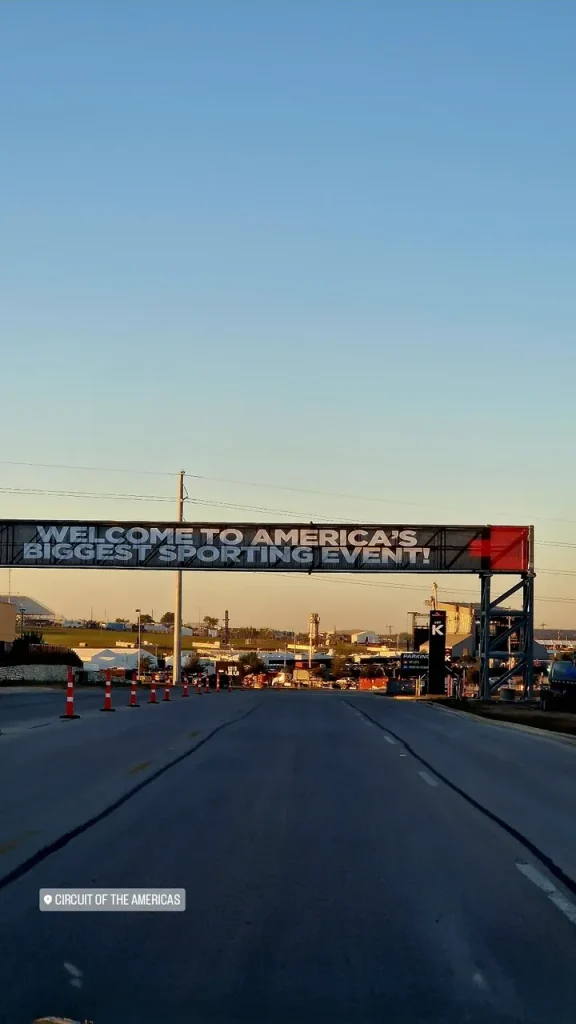
Television audience, cultural prominence, financial scale, single-day attendance, and cumulative attendance are different measures. A claim that moves between them becomes difficult to assess.
The Super Bowl is the obvious reference point for broader American sporting prominence. The Indianapolis 500 is central to the discussion of enormous race-day crowds. COTA’s cumulative weekend attendance describes something else. A person attending on Friday, Saturday, and Sunday can contribute three entries to a weekend total. That is a usable measure of activity across an event, provided it is identified clearly. It is not the same as three separate people attending, and it should not be compared casually with another event’s single-day crowd. If multiple days are being counted, comparable days elsewhere deserve consideration too. The sign itself is at COTA. Without further evidence, responsibility for its precise wording should not automatically be assigned to Formula 1 management.
There is also no need to turn disagreement with the slogan into invented estimates of how many Americans know the race is happening. F1 can have a substantial, growing audience without being the country’s dominant sporting attraction. The event’s appeal does not depend on winning every possible comparison.
COTA’s new Turn 1 building has generated a similarly heated debate over what the circuit is becoming.
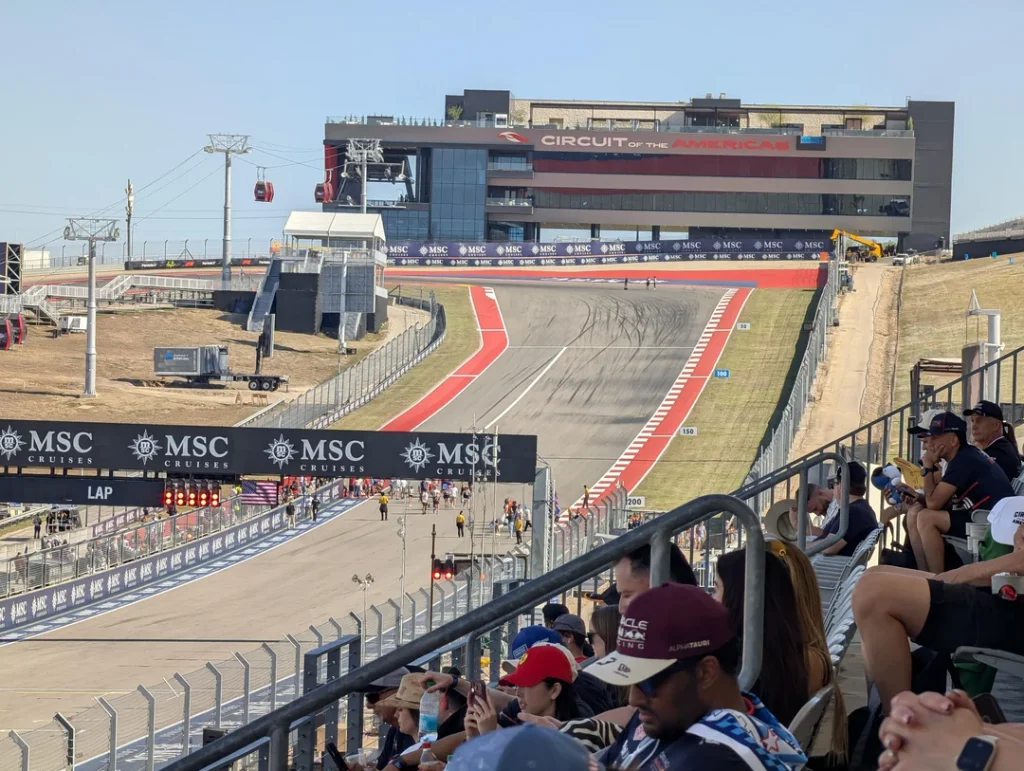
Its finished appearance is different from the red structure some had expected, but the underlying disagreement remains: has the building damaged a distinctive view, or are people attaching excessive importance to an empty skyline?
The open background was part of the appeal for those who liked seeing cars climb toward the sky. Negative space can give a photograph character and emphasize the steepness of the ascent. A view does not need a famous skyline to be worth preserving. At the same time, some of the discussion has confused the American flag at Turn 1 with the Texas flag associated with a separate Leclerc sunset shot. Those are different views, and treating them as interchangeable weakens the criticism. The effect on spectators will also vary. A changed television backdrop need not ruin the experience from a grandstand, and the eventual broadcast angles will determine how often the building dominates the picture.
The more consequential concern is access. Accounts in the discussion describe club racing and high-performance driving events losing opportunities as the venue places greater emphasis on private membership. Those accounts raise a question that extends beyond architecture: how much space will remain for participants who cannot buy into an exclusive club? A project can make commercial sense while reducing access for other users. Calling the building a waste of money does not address that tradeoff. Neither does pointing to potential profitability settle whether the change benefits the wider motorsport community.
The exact future allocation of track time should not be assumed from membership claims alone. But if established clubs lose their opportunities, the consequences would be more substantial than an altered photograph.
COTA’s surface offers a more immediate concern for the drivers.
Verstappen described the bumps as “unacceptable” and “out of control,” bringing renewed attention to a recurring criticism of the venue.
The discussion repeatedly points toward expansive clay, changing moisture levels, and movement beneath the asphalt. It also contains competing explanations involving foundations, drainage, resurfacing, and the practicality of deeper repairs. Those explanations should not be treated as a settled engineering report. Comparisons with Dutch roads, Arctic construction, airports, or buildings can illustrate that difficult ground conditions are manageable, but they do not establish that identical methods are appropriate or affordable at COTA. Likewise, describing the site simply as a swamp compresses a complex problem into an easy punch line.
The relevant distinction is between treating a surface defect and addressing whatever causes it to recur. Resurfacing can improve the immediate condition without necessarily preventing future movement. Establishing the right long-term solution requires more than confident estimates about cost or assertions about what the circuit owner is unwilling to spend. Verstappen’s criticism deserves to be assessed on its substance. It does not need an exaggerated headline to matter. Away from the asphalt, Calum Nicholas’s account of Russell offers a reminder of how much gets lost when drivers become fixed characters in F1’s public narrative.
“I like George, I always found him a real gent,” Nicholas said, recalling the pre-race routine of sitting on the pit wall before heading to the grid. “Every weekend, George would be walking down the pit lane and without fail, every single time, he’d make an effort to say, ‘Have a good day lads, good luck.’” It is a small gesture, but its repetition gives the account weight. Courtesy directed toward a rival crew does not fit neatly with the assumption that every polished interaction must be manufactured.
Russell’s careful delivery can be interpreted as insincerity, while a more impulsive driver is criticized for speaking without thinking. There is no reliably acceptable level of media training when an audience has already decided what a driver’s personality means. The discussion of his “forecast a podium” radio illustrates the importance of context. A sarcastic exchange about forecasts can sound very different when reduced to a standalone sentence. That does not require believing every editorial choice is part of a deliberate campaign against him. It does require recognizing that selection and presentation influence perception. His confrontation with Valtteri Bottas at Imola remains open to criticism. His attempt to help Zhou Guanyu at Silverstone also belongs in the picture. Neither moment needs to erase the other.
Good manners do not become fraudulent because a competitive driver sometimes loses his temper. Nor should accent, appearance, or expectations about masculinity become shortcuts for judging character.
Ocon’s response to losing his Haas seat demonstrates how quickly those judgments can harden.
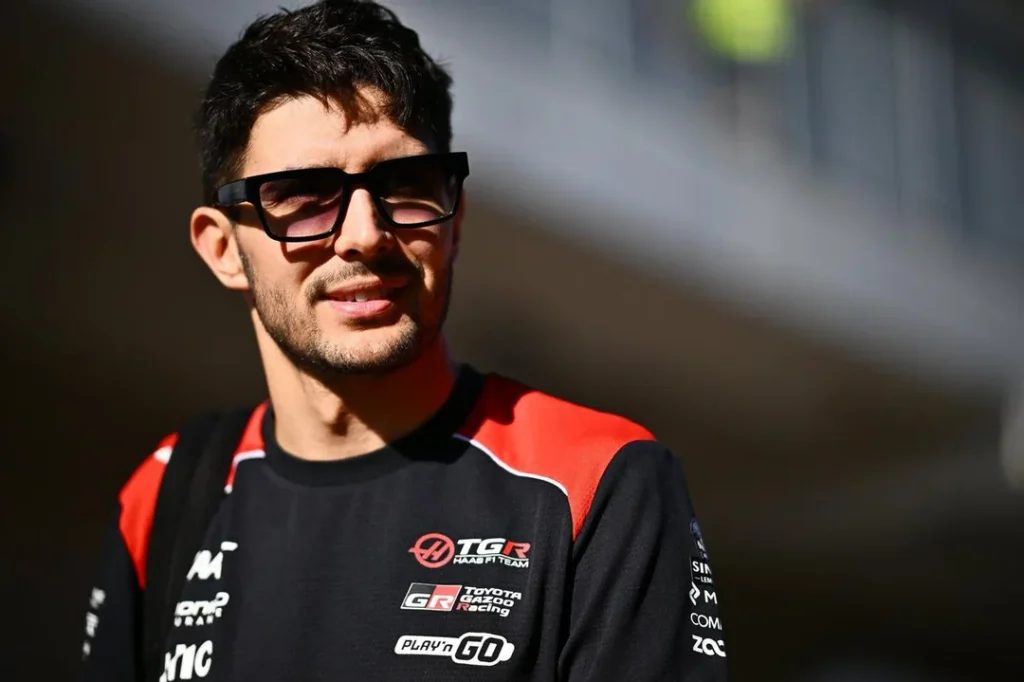
With Rafael Câmara signed for 2027, discussion has already shifted toward an apparent retirement. Yet losing a seat and announcing the end of a career are different things.
Ocon’s own words leave that distinction open.
“It’s not the end anyway,” he said. “I’m not calling for any support from any drivers or whatever. That’s not what I need. It’s a difficult world for everybody in a way.”
He also said Lance Stroll had spoken to him, while other drivers had not sent private messages despite offering public support. That answer can sound defensive. It cannot establish who likes him, why someone did not text, or what every relationship on the grid is like. Drivers are professional rivals and colleagues. They are not required to form one friendship group, and their private correspondence is a poor basis for a definitive character assessment.
Ocon’s record as a race winner and podium finisher deserves recognition even if Haas sees greater value in a younger prospect. Experience can be useful without guaranteeing a seat; potential can be attractive without guaranteeing an improvement. Questions about performance and working relationships are legitimate. Claims that he is universally disliked, or that his return is impossible, go further than the evidence allows. Nicholas’s description of Russell and Ocon’s account of his situation both point toward the same limitation in the way F1 personalities are judged. The public sees selected moments from demanding careers, then often treats those moments as complete biographies.
Austin provides plenty to assess without filling those gaps ourselves: Ferrari’s execution, Hadjar’s performance, COTA’s surface and accessibility, the management of calendar uncertainty, and the standards applied to new hosts. Those questions become more useful when the distinction between what is known, what is argued, and what is imagined stays clear.