

Max Verstappen emerged victorious from a chaotic, rain-affected Sprint at the 2026 Singapore Grand Prix, leading Lewis Hamilton and Charles Leclerc across the finish line in a race defined as much by its crashes and controversies as its results.
While Verstappen celebrated another victory, Mercedes suffered a costly setback when George Russell crashed out after experiencing unexpected power delivery. McLaren, meanwhile, turned a potential double-points finish into a disaster when Lando Norris collided with teammate Oscar Piastri on the final lap.
Norris salvaged eighth place and a single championship point, but Piastri retired with substantial damage to his car. The incident sparked criticism of Norris’s judgment, questions about McLaren’s internal management, and an increasingly uncomfortable debate about whether a driver having the right to attempt an overtake necessarily means they should.
Verstappen Takes Victory as Ferrari Secures Double Podium
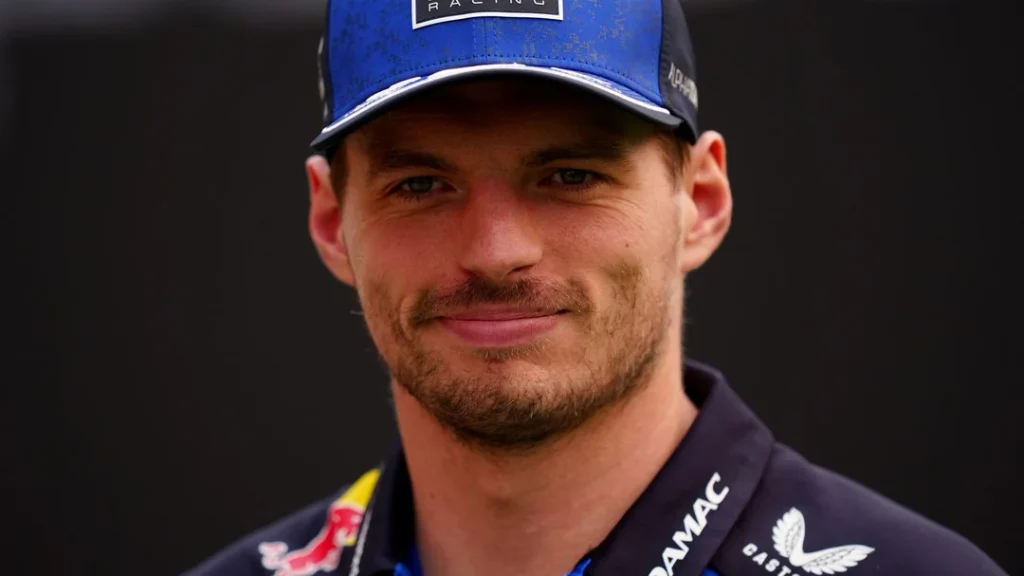
Verstappen claimed the Singapore Sprint victory ahead of Hamilton and Leclerc, with Kimi Antonelli finishing fourth despite spending much of the race unable to make progress through traffic.
Liam Lawson completed the top five, followed by Oliver Bearman, Nico Hülkenberg, and Norris, who collected the final available point. The top 10 finished as follows:
| Position | Driver |
|---|---|
| 1 | Max Verstappen |
| 2 | Lewis Hamilton |
| 3 | Charles Leclerc |
| 4 | Kimi Antonelli |
| 5 | Liam Lawson |
| 6 | Oliver Bearman |
| 7 | Nico Hülkenberg |
| 8 | Lando Norris |
| 9 | Pierre Gasly |
| 10 | Esteban Ocon |
Hamilton produced one of the more memorable moments of the Sprint with an impressive opening-lap move, while Ferrari’s two podium finishes offered a welcome contrast to the difficulties experienced by several rivals. Verstappen’s victory also carried important implications for the constructors’ championship. Red Bull has been closing on McLaren, and the latter’s latest self-inflicted setback could prove increasingly expensive. The gap between the teams was reported by fans to have narrowed to just 11 points following the Sprint, raising the stakes for Sunday’s Grand Prix. For all the incidents, however, the racing itself received mixed reviews. Outside the opening exchanges, crashes, and the final-lap McLaren collision, some viewers felt the Sprint offered relatively little entertainment.
That dissatisfaction would become part of a wider discussion about whether Sprint races are delivering what Formula 1 intended.
Russell Crashes Out After Unexpected Power Delivery
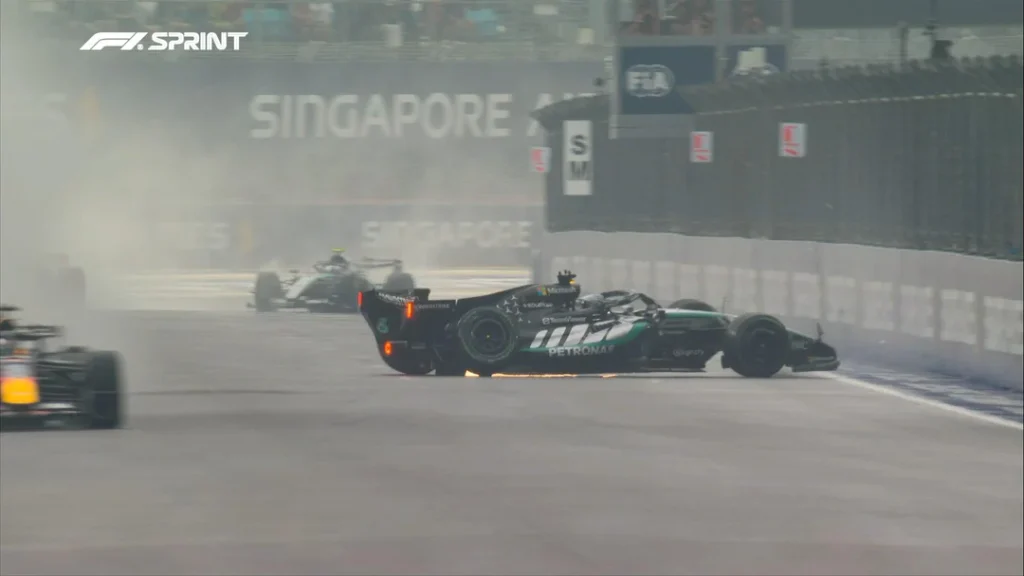
George Russell’s Sprint ended against the barriers after the Mercedes driver lost control in the slippery conditions.
Russell subsequently explained that he had received more power than expected when accelerating, causing him to run wider than intended. Mercedes representative Bradley Lord also discussed the unexpected power delivery during the post-race coverage, lending further context to Russell’s explanation. The incident raised familiar questions about the behavior of Formula 1’s 2026 power units.
With the cars relying heavily on electrical energy deployment, drivers must contend with power delivery characteristics that can be particularly difficult to manage when grip is limited. Even a relatively small difference between expected and actual torque can have significant consequences when a driver is already operating near the limit of adhesion. In Russell’s case, the debate centered on whether the unexpected power pushed him onto a slippery painted white line or whether the loss of grip was fundamentally a driving mistake.
The distinction matters. A driver who applies too much throttle on a wet surface bears responsibility for the resulting loss of control. But a car delivering more power than the driver anticipates introduces another variable, particularly when the available grip is already marginal. Similar discussions have followed incidents involving Verstappen, Leclerc, and Piastri this season, fueling concerns that the new power units can produce behavior that is difficult for drivers to anticipate.
There is also a reasonable counterargument: drivers remain responsible for adapting to their machinery and the conditions, and unexpected power delivery does not automatically establish a technical malfunction. Russell himself did not attempt to escape responsibility. He apologized repeatedly over team radio and acknowledged his mistake, even while explaining the unexpected behavior of the car. Without detailed telemetry, it is impossible to establish precisely how much the power delivery contributed to the accident.
What is clear is that Russell paid a substantial price. His retirement allowed teammate Antonelli to extend his championship advantage over Russell by five points, despite the younger Mercedes driver spending much of the Sprint stuck behind other cars. Antonelli’s fourth-place finish was not particularly spectacular, but it was effective.
In a race where several drivers found themselves in trouble, staying out of incidents proved just as valuable as outright speed.
Another Wet-Weather Delay Revives Familiar Questions
The Sprint was delayed by wet conditions at Marina Bay, renewing criticism of Formula 1’s approach to racing in the rain.
For some fans, the frustration is straightforward: Formula 1 invests in full wet-weather tires, transports them around the world, and then frequently appears reluctant to use them in the conditions for which they were designed. That has prompted questions about whether the tires are sufficiently effective, whether race control is overly cautious, and whether modern Formula 1 has become too reluctant to race in challenging weather. The opposing argument is equally important.
Standing water, poor visibility, and the risk of aquaplaning can make racing genuinely dangerous, regardless of driver ability. A tire capable of dispersing water cannot eliminate every hazard, particularly on a street circuit where painted markings and changing grip levels add further complications. Russell’s crash illustrated how quickly conditions can catch out even experienced drivers. Still, the repeated delays and restrictions have left some viewers questioning the purpose of full wet tires and whether Formula 1’s approach strikes the appropriate balance between safety and competition.
Those frustrations have only intensified under the 2026 regulations, with energy deployment and unpredictable power delivery adding another layer of complexity to wet-weather racing.
Norris and Piastri Collide on the Final Lap
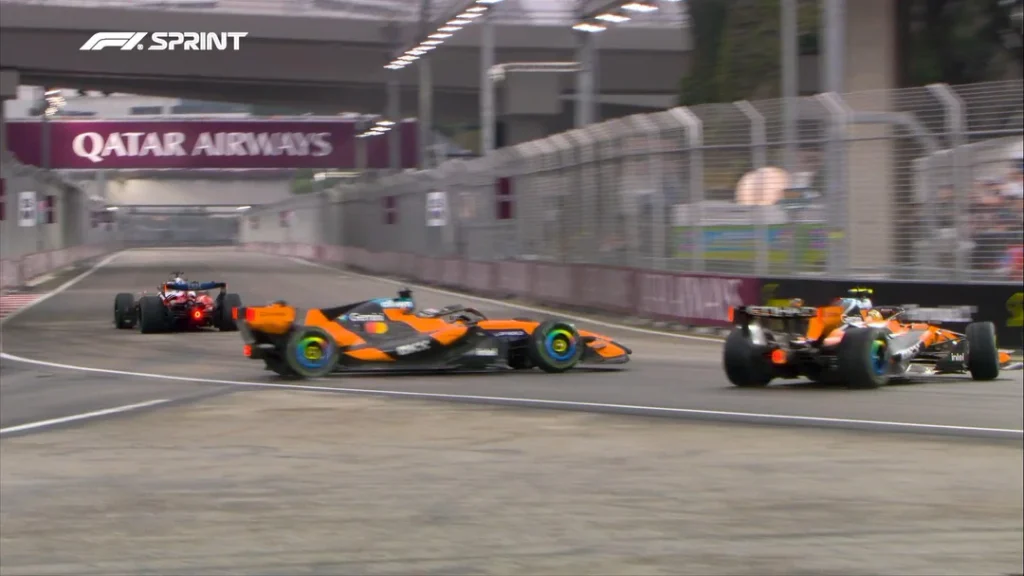
The most controversial moment arrived on the final lap.
Norris attempted an inside overtake on Piastri at Turn 5 while the two McLarens were chasing the Ferrari ahead. The gap narrowed as the cars approached the apex, and the teammates made contact. Piastri retired, while Norris recovered to finish eighth.
The stewards reportedly determined that neither driver was predominantly responsible for the collision and took no further action. That decision did little to quiet the criticism. The central argument was not necessarily that Norris had attempted an illegal maneuver. Rather, it was that the move offered an extremely limited potential reward while exposing both McLarens to a substantial risk.
Norris was fighting his teammate for a single additional Sprint point. McLaren, meanwhile, was attempting to defend its position in the constructors’ championship against a resurgent Red Bull. Even if Norris had completed the overtake successfully, McLaren’s combined points total would have remained unchanged.
Instead, the team lost the opportunity to score with both cars and faced a significant repair operation before Grand Prix qualifying. That is what makes the decision particularly difficult to defend from a team perspective. A driver fighting a championship rival for a decisive position might reasonably accept a higher level of risk. Attempting the same maneuver against a teammate for a marginal points gain, with the constructors’ championship still at stake, presents a very different calculation.
There is, however, a legitimate counterargument. The Sprint is a competitive race, and drivers cannot be expected to abandon every overtaking opportunity simply because the car ahead belongs to the same team. At Singapore, where overtaking is difficult, a visible opening may be one of relatively few opportunities to gain a position.
The move itself was not universally regarded as outrageous. Some viewers considered the gap sufficient to justify an attempt, even if the circumstances made the decision questionable.
Ultimately, the difference between a permissible maneuver and a strategically sensible one became the defining argument of McLaren’s afternoon.
Norris Defends His Decision: “I Have the Right to Do That”
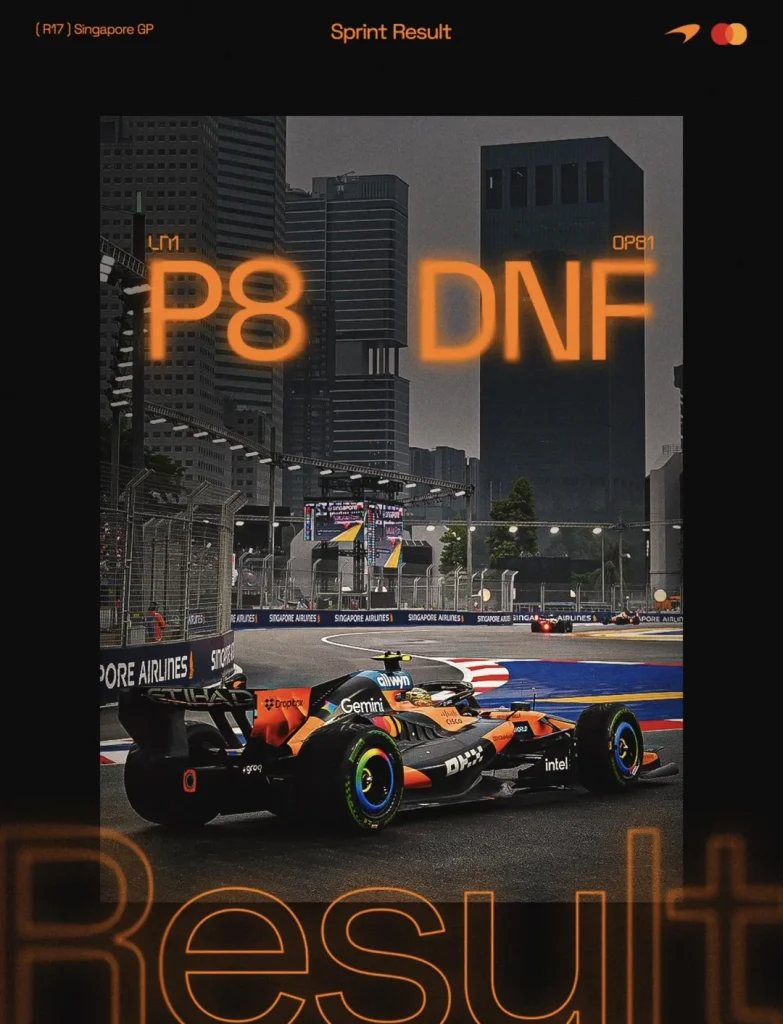
Norris defended his attempt in post-race interviews, explaining that he had seen an opportunity at Turn 5.
“There was a big opportunity into five,” Norris said, adding that the gap had closed more than he would have liked.
“It was a big gap, so I went for it. I have the right to do that. The rest we go review as a team.”
His explanation was consistent with the stewards’ reported decision not to assign predominant blame to either driver. But it also reinforced the distinction between what a driver is permitted to do and what serves the team’s interests. The criticism intensified following another interview exchange. Asked whether attempting the move against his teammate in a Sprint was unnecessary, Norris responded by asking the interviewer to identify the event.
“What’s the title of the race?”
When the interviewer answered “Sprint,” Norris replied:
“What’s after sprint? Yeah, sprint race. Wow, good job.”
The sarcastic response attracted almost as much attention as the collision itself. Some viewers felt Norris was being unfairly criticized for doing what racing drivers are supposed to do: attempt overtakes. Others believed the interview demonstrated a reluctance to acknowledge that the consequences of the maneuver outweighed its potential benefit.
Norris has also faced renewed scrutiny over his recent criticism of other drivers, including Franco Colapinto. Fans questioned whether he was applying the same standards to his own racing that he had previously demanded of others. That does not mean Norris should be judged more harshly simply because he has criticized another driver. But public comments about driving standards inevitably attract greater attention when the speaker becomes involved in a controversial incident of their own.
The collision and the interviews afterward have therefore become two related, but separate, controversies. The first concerns Norris’s judgment behind the wheel.
The second concerns how he chose to explain that judgment afterward.
Piastri Takes a Very Different Approach
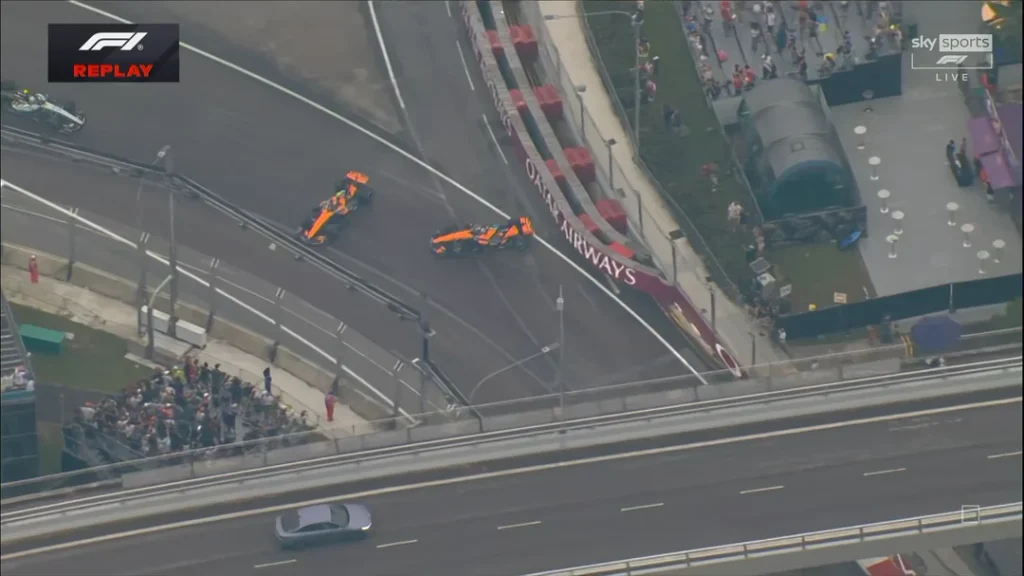
While Norris’s interviews attracted criticism, Piastri adopted a considerably more measured tone.
“From where I sit, you know, it’s just for P4 and P5 in a sprint. I’m not that bothered,” Piastri explained.
“Just obviously now it’s a lot of work for the team to get both cars fixed. Just a shame for the team.”
Rather than focus on blame or the lost position, Piastri emphasized the consequences for McLaren’s mechanics. He was subsequently seen appearing relaxed and smiling during an interaction with CEO Zak Brown. That prompted some fans to question whether the online reaction had become disproportionate to the incident itself.
Piastri’s response certainly suggests he was not interested in escalating the controversy publicly. But it would be a mistake to interpret his calm demeanor as proof that the incident had no consequences. The loss of points, damage to the car, and additional work required before qualifying were real, regardless of how frustrated Piastri appeared.
There is also no reliable way to determine a driver’s private emotions from a brief video or interview. What can be said is that Piastri chose to focus on the team’s immediate priorities rather than turn the collision into a public dispute.
With qualifying still to come, that was arguably the most productive response available.
McLaren Faces Major Repairs as Brown and Stella Decline Interviews
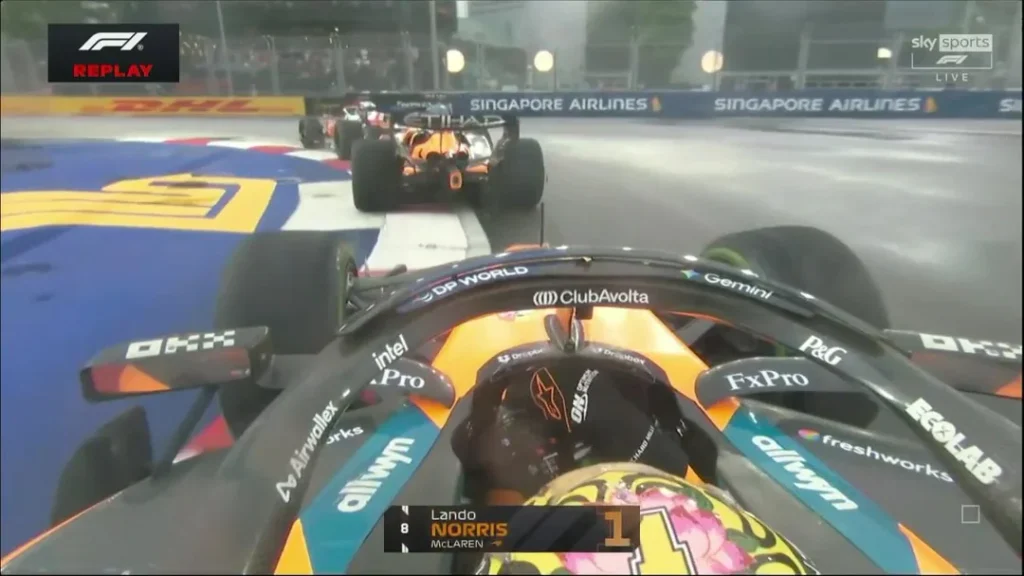
The collision left McLaren with far more than a disappointing Sprint classification.
Former F1 strategist and broadcaster Ruth Buscombe reported significant damage to Piastri’s car.
“I actually don’t like that he went for it,” Buscombe said of Norris’s attempted overtake.
“Both of those cars could be on pole this afternoon, but now the rear right of Oscar’s car is gone. They’re rebuilding the rear end.”
Her comments highlighted the potential consequences for qualifying. Rebuilding the rear of a Formula 1 car is not simply a matter of replacing damaged components. Mechanics must ensure the car is assembled correctly, while engineers need confidence that its suspension, aerodynamic configuration, and setup remain as intended.
Even when repairs are completed in time, the rushed preparation can create additional challenges. Whether those repairs ultimately compromise Piastri’s qualifying performance remains to be seen. Buscombe’s suggestion that either McLaren could have challenged for pole also generated debate.
Some fans questioned whether McLaren had the outright pace to beat Verstappen and Ferrari, while others noted that the margins between the leading cars were sufficiently small for a strong lap or changing conditions to alter the order. Regardless of their ultimate qualifying potential, both drivers had a far better opportunity before the collision than Piastri did with a damaged car. The frustration reportedly extended to McLaren’s leadership. Ted Kravitz revealed that Brown and team principal Andrea Stella had declined interview requests following the Sprint.
“Both Zak Brown and Andrea Stella have, let’s put it delicately, declined to do any interviews at the moment, clearly furious both of them,” Kravitz reported.
Neither executive’s refusal to speak establishes precisely what they were thinking, but it underlined the seriousness with which the incident was being received. McLaren has previously faced scrutiny over its management of Norris and Piastri, and another teammate collision inevitably renews questions about its rules of engagement. There is a difficult balance to strike. Allowing drivers to race freely can prevent resentment and maintain sporting fairness. But when the team’s constructors’ championship position is under pressure, avoiding unnecessary contact becomes increasingly important.
McLaren must now determine whether the Singapore collision was simply an unfortunate racing incident or evidence that its approach requires adjustment.
Norris’s Recovery Raises Another Safety Debate
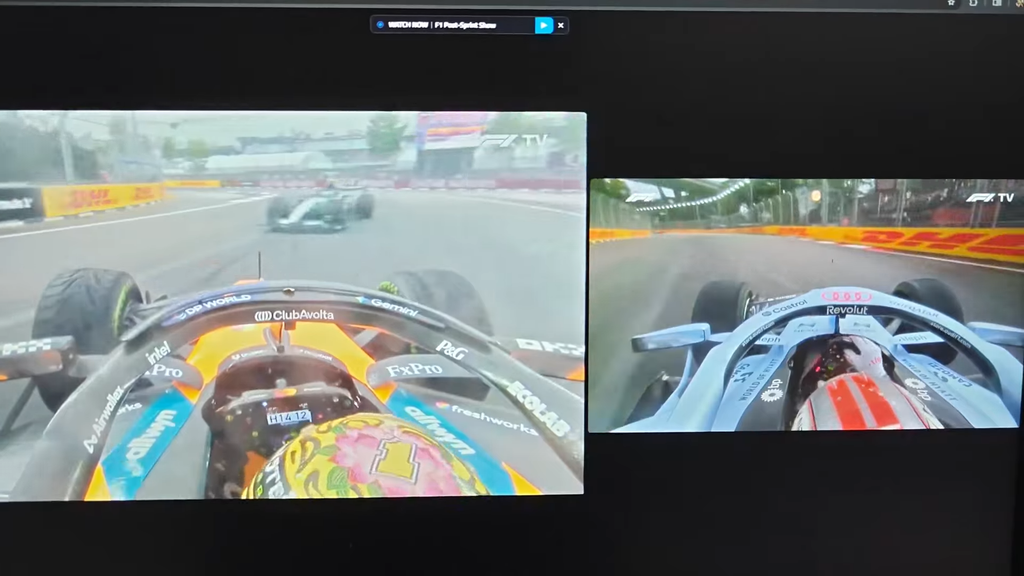
The initial contact was not the only controversial aspect of Norris’s final lap.
Onboard footage of his recovery after the collision prompted questions about his maneuvering on a live circuit. Norris was seen reversing and turning his car around as other competitors approached, including an Audi. Some viewers considered the maneuver dangerous, arguing that moving against the direction of travel and crossing the circuit while racing continued created an unnecessary risk.
Others defended Norris, suggesting he was attempting to move away from the racing line and recover his car as safely as the circumstances allowed. Comparisons were also drawn with Arvid Lindblad, who had reportedly waited for traffic to pass before completing a similar recovery maneuver. The precise circumstances of each incident matter, including the position of approaching cars, yellow flags, available escape roads, and instructions from race engineers. Without a confirmed stewards’ ruling on Norris’s recovery maneuver, it would be premature to conclude that he committed a separate offense.
Nevertheless, the footage added another dimension to an already difficult afternoon for McLaren.
Is Formula 1’s Sprint Format Worth the Risk?
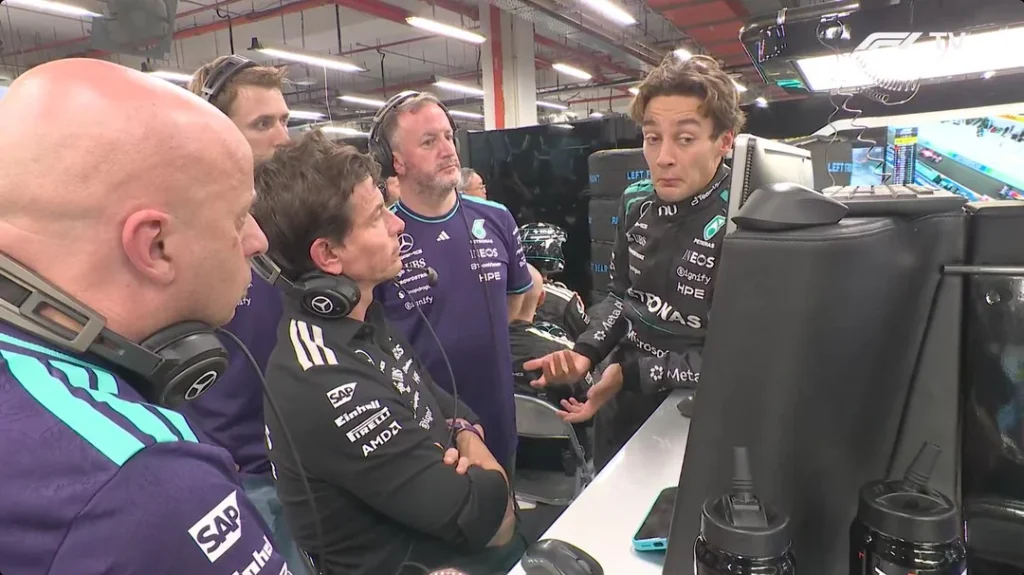
Beyond the individual incidents, Singapore revived a broader debate about the value of Sprint racing.
Verstappen has previously indicated that Sprint victories do not carry the same significance for him as Grand Prix wins. That sentiment appears to be shared by some fans who see the format as an additional competitive session rather than a particularly meaningful achievement. The issue is partly structural.
Sprint races are relatively short, generally offer limited strategic variation, and award substantially fewer points than a Grand Prix. With qualifying and the main race still ahead, drivers and teams must weigh every aggressive maneuver against the possibility of damaging a car or compromising the remainder of the weekend. Singapore provided a particularly striking example.
Norris attempted an overtake for a single point, Piastri retired, and McLaren was left rebuilding a damaged car ahead of qualifying. At the same time, demanding that drivers avoid racing because the Sprint is less important risks undermining the entire purpose of the format. If drivers are expected to preserve their cars rather than compete, the event becomes little more than an additional demonstration of the competitive order.
Fans have also questioned whether Sprint races are particularly well suited to street circuits where overtaking is already difficult. With the format reportedly expanding to 10 events in 2027, including Monaco, those concerns are unlikely to disappear. Comparisons with MotoGP have highlighted the differences between the two championships, particularly the greater opportunities for overtaking and different points structure in motorcycle racing. Formula 1’s challenge is to create Sprint races that are meaningful enough to encourage competition without making the potential consequences of racing disproportionately expensive.
Singapore demonstrated just how difficult that balance can be.
A Sprint That Could Have Lasting Championship Consequences
Verstappen leaves the Singapore Sprint with another victory, Ferrari has two podium finishes, and Antonelli has strengthened his position relative to Russell.
For McLaren, however, the result represents another missed opportunity at a time when its constructors’ championship position is becoming increasingly vulnerable. Norris gained a single point while Piastri retired, but the consequences extend beyond their individual classifications. The team lost valuable points, suffered expensive damage, and now faces renewed scrutiny over how its drivers race one another.
It is possible to accept that Norris had a legitimate opportunity to attempt an overtake while still questioning whether he should have taken it. That distinction is particularly important in a team sport where the potential reward for one driver can be outweighed by the collective cost. Piastri’s calm reaction may help McLaren move beyond the immediate controversy, but it does not eliminate the underlying competitive problem.
Nor should the criticism obscure the fact that Formula 1 drivers are expected to race, take calculated risks, and occasionally make mistakes. The question is whether this particular risk was calculated well. With Red Bull closing in and Sunday’s Grand Prix still ahead, McLaren has little time to dwell on the answer.
For Verstappen, the Singapore Sprint was another victory. For Russell, it was a painful reminder of how unpredictable the 2026 cars can be in difficult conditions.
And for McLaren, it was a costly demonstration that the right to race and the wisdom of racing are not always the same thing.