

Formula 1 could finally be heading back to Africa, Fernando Alonso still believes a third World Championship is possible, George Russell’s miserable run has produced another setback before Singapore, and Valtteri Bottas has apparently decided that simply traveling between races like a normal person isn’t interesting enough.
Meanwhile, the approach to Singapore has inevitably reopened some of the circuit’s most infamous history — including one Fernando Alonso victory that requires a rather enormous asterisk.
Here is everything making news around Formula 1.
Rwanda Reportedly Set to Join the F1 Calendar in 2030
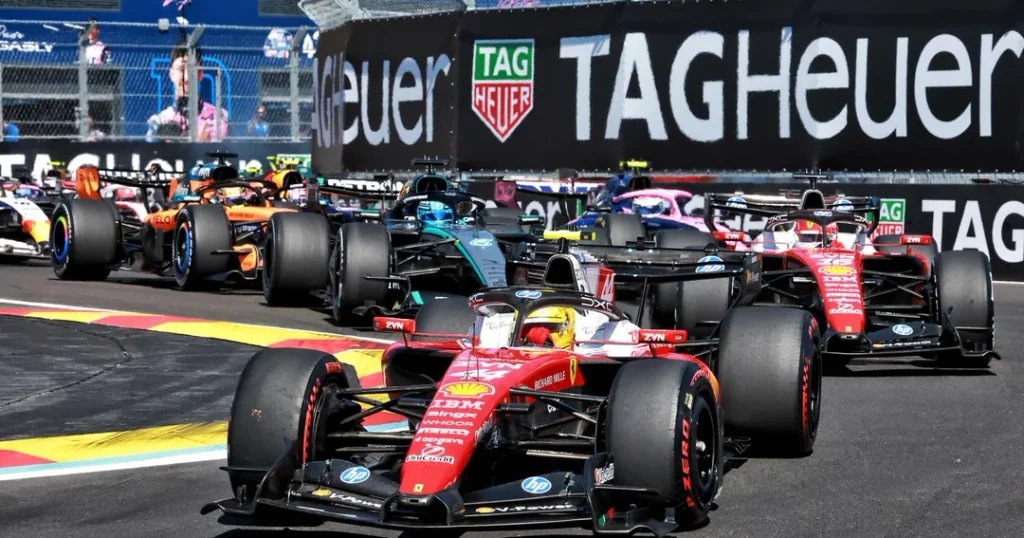
Formula 1’s long-discussed return to Africa may finally have a destination.
According to RacingNews365, well-placed paddock sources indicate Rwanda is set to be granted a Grand Prix beginning in 2030. An agreement is reportedly already in place, with an official announcement potentially coming later this year or even within the coming weeks. The report also says Rwanda has decided to construct a permanent circuit based on previously leaked plans. That immediately creates another question: what happens to the existing calendar?
Assuming Formula 1 maintains its recent position that 24 races is the desired number, something presumably has to give. Among the current circuits without contracts extending into 2030 are Portimão, Mexico City, Singapore and Suzuka. Of those, losing Suzuka would probably generate the strongest reaction. There is an argument that recent Japanese Grands Prix haven’t always produced spectacular racing, but Suzuka’s status within Formula 1 goes beyond the number of overtakes produced on a particular Sunday. The same argument has surrounded Spa. Both are iconic circuits whose characteristics have sometimes been compromised by the cars and regulations rather than the layouts suddenly becoming poor.
Monaco is perhaps the ultimate example of Formula 1 already accepting that historical and cultural importance can justify keeping a circuit even when overtaking is difficult. Mexico City presents a different calculation. The circuit itself may be more expendable to some fans, but the market surrounding it is substantial, while its altitude gives the weekend characteristics unlike almost anything else on the calendar. And Rwanda isn’t necessarily the only candidate.
Argentina and South Africa have also been discussed, with the Oscar y Juan Gálvez circuit and Kyalami among the potential options. There is also another circuit project being planned near Cape Town. After Sepang’s return for the Bahrain Grand Prix in Malaysia, there will inevitably be people hoping Malaysia somehow remains involved too. But this year’s event was a unique situation funded by Bahrain, and expecting F1 itself to pay to retain a circuit because fans enjoy it runs against the commercial model that has increasingly shaped the calendar.
Which brings us to the uncomfortable part of the Rwanda discussion.
Who Exactly Is Modern F1 Being Built For?
The Rwanda report arrived alongside a broader fan discussion asking a deceptively simple question: if dedicated fans complain about some of the circuits and regulations, and drivers aren’t always enthusiastic either, who exactly is Formula 1 catering to?
The simplest answer is money. But the more interesting answer is that the online hardcore fanbase can easily overestimate how representative it is of Formula 1’s overall audience. The people debating energy deployment, superclipping, circuit design and technical regulations every week are among the most engaged consumers of Formula 1. That doesn’t necessarily make their preferences representative of the millions of people watching around the world.
The recent Sepang weekend illustrated that distinction rather nicely. Fans at the circuit were loudly cheering overtakes even when cars were simply clearing backmarkers under blue flags. That doesn’t mean those spectators didn’t understand racing. If you’ve paid to attend a Grand Prix and a car makes a move directly in front of your grandstand, why wouldn’t you cheer? Reports from spectators described an extraordinarily energetic crowd, particularly after the rain arrived on Sunday. Fans were singing, doing waves and reacting to virtually everything happening on track.
For many viewers, that’s Formula 1. They don’t need to understand every detail of electrical deployment to enjoy seeing cars race one another. And despite the constant criticism visible online, grandstands continue filling and advertisers continue spending money to reach the audience. Formula 1 has little commercial incentive to completely reshape a product that remains enormously popular.
There are also fans who genuinely like aspects of the current regulations. The aerodynamic package in particular has supporters who prefer it to the DRS trains seen under previous rules. Others don’t necessarily oppose the 50/50 power split but question decisions such as removing the MGU-H, not implementing front-wheel regeneration or leaving so much energy deployment to algorithms rather than drivers. The fanbase isn’t actually unanimous. That doesn’t mean every commercial decision is automatically good for the sport. It means Liberty’s incentives are considerably more complicated than simply giving the most engaged fans whatever they request.
Rwanda could become another example.
Rwanda Comes With Much Bigger Questions Than the Track Layout
The idea of finally returning Formula 1 to Africa is understandably exciting.
But the proposed Rwandan race has already generated concern over human rights, regional conflict and whether such a project makes economic or logistical sense. Fans have pointed toward Rwanda’s involvement in the conflict in the Democratic Republic of Congo and allegations surrounding the country’s government. Others immediately noted the obvious inconsistency in suddenly demanding a moral purity test from Rwanda when Formula 1 already races in countries regularly criticized over human rights and geopolitical issues. That doesn’t make concerns about Rwanda irrelevant. It instead exposes a much broader argument about Formula 1’s willingness to separate its commercial relationships from the politics and conduct of host nations.
If Rwanda joins, it won’t create that debate. It will simply become the newest example of it. There are practical concerns too.
One account from someone who spends several weeks each year in Rwanda highlighted the enormous logistical challenge involved. Kigali’s existing airport capacity is limited, Rwanda is landlocked, and moving the equipment and people required for an F1 weekend would be an immense undertaking. Affordability is another issue. Building a permanent circuit requires an enormous initial investment before considering the recurring cost of hosting Formula 1. If much of the local population cannot realistically afford Grand Prix tickets, the long-term sustainability of the project becomes a legitimate question.
The nightmare scenario would be spending heavily on a permanent facility only for Formula 1 to move elsewhere several years later. Vietnam remains the obvious warning of what can happen when enormous infrastructure investment doesn’t ultimately produce a lasting Grand Prix.
Rwanda has until 2030 to answer those questions if the reported agreement becomes official.
George Russell Is Starting at the Back in Singapore

While Formula 1 looks toward 2030, George Russell probably doesn’t want to look much further than the next few days.
Sky Sports reports that Russell is set to start the Singapore Grand Prix from the back because of an engine penalty. Of all the places to take one, Singapore isn’t ideal. The revised configuration may have improved matters, but overtaking remains difficult. Cars are unlikely to become particularly energy-starved around such a tight circuit, meaning Russell could require a significant pace advantage to pass competitive midfield cars.
Backmarkers are one thing. Breaking through a train of upper-midfield cars could be another entirely. Singapore 2023 provides a useful reminder of how difficult passing can become when cars are deliberately kept together. Carlos Sainz famously controlled the pace and kept Lando Norris within DRS range, making it extremely difficult for the faster Mercedes cars on fresher tires to get through.
Russell’s best friend this weekend might therefore be chaos. Rain, changing tires and well-timed Safety Cars could completely scramble the order and give a driver starting at the back opportunities that simply wouldn’t exist in a conventional dry race. Unfortunately, after what happened at Sepang, expecting Formula 1 to happily race through truly severe wet conditions may be optimistic.
The entire situation also makes Mercedes’ earlier decision look particularly painful in hindsight.
Should Mercedes Have Taken Russell’s Penalty at Sepang?
Mercedes had an opportunity to take the hit in Malaysia.
In retrospect, that looks extremely attractive. With the bizarre opening to the Bahrain Grand Prix in Malaysia and Russell’s pace on intermediates, starting from the back at Sepang might have been far less damaging than doing so in Singapore. But hindsight makes these decisions considerably easier.
Mercedes had reasons for delaying the penalty, including its upcoming upgrade and an effort to avoid taking penalties across two separate races. The updated ADUO turbo itself could trigger another penalty because of damaged components earlier in the season. There is now an indication that Mercedes HPP could fast-track the updated power unit for Singapore, potentially allowing Russell to take the pain once rather than facing another penalty later. That would at least prevent an even stranger possibility: Russell accumulating more grid penalties than victories across consecutive races in his career.
His championship situation makes the timing hurt even more. Russell’s second place isn’t necessarily secure if Ferrari improves over the final stretch, although there is a fair argument about how much second in the Drivers’ Championship ultimately matters when the objective entering the season was to win it. For a driver who has never finished higher than fourth in the championship, P2 would still represent a career-best result.
Emotionally, however, that may offer limited consolation when his young teammate has controlled so much of the season. Russell entered the year with a legitimate opportunity. Instead, a combination of misfortune and being beaten by his teammate has gradually taken that possibility away. Now he gets Singapore from the back.
At this point, bold strategy may be all Mercedes has left.
Alonso Still Believes Championship No. 3 Is Possible
Fernando Alonso, meanwhile, apparently sees no reason to lower his expectations.
Asked whether he still considers himself capable of winning a third World Championship, Alonso told El Larguero:
“If I didn’t, I wouldn’t have renewed. In the end, I have no need to continue for another year just for the love of racing or to travel around the world. I’ve achieved more than I could ever have dreamed of.”
His reason for remaining is straightforward.
“But I continue racing because I believe that, if I have a fast and competitive car, it’s going to be very difficult to beat me.”
Alonso acknowledged that Aston Martin has started the new regulatory era badly, but he isn’t interested in abandoning the project at the first sign of difficulty.
“We’ve come here to fight, to become more competitive, and that’s part of the DNA we have.”
Every Formula 1 driver needs extraordinary self-belief. Nobody is going to publicly say that even with the best car they expect someone else to beat them. But Alonso’s claim carries a little more intrigue because we’re still waiting for convincing evidence that age has removed his ability to produce elite performances. His Malaysia weekend provided another reminder.
Stroll initially benefited from being on intermediates while Alonso was among those on slicks and fell significantly behind, yet Alonso ultimately finished eighth to Stroll’s 12th and scored seven points. The question isn’t whether 45-year-old Alonso is identical to 25-year-old Alonso. He obviously has decades more experience now. The relevant question is whether whatever he may have lost physically has yet outweighed everything he has accumulated in racecraft and understanding.
And that leads to the fantasy scenario. Alonso, Lewis Hamilton and Max Verstappen in genuinely championship-capable cars at the same time would be extraordinary. Add Kimi Antonelli and Lando Norris in competitive machinery and suddenly the dream becomes a five-driver, five-team fight.
Whether the cars will cooperate is another matter entirely.
Lance Stroll Decided He Wasn’t Lifting
At least Aston Martin gave Lance Stroll something to enjoy in Malaysia.
At one point, Stroll’s engineer advised him to lift through Turn 12. Stroll’s response? He was going flat out instead. It was one of those occasional Stroll moments where a driver who receives endless criticism suddenly reminds everyone why he reached Formula 1 in the first place.
Wet and mixed conditions have produced several of those flashes over the years. The running joke is that Stroll receives one government-mandated “Senna mode” appearance per season before returning to normal programming.
There may actually be something about lower-grip conditions that suits him, although attempts to quantify it from his results against Alonso become messy very quickly because of retirements, strategy and tiny sample sizes. Perhaps rallying was the career waiting for him all along. More seriously, Malaysia also demonstrated what happens when a driver who has spent much of the season fighting an uncompetitive car suddenly gets something he can attack with.
Stroll wasn’t interested in optimizing a computer model through Turn 12. He wanted to race.
For one corner at least, that was enough.
Aston Martin’s Improvement Is Becoming Interesting
There were broader positive signs for Aston Martin at Sepang too.
Stroll spent significant time ahead of Alonso, although their different opening strategies explain much of that position, with Stroll taking intermediates while Alonso remained on slicks. The car itself nevertheless looked far more competitive than it has for much of the season. That matters as much for morale as results.
Aston Martin needs tangible signs that the project is moving somewhere, particularly with Adrian Newey involved and Alonso still explicitly saying he believes the team can eventually give him the car required to fight for a championship. There was also discussion over whether Honda has now moved ahead of Audi in current power-unit performance. One explanation offered for Sepang was that restricted electrical deployment reduced Honda’s deficit substantially, with Alonso reportedly losing only around 0.05 seconds per lap to Norris in ERS-restricted areas. Singapore’s further limitations could therefore potentially suit Aston Martin again.
Audi, meanwhile, has taken a different developmental approach, with its attention increasingly directed toward the future rather than extracting everything possible from the current engine. That creates two very different projects. Aston Martin and Honda need visible improvement now.
Audi is asking for patience.
Alonso Owns Singapore’s Strangest Record
Alonso also enters Singapore with a record nobody else has matched.
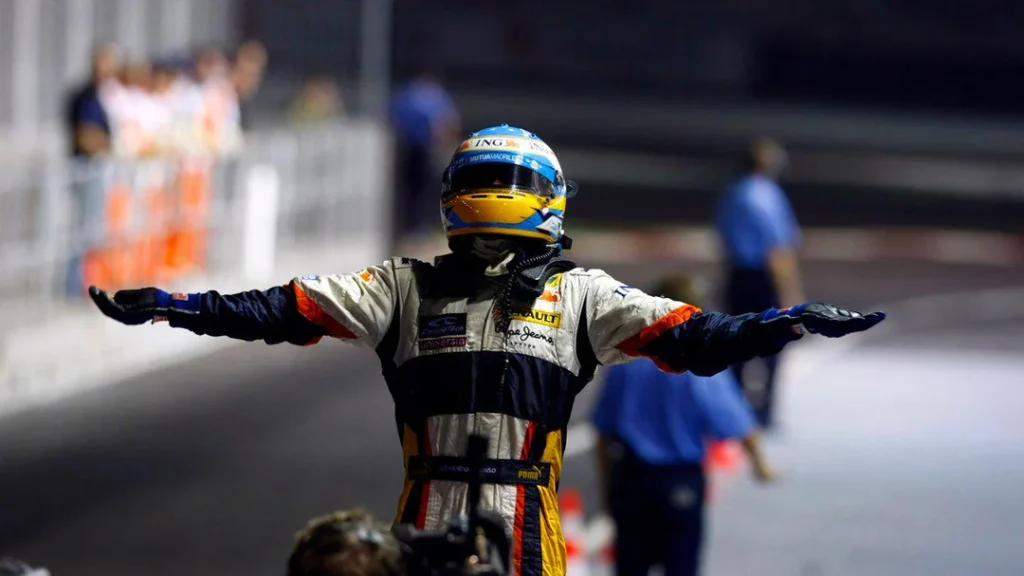
He is the only driver to win the Singapore Grand Prix after starting outside the top five. He did it from 15th in 2008. There is, of course, the small matter of how.
Nelson Piquet Jr.’s crash created the circumstances that transformed Alonso’s race, in what became one of Formula 1’s most infamous scandals. So yes, technically Alonso won from 15th. It is also probably the single Singapore statistic most desperately in need of an asterisk.
The irony becomes even richer given where some of the people involved ultimately ended up. A scandal serious enough to produce enormous consequences did not permanently remove everyone responsible from the Formula 1 world. Felipe Massa’s disastrous pit stop, where he drove away with the refueling hose attached, also played a major role in what happened that night.
“Perfect teamwork and strategy” is therefore one way of describing Alonso’s 2008 victory.
Just perhaps not the one Formula 1 would choose.
Singapore Also Gave Us One of Ferrari’s Most Painful Starts
If 2008 is Singapore’s most notorious race, 2017 produced one of its most unforgettable starts.
Sebastian Vettel, Kimi Räikkönen and Max Verstappen collided almost immediately, eliminating both Ferraris and Verstappen while Lewis Hamilton went from fifth to the lead by the end of the opening lap. Hamilton went on to win. The onboard footage from Vettel remains almost darkly comedic: the Ferrari rolling backward as the field drives past, Vettel carefully steering it away from traffic before spinning around and revealing the enormous damage.
The incident remains debated, but the geometry was brutal. Räikkönen produced a superb launch on Verstappen’s inside while Vettel moved aggressively across from the other side. Verstappen had nowhere to disappear. Vettel may have expected him to move left, except Räikkönen had already occupied that space. Vettel didn’t need to fight Verstappen as aggressively as he did either. His championship concern was Hamilton, who had started behind.
Instead, all three were gone. Ferrari then produced an immortal social-media response:
“VER took #Kimi7 and #Seb5 out at the start.”
Followed by:
“What we tweeted was a factual description of events. No need to speculate on this.”
Nine years later, that post apparently remains online. Respect the commitment. Singapore didn’t mathematically end Vettel’s championship challenge, but it was the beginning of a devastating stretch. Malaysia then brought his qualifying engine problem and Japan finally killed the remaining title hopes. Sometimes championships disappear gradually.
Sometimes both of your cars crash before Turn 1.
Valtteri Bottas Is Still Cycling to Singapore
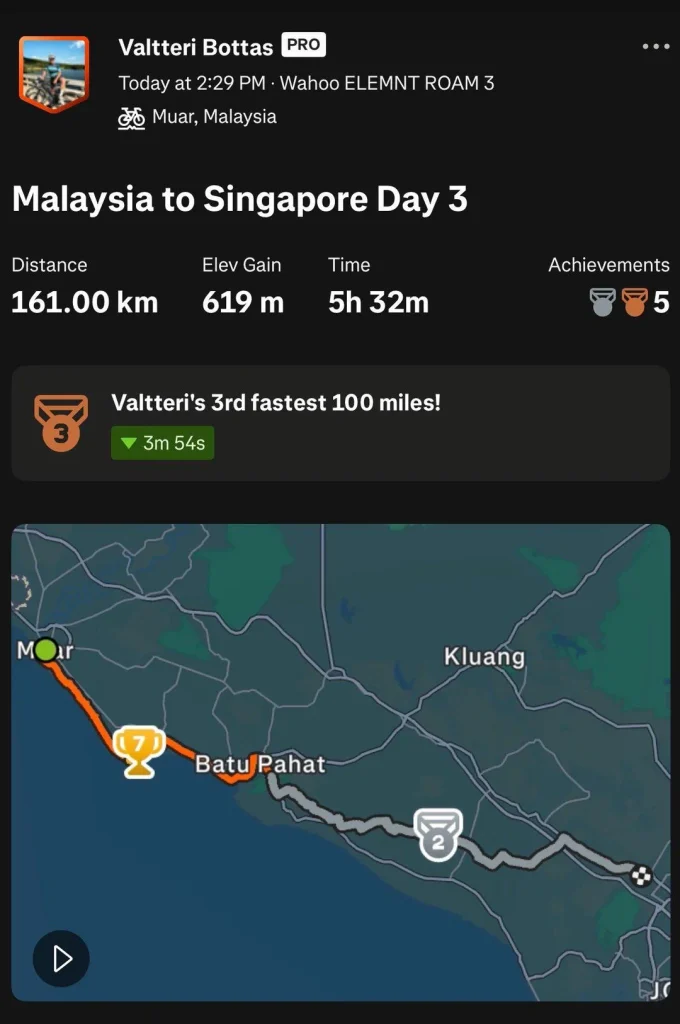
While everyone else prepares for Singapore through more conventional methods, Valtteri Bottas has continued cycling from Malaysia.
Day 3 took him through oil palm plantations, including riding after dark. And if that sounds slightly insane, local accounts suggest that’s because it is. The challenges aren’t merely heat and humidity. Plantation terrain can include poor illumination, rough surfaces, depressions, loose palm fruit, branches, thorns and irrigation channels, while wildlife can include wild boar and venomous snakes.
Importantly, Bottas isn’t simply wandering through Malaysia alone hoping Google Maps works. The ride is planned, he has support, and his management, Cadillac and bike sponsor Canyon are involved. Bottas is also far from an amateur cyclist; he surrendered his place at the gravel world championship next weekend. His pace makes that rather obvious.
He was reportedly averaging approximately 28.5 km/h across two days, including consecutive 100-mile days, despite the tropical climate. For perspective, some recreational cyclists would require more than twice as long to cover similar distances on pavement in moderate conditions. So if anyone was worried about Bottas acclimatizing to Singapore’s humidity, we can probably cross that concern off the list.
The more interesting question is whether cycling for hours between consecutive Grands Prix represents optimal race preparation. Probably not in the most clinically optimized sense. But Bottas is an elite cyclist for whom these distances aren’t remotely as extraordinary as they would be for most people. There is also something to be said for arriving at a race happy rather than spending the entire week inside a hotel following a theoretically perfect preparation schedule.
And Cadillac certainly isn’t suffering from the publicity. The team’s driver cycling hundreds of miles between consecutive Grands Prix has generated considerably more attention than Cadillac’s on-track performance recently.
Sometimes the marketing campaign simply writes itself.
Max Verstappen Is Apparently F1’s Second-Most Efficient Swearer

Finally, somebody has performed the analysis nobody knew Formula 1 needed.
An examination of team-radio communications from 2018 through 2026, using the Formula Dream F1 Team Radio Archive and excluding 2022 because data wasn’t available, counted profanity across the grid. Max Verstappen produced the largest raw total among the listed drivers with 222 swear words across 3,361 radio messages. But measured per 1,000 words, Pierre Gasly beat him.
Gasly: 3.66. Verstappen: 3.17. Charles Leclerc came next among the main sample at 2.35, followed by Sergio Pérez at 1.98 and Daniel Ricciardo at 1.89.
Lewis Hamilton was way down at 0.72. Naturally, Hamilton somehow finished with exactly 44 recorded swear words. Because of course he did.
The analysis used 40 terms across eight languages and attempted to identify masked and bleeped profanity while separating words into strong, mild and insult categories. Drivers with fewer than 1,000 transcribed messages weren’t included in the main comparison, which initially created the obvious question: where is Yuki Tsunoda? In the wider dataset, Tsunoda reportedly scores 3.74 per 1,000 words.
But even that isn’t enough. Oliver Bearman reportedly sits at 6.75. Isack Hadjar: 6.57.
Suddenly Gasly and Verstappen look restrained. And perhaps the funniest part is that we’re doing this analysis during a triple-header rather than saving it for the winter break.
Apparently the offseason content has arrived early.