

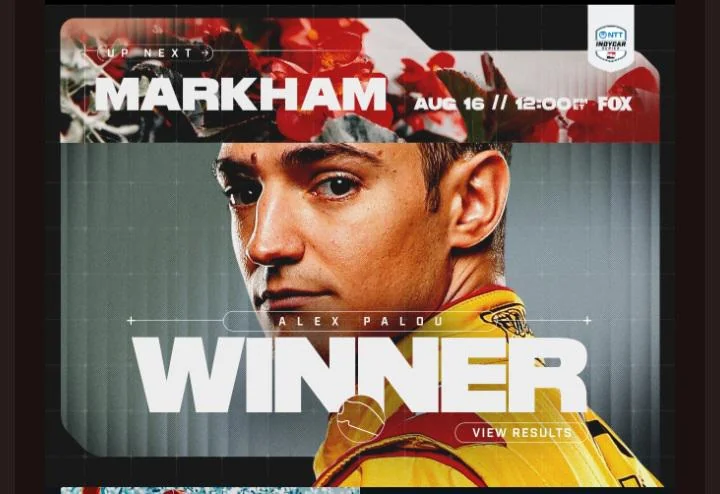
IndyCar has not even put a car on track in Markham yet, and somehow the weekend already has nearly everything.
There is an unfinished street circuit. Graham Rahal is openly questioning whether cars will be able to run. Rinus VeeKay managed to dislocate a rib in a simulator. The fanbase is debating the future of Chip Ganassi Racing’s No. 9. And, naturally, Álex Palou has apparently already won the race. Welcome to another perfectly normal IndyCar weekend.
The biggest immediate question, however, is considerably less funny: will the Markham circuit actually be ready when cars are supposed to take to the track?
Markham Is Racing Against the Clock
The first warning came when the scheduled Thursday track walk was scrapped as construction continued around the new street circuit.
According to Bob, the streets themselves had already been paved, so the racing surface was unlikely to be the problem. The bigger issue was everything that needed to turn those streets into an actual racetrack. Barriers. Fencing. Timing equipment. And quite a lot of it. The 12-turn, 2.19-mile circuit was still undergoing construction Thursday, with the track walk pushed from 2 p.m. Thursday to 8 a.m. Friday. USF Pro 2000 was scheduled to take the track at 9 a.m., while IndyCar’s first session remained scheduled for 3:05 p.m.
That left a remarkably small window. One estimate circulating Thursday suggested there were still 390 blocks needing installation, with the entire crew potentially working overnight and still struggling to put even 100 of them into place. For a street race, there is always an element of controlled chaos. Public roads have to remain public roads until they don’t, and organizers inevitably have to squeeze enormous amounts of construction into tiny windows.
But Markham appeared to be pushing that concept to its limit. The immediate fan solution was simple: race it as it is. If necessary, apparently we can return to the 1970s philosophy of motorsport safety, scatter some hay bales around the circuit, throw up some chain-link fencing and hope everyone remembers how things used to work.
That suggestion came with an important counterpoint from someone who had actually raced two-stroke karts around hay bales: hitting them at speed really hurts. Their experience included a street event where competitors crested a roughly 10-foot hill, braked downhill into a hard 90-degree corner and relied on a single layer of hay bales to prevent them from reaching a barbed-wire fence. So perhaps we stick with the modern barriers.
At least the streets are paved.
Graham Rahal Isn’t Convinced
Graham Rahal added considerably more weight to the concern.
Rahal called the circuit layout “awesome,” but his assessment of its readiness was much less encouraging.
“I’m just not sure how we see cars on track tomorrow.”
For the record, the expectation remained that IndyCar practice would ultimately happen. The support series appeared to be in a much more precarious position, particularly with USF Pro 2000 scheduled to run only an hour after the rescheduled track walk. There was some comparison to NASCAR’s inaugural Chicago street race, where construction also went extremely late before the event ultimately went ahead. But even by that standard, Markham appeared unusually far behind. And that is especially surprising because this isn’t an organizer learning how to build its first street circuit.
Green Savoree has experience putting together street races, leading to questions about whether the problem was planning or simply how much access organizers were given to the roads and surrounding infrastructure. One plausible explanation circulating among fans was that another organization, potentially transit or another local entity, simply could not give organizers access as early as they wanted. In other words, the organizers might have known exactly how much time they needed without actually being given that amount of time. With a new and longer circuit, there is also simply more infrastructure to install.
That hasn’t stopped the criticism. Some fans have pointed to the situation as evidence of poor planning and permitting, while others have used it to reopen much broader arguments about Green Savoree and its role in IndyCar. That debate quickly expanded to complaints about Mid-Ohio, Portland and St. Petersburg, followed almost immediately by the counterargument that firing an experienced promoter responsible for multiple established events isn’t exactly a magical solution to IndyCar’s scheduling problems. And Portland isn’t owned by Green Savoree anyway.
There is probably a more useful middle ground here. The situation in Markham clearly isn’t ideal, but a first-time street event was always going to come with complications. The real evaluation should come once we know whether this was an uncomfortable but ultimately successful overnight scramble or something that actually disrupts the weekend. The most important thing is that schedule pressure doesn’t become safety pressure. If the barriers and fencing aren’t ready, the cars shouldn’t be on track.
Even if the Canadian tire barriers are square and therefore theoretically easier to stack.
The Graham Rahal Reliability Index
There was another amusing layer to the concern: IndyCar fans apparently require independent verification whenever Graham Rahal complains about something.
Rahal has developed enough of a reputation for voicing his displeasure that some fans initially treated his warning less like breaking news and more like a weather forecast from someone who predicts thunderstorms every day. Then other reports started backing him up.
That changed the conversation from “Graham is complaining again” to “Okay, Graham may actually have a point this time.”
One fan summarized the standard rather perfectly: if Rahal has an opinion, they want it backed by literally anyone other than Graham Rahal. Fair enough. A broken clock and all that.
There were even jokes about waiting for Rahal to declare Markham a terrible place altogether, which triggered an entirely unrelated argument over Markham, Indianapolis and which cities do or do not qualify as terrible places.
It wouldn’t be an IndyCar discussion if we remained on topic for too long.
IndyCar Fans Have Found Something New to Worry About
The Markham situation has also triggered concern about the upcoming Washington, D.C. race.
If constructing Markham under a tight road-closure schedule is proving this difficult, another ambitious street event immediately raises questions about whether similar logistical problems could emerge there. There isn’t information here establishing that Washington will encounter the same problems, so it is far too early to declare that it will. But worrying prematurely may actually be the defining IndyCar fan experience.
Worry about whether the track will be finished. If the race happens smoothly, worry about the television ratings. If the ratings are good, worry about Álex Palou winning too much.
If Palou wins again, wonder whether maybe next time will finally be different. If you’re not participating in some degree of doom and gloom, are you even watching IndyCar? The series has certainly given longtime fans enough historical trauma to develop the habit. Discussions about Markham somehow spiraled all the way into CART, the IRL split, Tony George and the dangerous eras of American open-wheel racing.
That’s a rather dramatic journey from “they still need to install some barriers,” but it illustrates something real about the fanbase: IndyCar supporters have spent decades waiting for the next thing to go wrong.
As one fan essentially put it, worrying about IndyCar is about 90 percent of being an IndyCar fan.
And apparently it has been a little while since the series had a truly embarrassing moment, so some are joking that perhaps we’re due.
Unfortunately, Álex Palou Has Already Won
While everyone else was debating whether the circuit would exist by Friday afternoon, the outcome of the race itself had apparently already leaked.
Breaking news from Markham: Álex Palou wins. Congratulations to everyone involved.
There is something wonderfully IndyCar about looking at an unfinished circuit before the first practice session and collectively deciding that none of this matters because Palou is going to win anyway. The hypothetical race script has practically written itself. Palou qualifies somewhere between second and fifth. During the first pit sequence, the leader stops while Palou stays out for another lap or two. A backmarker spins at precisely the right moment, the caution appears just after Palou reaches pit road, and suddenly he cycles into the lead.
The two drivers with enough pace to challenge him then start racing each other, both suffer problematic pit stops, and Palou disappears. Perhaps he even has enough time for an extra stop and a bag of ketchup chips before winning comfortably. If chaos truly takes over, however, there is another possibility. Scott Dixon wins.
Some things in IndyCar are eternal.
Rinus VeeKay Somehow Injured Himself in a Simulator
As if the unfinished racetrack wasn’t enough, Rinus VeeKay provided perhaps the strangest injury story of the week.
According to Bob, VeeKay dislocated a rib while performing simulator work for Markham. Yes. In the simulator.
There have apparently been simulator injuries before — Mika Häkkinen breaking his wrist was brought up as another example — but VeeKay’s injury still generated the obvious question: How? One theory was that the simulator could use some type of system designed to reproduce forces on the driver’s torso. Another possibility is simply that rib dislocations can happen much more easily than most people realize.
Fans shared stories of dislocating ribs through coughing, being hit by waves at the beach and even riding a roller coaster. Compression and stretching were also cited as possible causes.
None of that makes “IndyCar driver dislocates rib while driving a computer” sound less ridiculous.
The best explanation might be that Markham includes a stadium-truck-style jump and VeeKay’s simulator was simply too committed to realism. Or perhaps every simulated crash is followed by a simulated tire changer walking over and kicking the driver in the ribs. Either way, the simulator apparently isn’t the harmless gaming setup people might imagine. Fans who have tried far less sophisticated racing simulators noted that even those can provide a legitimate physical workout, while the full-scale equipment used by professional drivers can be considerably more intimidating.
Fortunately, the situation sounds much less alarming than the headline. VeeKay reportedly visited GM’s physical therapist upstairs and was able to return and finish the simulator session that same afternoon.
Considering how many IndyCar drivers seem to have collected injuries at this point, getting hurt without even reaching the actual racecar is an impressive new addition to the list.
VeeKay’s Future Is Also Becoming a Major Story
VeeKay’s rib isn’t the only thing generating discussion around him.
The battle over Chip Ganassi Racing’s No. 9 for next season appears to be increasingly focused on two names: VeeKay and Christian Lundgaard. The consensus among fans is leaning heavily toward Lundgaard. Part of the argument has centered on a matching clause connected to VeeKay and JHR, with the idea being that Ganassi would potentially have to make an offer large enough that Hollinger wouldn’t simply match it.
The amusing theoretical strategy would be for Chip Ganassi to offer VeeKay a huge contract, force Hollinger to match it and then sign Lundgaard for considerably less. Chip likes winners. But Chip also likes money.
However, there is also pushback against the idea that the matching clause is what will ultimately keep VeeKay at JHR. The Dutch IndyCar insider and VeeKay’s father have reportedly suggested or implied that the clause isn’t the reason he will probably remain there. Meanwhile, Marshall Pruett reportedly said in a recent mailbag that the decision to go with Lundgaard has essentially been made. That fits the overwhelming expectation around the fanbase: many would like to see VeeKay in the No. 9, but they expect Lundgaard to get it.
And it’s difficult to argue that either driver hasn’t earned the opportunity. VeeKay has consistently impressed relative to the equipment available to him, while Lundgaard has gone directly into Pato O’Ward’s territory and demonstrated what he can do. The distinction may ultimately come down to what Ganassi values most.
VeeKay’s case includes his oval ability and his performance in lower-to-midfield machinery. Lundgaard’s road and street-course form, meanwhile, creates the tantalizing possibility that he could put more pressure on Palou. Considering everyone has apparently already accepted that Palou wins every IndyCar race before it starts, perhaps putting someone next to him who might actually make his life difficult isn’t a bad idea. The driver who misses the No. 9 could still become one of the most interesting pieces of the future driver market. Fans are already imagining VeeKay eventually landing in a Penske, including speculation around the No. 3 or No. 12 depending on how Penske’s lineup develops. Those possibilities remain speculation.
For now, Lundgaard appears to be the favorite for Ganassi.
Can We Build the Racetrack First?
There is something almost perfect about the state of IndyCar heading into Markham.
The paddock is discussing next year’s driver market while construction crews are still trying to finish this week’s racetrack. VeeKay is simultaneously being linked to one of the biggest seats on the grid and recovering from an injury sustained without actually driving on the grid. Fans are already worrying about Washington before Markham has held its first session.
And Palou has apparently won a race that doesn’t yet have a finished circuit. Perhaps everything will be ready Friday morning. Perhaps the support schedule gets moved around while IndyCar runs as planned later in the afternoon. Perhaps the entire concern will look dramatically overblown once cars finally leave pit lane. First-time street races can be messy. But until those cars actually appear, there is going to be one question hanging over Markham:
Can IndyCar finish building the racetrack before Álex Palou finishes winning on it?