

IndyCar may constantly be looking toward its next generation, but some of the biggest conversations around the series this week have been rooted in a much older question: how much should racing change?
That debate was especially loud following Portland, where Will Power and Felix Rosenqvist both voiced frustration with the way lapped cars can influence the fight at the front. At the same time, fans were looking backward at everything from Bobby Unser’s unmistakable broadcasting style to Mario Andretti’s remarkable 2003 Indianapolis test crash. Taken together, the conversations capture something IndyCar does particularly well: its history never feels very far away from its present.
And nowhere is that more obvious than in the argument over traffic.
Power and Rosenqvist Want IndyCar to Rethink Lapped Cars
Power was particularly frustrated after Portland, saying he lost significant time while trying to work past Sting Ray Robb.
“I absolutely got held up massively,” Power said. “I was racing a back marker into Turn 10. I was beside him and he actually raced me into Turn 10, which was surprising. Yeah, that hurt.”
Rosenqvist raised the same issue, although he was careful not to suggest that traffic alone cost him the victory.
“Sometimes you’re getting three seconds because of a lap car, the next time you lose three seconds,” Rosenqvist explained. “Without sounding salty, I don’t think I would have won the race anyway, but I think it’s kind of time for us as a series to grow up and not have the lapped car situation.
“I think it makes us all look stupid. When you work hard and all of a sudden you lose five seconds behind a lapped car, I don’t think it’s right. I don’t think anyone wants to see that. Again, I don’t think I would have won anyway. I think all drivers probably agree with me.”
Power went even further, arguing that IndyCar is hanging onto a philosophy that belongs to another era.
“I’ve said it forever. It’s kind of ridiculous we have a 1970’s rule going on, but we’ve always done that,” Power said. “It’s a little bit different now. Drives me crazy all these cars. If IndyCar won’t do anything, I think all the drivers get together and have a gentlemen’s agreement.”
It sounds straightforward when two frontrunners describe losing several seconds behind cars they are trying to lap.
The fan reaction, however, suggests the issue is anything but straightforward.
Is Traffic a Problem — Or Part of Racing?
One side of the argument agrees completely with Power and Rosenqvist.
If a driver several positions down the order is not realistically racing the leader for position, why should that driver be able to dramatically affect the battle for a victory? There is also frustration because the same names seem to repeatedly end up at the center of these discussions. Robb received much of the criticism after Portland, while Louis Foster, Graham Rahal and Nolan Siegel were also mentioned as drivers who have previously complicated things for leaders. But even that characterization immediately becomes messy.
Rahal, for example, was praised for getting out of the way at Portland, while others pointed out that he has spent more time closer to the front this season than the typical definition of a backmarker might suggest. There was even speculation that cooperation between lapped cars and leaders can sometimes become a manufacturer game, with drivers perhaps more willing to make things easier for cars powered by the same manufacturer. Whether or not that explains any individual incident, it illustrates why writing a simple blue-flag rule becomes complicated quickly. Because the opposing argument is basically the oldest racing argument imaginable:
Pass them. Traffic has always existed. Drivers have always needed to negotiate it. Sometimes a slower car helps you. Sometimes it hurts you. Sometimes one driver reaches the traffic at exactly the right moment while another catches it in exactly the wrong place. That unpredictability is part of racing. Several racers in the discussion described exactly that experience from their own competition. Lapped cars can effectively become moving obstacles, opportunities or even accidental picks. A driver who recognizes traffic early and uses it intelligently can gain an advantage.
Under that philosophy, removing traffic does not necessarily make racing fairer. It removes another skill from the race.
The Backmarkers Are Still Racing Too
There is another issue IndyCar has that makes the discussion different from series where only a limited number of finishing positions score points:
Every position matters. Robb finished only around a second behind Santino Ferrucci at Portland. From the perspective of the leaders, he may have been traffic. From his perspective, he was still racing someone. Those extra positions can matter enormously to teams further down the order.
That creates the central contradiction. The leader believes the slower car is interfering in a battle it is not part of. The slower car believes the leader is asking it to sacrifice its own race.
Both can be right. A driver fighting to avoid going a lap down can still benefit if something happens to another competitor later. One discussion even pointed back to Jack Harvey at Belle Isle in 2022. Harvey’s nearest competition had been more than 10 seconds ahead, making his efforts to remain on the lead lap seem unnecessary at the time. Then Rinus VeeKay crashed on the final lap, allowing Harvey to gain the position. It was an unusual circumstance. But racing is full of unusual circumstances.
If the rule effectively becomes “move over because the person behind you is having a more important race,” where exactly is the line?
Twenty-third place with ten laps remaining? Twenty-first? Fifteenth?
What if the lapped driver is actively fighting another car? And what happens if the leader subsequently retires? There is an etiquette question here that may ultimately be more important than the rule itself. A backmarker aggressively blocking a leader is one thing. Holding a predictable racing line and making the faster car complete an actual pass is something very different.
Several fans argued that this is how traffic should be handled: the slower car stays predictable rather than suddenly moving somewhere unexpected, while the leader remains responsible for completing the pass.
Maybe the Bigger Problem Is the Car
There is also a third possibility.
Maybe everyone is arguing about blue flags because passing has become too difficult. A significant portion of the discussion blamed the difficulty leaders experience around slower cars not on IndyCar’s rules but on the cars themselves. The logic is compelling.
Traffic has existed throughout IndyCar history. Dirty air and marbles are nothing new either. But greater parity means even a driver near the back of today’s field may still possess enough pace to make overtaking substantially more difficult than it would have been decades ago. Several fans also pointed toward aero wash and the current hybrid package as reasons passing has become increasingly difficult, while others suggested certain tracks compound the problem because of their narrow layouts. Portland, Mid-Ohio, Detroit, St. Petersburg, Barber, Long Beach and the Indianapolis road course were all pulled into that wider argument.
Not everyone agreed, of course. Several of those tracks remain extremely popular among the same fans debating the issue. But the fundamental question remains interesting. If a frontrunner cannot efficiently pass a backmarker, is the solution to tell the backmarker to move?
Or is that simply hiding a deeper problem with the racing product? There was an old racing sentiment resurfacing throughout the discussion: if you cannot pass a backmarker, how are you supposed to pass someone you are actually racing for position? Power and Rosenqvist understandably see several seconds disappearing behind slower cars and wonder why IndyCar allows it. A large section of the audience sees exactly the same thing and thinks that is the race.
And somehow, that disagreement feels extremely IndyCar.
Sting Ray Robb: Villain or Accidental Hero?
Robb has become the obvious character in the latest chapter of the debate.
But fan reaction also revealed something amusing about how quickly racing morality can change depending on who gets delayed. There was a strong feeling that if Robb had held up Alex Palou and prevented another victory, the reaction might have been very different.
Suddenly, Sting Ray could have become “King Ray.”
That says plenty about fandom. A backmarker ruining your driver’s race is unacceptable. A backmarker ruining the dominant driver’s race? Apparently that might qualify as public service.
It is another reason creating rules around these situations becomes difficult. Fans often say they want consistency, but racing emotion rarely operates consistently.
IndyCar Fans Take a Trip Back to Bobby Unser’s Broadcast Booth
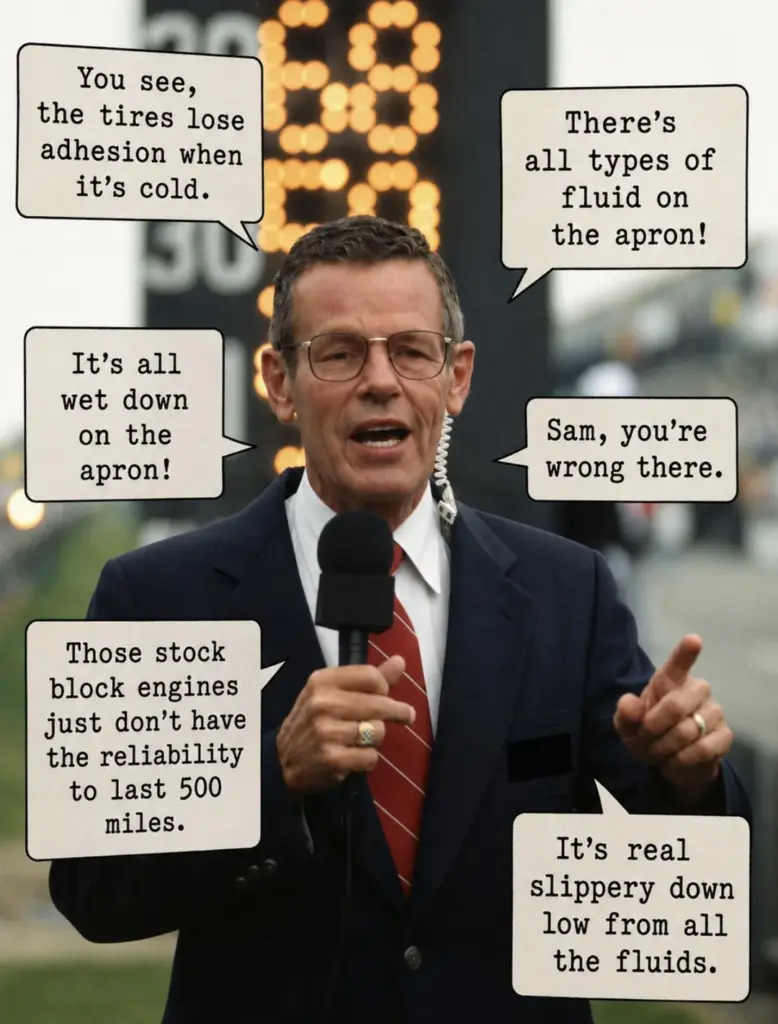
While modern IndyCar was debating what should happen when leaders catch slower cars, another conversation sent fans directly back into broadcasts of the Indianapolis 500 from the late 1980s through the mid-1990s.
And for anyone familiar with those races, apparently only a handful of words were necessary to summon Bobby Unser’s voice. Adhesion. Cold tires.
Fluid on the apron. Wetness on the apron. Stock-block engine reliability.
And, perhaps most importantly: Sam being wrong. The memories quickly became less about individual races and more about the peculiar comfort of hearing the same Unser phrases again and again.
Fans could practically reconstruct entire broadcasts from memory. Cold tires needed adhesion. The lower portion of the track was slippery. There was probably some sort of fluid down there.
Some portion of the surface was “ce-ment.”
And eventually Unser was going to explain why Sam Posey’s interpretation of something was incorrect. One fan described putting old Indy 500 broadcasts on when struggling to fall asleep, with Unser’s familiar commentary becoming almost comforting background noise. That may sound like criticism.
It was clearly meant with affection.
Every Generation Apparently Complains About the Commentary
The Unser nostalgia also turned into a broader debate over IndyCar broadcasters.
Fans who remembered Eddie Cheever and Scott Goodyear quickly countered anyone complaining about modern commentary with the equivalent of: you have no idea how good you have it. Their repeated explanations became memes of their own. An IndyCar traveling approximately the length of a football field in a second.
Push-to-pass being compared to a debit card. Drivers competing for the same piece of real estate. Some viewers became so frustrated with the television commentary during that era that they learned how to synchronize IndyCar Radio with the television broadcast.
Others remembered the Cheever-Goodyear pairing as dull rather than actively bad, preferring that style to broadcasters who become overly excited about relatively minor moments. James Hinchcliffe received particular praise for appearing to save his excitement for moments that genuinely warrant it. Then there are the modern repeated words.
Fans may have escaped endless discussions of football fields and debit cards, but now some apparently cannot hear the word “marbles” one more time.
Which suggests the real IndyCar tradition may not be any particular commentary style. It may simply be complaining about whoever happens to be calling the race.
Give it another generation and today’s phrases will probably become nostalgic too.
Bobby Unser’s Greatest Talent May Have Been Predicting Disaster
One particularly affectionate memory involved Unser’s apparent ability to accidentally curse drivers.
Fans recalled him praising how well someone — especially Michael Andretti — was running, only for something catastrophic to happen shortly afterward. Michael apparently received the worst of it. The running joke was that once Bobby started talking about how strong the race looked, trouble could not be far away.
That mythology joins all the other unmistakable Unserisms: adhesion, the apron, cold tires, the pronunciation of “cement,” disagreements with Posey and a voice that climbed noticeably higher whenever things became exciting.
Modern broadcasting may contain more detailed understanding of concepts viewers now recognize immediately, including aero push and small movements from the car. But there is something about an unmistakable broadcasting personality that survives much longer than the technical analysis itself.
Decades later, fans still know exactly how Bobby Unser would have said the word “adhesion.”
And Then Mario Andretti Flew Through the Air
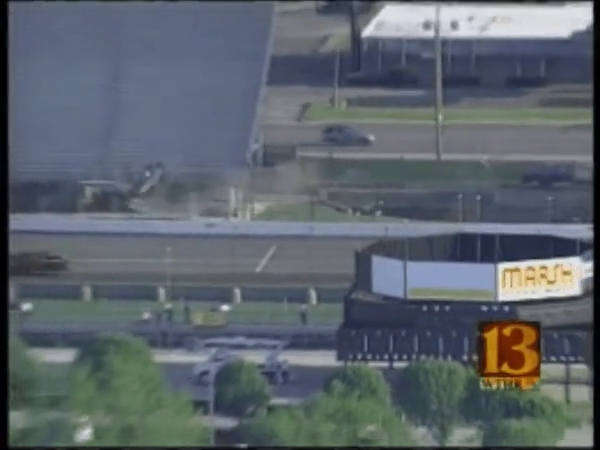
If the Unser discussion demonstrated how quickly old broadcasts can transport fans backward, another resurfaced clip created the opposite reaction.
Someone simply asked: What crash is this? The answer was Mario Andretti.
And then came the collective realization that the crash occurred in 2003. Twenty-three years ago. For some fans, that felt surprisingly recent.
For others, realizing that 2003 was now 23 years in the past triggered an entirely different kind of crisis. The resulting discussion became less about the crash and more about the deeply uncomfortable mathematics of aging. Something can feel recent while also being almost a quarter-century old.
Both things somehow become true at the same time. The perception becomes even stranger because Mario’s career stretches so far backward that 2003 genuinely does look relatively recent in the context of his racing life. Fans pointed out that the crash is closer to today than it is to the beginning of Andretti’s career.
It is also closer to today than his Formula 1 championship. Another observation made the timeline feel even stranger: despite the amount of time that has passed, the car Andretti was driving was only one IndyCar chassis generation removed from what races today. Twenty-three years. One generation of race car.
Time gets weird around Indianapolis.
The Story Behind Andretti’s 2003 Flight
The crash happened during testing at Indianapolis in April 2003.
Andretti was 63 years old. Tony Kanaan was injured, and Andretti was testing Kanaan’s car. During the test, debris from a previous Kenny Brack crash remained involved in what happened next: Andretti struck debris and the car was launched spectacularly into the air. The footage remains extraordinary.
A traffic helicopter happened to capture the incident, an especially fortunate coincidence because there were reportedly no news crews positioned to film the private test and the track cameras were not operating. Without that helicopter, the crash might have become one of those Indianapolis incidents known primarily through description rather than widely available footage. Instead, generations of fans can now watch a 63-year-old Mario Andretti appearing to challenge Indianapolis Motor Speedway’s unofficial altitude record.
The images look violent. Andretti reportedly escaped with little more than a scratch on his chin. That detail almost feels impossible.
One fan imagined the absurd perspective of somebody simply driving along nearby 16th Street, looking across and seeing an Indy car somersaulting through the sky — then later discovering the person inside was Mario Andretti. The Andretti element makes the entire scene feel even more surreal. He had already been retired for roughly a decade.
He was only testing because Kanaan was hurt. And according to the discussion, Andretti had even indicated that he could potentially still run the race if Kanaan remained unable to compete. At 63. Because of course Mario Andretti apparently looked at retirement and still left a small asterisk next to it.
One story from after the crash may capture the attitude best. When asked how he intended to explain what had happened to his wife, Andretti reportedly joked that he simply wasn’t going to tell her.
Twenty-Three Years Somehow Feels Like Yesterday
The conversation around the crash eventually became almost philosophical.
Twenty-three years is objectively a huge amount of time. It can contain an entire childhood and then some. But memory does not operate like a calendar. For someone younger, seven years can encompass completely different stages of life.
For someone older, seven years may feel like essentially the same chapter. One fan summarized the feeling perfectly: the days are long, but the years are short. The COVID era has apparently distorted that perception even further, with memories from 2021 still occasionally registering emotionally as something that happened “last year.”
So perhaps 2003 being 23 years ago should not be shocking. It still is.
Especially when the footage involves Mario Andretti doing something that looks too outrageous to belong to any normal era in the first place.
IndyCar Keeps Arguing With Its Own History
What makes these three conversations fit together is not necessarily the subject matter.
One is about lapped cars. One is about television commentary. One is about Mario Andretti flying through the air during a test more than two decades ago.
The connection is that IndyCar continues to have an unusually active relationship with its past. Power can describe the current lapped-car rule as something out of the 1970s, while fans respond that negotiating traffic has always been part of racing. Modern viewers can complain about broadcasters, while older fans immediately respond with the phrases they heard repeated endlessly decades ago.
A crash from 2003 can resurface and somehow feel both ancient and recent at exactly the same time. Even arguments over whether IndyCar should evolve frequently become arguments about which parts of racing history are worth preserving. Should traffic remain unpredictable because that is what racing has always demanded?
Should the series intervene because modern cars and modern parity have changed the circumstances? Is forcing a leader to negotiate a slower car genuine racing? Or is allowing that slower car to erase five seconds from a battle for the win an outdated approach that damages the show?
There probably is not a perfect answer. But Power’s description of IndyCar carrying a “1970’s rule” into 2026 accidentally captures something broader about the series. IndyCar is constantly racing forward while dragging an enormous amount of history behind it.
Sometimes that history is frustrating. Sometimes it is dangerous. Sometimes it is a 63-year-old Mario Andretti unexpectedly flying through the Indianapolis air.
And sometimes it is simply Bobby Unser reminding Sam, one more time, that those tires still need a little more adhesion.