

Formula 1 loves rankings.
Fastest driver. Greatest driver. Best qualifier. Most dominant season. Strongest teammate battle. Best wet-weather performer. Greatest championship fight. We quantify everything because numbers make arguments feel cleaner. Then Formula 1 immediately reminds us why those arguments are never actually clean.
A resurfaced F1 and AWS machine-learning ranking has once again put Ayrton Senna at the top of a list of the fastest drivers of the past 40 years, while simultaneously placing Heikki Kovalainen and Jarno Trulli ahead of Sebastian Vettel. Tiff Needell has argued that Senna’s willingness to cross certain lines on track should prevent him from ever being considered the greatest. Max Verstappen’s absurd 2023 statistics have reignited discussion over whether dominance should elevate a driver’s legacy or simply make a season boring.
Meanwhile, F1’s current qualifying battles are giving us another reminder that evaluating drivers against their teammates can dramatically change how we perceive them. And somewhere in all of this, Nicholas Latifi has apparently become one of Formula 1’s greatest wet-weather specialists. Maybe statistics do not settle Formula 1 debates.
Maybe they just give us new ones.
F1 and AWS Once Tried to Mathematically Find the Fastest Drivers
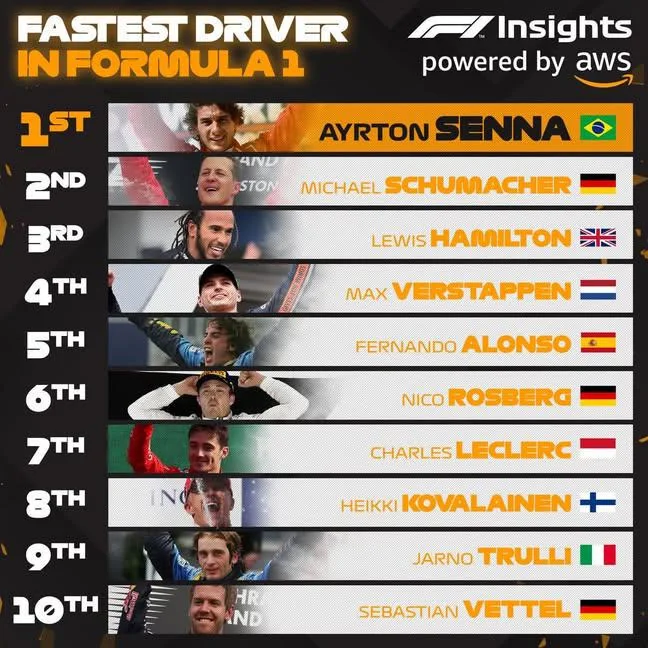
Back in 2020, Formula 1 and AWS used machine learning to rank the fastest F1 drivers of the previous 40 years.
The top ten:
- Ayrton Senna
- Michael Schumacher
- Lewis Hamilton
- Max Verstappen
- Fernando Alonso
- Nico Rosberg
- Charles Leclerc
- Heikki Kovalainen
- Jarno Trulli
- Sebastian Vettel
There is a point somewhere around Kovalainen where most people probably stop nodding. At first glance, the list looks like somebody accidentally pressed randomize after Alonso. But the methodology explains at least some of the weirdness.
This was not supposed to determine the greatest driver. It was not measuring racecraft, championships, consistency, tire management or the ability to process an entire Grand Prix while driving at 200 mph. The model focused on pure qualifying speed.
Drivers were compared through qualifying performances against teammates, with F1 and AWS attempting to account for factors including crashes, failures, age, career breaks and changing weather conditions. That distinction matters. Nico Rosberg at sixth becomes considerably easier to understand if the question is purely speed rather than total career achievement.
Jarno Trulli makes more sense too. Trulli developed a reputation as an exceptional qualifier. The fact that the phrase “Trulli Train” became synonymous with faster cars becoming stuck behind him on Sundays almost strengthens the argument that Saturday pace and complete racing ability are very different things. You can be phenomenal over one lap and still create a queue on Sunday.
Kovalainen is much harder to explain.
Heikki Kovalainen Is Where the Algorithm Gets Weird
Kovalainen’s appearance at eighth is probably the strongest argument for why machine-learning rankings should be treated as conversation starters rather than definitive historical truth.
Part of the problem may lie in how teammate comparisons interact with different stages of a driver’s career. Kovalainen faced Giancarlo Fisichella, Lewis Hamilton and Jarno Trulli. He beat an older Fisichella 9-8 in qualifying in 2007 and later beat an older Trulli 24-13 during their Lotus seasons.
Against Hamilton, he lost decisively, but not by an absolutely catastrophic margin. An algorithm connecting drivers through teammate relationships can therefore start building a chain. If Fisichella is rated highly because of qualifying results against drivers who were themselves outside their peaks, Kovalainen receives some of that benefit.
If Trulli is rated highly for qualifying speed but is being judged partly through his later career, beating him potentially becomes disproportionately valuable. Then qualifying-era complications enter the picture. Some seasons featured cars qualifying with race fuel onboard. Teams could strategically run different fuel loads. A driver appearing unusually quick on the grid might simply have been carrying less fuel than the driver beside them.
Trulli was particularly strong in qualifying, but comparing those sessions directly with modern flat-out qualifying requires enormous context. Machine learning can process enormous datasets. It cannot magically eliminate the historical circumstances surrounding them.
That may be the fundamental problem with attempting to calculate something as vague as “pure speed.”
Alain Prost at 20th Is the Bigger Red Flag
If Kovalainen being eighth looks strange, Alain Prost reportedly appearing 20th is even harder to reconcile.
The counterargument is that Prost built his career around something the model was deliberately not trying to measure. He was not interested in winning qualifying contests for the sake of winning qualifying contests. He wanted championships.
Prost understood that Formula 1 during his era demanded mechanical sympathy. Cars failed constantly. Pushing every component to the limit every lap was not necessarily the fastest way to complete a season. Sometimes the quickest driver is the one who knows when not to be quick. That is a very difficult skill to put into an algorithm designed around qualifying speed.
And Prost was hardly slow. At the time of his retirement, he had been among Formula 1’s leading drivers in pole positions and fastest laps. His reputation for calculated racing has sometimes created a strange retrospective assumption that he somehow lacked outright pace.
He did not. He simply understood that being fastest on Saturday did not matter nearly as much as having the most points months later. That distinction gets us to the larger problem.
What exactly are we trying to measure?
Senna Is No. 1 — But Does Fastest Mean Greatest?
Ayrton Senna topping a qualifying-speed model surprises almost nobody.
His reputation has always been built partly around extraordinary one-lap pace. The bigger argument surrounding Senna this week came from Tiff Needell, who questioned whether Senna could ever truly be considered Formula 1’s greatest driver because of the way he occasionally raced. That argument goes far beyond lap time.
Senna carried an aggressive reputation long before Formula 1. Martin Brundle has spoken about battling him in British Formula 3, where other drivers sometimes backed down because they could not afford the damage that might result from refusing to yield. Brundle did not.
At one point, Senna’s car ended up on top of Brundle’s. That “I win or we crash” mentality eventually became part of Senna’s Formula 1 mythology. And this is where the definition of greatness becomes uncomfortable.
If greatness means maximizing speed regardless of everything else, Senna belongs near the top of almost any conversation. If greatness requires winning without intentionally creating unacceptable risk, the conversation changes. Senna’s collision with Alain Prost at Suzuka in 1990 remains impossible to separate from his legacy.
Whatever someone believes about the events of 1989, intentionally creating a collision at high speed in cars from that era is very different from a clumsy defensive move at low speed. Drivers had far less cockpit protection. There was no HANS device.
They sat dramatically more exposed. That context matters.
Retaliation does not make the danger disappear.
The Senna Debate Is Also About How We Remember Drivers
Senna’s death inevitably changed how his career is remembered.
That does not mean his reputation was created by his death. He was already enormously popular. But tragedy freezes athletes in a particular moment.
They never experience the slow decline that can reshape how fans remember careers. They never stay too long. They never have the awkward final seasons where younger drivers suddenly expose their limitations. Their story simply stops. That inevitably creates unanswered questions.
Would Senna have won additional championships? Could he have matched or exceeded Juan Manuel Fangio? Would he have remained at Williams?
Would Ferrari have pursued him? Would his aggressive driving have eventually attracted more criticism as safety standards and expectations changed? We can speculate forever.
We cannot know. What we can say is that if Senna raced exactly the same way today, many incidents romanticized as part of his uncompromising character would probably create the same furious debates that surround Max Verstappen. That parallel is difficult to ignore.
Both built reputations around creating situations where the driver alongside had to decide whether continuing the fight was worth risking contact. When it works, it looks fearless. When it goes wrong, it looks reckless.
And which word fans choose often depends on which driver they already support.
Jim Clark Comparisons Have Their Own Problem
Needell’s argument also introduced Jim Clark as an example of a cleaner kind of greatness.
But even that comparison is difficult. Clark raced in an era where crashing could very realistically kill you. That fundamentally changes how drivers approach contact.
Modern Formula 1 allows drivers to push boundaries because safety has improved enough that an accident is usually something they can walk away from. That was not Clark’s reality. Drivers from his era were not making the same risk calculation Senna was making decades later.
That does not diminish Clark. It simply makes direct comparisons across eras extremely difficult. The cars changed.
The tracks changed. The rules changed. The consequences changed. Greatest-of-all-time debates pretend all of these people competed inside the same experiment.
They did not.
Then There Is Max Verstappen’s 2023 Season

If qualifying models make driver comparisons complicated, dominance statistics somehow make them even more controversial.
There were 1,325 racing laps during the 2023 Formula 1 season. Max Verstappen led 1,003 of them. That is 75.70 percent.
He also won at a rate that surpassed records that had survived for generations. There is no way around it. The season was historically dominant.
And that made it simultaneously incredible and boring. Those two things can coexist. Watching somebody operate at that level is fascinating.
Watching a championship where you already expect that person to win every Sunday is not. For stretches of 2023, the real question was not whether Verstappen would reach the front. It was when.
Qualifying poorly almost created entertainment because it gave him more cars to pass before the inevitable happened. The RB19 was extraordinary. Verstappen also drove it with remarkable consistency.
Those are not mutually exclusive statements.
Was the RB19 the Most Dominant Car, or Was Verstappen the Most Dominant Driver?
This is another place where statistics become slippery.
The RB19 was the fastest car at nearly every circuit. But that does not necessarily mean its pure performance advantage was greater than every dominant F1 car before it. Cars such as the McLaren MP4/4 and other historically dominant machines have arguments based purely on relative performance.
What made 2023 so extraordinary was the combination. A phenomenal car. Excellent reliability.
And a driver who almost never wasted what he had. Singapore became remarkable largely because Red Bull suddenly looked vulnerable. That says everything about the rest of the season.
One bad weekend felt like an event. Without Singapore interrupting the sequence, Verstappen’s winning streak could have become even more absurd. You can play the same game with Australia in 2024 and create hypothetical streaks that become almost comical.
But that quickly becomes pointless. Once we start changing individual races while assuming everything afterward remains identical, we are no longer analyzing history.
We are writing fan fiction.
Hamilton’s Dominance Was Different
Comparisons with Lewis Hamilton’s Mercedes years are inevitable.
Hamilton had dominant cars. But his situation was rarely identical to Verstappen’s 2023 environment. For part of the Mercedes era, Nico Rosberg was sitting in the other car and eventually won a championship.
Later, Valtteri Bottas could take races from Hamilton even if he rarely sustained a season-long challenge. There were also external threats at different points from Sebastian Vettel and eventually Verstappen. That does not automatically make Hamilton’s achievements greater or Verstappen’s smaller.
It simply means dominance can take different forms. A dominant car with two competitive drivers creates internal tension. A dominant car with one driver operating at a completely different level from his teammate creates statistical annihilation. Both can produce enormous championship margins.
They do not necessarily tell us the same thing.
Which Brings Us to 2026’s Teammate Battles
Formula 1’s qualifying scorecard through the season so far offers another reminder that teammate comparisons can reshape reputations very quickly.
The current qualifying battles provided are:
- Kimi Antonelli 7-4 George Russell
- Lewis Hamilton 5-6 Charles Leclerc
- Lando Norris 7-4 Oscar Piastri
- Max Verstappen 8-3 Isack Hadjar
- Liam Lawson 6-5 Arvid Lindblad
- Pierre Gasly 8-3 Franco Colapinto
- Esteban Ocon 3-8 Oliver Bearman
- Nico Hulkenberg 6-5 Gabriel Bortoleto
- Alex Albon 2-9 Carlos Sainz
- Lance Stroll 2-9 Fernando Alonso
- Sergio Perez 6-5 Valtteri Bottas
Some of those are roughly what we might expect.
Others are not.
Carlos Sainz Has Completely Changed the Alex Albon Conversation
The biggest shock may be Williams.
Sainz leads Albon 9-2 in qualifying. For years, Albon looked extremely strong at Williams. But he also spent much of that period without a teammate capable of providing a truly reliable benchmark.
Nicholas Latifi and Logan Sargeant did not give us a clear indication of exactly where Albon ranked against established top-level competition. Sainz does. And suddenly Albon looks much more ordinary on Saturdays.
That does not mean everything Albon did previously was fake. It means context changed. Dominating a weak teammate can inflate a driver’s reputation just as losing narrowly to an elite teammate can damage one unfairly.
The AWS ranking demonstrates exactly the same problem on a much larger scale. Teammate quality matters enormously. Sainz is now providing the benchmark Albon lacked.
And right now, that benchmark is uncomfortable.
Oliver Bearman Is Doing Something Similar to Esteban Ocon
Bearman leading Ocon 8-3 is another result that stands out.
Ocon has built a long Formula 1 career around being a solid, difficult teammate. Seeing Bearman comfortably ahead therefore matters. It does not tell us everything about either driver.
Qualifying is one component. Race performance, reliability and weekend circumstances still matter. But young drivers establish credibility by beating experienced teammates.
Bearman is doing exactly that. The same is true of Antonelli against Russell. A 7-4 advantage over a driver with Russell’s qualifying reputation is impossible to ignore.
George has spent years carrying the “Mr. Saturday” label.
Antonelli leading that matchup is therefore one of the more significant qualifying stories of the season.
Lando Norris Is Still Beating Oscar Piastri
Another result worth discussing is McLaren.
Norris leads Piastri 7-4. There was plenty of expectation that Piastri would eventually overtake Norris inside McLaren. His reputation has always been enhanced by his calmness, his ruthless entry into Formula 1 and his apparent ability to improve rapidly.
But Norris keeps beating his teammates. At some point, that stops being surprising and simply becomes who Lando Norris is. The idea that Piastri’s personality somehow makes him more naturally ruthless than Norris may have distorted how people evaluate the matchup.
Being nice away from the circuit does not make somebody slower inside the car. Norris has repeatedly demonstrated that. Piastri still has enormous ability.
But if he wants to establish himself as McLaren’s unquestioned benchmark, he eventually has to beat Norris consistently rather than simply look like somebody who might.
Piastri Has at Least Become the King of Grill the Grid
There is one championship Piastri seems increasingly determined to dominate.
Grill the Grid. The two-time defending champion produced another impressive performance in the latest episode, casually listing driver numbers while other competitors struggled through guesses. It is becoming a genuine part of his character.
Piastri approaches these quizzes with the same dry expression he uses for almost everything else, which somehow makes it funnier when he starts rattling off obscure F1 information. At this point, driving the McLaren may just be his side quest. The real target is becoming the Sebastian Vettel of F1 trivia.
Vettel’s legendary ability to recite championship history remains the benchmark. Watching Vettel perfectly work his way through world champions by year remains one of the greatest Grill the Grid performances. Piastri versus Vettel is now the matchup we need. Forget qualifying. Forget lap time.
Put them at a table and ask them increasingly ridiculous Formula 1 questions until somebody cracks.
Gabriel Bortoleto May Want to Avoid the Brazilian Internet for a While
One of the funniest moments from the episode came from Gabriel Bortoleto struggling with questions involving Ayrton Senna.
That would be harmless for almost anyone else. Bortoleto is Brazilian. Missing details surrounding perhaps Brazil’s most famous racing driver was always going to generate attention.
In fairness, blanking during a quiz does not mean somebody lacks knowledge. Bortoleto has demonstrated Senna knowledge before. Sometimes somebody asks you a question you absolutely know and your brain simply shuts down. Unfortunately, when the question involves your country’s national racing hero, the internet does not care about that distinction.
Apparently the punishment is temporary revocation of your Brazilian racing credentials.
Nicholas Latifi: Wet-Weather Legend
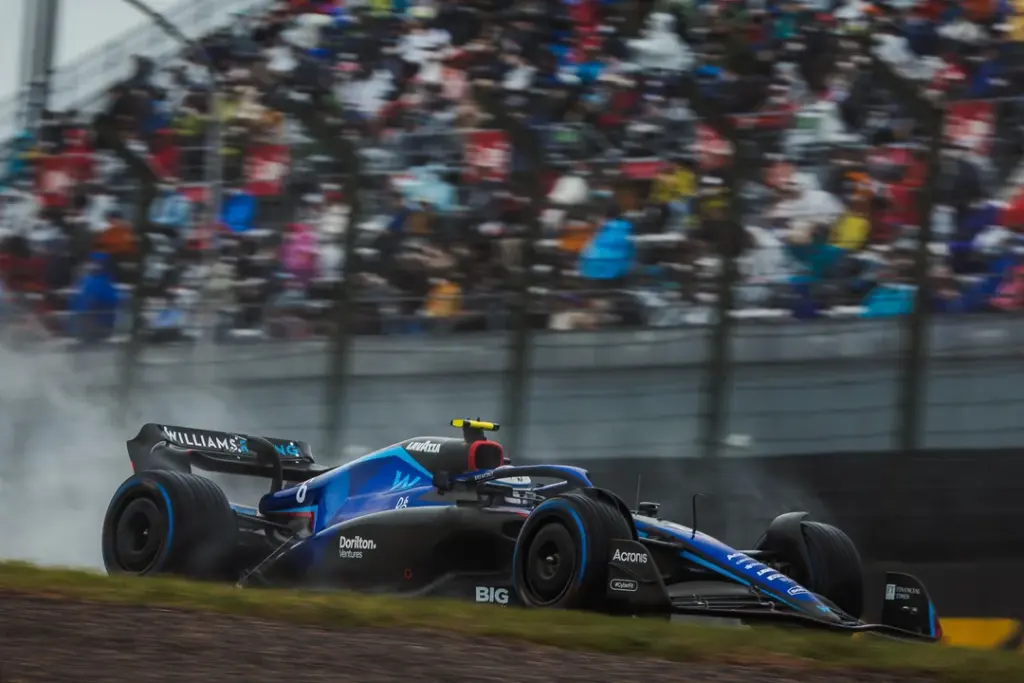
Then there are statistics that are technically correct and spiritually hilarious.
Nicholas Latifi never scored Formula 1 points in a completely dry race. His points came from: Hungary 2021: P7.
Belgium 2021: P9. Japan 2022: P9. Every one of those races was affected by rain or wet conditions.
Therefore, using the most irresponsible possible interpretation of the data, Nicholas Latifi was a wet-weather specialist. Perhaps even a wet-weather legend. GOATifi was simply waiting for H2O.
There is even the memory of Latifi producing unexpected speed in wet practice conditions, which only strengthens the completely unserious mythology. Senna. Schumacher.
Verstappen. Latifi. The rain masters. Statistics cannot lie.
They can, however, be bullied into saying extremely stupid things.
Latifi Is Actually a Great Example of Why Context Matters
The joke works because it exposes something real.
A percentage improvement from a low baseline can look enormous. A driver who struggles badly in normal conditions can appear statistically exceptional when unusual circumstances compress the field or create opportunities. That does not mean the improvement is meaningless.
Some drivers genuinely do perform relatively better when grip disappears. But saying Latifi scored all his points in rain-affected races is not the same as proving Latifi was one of Formula 1’s best wet-weather drivers. It is correlation.
Not a complete evaluation. That sounds obvious when we are talking about Latifi.
People become much less careful when the statistic supports an argument about a driver they already love.
Formula 1 Is Also Marking 50 Years Since Its Last Female Racer
While fans debate which men belong on historical lists, Formula 1 is also confronting a much more significant absence.
It has been 50 years since a woman last raced in Formula 1. The simplistic explanation is that there are only 22 seats and an enormous number of drivers competing for them. If a woman were clearly fast enough, the commercial attention alone would make her incredibly attractive to a team.
That is probably true. But it also avoids the real problem. Women are not reaching the levels directly beneath Formula 1 in large enough numbers either.
You cannot solve the top of the pyramid without looking at the base.
Jamie Chadwick Is Right: The Answer Starts With Grassroots

Jamie Chadwick has argued that grassroots participation is key to eventually getting another woman into Formula 1.
That is difficult to dispute. The fundamental issue is not that Formula 1 teams are rejecting dozens of elite female drivers. The issue is that there are nowhere near enough girls entering competitive karting early enough to create a comparable talent pool.
Elite motorsport development starts absurdly young. By the time most people are old enough to seriously think about becoming racing drivers, the future Formula 1 drivers have already spent years competing. That creates a numbers problem.
If vastly more boys begin karting than girls, vastly more elite male outliers will emerge. The interesting development is that the participation gap appears to be shrinking. More girls are karting.
F1 Academy has increased visibility. Young female drivers now have examples showing that motorsport is an available path rather than something they must discover accidentally. That does not guarantee a future F1 driver.
But it increases the probability.
The Next Female F1 Driver Probably Has to Start Very Young
The biggest mistake would be thinking Formula 1 can simply find an already-developed female driver somewhere.
That is not how modern F1 development works. The next woman to reach Formula 1 will probably look much more like the existing male pipeline. Karting very young.
Strong junior results. Serious financial backing. A major driver academy.
F4. Then the ladder. What matters is giving enough girls access to that pipeline that eventually somebody emerges who is undeniably good enough.
Not good enough “for a woman.”
Good enough for Formula 1. That distinction is essential. A token appointment would probably hurt more than it helps.
The first woman to return to an F1 grid will immediately face enormous scrutiny. Every mistake will be magnified. Every weak weekend will become ammunition for people who already believe women cannot compete at that level. The best protection against that is simple.
Speed.
Money Remains the Ugly Reality
Of course, there is another uncomfortable part of this discussion.
Motorsport development costs an absurd amount of money. Competitive karting can consume thousands of dollars per weekend before considering the kart itself, equipment, travel and professional support. That means the talent funnel is not merely filtering for ability.
It is filtering for families capable of funding ability. So perhaps the joke about millionaires putting their daughters into karting is not entirely a joke. If wealthy families who once spent enormous sums developing their sons increasingly do the same for their daughters, the talent pool changes.
That does not make motorsport equitable. It simply makes the existing inequitable system slightly less gender-exclusive. A future female F1 driver may come from enormous family wealth. She may come through a manufacturer academy. She may come from a racing family.
She may come from somewhere we cannot predict. But she almost certainly needs serious backing very early.
That is true for the boys too.
Sim Racing Helps — But Probably Does Not Replace Karting Yet
Sim racing offers one potential equalizer.
A serious simulator still costs money. But compared with running an entire karting program, it is dramatically cheaper. That creates opportunities for far more people to discover and develop racing instincts.
The problem is timing. Modern Formula 1 drivers begin developing extremely young. By the time someone becomes seriously involved in sim racing, a future F1 rival may already have thousands of competitive karting laps.
So sim racing may widen access. It probably does not completely replace the existing pathway yet. The real breakthrough would be combining both.
Use sims to identify talent cheaply. Then provide funding to move the best drivers into real competition early enough that they are not permanently behind.
That could help boys and girls.
Could a Woman Physically Handle Formula 1?
Whenever this conversation happens, somebody inevitably argues that Formula 1 is simply too physically demanding.
That argument is much weaker than it sounds. F1 is extraordinarily physical. Drivers experience sustained G-forces, heat and enormous cardiovascular demands.
But the important question is not whether the average woman is as physically strong as the average man. It is whether an elite female athlete can meet the specific physical requirements of driving an F1 car. There is little reason to assume that is impossible.
F1 does not reward unlimited strength. Once a driver is strong enough to operate the car effectively and withstand the loads, additional brute strength does not automatically produce faster lap times. The bigger challenge may actually exist lower down the ladder, where cars without power steering can create different physical demands while drivers are still developing.
That becomes another reason to think about the pipeline structurally rather than simply waiting for a woman to magically appear at Formula 1 level.
So What Actually Makes a Good Formula 1 Season?
After arguing about drivers, perhaps the more important question is whether fans even agree on what they want from Formula 1.
The easiest answer: Competitive races and a competitive championship. Having both is ideal.
But you can have one without the other. 2020 showed how a championship can be predictable while individual races remain memorable because of midfield fights, unusual podiums and chaotic weekends. 2023 showed the opposite extreme.
You could admire Verstappen’s extraordinary performance while also feeling almost no suspense about the championship. 2025 demonstrated that even a close title race does not automatically make every Grand Prix great. Then there is 2021.
That remains the obvious modern benchmark for chaos. Almost every weekend felt important. Fans went into races nervous.
The online community became a war zone. Even races that were objectively terrible created enormous arguments. Belgium barely needed racing to become unforgettable.
That may actually be the formula. Unpredictability on the track. Predictability from the people governing it.
A championship fight close enough that every mistake matters. Multiple teams capable of winning. Drivers who genuinely dislike losing to each other. Some off-track drama.
And enough uncertainty that you do not know what the story will be before Sunday begins.
Unless Your Favorite Driver Is Dominating
There is, however, one universal exception.
Fans hate dominance. Unless their driver is the one dominating. Then dominance becomes greatness.
A team spending enormous money is ruining the sport. Unless your team signs the superstar. Then it is ambition.
Aggressive driving is dangerous. Unless your driver makes the move. Then it is racing instinct.
A championship is boring if somebody wins every week. Unless you have waited years to watch that person win. Formula 1 fandom is not particularly consistent.
That is part of what makes it fun.
Maybe Greatness Cannot Be Reduced to One Number
That is ultimately what connects all of these stories.
AWS can build an algorithm to estimate pure qualifying speed and still produce a ranking where Heikki Kovalainen sits ahead of Sebastian Vettel. Verstappen can lead more than three-quarters of an entire season’s racing laps and fans can simultaneously call the achievement magnificent and the season boring. Albon can look outstanding for years until Sainz arrives and suddenly changes the benchmark.
Latifi can technically score every point of his career in rain-affected races without becoming Ayrton Senna. Piastri can lose qualifying battles while becoming Formula 1’s undisputed trivia monster. And Senna can simultaneously be one of the quickest drivers who ever lived and someone whose most controversial decisions remain difficult to defend.
Greatness is not one thing. Pure speed matters. Racecraft matters.
Consistency matters. Judgment matters. Adaptability matters.
Teammates matter. Equipment matters. Era matters.
Opportunity matters. And sometimes simply knowing when not to push matters. That is why Formula 1 will never settle the GOAT argument.
Every time somebody invents a statistic that supposedly ends the conversation, the sport immediately produces another reason to start it again.