

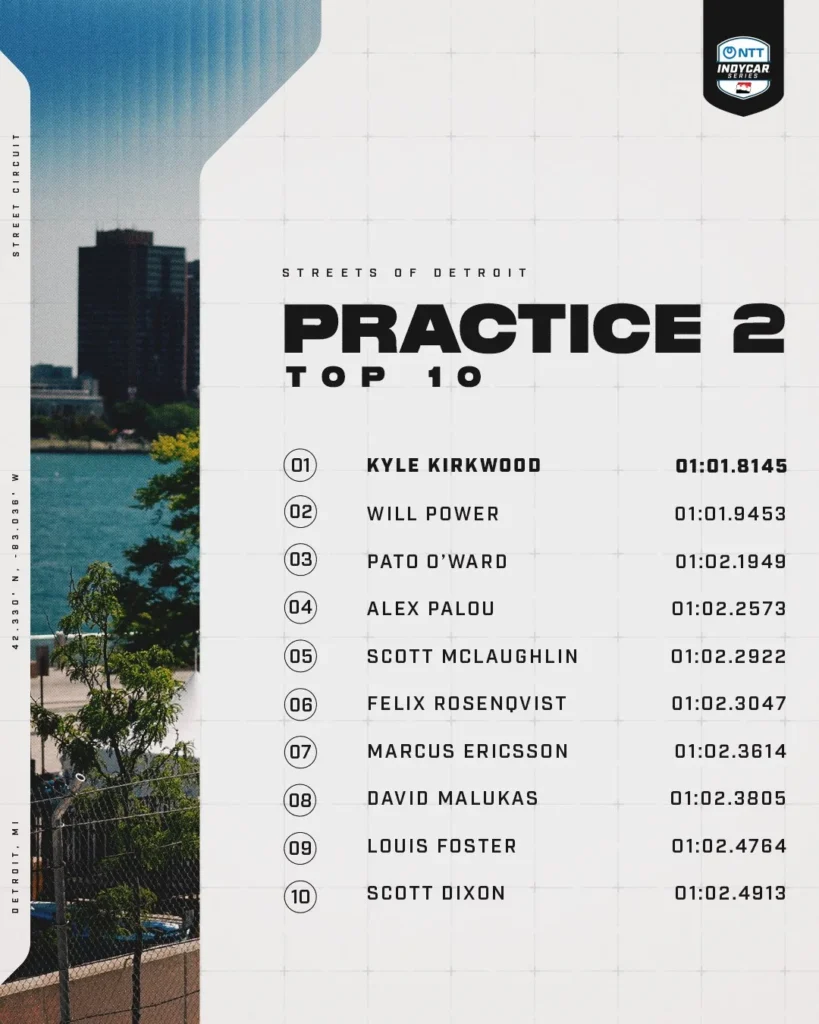
Kyle Kirkwood topped Practice 2 for the 2026 Chevrolet Detroit Grand Prix, setting the fastest lap of the session with a 1:01.8145 as Andretti once again showed impressive speed on a temporary street circuit.
Kirkwood led a tightly packed field ahead of Will Power, Pato O’Ward, Alex Palou, Scott McLaughlin, Felix Rosenqvist, Marcus Ericsson, David Malukas, Louis Foster, and Scott Dixon, with several familiar contenders finding themselves near the top of the timesheets as teams continued to search for the ideal setup around Detroit’s unforgiving streets.
While Kirkwood ultimately ended the session fastest, much of the conversation throughout Practice 2 centered on reliability concerns and a series of incidents that interrupted the flow of the afternoon.
Chevrolet Reliability Questions Continue to Grow
One of the dominant talking points from the session was a growing sense of concern surrounding Chevrolet-powered entries after multiple apparent engine-related issues surfaced during practice.
Observers noted another Chevrolet powerplant failure during the session, adding to a trend that has increasingly caught the attention of fans and teams alike. The situation became especially notable because Detroit’s tight walls and limited run-off areas leave little room for mechanical problems.
Several incidents prompted red flags throughout the session. Rinus VeeKay was seen stopped with smoke and fire, while Christian Lundgaard also suffered a failure that brought out another interruption. The recurring issues led many to question whether Chevrolet teams could confidently make it through the remainder of the weekend without further setbacks.
The contrast between the apparent reliability struggles and Team Penske’s performance did not go unnoticed. While several Chevrolet-powered cars encountered problems, Penske entries continued to feature near the front of the timing sheets, leaving many wondering whether the broader reliability concerns would ultimately affect the competitive order once qualifying and the race begin.
For drivers in Chevrolet machinery, the remainder of the weekend now carries an added layer of uncertainty. Street circuits already punish the smallest mistakes, and mechanical reliability concerns only increase the challenge.
Will Power Continues to Show Strong Pace
Among the biggest positives from the session was the speed shown by Will Power.
Power finished second behind Kirkwood and looked competitive throughout the afternoon, continuing a trend of strong pace that has often generated optimism before Detroit weekends. His appearance near the top of the timesheets immediately sparked discussion about whether this could finally be the weekend where that speed translates into a complete result.
The Australian veteran’s pace was difficult to ignore, particularly given the balance Penske appeared to have relative to several rivals. Yet Detroit’s reputation for chaos, cautions, strategy swings, and unpredictable outcomes means that practice pace alone rarely guarantees success.
Still, Power’s position near the front added another intriguing storyline heading into qualifying.
Andretti’s Street-Course Strength Returns
Kirkwood’s session-leading lap also reignited discussion about Andretti’s continuing strength on street circuits.
The team has frequently shown impressive form whenever the series visits temporary street tracks, and Detroit once again appeared to suit the package. Questions naturally emerged about what Andretti does differently in these environments.
One explanation repeatedly pointed toward the team’s damper package working in conjunction with its street-course setup philosophy. Whatever the precise formula may be, the results were visible once again in Practice 2 as Kirkwood led the field and Marcus Ericsson finished seventh.
For a team that has consistently found speed on these circuits, another strong Detroit weekend suddenly looks possible.
Rosenqvist Continues Strong Form
Felix Rosenqvist quietly put together another impressive session, finishing sixth and continuing a run of form that has increasingly caught attention throughout the season.
Discussion surrounding Rosenqvist was fueled not only by his pace but also by the realization that he is competing during a contract year. His recent performances have begun to resemble those of a driver determined to maximize every opportunity available.
His aggressive approach last weekend remained fresh in many minds, with comparisons drawn to memorable high-line drives that showcased a willingness to take risks where others would not.
If Rosenqvist can carry that momentum into qualifying, he could become one of the more dangerous contenders on the grid.
Questions Surround Newgarden
Josef Newgarden’s afternoon generated a very different conversation.
Following an earlier incident, observers found themselves wondering whether Detroit simply remains a difficult venue for the two-time Indianapolis 500 winner or whether lingering physical effects from his recent injury are still influencing performance.
Some pointed out that unusual tire behavior this weekend may have contributed to the lack of outright pace. Others suggested traffic may have compromised key laps during the session.
Whatever the explanation, Newgarden did not appear near the sharp end of the timing sheets, creating another storyline to watch as the weekend progresses.
Detroit’s Challenge Remains Unmatched
The session also served as another reminder of why Detroit remains one of the most demanding stops on the IndyCar calendar.
Mechanical failures, red flags, tire questions, setup experimentation, and the ever-present threat of contact with the walls combined to create a practice session that felt far more dramatic than a simple timing sheet might suggest.
Even away from the racing itself, discussion emerged around the unique operational challenges of race control and trackside officiating. Questions regarding why flag marshals do not use wrist tethers led to explanations highlighting the fast-paced nature of flag exchanges and the potential safety concerns that could arise if a flag became attached to a passing car.
Those details offered another glimpse into the complexity of operating a race weekend on a circuit where events can change in an instant.
Practice 2 Results
- Kyle Kirkwood – 1:01.8145
- Will Power
- Pato O’Ward
- Alex Palou
- Scott McLaughlin
- Felix Rosenqvist
- Marcus Ericsson
- David Malukas
- Louis Foster
- Scott Dixon
With Kirkwood leading the way, Power looking strong, Rosenqvist continuing his impressive form, and reliability concerns hovering over several Chevrolet teams, Practice 2 provided no shortage of storylines heading into the remainder of the Chevrolet Detroit Grand Prix weekend.
If Friday was any indication, Detroit is once again preparing to deliver a weekend where pace is only part of the equation. Survival may prove just as important.