

Haas team principal Ayao Komatsu summed up the team’s current position with a line that almost sounded like reverse sandbagging: “We shouldn’t be fourth. We’re the smallest F1 team.”
The obvious response is that maybe Haas should be first. If the team is the smallest, and first is the smallest number on the timing sheet, the logic is airtight. Fourth suddenly feels like underachievement.
That is the strange energy around Haas right now. Komatsu’s point is grounded in scale, but the optics are almost comically positive. This is the kind of “problem” most midfield teams would love to have: being smaller than the rest and still performing above expectation. It carries the same tone as complaining that the steak is too tender or the lobster too buttery.
There is also history cautioning against assuming size should define ceiling. Brawn GP remains the ultimate counterexample: a skeleton-budget operation with limited parts, little margin, and yet a championship-winning peak built on timing, execution, and one of the most famous technical advantages in modern F1. Haas is not Brawn, but the comparison matters because F1 has always left room for a small team to briefly punch far above its structural weight.
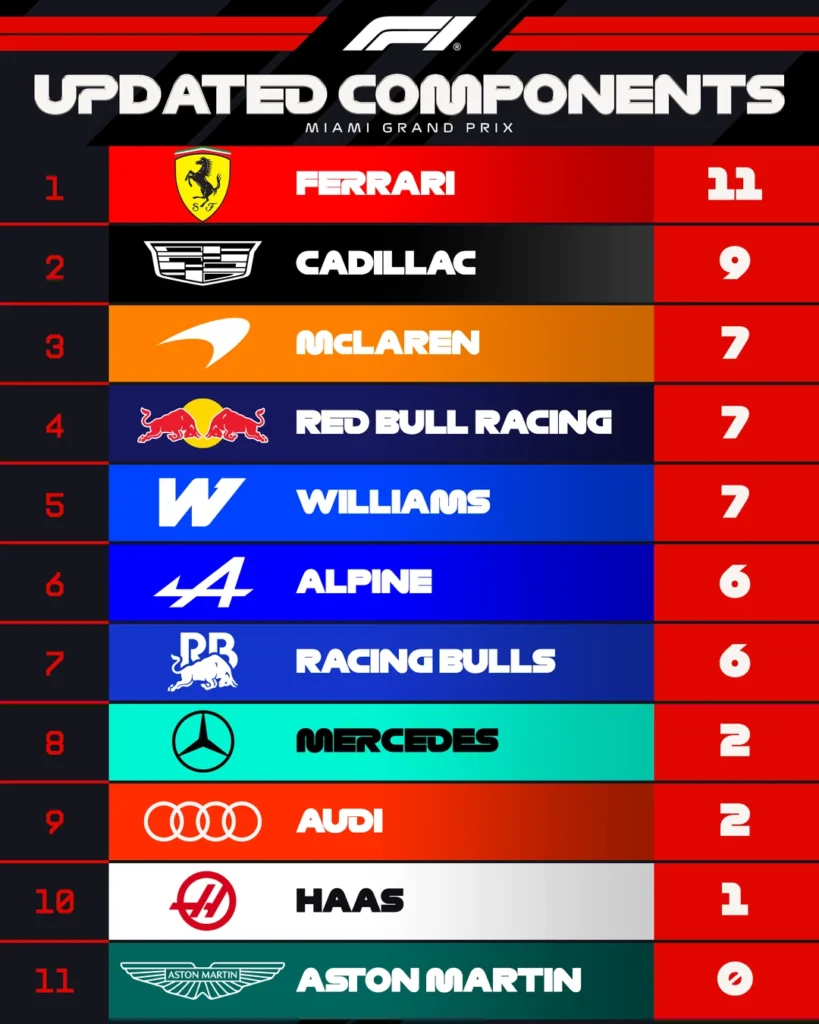
Meanwhile, Miami has become a major upgrade weekend. The list of aero components is substantial: Ferrari leads with 11, Cadillac has 9, McLaren, Red Bull, and Williams each bring 7, Alpine and Racing Bulls have 6, Mercedes and Audi have 2, Haas has 1, and Aston Martin has 0.
That Aston Martin zero needs context. The list only includes aero components, not power unit reliability upgrades. Honda reliability work is not captured there, and that matters most for Aston Martin-Honda right now. Still, seeing the worst-performing car bring no listed aero components is jarring. Either the team is freezing one half of the equation to isolate the engine-side issues, or it is waiting on a bigger package. In that sense, doing nothing visible may actually be deliberate: changing aero while chasing reliability, vibration, and power deployment issues could risk chasing bad data.

Red Bull’s listed upgrades are more visually obvious. The RB22 sidepods have changed significantly, bringing back discussion of bathtub, waterslide, and wider sidepod concepts. The comparison to the McLaren MP4-26 is tempting at first glance, though the details are not really the same. The MP4-26 was known for its L-shaped inlets, while Red Bull’s new concept looks closer to a walled waterslide approach than a true MP4-26 revival.
The bigger point is that Red Bull appears to have stepped back from its narrower bodywork direction and toward something broader. The aerodynamic logic is clear enough: wide sidepods can help manage front tyre wake, push turbulence outward, and guide cleaner airflow toward the rear. The trade-off is that smaller sidepods can theoretically reduce drag and expose more floor, but only if the team can control front-wheel turbulence well enough. Mercedes’ zero-pod struggle remains the cautionary tale, even if Red Bull’s concept was not a direct copy.
Miami also arrives with a philosophical fight over overtaking. Frederic Vasseur argued that the new overtaking is “far less artificial than DRS.”
That depends on what “artificial” means. DRS was a designated overtaking lane: get within range, wait for the approved straight, press the button, and see if the pass happens. The new system feels less fixed because overtakes can happen in more places, but it can also feel less driver-led when energy deployment and harvesting create speed deltas that drivers do not fully control.
The strongest case for Vasseur is variety. DRS often made overtaking predictable, with passes concentrated at the end of long straights. The new system has produced moves around more of the lap, with defending drivers also able to respond depending on battery state. That is more dynamic than a single “government-approved” overtaking zone.
The strongest case against it is control. If a driver overtakes because the car ahead is suddenly down on energy, or because their own deployment arrives at a moment they did not actively choose, then the racing risks becoming less about attack and defense and more about dodging mismatched battery states. The Lando Norris China example captures that concern: overtaking without wanting to, then being repassed once the battery picture flips, is entertaining but also awkward.
So Vasseur may be right that it is less artificial than DRS in shape. But it is not automatically more natural in feel. The best version of this system is one where energy strategy creates choices, risk, and counterplay. The worst version is one where the cars decide the fight before the drivers do.
That is why Miami’s upgrade weekend feels bigger than a normal development round. Ferrari is throwing parts at the car. Cadillac is showing ambition. Red Bull is changing visual philosophy. Aston Martin is, at least aerodynamically, standing still. Haas is somehow fourth despite being the smallest team. And F1 is still trying to decide whether its new overtaking era is a better racing tool or just a different kind of boost pad.
For now, the sport has traded one artificial solution for another. The difference is that this one is less predictable, more chaotic, and — depending on your tolerance for battery roulette — possibly more fun.